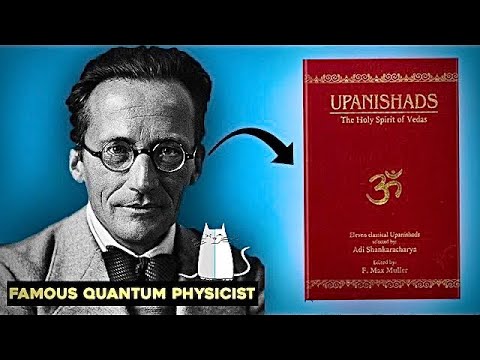
Quantum Physicist Erwin Schrödinger Thoughts on Upanishadic philosophy | Eternal Talks |
What this covers
This nine-minute video is a scripted voiceover, not a conversation, and it traces how Erwin Schrödinger came to read quantum mechanics through Indian thought. It starts with his first exposure around 1918, via Arthur Schopenhauer, who called the Upanishads the "soles" of his life and death. It then sets out the core vocabulary: Brahman as the universal self, Atman as the individual self, and Tat Tvam Asi as the claim that they are identical. Quotations from the Isha and Chandogya Upanishads support that picture of a single reality underlying everything.
The middle of the video makes its physics-and-philosophy case. Schrödinger's own puzzle, raised in What is Life?, is why billions of observers' worlds should agree if observation creates them. The narration gives the Upanishadic answer: there is only one mind, and multiplicity is apparent. It reads wave-function collapse as parallel to Maya, with a mirror-gallery image of one mountain peak seen from different valleys. It also treats the vanishing gap between observer and observed as echoing non-duality. These parallels are the narrator's claims, and several are flagged as contested.
The video then turns to the mind-body problem. Here it argues the problem is a fruitless search for where mind acts on matter, because the material world was built by removing the self from it. That removal is called objectivation, and the video says it is why Western science finds idealism "unpalatable." It contrasts this with the modern materialist view of consciousness as a byproduct of the brain.
Biographical asides add color: Schrödinger reportedly named his dog Atman, ended talks with "Atman is equal to Brahman" as a "second Schrödinger equation," and was quoted back to himself in a farewell letter from Sheila May.
Erwin Schrödinger discovered in the Upanishads a philosophical framework that resolves quantum mechanics' observer-observed paradox through the idealist doctrine that consciousness is fundamental and reality (maya) is its manifestation, rejecting Western materialism's unsolvable mind-body problem.
- Schrödinger found that quantum mechanics' wave-function collapse parallels the Upanishadic concept of maya—apparent plurality masking underlying unity
- The Upanishadic doctrine that 'Brahman and Atman are identical' directly addresses quantum physics' observer-observed entanglement without requiring a separate causal mechanism
- Schrödinger explicitly rejected Western materialism's fruitless search for where mind acts on matter, adopting instead the Upanishadic idealist view that consciousness is ontologically primary
This asset isn't compiled yet
You're seeing its claims, ranked. Compile it to build the argument threads, weight them, and check each claim against your library — the full view.
Schrödinger named his dog Atman and his conference talks would often end with the statement 'Atman is equal to Brahman,' which he somewhat self-aggrandizingly called the second Schrödinger equation.
“schrodinger named his dog antman and his conference talks wood one account often end with the statement atman is equal to brahman that he would call somewhat self aggrandizingly the second schrodinger”
Schrödinger had wholly internalized the Upanishadic core message, and this is evidenced by his descriptions of 'myriads of suns surrounded by possibly inhabited planets' and 'multiplicity of galaxies' as expressions of Maya—reality rising out of consciousness, not the reverse.
“schrodinger was not making passing references to the upanishads instead he had wholly internalized their core message myriads of sons surrounded by possibly inhabited planets multiplicity of galaxies and each one with its myriads of sons according to me all these things are maya describe how reality rises out of consciousness but consciousness cannot be found inside our bodies as a substance or an organ”
In his 1944 book 'What is Life?', Schrödinger posed a logical problem: if the world is created by our observation, there should be billions of different worlds—one for each observer—but our worlds are synchronized; the Upanishads provide the answer that there is only one mind, and multiplicity is only apparent.
“in his 1944 book what is live schrodinger took on a peculiar line of thought if the world is indeed created by our act of observation there should be billions of such words one for each of us how come your word my word are the same if something happens in my war does it happen in your world too what causes all these words to synchronize with each other he found his answer again in the upanishads there is obviously only one alternative namely the unification of minds or consciousness their multiplicity is only apparent in truth there is only one mind”
Modern science today predominantly adopts materialism, the view that consciousness is a byproduct of neurochemical processes in the brain and cannot exist without them, as opposed to the Upanishadic idealist view that consciousness exists by itself and the physical world depends on it.
“most exponents of modern science today lean towards the materialist view that consciousness is a byproduct of the neurochemical processes occurring in our brain it depends on these processes and cannot exist without them on the other hand the upanishads uphold an idealist view that consciousness exists by itself and that the physical world depends on it”
There is no objective reality that exists independently of the observer, according to the Upanishads, which Schrödinger supported, contrasting with Western science's aversion to this doctrine.
“there is no objective reality that exists independently of the observer schrodinger supported this view and lamented the aversion for it”
Quantum physics eliminates the gap between the observer and the observed, which parallels the Upanishadic claim that the observer and the observed are the same thing.
“quantum physics eliminates the gap between the observer and the observed the upanishads say that the observer and the observed are the same things”
Schrödinger interpreted the Upanishadic concept of Maya (illusion produced by ignorance) as parallel to quantum mechanics' wave-function collapse: apparent plurality masks underlying unity, just as a gallery of mirrors creates the illusion that Gory Shankar and Mount Everest are different peaks when they are the same peak viewed from different valleys.
“according to the upanishads brahman alone exists everything we see around us is maya a distortion of the brahmana caused due to our ignorance and imperfect senses...on this schrodinger road there is only one thing and that what seems to be a plurality is merely a series of different aspects of this one thing produced by a deception the indian maya the same illusion is produced in a gallery of mirrors and in the same way gory shankar and mount everest turned out to be the same peak seen from different valleys”
The mind-body problem is a fruitless quest for the place where mind acts on matter or vice versa, because the material world has been constructed precisely by taking the self (mind) out of it, so mind can neither act on matter nor be acted on by it, which resolves the problem by reframing the ontological relationship.
“so the mind-body problem he wrote is our fruitless quest for the place where mind acts on matter or vice versa the material world has only been constructed at the price of taking the self that is mind out of it removing it mind is not part of it obviously therefore it can neither act on it nor be acted on by any of its parts”
Quantum physics insists that reality exists as waves, and wave-particle duality arises because our observation reduces the wave nature of reality to the incomplete particle reality we perceive, a reduction known as wave-function collapse, which parallels Maya.
“quantum physics insists that reality exists as waves and wave particle duality rises due to our observation because we cannot perceive the true wave nature of reality our observation reduces it to the incomplete reality we see this reduction is what we know as the collapse of the wave function the emergence of maya thus neatly maps to the collapse”
Schrödinger lamented that Western thought finds the Upanishadic idealist doctrine 'unpalatable' and dismisses it as 'fantastic' and 'unscientific' because Western science is based on objectivation—the exclusion of the subject of cognizance (mind) from its inquiry.
“it must be said that to western thought this doctrine has little appeal it is unpalatable and it is dubbed fantastic unscientific well so it is because our science greek science is based on objectivation whereby it has cut itself off from an adequate understanding of the subject of cognizance of the mind”
Erwin Schrödinger was first exposed to Indian philosophy around 1918 through Arthur Schopenhauer's writings on the Upanishads.
“schrodinger was first exposed to indian philosophy around 1918 through the writings of the german philosopher arthur schopenhauer”
When Schrödinger's affair with the Irish artist Sheila May ended, she wrote him a letter alluding to his fascination with non-duality, stating 'I looked into your eyes and found all life there...we are two now not one,' invoking his own philosophy against him.
“when his affair with the irish artist sheila may ended she wrote him a letter that alluded to this fascination i looked into your eyes and found all life there that spirit which you said was no more you or me but us one mind one being you can love me all your life but we are two now not one”
The Upanishads describe Brahman as the universal self or ultimate singular reality, and Atman as the individual's inner self or soul, with the central tenet Tat Tvam Asi ('That Thou Art') expressing their identity.
“brahman is the universal self or the ultimate singular reality the atman is the individual's inner self the soul a central tenet of the upanishads is which means the brahman and the atman are identical”
The Isha Upanishad states that 'the Brahman forms everything that is living or non-living' and 'the wise man knows that all beings are identical with his self and his self is the self of all beings.'
“the isha ugandishad states the brahman forms everything that is living or non-living the wise man knows that all beings are identical with his self and his self is the self of all beings”
The Chandogya Upanishad states 'All this is Brahman, everything comes from Brahman, everything goes back to Brahman, and everything is sustained by the Brahman.'
“the chandogya upanishad says all this is brahman everything comes from brahman everything goes back to brahman and everything is sustained by the brahmana”
Arthur Schopenhauer declared the Upanishads to be 'the soles of my life' and 'the soles of my death,' and he was an ardent student of the Upanishads.
“schopenhauer had declared in the whole world there is no study so beneficial and as elevating as that of the upanishads it has been the soles of my life it will be the soles of my death”
The mind-body problem—how non-material consciousness can interact with and control material bodies—has vexed philosophers for a long time because consciousness cannot be found as a substance or organ inside the body.
“in that case how can a non-material consciousness interact with and control our material bodies exactly where does mind interact with matter this question is known as the mind-body problem and has vexed philosophers for a long time since we haven't been able to locate or explain this interaction”