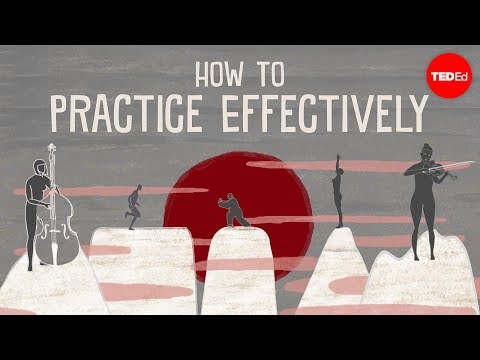
How to practice effectively...for just about anything - Annie Bosler and Don Greene
What this covers
This five-minute TED-Ed animation, narrated over Martina Meštrović's illustrations and built from a lesson by Annie Bosler and Don Greene, asks what practice actually does inside the brain. It begins by defining practice as repetition aimed at improvement, then dismisses the search for a magic number of hours needed for mastery. The argument is that quality counts as much as quantity. The film then explains the anatomy behind movement: signals travel from grey matter down the spinal cord along chains of axons to the muscles, while white matter is the fatty tissue and nerve fiber that carries them.
The biological core is myelin, which wraps axons like insulation on electrical cable. Studies in mice suggest that repeating a motion adds layers of it, producing a "neural superhighway" between brain and muscle. The film uses this to challenge the athlete's habit of crediting "muscle memory," noting that muscles do not remember anything and that myelination of neural pathways is the more plausible explanation.
The practical half defines effective practice as consistent, intensely focused, and aimed at the edge of current ability. Several specific points follow:
- A study of 260 students found they stayed on task for only about six minutes at a time, with laptops, phones, and Facebook the main distractions. - Coordination is built by repetition whether the repetitions are correct or not, so speed should rise gradually. - Top athletes, musicians, and dancers often spend 50–60 hours a week on their craft, split into several shorter sessions.
The most surprising claim concerns mental rehearsal. In a study of 144 basketball players, those who only imagined one-handed free throws improved by nearly the same amount over two weeks as those who physically practiced. This held for intermediate and experienced players, and the film says it applies once a motion is already established. It closes by predicting that understanding of practice will improve as brain science advances.
Physical skill mastery depends on myelination of neural pathways through consistent, focused practice targeting the edge of current abilities, rather than simply accumulating practice hours or relying on 'muscle memory.'
- Myelin sheaths insulating axons act as neural superhighways, increasing signal efficiency and speed with repeated practice
- Effective practice requires focus, slow-motion progression, frequent repetition with breaks, and mental imagery—not just raw hours
- Mental practice alone can reinforce established physical motions as effectively as physical practice for experienced performers
This asset isn't compiled yet
You're seeing its claims, ranked. Compile it to build the argument threads, weight them, and check each claim against your library — the full view.
There are many theories attempting to quantify the number of hours, days, and years of practice needed to master a skill, but there is no magic number because mastery is not simply about the amount of hours of practice—it is also about the quality and effectiveness of that practice.
“There are many theories that attempt to quantify the number of hours, days, and even years of practice that it takes to master a skill. While we don't yet have a magic number, we do know that mastery isn't simply about the amount of hours of practice. It's also the quality and effectiveness of that practice.”
Once a physical motion has been established, it can be reinforced just by imagining it in vivid detail.
“It's a bit surprising, but a number of studies suggest that once a physical motion has been established, it can be reinforced just by imagining it.”
Effective practice has three characteristics: it is consistent, intensely focused, and targets content or weaknesses that lie at the edge of one's current abilities.
“Effective practice is consistent, intensely focused, and targets content or weaknesses that lie at the edge of one's current abilities.”
Athletes and performers commonly attribute their success to 'muscle memory,' but muscles themselves do not actually have memory; rather, it may be the myelination of neural pathways that gives these athletes and performers their edge with faster and more efficient neural pathways.
“So while many athletes and performers attribute their successes to muscle memory, muscles themselves don't really have memory. Rather, it may be the myelination of neural pathways that gives these athletes and performers their edge with faster and more efficient neural pathways.”
Coordination is built with repetitions whether correct or incorrect, so if you gradually increase the speed of quality repetitions, you have a better chance of doing them correctly.
“Coordination is built with repetitions, whether correct or incorrect. If you gradually increase the speed of the quality repetitons, you have a better chance of doing them correctly.”
Axons in white matter are wrapped with myelin, a fatty substance that acts like insulation on electrical cables, preventing energy loss from electrical signals and moving them more efficiently along neural pathways.
“The axons that exist in the white matter are wrapped with a fatty substance called myelin. And it's this myelin covering, or sheath, that seems to change with practice. Myelin is similar to insulation on electrical cables. It prevents energy loss from electrical signals that the brain uses, moving them more efficiently along neural pathways.”
In one study of 260 students studying, on average those students were able to stay on task for only six minutes at a time, with laptops, smartphones, and particularly Facebook being the root of most distractions.
“In one study, researchers observed 260 students studying. On average, those students were able to stay on task for only six minutes at a time. Laptops, smartphones, and particularly Facebook were the root of most distractions.”
Recent studies in mice suggest that repetition of a physical motion increases the layers of myelin sheath that insulates the axons, and more layers create greater insulation around axon chains, forming a neural superhighway for information connecting brain to muscles.
“Some recent studies in mice suggest that the repetition of a physical motion increases the layers of myelin sheath that insulates the axons. And the more layers, the greater the insulation around the axon chains, forming a sort of superhighway for information connecting your brain to your muscles.”
In a study of 144 basketball players divided into two groups, where Group A physically practiced one-handed free throws while Group B only mentally practiced them, the intermediate and experienced players in both groups had improved by nearly the same amount when tested at the end of two weeks.
“In one study, 144 basketball players were divided into two groups. Group A physically practiced one-handed free throws while Group B only mentally practiced them. When they were tested at the end of the two week experiment, the intermediate and experienced players in both groups had improved by nearly the same amount.”
Focusing on the task at hand during practice requires minimizing potential distractions by turning off the computer or TV and putting cell phones on airplane mode.
“Focus on the task at hand. Minimize potential distractions by turning off the computer or TV and putting your cell phone on airplane mode.”
Studies have shown that many top athletes, musicians, and dancers spend 50-60 hours per week on activities related to their craft, often dividing their effective practice time into multiple daily practice sessions of limited duration rather than single long sessions.
“Studies have shown that many top athletes, musicians, and dancers spend 50-60 hours per week on activities related to their craft. Many divide their time used for effective practice into multiple daily practice sessions of limited duration.”
The brain contains two kinds of neural tissue: grey matter that processes information and directs signals and sensory stimuli to nerve cells, and white matter composed mostly of fatty tissue and nerve fibers.
“Our brains have two kinds of neural tissue: grey matter and white matter. The grey matter processes information in the brain, directing signals and sensory stimuli to nerve cells, while white matter is mostly made up of fatty tissue and nerve fibers.”
For bodily movement to occur, information must travel from the brain's grey matter down the spinal cord through a chain of nerve fibers called axons to muscles.
“In order for our bodies to move, information needs to travel from the brain's grey matter, down the spinal cord, through a chain of nerve fibers called axons to our muscles.”
Practice is defined as the repetition of an action with the goal of improvement, helping us perform with more ease, speed, and confidence.
“Practice is the repetition of an action with the goal of improvement, and it helps us perform with more ease, speed, and confidence.”
As scientists get closer to unraveling the secrets of our brains, understanding of effective practice will only improve, and in the meantime, effective practice is the best way we have of pushing individual limits, achieving new heights, and maximizing our potential.
“As scientists get closer to unraveling the secrets of our brains, our understanding of effective practice will only improve. In the meantime, effective practice is the best way we have of pushing our individual limits, achieving new heights, and maximizing our potential.”