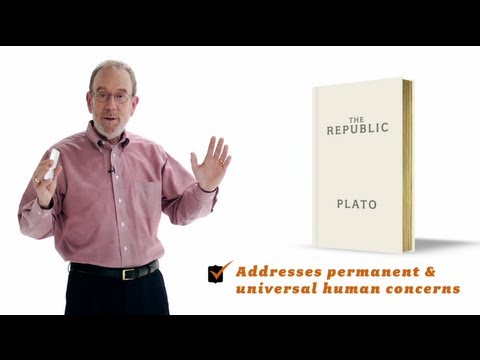
Jeffrey Brenzel: The Essential Value of a Classic Education | Big Think
What this covers
This is a solo talk by Jeff Brenzel, Yale's Dean of Undergraduate Admissions and a lecturer in philosophy, who makes his case by example rather than abstraction. He opens with questions the classics raise: whether Socrates was right that the just man is happier even when starved in prison, what Shakespeare shows about lust, envy and ambition, and whether Hobbes's 1651 claim that only an all-powerful king prevents mutual robbery and killing still bears on us. He then walks through works and authors, using the Five Criteria for Identifying a Classic and the idea of permanent concerns about the human condition to explain what earns a book that status.
The longest sustained stretch is Plato's Republic. Brenzel frames its core question as the best life for a human being and the best society for producing it. He follows the argument between Thrasymachus, who holds that might makes right and the tyrant lives best, and Socrates, who answers with the figure of the good shepherd ruling for the sheep. He also notes that Socrates claimed only to know his own ignorance.
From there he traces a lineage of intellectual game-changers. Aristotle's Nicomachean Ethics grounds virtue ethics. Thomas Aquinas synthesizes Aristotle with Christian thought, Luther attacks that synthesis, and Dante and John Milton give poetic form to rival visions of human nature. Under The Marriage of Jerusalem and Athens, he argues that Christian ideas owe much to Greek philosophy. One surprising aside is that the familiar Satan, the fallen Lucifer tied to original sin, is not taught in Scripture and took shape centuries after Christ.
The range widens to Moby Dick, Jane Austen's narrow but devastating social world, Emily Dickinson, Confucius, and Malthus, whose 1798 population argument returns in peak-oil and collapse debates. Dickinson and Confucius illustrate the book's claim for the value of strangeness, the encounter with a mind unlike your own.
Reading canonical classic works—despite their difficulty and the scarcity of time—offers irreplaceable educational and personal transformation unavailable through summaries or modern alternatives, because engaging with great minds directly rewires how you think and who you become.
- Classics reward every degree of effort maximally, unlike secondary sources or digests which cannot substitute for originals
- The strenuous effort required is not a flaw but essential—it forces transformation of perspective and self, not mere information transfer
- Rereading classics across a lifetime yields different insights at each life stage, revealing their inexhaustible depth
This asset isn't compiled yet
You're seeing its claims, ranked. Compile it to build the argument threads, weight them, and check each claim against your library — the full view.
What is the best sort of life for a human being is a permanent question that you will ask yourself as you figure out career, residence, marriage, and child-rearing, and science has not delivered a new answer; people have been asking and answering this for a long time
“What is the best sort of life for a human being? This is a question that you'll be asking yourself as you try to figure out things like where am I going to get a job, where am I going to live, who am I going to marry, how am I going to raise my children. These are questions that are permanent aspects of the human condition. You're also going to discover that this is not the kind of question in which science has suddenly delivered a fantastic new answer. People have been asking and answering this question for a long time”
The core question posed by Plato's Republic is: what is the best sort of life for a human being and what is the best society for producing the conditions under which human beings could live that kind of life
“Plato tries to formulate two basic fundamental and universal questions. What is the best sort of life for a human being and beyond that what is the best society for producing the conditions under which human beings could live that kind of life?”
The argument that 'might is right' and justice has no fixed meaning is a universally recurring argument not only throughout college dorm conversations but throughout the centuries in debates among the very best philosophers
“So have you ever heard someone make this argument before, that might makes right, that justice has no fixed meaning, that what is considered just in a society is just whatever the people running the society say it is? I'd be surprised if you hadn't because it's a universally recurring argument, not only throughout the dorms of any good colleges down through time, but also down through the centuries in the debates of the very best philosophers.”
Plato's ideas remained vital in Greece and Rome for 400 years until and beyond the coming of Christ, and Christian concepts of God, human nature, and human fulfillment owe a great deal to Plato and Aristotle through what historians call the marriage of Jerusalem and Athens—the integration of Greek and Jewish thinking.
“First, their thinking stays very much alive in Greece and Rome for 400 years, until the coming of Christ and beyond that for many centuries more. If you happen to be a Christian what you think of Christianity, the very concepts and ideas that form the basis for Christianity actually turn out to owe a great deal to Plato and Aristotle. Virtually everything that Christianity teaches about God, about human nature, about human fulfillment arises from what the historians of religion like to call the marriage of Jerusalem and Athens that is the marriage of Greek and Jewish thinking.”
Many Christians believe Satan was once a great archangel named Lucifer who rebelled in heaven before creation, successfully tempted Adam and Eve in the Garden, and his sin passed down as original sin to all humanity, but these beliefs are not taught in Scripture and Satan as we imagine him is a much later invention, not identified as a fallen angel or fully with the serpent in the garden until four centuries after Christ.
“Many Christians believe that Satan, the Devil was once a great archangel, in fact, that he was the highest of all the angels and that his name was Lucifer and that he rebelled against God in heaven before the creation of the entire world. Later he successfully tempted our first parents, Adam and Eve to eat an apple in the Garden of Eden and then this sin was passed down as an original sin to all the human race that flowed from those two beginning parents. They also think that these beliefs about Satan are actually taught in the scripture, that you could go into the Bible and find them, but they're not. There is actually remarkably little in the Hebrew Scriptures about Satan and what is there does not happen to include these beliefs. Satan as we imagine him, and usually Satan is a he, is actually a much later invention and he is not thought of as either a fallen angel or even fully identified with the serpent in the garden who tempts Adam and Eve to taste the fruit until four centuries after the life of Christ.”
Socrates claimed in 400 BC that a man lives a happier life if he is just, even if thrown starving into prison for the rest of his life, than if he is unjust and celebrated and honored all his days and never caught for his crimes.
“Socrates claimed in 400BC that a man lives a happier life if he's just, even if he is thrown starving into prison for the rest of his life than if he is unjust and he is celebrated and honored all of his days and is never caught for his crimes.”
Ishmael's observation that 'all men live enveloped in whale lines... all are born with halters round their necks; but it is only when caught in the swift, sudden turn of death, that mortals realize the silent, subtle, ever-present perils of life' suggests that a true philosopher who fully and completely understands the ever-present possibility of death will be no worse off and no less calm sitting amid whizzing harpoon lines than sitting at home by the fire.
“The graceful repose of the line, as it silently serpentines about the oarsmen before being brought into actual play- this is a thing which carries more of true terror than any other aspect of this dangerous affair. But why say more? All men live enveloped in whale lines.All are born with halters round their necks; but it is only when caught in the swift, sudden turn of death, that mortals realize the silent, subtle, ever-present perils of life. But if you be a true philosopher, though seated in a whale boat, you would not at heart feel one whit more of terror, than though seated before your evening fire with a poker, not a harpoon, by your side. So what is Ishmael telling us here? At one level he seems to be saying that a wise person, someone who fully and completely understands the ever-present possibility of death is going to be no worse off and no less calm sitting amid a bunch of whizzing harpoon lines than she is sitting home by the fire.”
Socrates claimed the only superiority he understood himself to have over other Athenians was that while he was absolutely certain he was completely ignorant, they all thought they actually knew something
“He liked to say that the only superiority that he understood himself to have over the other citizens of Athens was that while he was absolutely certain that he was completely ignorant they all thought they actually knew something.”
Thomas Hobbes wrote in 1651 that unless we surrender all ultimate control to a legitimate king, we would all rob and kill each other, and this argument remains relevant today even though we no longer believe in kings.
“Thomas Hobbes wrote in 1651 a book called Leviathan, one of the two or three most influential works in the history of thinking about government and politics in western society. He was writing from the midst of a raging civil war and he argued that unless we gave all the power, unless we surrendered all ultimate control to a legitimate king that we would all rob and kill each other. Was he right about that? Is that the way things actually work and is the question relevant to us today when we no longer believe in kings?”
Aristotle wrote the Nicomachean Ethics about human happiness, arguing that virtue is its own reward—the things that make you an excellent parent and citizen are also the things that, if pursued consciously and done well, make you happy—establishing the foundation for virtue ethics, which philosophers and psychologists study today.
“In ancient Greece Aristotle wrote a book called the Nicomachean Ethics or for short the Ethics. It's actually a book about human happiness about what it takes to be a happy person. Now we don't ordinarily associate the idea of ethics with a work on happiness. We think about ethics as being things like moral obligations, duties, what we're called upon to perform despite our desires to do other things. So Aristotle had a different perspective on this. He was an original proponent of the idea and you may have heard this idea that virtue is its own reward, that in fact, the things that make you an excellent parent, the things that make you an excellent citizen are also the things if pursued consciously and done well make you a happy human being. In other words, that there is a dedication to excellence where excellence consists of the virtues that are required for us to live well and do well with one another that is the foundation for human beings to be happy. This goes these days by the name virtue ethics and philosophers and psychologists all over the world are studying in fact”
Young aristocrat Plato followed Socrates around the town and later wrote dialogues featuring Socrates in the principal role, with early dialogues reflecting Socrates walking around asking difficult questions, and later dialogues using Socrates as a mouthpiece for Plato's own developing thought
“one of the young aristocrats who got a big charge out of following Socrates around the town was a young wrestler named Plato... Plato wrote a series of dialogues after Socrates died that featured his hero in the principle role. The early dialogues do seem to reflect for us this business of walking around asking these difficult questions that no one can answer. Later, in the later dialogues Plato begins to use Socrates as a mouthpiece or as someone who represents the kinds of new questions that Plato himself began to ask under Socrates' inspiration.”
Dante, living one generation after Aquinas, read and was influenced by Aquinas's work and presented his own view of human nature, fulfillment, and destiny in three epic poems about hell, purgatory, and heaven (Dante's Inferno and the Divine Comedy), becoming one of the three or four greatest poets ever to live.
“Meanwhile, the Italian poet Dante who lives one generation after Aquinas reads Aquinas, is influenced by his work and as one of the three or four greatest poets ever to live presents us with his own view of human nature, fulfillment and human destiny when he writes his three epic poems about hell, purgatory and heaven. You've probably heard of Dante's Inferno.”
Moby Dick is a classic because it uses a whale-hunting story to weave a mighty fable about good and evil, human will, mysterious human connections, and the struggle with nature and human nature itself, and though virtually ignored at publication, it became a game-changer that influenced all significant American writers.
“Herman Melville does use a story about whale hunting, which includes an enormous amount of material about whales to weave a mighty fable, a fable about good and evil, about the human will, about the mysterious connections that bind people together or the differences that drive them apart and about the human struggle with nature in the very largest sense of the word and our struggle with our own natures as well. Though virtually ignored when it was published—though virtually ignored when it was published Moby Dick later became a game-changer. It has continually grown in the estimation of the best readers and critics. No significant American writer is unaware of its influence or doesn't take account of it in their own work.”
Plato's encounter with Socrates inspired all of Plato's thought, and Alfred North Whitehead claimed that all of Western thought is nothing more than a series of footnotes to Plato, demonstrating the foundational influence of the Socratic tradition.
“To give you some indication of how expert readers over time have understood Plato's thought and its central importance in the tradition, the great twentieth century philosopher and mathematician Alfred North Whitehead once said that all of western thought is nothing more than a series of footnotes to Plato. Quite a claim and remember that it was Plato's encounter with Socrates that inspired all of Plato's thought.”
Thrasymachus argues that might makes right, justice is merely the interest of the stronger, all governments make laws according to their own interests and call it justice, and therefore the absolute tyrant has the best life because all people would become tyrants if they could.
“Listen then, says Thrasymachus. I proclaim that might is right and that justice as you call it is whatever happens to be in the interest of the stronger. There are different forms of government, but they all make laws according to their own interests, which they deliver to their subjects calling it justice and they punish whoever breaks these laws and they call that person unjust and that is what I mean to say when I say that in all states there is the same principle of justice, which is neither more, nor less than the interest of the government and as the government necessarily has the ultimate power the only reasonable conclusion is that everywhere there is only one principle of so-called justice, which is that justice turns out to be whatever happens to be in the interest of the stronger. By this standard, Thrasymachus goes on to say, the best life is actually the one to be had by the absolute tyrant who can take anything that he wishes by force and make everyone else pay honor and obedience, so not only is being a tyrant the best kind of life, all people would become tyrants if only they could.”
Socrates responds to Thrasymachus by distinguishing between good rulers and bad rulers analogously to good shepherds and bad shepherds: good rulers act in the interests of subjects just as good shepherds act in the interests of sheep, so a truly named good ruler will be just because rulers rule in the interests of subjects, not themselves.
“Socrates tries to answer Thrasymachus by pointing out that we distinguish between good rulers and bad rulers just like we distinguish between good shepherds and bad shepherds or good boat captains and bad boat captains. The good shepherds act in the best interests of the sheep and the good boat captain act in the best interest of their boats and passengers, so a ruler, if he is rightly named a ruler or she is rightly named a ruler is someone who acts in the best interest of the subjects and the bad ones don't. So it's the same for rulers as it is for boat captains and for sheep and shepherds. A ruler who is rightly called a good ruler will be just and we mean by this that the ruler rules in the interests of the subjects, not in the interest of himself or herself.”
The young friends of Socrates push the debate further, asking Socrates to prove that the just person is always happier and has a better life than the unjust person no matter how poor, deprived, disgraced or reviled the just person might be and no matter how wealthy, honored and completely unharmed the unjust person might be.
“the young friends of Socrates are not satisfied with this outcome and they take up the core question, but in a much harder form. They ask Socrates to prove to them the just person is always happier and always has a better life than the unjust person no matter how poor, deprived, disgraced or reviled the just man might be and no matter how wealthy, honored and completely unharmed an unjust man might be.”
Thomas Aquinas, around 1250, rediscovered many lost works of Aristotle, synthesized Aristotelian thought with Augustinian Christian thought, created a game-changing synthesis that became the primary theological foundation of the Roman Catholic Church and remains so to the present day.
“Then another 800 years after St. Augustine a priest around the year 1250 named Thomas Aquinas rediscovers many of the lost works of Aristotle. To put this very briefly, he puts together the thought of Aristotle with the thought of Augustine, comes up with a new synthesis for Christian thinking and it turns out to be a game-changer. The result is for the most part, what the Roman Catholic Church teaches to this very day. St. Thomas Aquinas is the primary orthodox theologian of Catholicism.”
Martin Luther, around 500 CE, became angry with the Catholic Church, attacked Aquinas and Aristotle, returned to Augustine and Paul for inspiration, and in doing so started a process that splintered Christianity into pieces, game-changing in its effects.
“So now fast forward another 250 years and we come to about the year 1500, Martin Luther in Germany. Now Luther gets very angry about a lot of things that are happening in the Catholic Church. He goes back and rips Aquinas apart. He trashes Aristotle and he returns for his inspiration to the game-changing works of St. Augustine and St. Paul. By doing this Luther also starts a process that splinters Christianity into a million pieces, game-changers.”
John Milton, writing about a hundred years after Luther, was influenced by the Protestant Reformation and wrote Paradise Lost, the greatest epic poem in the English language, presenting a Protestant picture of human nature, history, destiny, and God's will.
“Another hundred or so years after Luther we have John Milton. Milton is an English poet. He takes his inspiration from the reforming of Christianity, the Protestant reformation and he writes the greatest epic poem in the English language Paradise Lost. It gives his own picture, the Protestant picture of human nature, human history, human destiny, God's will.”
Emily Dickinson was one of the two or three master poets the United States has produced, and reading her introduces you to a mind and heart that works differently from yours, expressing exceptionally focused and intense emotions through quotes like 'Parting is all we know of heaven and is all we need of hell' and 'One need not be a chamber to be haunted.'
“Emily Dickinson was one of the two or three master poets that the United States has produced. She had an even more narrow and an even stranger world to show us consisting primarily of the workings of her own mind and her emotions, which were exceptionally focused and intense. It was Dickinson, a virtual recluse who said, 'Parting is all we know of heaven and is all we need of hell.' She also said, 'One need not be a chamber to be haunted.' And also this, 'An ear can break a human heart as quickly as a sphere.' 'We wish the ear had not a heart, so dangerously near.' Reading Emily Dickinson will introduce you to a mind and a heart that simply does not work like yours.”
Jane Austen was a brilliant novelist who confined her subject matter to the manners, ways of life, marriage and family arrangements of English country gentry of the late 1700s, but she knew this world and these people inside and out and was an exceptional, clever and devastating observer of the human heart.
“But Jane Austen was a brilliant novelist. She described her writing as being something done with a fine brush on very small pieces of ivory. In part what she meant was that she kept her subject matter very confined and what Jane Austen wrote about were the manners and the ways of life and the marriage and family arrangements of English country gentry of the late 1700s. Now it's very unlikely that you're going to have much knowledge about the ways of life that were current among the English gentry in the late 1700s and that is just what makes encountering them valuable and what makes encountering Jane Austen herself valuable for she knows this world and these people inside and out and she is an exceptional, clever and devastating observer of the human heart.”
Malthus published 'An Essay on the Principle of Population' in 1798 arguing that populations can only grow to the point of collapse from limited resources, famine, and disease, which influenced Darwin's theory of evolution, but was considered wrong by industrial-age economists and scientists because he didn't account for human ingenuity overcoming resource bottlenecks.
“A couple of examples, a man name Malthus in 1798 published a classic work in political economy. It's called An Essay in the Principle of Population. Now the basic idea is that populations can only grow up to the point where the necessary collapse because of limited resources, famine and disease, but the essay explores the ideas in a lot of very interesting ways and actually it was a major influence on Charles Darwin and the development of the theory of evolution. So Malthus, Thomas Malthus. Despite the game-changing nature of this work economists and scientists of the industrial age have generally held that Malthus was wrong. Why, because he predicted we were all going to die back in the eighteenth century. He thought that we were going to outrun the food sources with our population and that nothing could stop a head long rush over the cliff. What he did not take into proper account were the game-changing aspects of human ingenuity and creativity that would find a way around resource bottlenecks.”
During the 1970s oil shocks and today with Google showing over 3 million results for 'Malthus,' Malthusian ideas have returned to prominence in debates about peak oil, environmental damage, global population, and prospects for global catastrophe, with books like 'The Future in Plain Sight,' 'Collapse,' and 'Peak Everything' invoking Malthus as people wonder if the world is about to prove him right.
“Now during the oil shocks of the 1970s and if you go back and look for this you'll see that the ideas of Malthus came very much back into view. Why, because people were seeing resources begin to run out. The world's population had doubled over a period of about 30 to 60 years and it was going to be set to double again, so Thomas Malthus and his ideas about what happens when you increase the population past the carrying load came around for more currency. Today if you Google the name Malthus you're going to get over three million hits on the internet. His fundamental ideas are once again at the center of debates about peak oil, environmental damage, global population, the prospects for global catastrophe. There are books out with titles such as The Future in Plain Sight, Collapse, Peak Everything. Malthusian ideas are everywhere and his work is being invoked as people wonder if the world is about to prove Malthus right in the end.”
Until very recent times, few women had access to the kind of education or encouragement to engage in intellectual work that men did, so women have only recently entered the long conversation of intellectual tradition, having been excluded from it.
“Let's consider two women writers for a moment and if you have been paying attention you might have noticed that I haven't talked about women thinkers or writers up to this point and in that regard it's important to remember that until very recent times very few women had access to the kinds of education or were given the kind of encouragement to engage in this kind of thinking or this kind of work or this kind of reading as they are today, so you might say it's only very recently that women have entered this long conversation. Why, because they were excluded from it.”
Thrasymachus objects that shepherds simply fatten sheep for slaughter, that the just person loses in private matters (the unjust partner gains more), in income tax situations, in government service, and in relationships (hated for refusing unlawful favors), while the unjust person gains in all these respects
“He points out that the shepherd hardly cares for the sheep. He is simply fattening them for the slaughter... Consider further most foolish Socrates, he says, that the just is always a loser in comparison with the unjust. First of all, in private matters wherever the unjust is the partner of the just you will find that the unjust man always gains more and the just man always gets less.”
First takeaway from reading classics: the value of forgotten ideas—some old ideas are not actually outdated; the entire European Renaissance consisted of people rediscovering ideas from the ancient world and giving them new application
“Number one, the value of forgotten ideas; some old ideas are not actually outdated. The entire period that we call the European Renaissance actually consisted of people rediscovering a bunch of ideas from the ancient world and giving them a new application. So point number one is some of these old ideas are actually valuable.”
Socrates did not write down a single word but was apparently plain and ugly, lived in poverty in a simple life walking around embarrassing prominent citizens with questions about their actions and beliefs
“It's a remarkable fact that for the past 24 centuries very few thinkers in the western tradition have been able to avoid having to come at some point to grips with Socrates... Socrates himself never actually wrote down a single word. He was apparently a very plain and ugly man who lived in poverty. He lived a very simple life as he walked around embarrassing the prominent citizens with his questions.”
Confucius said: 'People can be forced to follow a path of action, but they cannot be forced to understand what they do. An inferior person should not be given something important to do, but can be quite useful doing something small. A superior person may be quite poor at doing elementary things, but extraordinary when something of sufficient importance must be attempted.'
“People, he said, can be forced to follow a path of action, but they cannot be forced to understand what they do. An inferior person should not be given something important to do, but he can be quite useful doing something small. A superior person may be quite poor at doing elementary things, but extraordinary when something of sufficient importance must be attempted.”
The Library of Congress has over 20 million volumes, and between books, journals, publications, the internet, blogs, Wikipedia, and the Googleplex, no individual can read more than 0.001% of everything ever written, making time-based reading selection an inescapable necessity.
“The Library of Congress has over 20 million volumes. That is the largest library in the world. That is not counting the journals, the publications. That is not counting the internet. It's not counting the blogs. It's not counting Wikipedia. It's not counting the entire Googleplex. Meanwhile down here on the personal level I'm 58 years-old. I've been a pretty strong reader for about 40 years. Back home I've got a personal library of about 2,000 books, volumes and if you do the math that is about 50 books times 40 years, about 50 books a year. It's about a book a week. I hope you can see the problem. My problem, which is also your problem, which is we aren't going to make it through the Library of Congress, not only that, we're not going to get to 99.999% of everything that has ever been written.”
If you are a Catholic believing the Church teaches the same things always and everywhere, or an Evangelical Protestant believing your views come directly from plain scripture reading, you are profoundly mistaken because Catholic and Protestant teachings result from collisions among ideas involving Plato, Aristotle, Augustine, Aquinas, Paul, Dante, Luther, and Milton.
“So if you happen to be a Catholic and you believe that the Catholic Church teaches the same thing always and everywhere and has from the very beginning or if you're an Evangelical Protestant and you believe that all of your own views come directly from a plain, straightforward reading of New Testament texts in either case you could not be more mistaken. The very teachings of the Catholic Church or the very ways that a Protestant Christian interprets the words of the Bible, the scripture results from speculations and collisions taking place among ideas that involve Plato, Aristotle, Augustine, Aquinas, St. Paul, Dante, Martin Luther and Milton.”
Reading the right old books in the right way is better than reading only new books, much less using only new ways of learning that have nothing to do with books at all
“My argument will be that reading the right old books in the right way is better than reading only new books, much less using only new ways of learning that have nothing to do with books at all.”
Socrates lived in Athens, ancient Greece about 400 years before the birth of Christ, and in the past 24 centuries very few thinkers in the western tradition have been able to avoid having to come to grips with Socrates and his life and his death, despite the remarkable fact that Socrates himself never wrote down a single word.
“Socrates was a philosopher who lived in Athens, ancient Greece about 400 years before the birth of Christ. You've probably heard his name even if you know nothing else about him. You may also know that the other citizens of Athens put him to death because he went around asking a lot of challenging questions, needling people, irritating them with questions about their actions and their beliefs that they didn't care to answer. Well it's a remarkable fact that for the past 24 centuries very few thinkers in the western tradition have been able to avoid having to come at some point to grips with Socrates and his life and his death. It's even more interesting that Socrates himself never actually wrote down a single word.”
Socrates enters into Søren Kierkegaard's work in the nineteenth century, and Kierkegaard is the godfather of existentialism, producing philosophers like Heidegger and Sartre, showing how a single classical figure's influence branches across centuries.
“So I could go on. Socrates and Plato and Aristotle exert influences in many other threads or conversations or discussions that are taking place in the western history of ideas. For instance, the encounter with Socrates enters very strongly into Soren Kierkegaard's work in the nineteenth century and Kierkegaard is the godfather of existentialism. Ultimately Kierkegaard produces all these other philosophers like Heidegger and Sartre.”
Socrates provoked and gave shape to Friedrich Nietzsche's thought in the nineteenth century, as Nietzsche sought to undo what he considered the disaster that Socrates had bequeathed to Western civilization.
“Socrates also provoked and gave shape an encounter; a philosophical encounter gave shape to Friedrich Nietzsche's thought also in the nineteenth century. As Nietzsche actually seeks to try to undo what he considers to be the disaster the Socrates had bequeathed to western civilization.”
In response to the harder challenge, Plato draws a compelling picture of human psychology, speculates on the nature of knowledge, presents a proposal for the ideal state, polishes it with a theory of enlightenment and ultimate reality, and speculates on relations between men and women, child-rearing and education, and the right way to investigate all kinds of questions.
“So the rest of the Republic is Plato's attempt to answer this question along with a number of other questions. In the course of it he draws a surprisingly compelling picture of human psychology. He speculates on the nature of knowledge. He presents a proposal for the ideal State and he polishes it all off with a theory about enlightenment and about the ultimate nature of reality. Along the way he speculates about the relations men and women, how to raise and educate children to be good citizens and the right way for human beings to investigate questions of all kinds. It's good stuff.”
Plato occupied a different cultural, moral, political, and religious universe than we do—Greeks lived in city states, believed in many gods, subscribed to hero-type morality, and shared Homer's epics as popular culture
“Plato occupied a very different cultural, moral, political and religious universe than we do. The Greeks lived in these small city states. They believed in lots and lots of Gods. They subscribed to kind of a hero type of morality or public ethic and beyond that these epic poems of Homer, the Iliad and the Odyssey were sort of like their popular culture.”
Reading a classic is like a wilderness expedition: you cannot be fully told what you will get from it before you experience it, because the real value is not information acquisition but transformation of who you are as a person through strenuous engagement with difficult material.
“I shared an experience a number of years ago when my son got involved and I got involved as well in the Boy Scouts...We hiked. We camped...we planned a two week wilderness expedition...My son asked, 'What exactly am I going to get out of this that I can't get from the hiking and camping that we've already done which I've liked perfectly fine...?' I finally said you know I don't think I can really tell you what you're going to get out of this. You have to experience it for yourself and then you'll know...So like me, he has now got an experience of the outdoors that has given him a permanent interest that he can pursue in life...So remember what Adler said. In one sense of course the great books are the most difficult to read, but they are in another sense the most readable...they are the most instructive...You're going to encounter a lot of things in your life that you need to know and things that you need to learn about that aren't going to change you much at all...I'm suggesting to you now that you're going to be in the same position with relation to these works that we've been talking about in this lecture as the scout who has done the weekend hiking.”
Classics change as you age—Macbeth is not the same book at age 50 as it was at age 18, and Milton and Plato do not hit you the same way at age 40 as at age 25—because although the text remains identical, you change, and what makes classics great is that they operate on so many levels that as your experience, reflection, and connections expand, the books keep talking to you.
“Now it's sort of odd. We don't think about going back to books that we've already read and you might say acquired or put into our storehouse of knowledge and we certainly don't expect books to change just because we read them the second time. Isn't that boring? Well one of the interesting things about the kinds of books that I'll be recommending to you in the materials for this lecture is that nothing about the book changes. The text is just the same as it has always been. The words are there just as you remember them. What has changed is you and what you find is that there is a certain inexhaustible aspect to these books. That is they are operating on so many levels that as you come into a new zone of experience or a new zone of reflection or your own connections expand, the connections that you're capable of making between things or that you're creating new thoughts or creating new ways of looking at things yourselves what you find is what makes these authors great is they keep talking to you. They keep opening up new things whenever you go back to them.”
Knowledge only creates a question about what to do with the knowledge or how it makes you think about other things, but wisdom is something distinct from knowledge
“Knowledge only creates a question about what to do with the knowledge or the question of how that knowledge makes you think about some other things. So I could go on. Socrates and Plato and Aristotle exert influences in many other threads or conversations or discussions that are taking place in the western history of ideas.”
What one should expect is that things are complex and difficult about any really great work of the human mind, just as it is true that things are complex and difficult about any important action in the world, whether it's business, law, government, or whatever complicated field one is going to end up pursuing; great works are challenging not because the writers were incompetent but because they're the best attempts to make the best sense that we possibly can out of a very complicated world.
“This tends to be true of every really great work of the human mind just as it is true that things are complex and difficult about any important action in the world, whether it's business or law or government or whatever complicated field you're going to end up pursuing. Now recognize that I'm not saying that the classics are good because they're challenging and difficult. Frankly, there are a lot of very challenging and difficult books that I would never recommend you read in a thousand years, right. It's the great works, the ones with the lasting influence and the biggest ideas are challenging for a different reason. They're not challenging because the writers were incompetent. They're challenging because they're the best attempts to make the best sense that we possibly can out of a very complicated world.”
It has sometimes been said that we all live on the thoughts of dead philosophers and dead poets, and this is probably true, so distinguishing between knowledge (e.g., that Satan's modern image entered Western imagination in the fourth century and transformed in 1667) and wisdom (whether and how this matters to one's own religious beliefs) is essential to understanding what reading classics teaches.
“It has sometimes been said that we all live on the thoughts of dead philosophers and dead poets. I think this is probably true. So we should stop and remember for a moment our distinction between knowledge and wisdom. It's one thing to discover, if it is a discovery and if you believe what I've said, that Satan in the way that we think about him entered into our imagination, our collective western imagination in the fourth century as Augustine was trying to work out salvation history and also that Satan went through a significant transformation in the year 1667. So those, you might you say, are bits of knowledge. Whether and how you take them to be important, whether they make any difference to your own view of religion or your own religious beliefs well that is a matter of wisdom.”
The best answer to why read these books is 'You climb up into the mountains, you make your most strenuous effort, you give it everything you have and what is your reward? It's the view.'
“So I give you the only answer that I really can, the best answer I know. Why read these books? It's the same answer I gave my son. You climb up into the mountains. You make your most strenuous effort. You give it everything you have and what is your reward? It's the view. It's the view. Thank you very much.”
Mortimer Adler argued that although great books require more effort than digests, the digests cannot be substituted for originals because you cannot get the same thing out of them, there is no royal road, the path of true learning is strewn with rocks not roses, but great books reward every degree of effort and ability to the maximum.
“the great books are too difficult for most of us in school or out. That's why we're forced to get our education from secondary teachers and from textbooks. I'm not denying that the great books are likely to require more effort than the digest. I am only saying that the digests cannot be substituted for the originals, and this is the important point, because you cannot get the same thing out of them. There is no royal road, Adler says. The path of true learning is strewn with rocks, not roses, but I am still saying, he goes on, that the great books can be read by every person. In one sense of course they are the most difficult to read, but they are in another sense the most readable both for the less and more competent reader because they are the most instructive. Obviously, says Adler, I do not mean most readable in the sense of with the least effort. Even for the expert reader these books are hard. I mean that these books reward every degree of effort and every degree of ability to the maximum.”
Five criteria identify a classic: (1) addresses permanent concerns about the human condition, (2) has been a game-changer creating profound shifts in perspective, (3) stimulated or influenced many other important works directly or indirectly, (4) many generations of expert readers rated it highly despite disagreeing on almost everything else, and (5) requires strenuous effort to understand but rewards it strongly in multiple fashions.
“So my five criteria or marks of a great book, a great classic in the sense that I'm using the term are these. So first, the work addresses permanent concerns about the human condition. From a philosophical perspective it has something to say about the way we should live. From a literary perspective it has something to say about imagining the possibilities for how we could live and from a historical perspective it tells us how we have lived. That's mark number one of a classic. Mark number two is that the work has been a game-changer. It has created profound shifts in perspective and not only for its earliest readers, but for all the readers who came later as well. Mark number three is that the work has stimulated or informed or influenced many other important works, whether directly or indirectly. Mark number four is that many generations of the best readers and the most expert critics have rated the work highly, one of the best or most important of its kind, even if those experts and readers shared no other views than that and even if they violently disagreed with the work. Mark number five is that the work usually requires a strenuous effort to engage and understand, but it also rewards the hard work strongly and in multiple fashions.”
Socrates defeats Thrasymachus by getting him to redefine justice not as a principle in the state but as justice in the soul—internal integrity—showing that justice is self-control and that without control of passions, vices, and emotions one cannot be just even to oneself, and therefore a tyrant lacking self-control cannot have the best life.
“So actually what Socrates does at that point in the dialogue is that he gets Thrasymachus to redefine justice, look away from justice in the State, but look at justice in the soul, that is kind of the internal integrity of a person and he gets Thrasymachus to agree that justice is something like self control, that if you're not in control of your own passions and emotions and vices and so forth that you can't be just even to yourself. So once he gets Thrasymachus on the path to the notion that justice is some kind of right order in the soul then he brings it back to the example of the State and he said, So Thrasymachus, if you believe that this is how justice works in the individual person, in the individual soul as a virtue then you have to agree with me that the tyrant doesn't have the best life.”
Great works of the past engage you with great minds who don't share your assumptions about culture, morality, religion, or politics—what Brenzel calls the value of strangeness—which is not only an additional perspective but a primary source of human creativity.
“the third thing is that great books of the past are going to engage you with a number of great minds who don't share any of your assumptions just as we were talking about with Plato. It's a different culture, a different morality, a different religion, a different politics. Call this the value of strangeness, which is not only an additional perspective on what you believe, but I'm going to claim it's also a primary source of human creativity.”
Harold Bloom, a great literary critic, called one of his books on Shakespeare 'The Invention of the Human' because Shakespeare with characters like Falstaff, Hamlet, and King Lear literally created around 1600 our modern sense of what it means to be a human being acting and thinking in the world.
“Many of the greatest critics and readers of world literature, including across cultures and across boundaries have had the same basic view of Shakespeare and that is whatever his flaws, whatever the weaknesses and whatever the strengths of other writers no one, no literary giant has ever written more profoundly or more inventively or more imaginatively about the human condition than Shakespeare. Harold Bloom, the great literary critic where I work and teach here at Yale called one of his books on Shakespeare the invention of the human and he meant by this that Shakespeare with these characters like Falstaff and Hamlet and King Leer quite literally created around the year 1600 our modern sense of what it means to be a human being acting and thinking in the world.”
We have come a very long way since Aristotle's biology, and no one goes to Aristotle except as a historian of science to learn biology today, but reading these works shows what progress consists of and that our notion of progress itself is complex—some areas like biology have advanced enormously while some like human happiness have resisted simple answers for centuries.
“This same example about Aristotle can help me illustrate the point I was making about takeaways, that you can measure how far we've come with certain ideas, so ideas of human happiness and psychological research into human happiness you might say is a big industry these days and I've made the note that I think Aristotle actually has something to contribute and from a different direction than most psychologists look. However, Aristotle was also a biologist. In fact, he founded the study of biology. He went around dissecting animals. He made lots of observations. But guess what? We've come a very long way since Aristotle and our understanding of biology and no one is going to go to Aristotle except as a historian of science that is an academic who is interested in this story to learn something about biology. So again reading these works gives you a very different sense of what progress consists of in one whole area of human thought and what even our notion of progress might mean when we start to talk about some like human happiness. Are there really new messages coming from the cosmos about what it takes to be happy?”
When people travel to foreign societies and encounter different answers to questions they took for granted, they bring back two things: recognition of difference and recognition that returning home, their own society now looks strange—they realize Americans are notorious for having blind spots about their own assumptions because Americans generally don't learn other languages or travel as much as people elsewhere.
“What do people feel like they learn from traveling, particularly travel to another society? One of the things that good travelers, people who have done this well and spent enough time in a foreign society to really learn something about it they generally say that what they bring back from that are two things. One is that they're struck by the ways that that society is different from our own and they're struck by the different kinds of answers that people give to questions that we suddenly discover we've made a lot of assumptions about. That is we've made an assumption about our lifestyle or an assumption about what people want out of life or an assumption about how people are going to get those things that actually isn't operating in this other society at all and of course it might make us stop and think is our way of doing this actually the best way of doing it, might I pick up some idea from this other place. You wouldn't notice what was going on so strongly if it didn't appear strange to you because what is strange pops out to us, but the intriguing thing is that when people return to their own society from a significant encounter with another society they generally find that suddenly their own society looks a little strange...This is something, by the way, that Americans are actually quite notorious for, having blind spots, not being able to see how many assumptions that they're making about politics, about government, about the world in part because Americans don't learn other languages generally speaking and Americans don't travel, don't have to travel in the ways that people in some parts of the world do.”
Plato uses language in slippery ways where terms like 'justice' or 'the just man' take on very different senses in different places, doing this intentionally to make readers aware of how language changes and shifts
“His language also slips around a lot, so a term like justice or the just man it's used in one sense in one place. It can take on a very different sense in another place. What is he trying to do there? He is trying to make you actually aware of the way that language changes and shifts”
The passage from Moby Dick describing Captain Ahab's obsessive hunt—'All that most maddens and torments... all the subtle demonisms of life and thought; all evil to crazy Ahab, were visibly personified, and made practically assailable in Moby Dick'—raises the question of whether all passions are worth pursuing, suggesting that the cultural advice to 'pursue your passions' may be dangerously misleading if those passions are destructive like Ahab's.
“All that most maddens and torments; all that stirs up the lees of things; all truth with malice in it; all that cracks the sinews and cakes the brain; all the subtle demonisms of life and thought; all evil to crazy Ahab, were visibly personified, and made practically assailable in Moby Dick. He piled upon the whale's white hump the sum of all the general rage and hate felt by his whole race from Adam down; and then, as if his chest had been a mortar, he burst his hot heart's shell upon it. Well aren't people always advising you to pursue your passions? What if some passions are worse than others?”
There is no more inexhaustible source of provocation, stimulation, entertainment, intellectual development, and excitement than the great works of the past.
“There is no more inexhaustible source of provocation, stimulation, entertainment, intellectual development and excitement than the great works of the past.”
The Republic is a living book that still fuels encounters, provokes students today just as Socrates provoked citizens in ancient Greece, has something to teach us, connects us to the ideas of many others, and has made our society what it is in very deep respects
“So the Republic is still what I would call a living book. It still fuels encounters. It still provokes us, provokes students in my classroom, I think, just as much as Socrates provoked them in the streets of ancient Greece. It has something to teach us. It has something to connect us very deeply to the ideas of many others. It's something that has made our society in some very deep respects what it is. You might say that Plato and his inspiration Socrates are the opposite of outdated thinkers.”
A new book someone just picked up may be very good and may become a classic someday, but it hasn't changed the game as yet for other writers and readers, hasn't provoked or influenced lots of other works, and you cannot know how experts and readers will evaluate it over time or how you will see it over time
“It may be in fact very good and your recommendation may persuade me to read it, particularly if I have a high opinion of you as an expert reader. Your new favorite book may in fact become a classic someday, but it hasn't changed the game as yet for other writers and readers. It hasn't provoked or influenced lots of other works. How could it? You don't know how experts and other readers are going to evaluate it over time.”
The Analects of Confucius is a foundational work in Chinese civilization to which the Chinese themselves are returning with new eyes, and Confucius had a more profound sense of family and social relationships than any thinker east or west, capable of fresh and startling insights into places and people.
“I would say the same thing about a classic that is outside of western civilization, the Analects of Confucius, which is a foundational work in Chinese civilization and it's one that the Chinese themselves are returning to, to examine with new eyes. Now Confucius had a profound sense of family and social relationships and the way that those things could construct the world, maybe a more profound sense of family and social relationships than any thinker east or west and not only that. He was capable of quite fresh and startling insights into places and people.”
You can be happy without reading great works—most people don't engage deeply with them—but the right question is not whether you can be happy without them, but whether your life could be better if you invited these authors into it.
“Do I think you can be happy without these works, without ever reading any of them? Of course I do, otherwise, the world would be full of very miserable and unhappy people because most folks don't dive very far into these kinds of works, but that's not exactly the right question. Is it? The right question is the one posed to you. Could your life be better personally if you invited some of these authors into it and how so?”
Directed Studies consisted of three four-year courses in the history of Western thought, literature, and politics, with no textbooks or summaries, only original works, starting with classical Greeks and rolling forward to about a century before present day
“In Directed Studies you take three four-year courses in the history of western thought and philosophy, in literature and in politics. You start with what the classic Greeks had to say and then you roll forward with the centuries until you end up about a century behind where we are right now. There are no textbooks. There are no summaries. There are no Cliff Notes. You read only the original works”
Directed Studies was the single most difficult and single most transforming educational experience Brenzel has ever had
“it was both the single most difficult and the single most transforming educational experience that I've ever had.”
During the wilderness expedition, a few days in things deteriorated with lousy weather, blisters, hunger, and tension, but the boys toughened up, weather cleared, they got higher and learned to rely on each other, break camp efficiently, fuel up for the day, and keep from blistering
“Sure enough a few days into this expedition, things began to deteriorate. We had some lousy weather. There were blisters. People were hungry... but then the boys started to toughen up. The weather cleared. We got higher up in the mountains. They started to rely on each other more. They figured out how to break camp efficiently. They figured out how to make the best of the food, how to fuel up for the day, how to keep from blistering”
At the summit of the highest peak in the New Mexico Rockies, the boys were exhilarated; Paul told his father 'This is by far the most fantastic thing that we've ever done together'
“when we emerged from the tree line we're on top of the highest peak in the region... We were exhilarated. The boys were exhilarated and my son came over to me and he said, 'Hey Dad.' I said, 'What?' He said, 'This is fantastic.' I said, 'I know.' And he said, 'I just want you to know I get it.' And I said, 'What do you mean?' And he said, 'This is by far the most fantastic thing that we've ever done together.'”
Through the wilderness expedition, Paul gained an experience of the outdoors that gave him a permanent interest he can pursue, and there was the element of connection between father and son made through having the experience together
“So like me, he has now got an experience of the outdoors that has given him a permanent interest that he can pursue in life and of course there was also the element of the experience that revolved around the connection that he and I made together by virtue of having the experience together.”
Where is the biggest bang for reading dollar and reading hour likely to come from: something published last week or something that stood the test of centuries and has spawned a great deal of what we'll be reading today?
“So let's remember the critical problem that we all have, way too many books and not nearly enough time. So where are you likely to get the biggest bang for your reading dollar and for your reading hour, something published last week or something that stood the centuries of tests by tough readers and that has in fact spawned a great deal of what you'll be reading today?”
When you achieve a radical new perspective—not just information but a transformation of how you put ideas together and who you are—you see different value in great works and see yourself in a new light, which is why it's important to start young with these works in college where you have guidance and support.
“So when you finally do achieve a radical new perspective, when it's not just a matter of taking in bits of information and knowledge, but it's a matter of changing how you put them together and also it's a matter of changing who you are as a result you will see a different value in these things, in for instance, these books and you're also going to see yourself in a new light. So there is also a reason of course here to start young with these works and in fact to make the choice to include them in some of your college courses. First of all, you're going to need some serious guidance and some coaching as you learn how to navigate this new kind of mountainous terrain and you're going to need some support as you encounter these game-changing, person-changing kinds of works and you're going to need some help trying to make the connections between these works and the other things that you're currently studying and that you're learning about in more contemporary kinds of context”
Reading great books doesn't make you a genius to understand them, but mastering the skills to engage with them—standing on the shoulders of giants—means you will see more than they saw and be better prepared to grapple with lesser works.
“The good news is that does mean that you have to be a genius to understand them. Thank God or I wouldn't have made it very far myself. You have heard the saying 'she got to where she is by standing on the shoulders of giants'. So here are the giants. Master the skills that it takes to get up on their shoulders and you're going to see quite a distance. You'll see more than they saw. You'll also be prepared, better prepared to grapple with lesser works that don't stand as tall.”
Shakespeare's hundreds of memorable characters, both men and women, respond to their life situations in ways that are vivid, unexpected, or unpredictable, opening new perspectives on what truly motivates each of us, and once you engage Shakespeare successfully, you can quickly sense in other writers whether they are capable of similar psychological depth.
“Many of his hundreds of memorable characters, men and women either vividly or unexpectedly respond to their life situations in ways that we couldn't predict of typecast or they open up new perspectives on what truly motivates each of us. So once you have successfully engaged Shakespeare in his comedies and in his tragedies you're going to very quickly sense in other writers whether or not they're capable of doing the same thing and if they are you're going to be drawn onto read them and if they're not you can safely set them aside because you've got a better standard against which to make your choices.”
Brenzel's son Paul questioned the value of a difficult wilderness expedition, asking what he would get that he couldn't get from hiking and camping they'd already done without pain and hassle
“So let me get this straight. We'll have to carry twice the weight on our backs... The food is going to be pretty bad... This is going to take like a couple of weeks... What exactly am I going to get out of this that I can't get from the hiking and camping that we've already done which I've liked perfectly fine and which we did without all this pain and hassle?”
Brenzel has never had a student think Plato was easy to read, but has never seen a student finish with Plato without understanding that he is extraordinary and wondrous
“I've taught Plato many times. I've never had a student who thought that Plato was easy, but I've never seen a student finish with Plato without understanding that he is also extraordinary and even wondrous”
Brenzel went to university in 1971 from a Catholic boys' high school where no one in his family had graduated from college, and he applied almost by accident to Directed Studies, a special freshman year program in the history of Western thought
“I went off to university in 1971. No one in my family had ever graduated from college... I applied in total ignorance and almost by accident to a special freshman year program called Directed Studies.”
About 15 years before this talk, Brenzel returned to Yale after founding companies, managing organizations, and earning a PhD in philosophy to teach in the Directed Studies program he had taken over 30 years earlier
“About 15 years ago I came back to Yale after founding companies, managing organizations and after earning a PhD in philosophy and I'm having the opportunity there today to teach in this very same program that I took over 30 years ago.”
A book on cat breeding, however good, does not qualify as a classic because it does not address permanent and universal concerns about the human condition, is not rated highly by broadly informed readers and critics, and does not require strenuous effort of understanding
“Even though my wife would be upset and I'm rather fond of cats myself, why? A book on cat breeding does not address permanent and universal concerns about the human condition. Most broadly informed readers and critics are not going to see it at the top of their book list and it's not going to require a strenuous effort of the kind that I'm imagining here.”
The benefits of reading the Republic specifically include giving you a sense of what makes a classic and better understanding of how classical works have shaped Western thought and institutions
“All I've done so far is to give you a sense of what I'm calling a classic and why I'm calling it that. That is I've tried to give you a rough and ready way to define the kind of book that we're discussing.”