What this covers
This is a roughly fourteen-minute solo episode of The AI Daily Brief in which the host works through a recent argument about why agents need a new kind of enterprise data. The starting point is the gap between systems of record, which capture state such as a deal closing at a 20% discount, and the decision lineage that explains why that discount was allowed. The host defines a context graph as the sum of decision traces stitched across entities over time. In the worked example, the CRM holds one fact, while the graph also holds the policy cap, the service incidents, the prior exemption, and the escalation evidence.
The middle of the episode catalogs where those traces go missing. Examples include exception logic that lives in people's heads, such as an unwritten extra 10% for healthcare buyers, and verbal approvals given in passing. Others are precedent that lives in conversation, and cross-system synthesis, where someone combines Salesforce, Zendesk, and Slack before a single action is logged. The host also looks back at a decade of warehouse and data lakehouse investment, calling those tools retrospective mirrors rather than operational front doors. A counterweight comes from Jamini Ball's essay. It asks where a canonical answer lives, using the problem of which ARR (Annual Recurring Revenue)) definition an agent should use, and it argues that some canonical infrastructure is not going away.
The later sections turn contentious and forward-looking. Cogent Enterprise argues against predefined schemas, saying agents should discover the organizational schema by working, which would surface policy in practice rather than formal policy. Aaron Levy of Box supplies the competitive angle: if everyone has the same agent talent, context is what differentiates. The host closes on change management, predicting that organizations will have to adapt to agents, and that humans will retain oversight, coordination, and judgment calls that cannot be reduced to rules or precedent.
Context graphs—queryable records of decision traces capturing the 'why' behind organizational decisions—will become essential infrastructure for autonomous agents to operate at scale, because agents require not just data access but understanding of how exceptions, precedents, and conflicts were historically resolved.
- Systems of record capture state ('what happened') but not decision lineage ('why it was allowed'), limiting agent autonomy
- Decision traces currently scattered across Slack, meetings, and human heads represent missing organizational knowledge that agents need to handle exceptions and precedents
- Context graphs emerge naturally from agent execution traces and become competitive advantage when companies can audit, debug, and turn exceptions into searchable precedent
This asset isn't compiled yet
You're seeing its claims, ranked. Compile it to build the argument threads, weight them, and check each claim against your library — the full view.
The more automation increases, the more critical it becomes that someone has explicitly decided what the correct answer is and where it lives in the organizational infrastructure.
“The more we automate, the more important it becomes that someone has done the unglamorous work of deciding what the correct answer is and where it lives.”
In large companies, the definition of a single metric like ARR (Annual Recurring Revenue) varies dramatically across departments: sales reports one number, finance reports another with different exclusions, accounting discusses revenue recognition rather than bookings, and legal notes that contracts often deviate from neat recurring subscription models.
“Anyone who has spent time inside a large company knows how messy this gets in practice. Take something as simple as what is our ARR? Ask the sales or and you will get one number. Ask finance and you get another with a different set of exclusions and adjustments. Ask accounting and now you're talking revenue recognition, not bookings. Ask legal and they will correctly remind you that half the ARR in a fast growing business is backed by contracts that look nothing like the neat recurring subscriptions you want it to be.”
In many organizations, there is a policy that in practice is broken almost every time, meaning the exception is actually the rule but hasn't been codified into policy; for example, always giving healthcare companies an extra 10% discount might be universal practice despite the formal policy saying otherwise.
“you can imagine in a lot of organizations that they have one type of policy that in practice they break almost every time. In other words, the exception isn't actually the exception. It's just the rule, but for whatever reason, it's not been codified into policy. Going back to that discounting for health companies example from the original piece, if that happens every time, that's actually not an exception. That's just the policy in practice when it comes to that type of organization.”
One category of decision traces missing from systems is exception logic that lives only in people's heads—for example, 'we always give healthcare companies an extra 10% because their procurement cycles are brutal,' which is tribal knowledge passed down through onboarding and side conversations, not captured in CRMs.
“One category is exception logic that lives in people's heads. For example, we always give healthcare companies an extra 10% because their procurement cycles are brutal. That's not in the CRM. They point out it's tribal knowledge passed down through onboarding and side conversations.”
Informal approval chains occur outside structured systems—for example, a manager walking by giving verbal approval to increase a discount by 5%—where the record only shows the final price, not who approved the deviation or why, erasing the decision trace.
“The final category of examples they give are approval chains that happen outside of structured systems. And this happens all the time. your boss happens to be walking by and you ask them if you can add an additional 5% to the discount. They give a thumbs up and keep walking. The record is only going to show the final price, not who approved the deviation or why.”
Another category of missing decision traces is precedent from past decisions—for example, 'we structured a similar deal for company X last quarter, we should be consistent'—which is common organizational knowledge that lives in conversations rather than queryable databases.
“Another category is precedent from past decisions. We structured a similar deal for company X last quarter. We should be consistent. Again, this is the common knowledge of the organization that lives in conversations, not queriable databases.”
Cross-system synthesis occurs when a human integrates data from Salesforce, Zendesk escalations, and Slack discussions to make a decision (e.g., flagging churn risk), leaving only the final action recorded (e.g., 'escalated to tier 3') with no trace of the contextual reasoning across systems that led to that decision.
“Another obvious but important one is cross-system synthesis where a person a human looks across data in Salesforce open escalations in Zenesk read a slack thread where someone flagged churn risk and ultimately synthesized all of that in their head decided to escalate leaving a record that only says escalated to tier 3.”
Before agents, companies have already spent a decade prioritizing the rationalization and reconciliation of data through data lakehouse and data warehouse solutions, even though the debate continues about how much these actually change how companies operate.
“Paul points out that even before agents, rationalizing and reconciling all this data is something that has been a priority for big companies over the last decade. It's where we got all of these data lakehouse and data warehouse companies. However, in practice, how much these things actually change the way companies operate is up for debate.”
The problem with data warehouses and lakehouses is that they functioned as retrospective mirrors rather than transactional front doors—the sales team still lived in Salesforce, finance still closed books in Netswuite, support still worked tickets in Zendesk, while the warehouse or lakehouse was downstream and disconnected from operational reality.
“The problem is that most of this lived downstream of the operational world. The sales team still lived in Salesforce. The finance team still closed the books in Netswuite. The support team still worked tickets in Zenesk. The warehouse or lakehouse was the retrospective mirror, not the transactional front door.”
Cogent Enterprise argues that context graphs should not be pre-structured with predefined schemas, unlike traditional knowledge graphs which fail because they require defining structure upfront; instead, context graphs should invert this by allowing agents to discover organizational schemas dynamically through their decision-making walkthroughs.
“The most counterintuitive development. We shouldn't predefine these context graphs. Traditional knowledge graphs fail because they require predefining structure up front. Context graphs invert this completely. Modern agents act as informed walkers through your decision landscape. As an agent solves a problem, traversing through APIs, querying documentation, reviewing past tickets, it discovers the organizational oncology on the fly, it learns which entities actually matter and how they genuinely relate through use, not through a manual schema someone designed in a workshop.”
Agents are only as good as their understanding of which system owns which truth and what the contract is between those truths—meaning agents require either a traditional system of record, a warehouse with semantic layer, or a new class of data control plane product, but some such infrastructure is absolutely not going away.
“agents are only as good as their understanding of which system owns which truth and what the contract is between those truths. Under the hood, something still has to say this is the canonical customer record or this is the legally binding contract term or this number is the one we report to Wall Street. That something might be a traditional system of record. It might be a warehouse back semantic layer or it might be a new class of data control plane product but it is absolutely not going away.”
The core question that animates Ball's essay is: 'If an enterprise workflow needs to know something at a specific step, where is the one place that answer is considered canonical?' This becomes critical because as workflows get more automated and agent-driven, the fragility point often has nothing to do with the model and everything to do with whether the agent pulled the right value from the right system at the right time.
“If an enterprise workflow needs to know something at a specific step, where is the one place that answer is considered canonical? Because as workflows get more automated and more agent-driven, the fragility point often has nothing to do with the model and everything to do with whether the agent pulled the right value from the right system at the right time.”
Getting agents to do more important work requires giving them access not just to better organized data, but to a type of data which may not currently exist in most enterprises.
“The concept is about what it takes to get agents to do more and more important work, which it turns out some argues is not just about giving them access to better organized data, but about giving them access to a type of data which right now might not exist.”
Agents need access to decision traces that show how rules were applied in the past, where exceptions were granted, how conflicts were resolved, who approved what, and which precedents actually govern organizational reality.
“agents don't just need rules. They need access to the decision traces that show how rules were applied in the past, where exceptions were granted, how conflicts were resolved, who approved what, and which precedents actually govern reality.”
A context graph is the sum total of decision traces stitched across entities in time—a living record of decision traces that makes precedent searchable over time and becomes the real source of truth for autonomy by explaining not just what happened but why it was allowed to happen.
“And this is what they call the context graph. The sum total of those decision traces. as they put it, a living record of decision traces stitched across entities in time. So precedent becomes searchable over time. The context graph becomes the real source of truth for autonomy because it explains not just what happened but why it was allowed to happen.”
Box's Aaron Levy explored the question: if everyone has the same access to agentic super-intelligences (talent), how do companies differentiate? For Levy, the answer is context and how organizations design for it.
“Box's Aaron Levy also wrote an essay about similar themes called the era of context. One of the big questions that he explored was that if everyone has the same access to talent, i.e. all of these agentic super intelligences, how do they then differentiate? What makes a difference between a good company and a great company? For him, it comes back to context and how we design for it.”
Each agent trajectory leaves a trace showing which systems were touched together, which data points co-occurred in decision chains, and how conflicts were resolved; accumulating thousands of these walks allows the organizational schema to reveal itself from actual usage patterns rather than from predetermined assumptions, creating world models rather than just retrieval systems.
“Each trajectory leaves a trace, which systems were touched together, which data points co-occurred in decision chains, how conflicts were resolved. Accumulate thousands of these walks and something remarkable emerges. The organizational schema reveals itself from actual usage patterns rather than predetermined assumptions. These become world models, not just retrieval systems.”
Due to agent extreme power and inherent limitations, organizations will have to adapt to how agents work rather than agents adapting to how organizations work, requiring substantial change management and optimization of organizational workflows to best enable context for agent success.
“Further, companies will have to drive a substantial amount of change management to make this all work. We imagined that AI systems would adapt to how we work. But it turns out due to their extreme power and inherent limitations, we will instead adapt to how they work. This means we will have to optimize our organizations and workflows to best enable context for agents to be successful.”
When an agent is asked to 'calculate ARR by segment and send a deck to the board,' the fundamental problem is not technical execution but determining which version of ARR to use, which table is canonical, and how to resolve disagreements between sales, finance, billing systems, and data warehouses that may have drifted from each other.
“imagine you tell an agent, go calculate ARR by segment and send a deck to the board. Which ARR should it use? Which table is canonical? If sales and finance disagree, who wins? If the billing system and the warehouse have drifted by a few%, which one does the agent treat as truth?”
Systems of record are good at capturing state (e.g., 'this deal closed at 20% discount') but bad at capturing decision lineage—the why behind why a 20% discount was allowed in this specific instance.
“For our purposes on this episode, an even simpler way to understand it is the what versus why gap. And the simple idea here is that while systems of record are good at state, i.e. this particular deal closed at a 20% discount, they are bad at decision lineage. Why a 20% discount was allowed this time?”
Because decision traces (the 'why') currently live scattered across Slack, DMs, meetings, and human heads, agents cannot scale their autonomy proportionally—they lack the decision lineage needed to handle exceptions and novel situations.
“As the authors point out, those decision traces, i.e. The why lives in Slack and DMs and in meetings and in human heads, limiting how much autonomy can then scale.”
In the practical example, the CRM records only one fact: '20% discount.' But the context graph contains all the decision traces: the policy cap, the service impact incidents, the prior exemption approval, the escalation evidence—making the 'why' first-class data rather than implicit reasoning.
“The CRM ends up with one fact, 20% discount. The context graph, however, has all of that information about why it contains all of those decision traces. And once you have the decision records they write, the why becomes first class data.”
With context graphs, companies can audit and debug autonomy at a level previously impossible, turn exceptions into precedent instead of relearning the same edge cases in Slack every quarter, and capture feedback loops where decision traces become searchable precedent and every automated decision adds another trace to the graph, creating compound value.
“Companies can now audit and debug autonomy and turn exceptions into precedent instead of relearning the same edge cases in Slack every quarter. The feedback loop they conclude is what makes this compound. captured decision traces become searchable precedent and every automated decision adds another trace to the graph.”
If agents are allowed to figure out the organizational schema from actual real-life experience (through context graph traces), they will discover 'policy in practice' rather than be constrained by the preassumptions of formal policy that humans would have programmed into them.
“if you allow the agents to figure out this organizational schema from the actual real life experience, they're going to be able to show those policy in practice areas rather than be constrained by the preassumptions of policy that people would have programmed into them.”
The core tenant of organizational change in the agent era is that users (employees) become responsible for directing and guiding agents on how to do their work, ensuring agents get the right context, making the individual contributor of today the manager of agents in the future.
“The core tenant of this change is that the user is responsible now for directing and guiding agents on how to do their work, ensuring it gets the right context along the way. In essence, he writes, the individual contributor of today becomes the manager of agents in the future.”
New human responsibilities in the agent era will include providing oversight and escalation paths, meaningful coordination throughout agent work, and shepherding work between various agents—similar to team management in the pre-AI era.
“Their new responsibilities will be providing the oversight and escalation paths, a meaningful amount of coordination throughout the work that the agents are doing, and shephering work between the various agents. Just like managers of teams in the preAI era”
Decision traces that make up context graphs are the most uniquely human part of how work gets done—they represent decisions that break the rules or deviate from previous patterns, capturing where organizations exercise judgment to respond to reality as it presents itself rather than as pre-imagined.
“the decision traces that make up the context graph are the most uniquely human part of how work gets done. They are the decisions that break the rules or even if they don't break the rules technically, break out of the patterns by which previous decisions were made. So much of being a good company is about being nimble and responding to reality as it presents itself, not as you imagined it.”
As humans and agent workers negotiate their relationship, much of the remaining human roles are likely to be in areas of judgment—making decisions that cannot be reduced to rules or precedent.
“it seems to me that as we figure out and negotiate the relationship between agent workers and human workers, it's likely that a lot of the human roles are going to be in these areas of judgment.”
Automating existing human workflows is largely a dead end or short-term value play because agents will eventually find ways to achieve the same output differently than humans do, so constraining agents to replicate human processes doesn't make sense.
“why I think automating existing human workflows is sort of a dead end or at least is mostly about short-term value. My argument is that ultimately agents are going to find ways to do things that come to the same output differently than the way that humans would do it. And so trying to constrain agents to just doing the exact same things that human did doesn't really make sense.”
Context graphs represent an entire missing category of information: the decision traces, exceptions, overrides, precedents, and cross-system context that currently lives in Slack threads, deal conversations, escalation calls, and people's heads, which Ball's framing assumes already exists somewhere but actually doesn't.
“Their key observation is that there is actually an entire category of information missing. They write, 'Balls framing assumes the data agents need already lives somewhere, and agents just need better access to it, plus better governance, semantic contracts, and explicit rules about which definition wins for which purpose.' That's half the picture. The other half is the missing layer that actually runs enterprises. The decision traces, the exceptions, overrides, precedents, and cross-system context that currently lives in Slack threads, deal conversations, escalation calls, and people's heads.”
Aaron Levy argues that designing systems to give agents access to needed data and ensuring agents can interoperate on that data will be incredibly important for competitive advantage.
“He writes, 'Designing our systems to get agents access to that data and ensuring that all of our agents can interoperate on that data is going to be incredibly important.”
If agents persist the decision traces they observe, they create a queryable record of how decisions were made—something that doesn't exist in most enterprises today.
“If you persist those traces, you get something that doesn't exist in most enterprises today. A queryable record of how decisions were made.”
Agents are inherently cross-system and action-oriented, meaning they don't live solely within one functional area and they don't just gather information—they attempt to use that information to make changes, which fundamentally changes the requirements for data governance and canonical sources.
“Agents come along and in his words change the equation. Agents are inherently cross-system, meaning they don't live solely within one of those functions and they are actionoriented. They are not just trying to gather information. They are trying to make use of that information to do things.”
Agents have a unique ability to collect decision trace information because agent-powered startups sit in the execution path and see the full context at decision time: what inputs were gathered, what policy was evaluated, what exception route was invoked, who approved, and what state was written.
“the good news, they say, is that agents have a really great ability to collect exactly this sort of information. They write system of agent startups sit in the execution path. They see the full context at decision time. What inputs were gathered across systems? What policy was evaluated? What exception route was invoked? Who approved and what state was written?”
Over time, captured decision traces naturally form a context graph with entities the business already cares about (accounts, renewals, tickets, incidents, policies, approvers, agent runs) connected by decision events (the moments that matter) and why links.
“Over time, these records naturally form a context graph. The entities the business already cares about, counts, renewals, tickets, incidents, policies, approvers, and agent runs connected by decision events, the moments that matter, and why links.”
The key question about context graph implementation is whether they are forward-looking only (requiring agents to create traces as they operate) or whether there is a way to map decision traces backward from existing human processes, potentially through voice agents capturing post-decision reasoning.
“the big question quite obviously becomes how do you start to map this? Is this something that can only be forward-looking or is there any way to go backwards? Is this something that is only going to be relevant as agents come online which can naturally create this context graph and map the why or are we talking about adding the mapping of decision traces to the human processes that exist right now.”
A practical example of context graph value: when a renewal agent proposes a 20% discount, policy caps renewals at 10% unless a service impact exemption is approved; the agent pulls three SEV1 incidents from PagerDuty, an open 'cancel unless fixed' escalation in Zendesk, and a prior renewal thread where a VP approved a similar exemption last quarter, then routes the exception to finance for approval.
“A renewal agent proposes a 20% discount. policy caps renewals at 10% unless a service impact exemption is approved. The agent pulls three SEV1 incidents from pager duty, an open cancel unless fixed escalation in Zenesk, and the prior renewal thread where a VP approved a similar exemption last quarter. It routes the exception to finance, finance approves.”
Rules tell an agent what should happen in general, whereas decision traces capture what actually happened in a specific case—the distinction between policy and practice.
“The distinction, the authors say, is between rules and decision traces. Rules, they say, tell an agent what should happen in general, whereas decision traces capture what happened in this specific case.”
Context engineering will be a key prediction for enterprise AI in 2026, involving the design of systems to provide agents with needed context and ensuring organizational workflows support agent effectiveness.
“why context engineering was one of my key predictions for enterprise AI in 2026.”
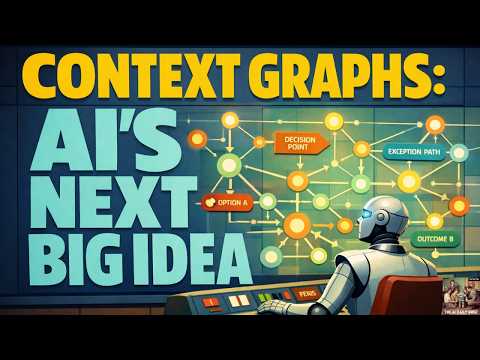
Context graphs are an emerging focus in the AI industry that represent AI's next big idea, driven by conversations about what enables agents to do more important work.
“there have been a couple of conversations recently which I think are particularly pertinent to the shape of the AI industry and what people are focused on building and implementing in 2026. And one of those is this idea of context graphs.”
Jamini Ball's essay 'Long Live Systems of Record' from December explores the debate around how agents change systems of record and what it means for the startup landscape, with underlying implications for how AI intersects with human knowledge work.
“we actually have to go back to an essay from earlier in December by investor Jamine Ball who wrote long live systems of record. And while his starting point was a debate in the startup and VC world around how agents change systems of record and what it means for the startup landscape, underlying this is actually a much more important conversation about how AI is going to intersect with human knowledge work.”
Everyone in the business world is starting to shift focus back to work after the holidays and there will likely be major AI announcements in 2026.
“You could feel basically everyone in the business world right now shaking off the slumber and restfulness of the holidays and starting to get back to work. And I anticipate that it will be almost no time before we start getting big announcements in AI land again.”
The context graph concept resonated broadly, and a key follow-up debate focused on how best to design these systems, with one important argument against pre-constraining AI within the design of context graphs.
“This essay was hugely resonant and tons and tons of people took and ran with the ideas. And one of the areas where people spent the most time is in this question of how best to design these systems. One of the most interesting follow-ups came from the cogent enterprise substack who basically argued to not pre-onstrain the AI in the design of these context graphs.”