Why Hydrogen DOES Have a Future
What this covers
Matt Ferrell's solo video starts from a reality check: in 2021, 62% of hydrogen production still ran on natural gas, and green hydrogen is under 1% of supply. He also notes that there is some scientific skepticism about how "green" even renewables-based production is. He cites cost as the main barrier, pointing to the 2021 U.S. Department of Energy Hydrogen Shot Summit and a Nature Communications study that blames high capital and operating expenses. Efficiency, transport, and storage round out the problems. Hydrogen molecules are small and tend to escape through cracks in pipes and vessels, so containing them takes extra engineering care.
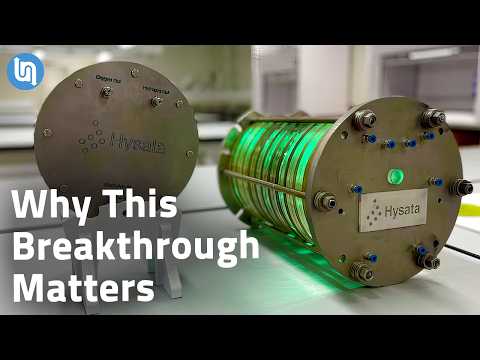
The middle of the video is about technology. Hysata's capillary-fed electrolyzer is explained in some detail: a reservoir keeps electrolyte away from the electrodes until it is drawn through a porous separator, and capillary action replaces the water as it is consumed. Because gas forms without bubbles blocking the electrodes, efficiency rises from about 75% to 95%. Ferrell frames this as an attack on the largest contributor to green hydrogen's levelized cost. He also covers Hysata's new plant in Port Kembla, Australia, with units due in 2025 and a "giga scale" ambition from CEO Paul Barrett.
The video then turns to production routes that skip the electrolyzer. Photocatalytic water splitting (PWS)) has been studied since 1972 but has struggled to scale. The video sets the roughly 1% record against a 5 to 10% viability target, then notes a University of Michigan result of 9.2% in the lab. Sparc Hydrogen's reactor is now being tested on a solar tower at the CSIRO Energy Centre in Newcastle. Firms converting hydrogen sulfide get a brief mention.
The closing argument is practical. The Rijnstate hospital in the Netherlands and Viamed San José in Spain both produce, store, and reuse hydrogen on site. Ferrell offers them as proof that localized use is where hydrogen makes sense now.
Green hydrogen technology is advancing through improved electrolyzer efficiency and alternative production methods, making it viable for specific localized applications like hospitals, though cost and storage challenges still limit widespread adoption.
- Hysata's capillary-fed electrolyzer has achieved 95% efficiency (vs. 75% previously), reducing electricity waste by 25% and lowering levelized cost of energy
- Alternative methods like photocatalytic water splitting and hydrogen sulfide conversion are reaching commercialization stages in Australia
- Hospitals in Netherlands and Spain are successfully implementing hydrogen for local energy storage and medical gas production, demonstrating practical use cases
This asset isn't compiled yet
You're seeing its claims, ranked. Compile it to build the argument threads, weight them, and check each claim against your library — the full view.
Hysata's capillary-fed electrolyzer works by using a reservoir at the bottom of the cell which keeps the electrolyte away from both the anode and cathode until it's drawn through a porous separator, allowing electrolyte to keep direct contact on only one side while gases are produced without bubbling action that hinders efficiency, and as water is electrolyzed out of the separator, capillary action naturally draws up more water to replace it, keeping everything running smoothly.
“Hysata's capillary-fed electrolyzer uses a reservoir at the bottom of the cell which keeps the electrolyte away and out of contact with both the anode and the cathode until it's drawn through a porous separator. This is oversimplified, but the result: the electrolyte keeps direct contact, but only on one side, and the gasses are still produced without that annoying bubbling action that just gets in the way. Since water isn't being drawn to the side with the electrode, the other side can keep releasing gas unhindered. As water is electrolyzed out of the separator, the capillary action naturally draws up more water to replace it, keeping everything running smoothly.”
A team from the University of Michigan managed to reach an impressive efficiency of 9.2% with photocatalytic water splitting using pure water and an indium gallium nitride photocatalyst earlier in 2023, approaching the 5 to 10% economic viability target.
“A team from the University of Michigan just managed to reach an impressive efficiency of 9.2% with pure water and an indium gallium nitride photocatalyst earlier this year.”
Viamed San José Hospital in Murcia, Spain installed a hydrogen energy system involving 289 solar panels powering hydrogen creation through electrolysis, with resulting hydrogen feeding into a boiler for space heating and oxygen produced as a byproduct repurposed as a critical resource for medical procedures.
“Just recently, the Viamed San José Hospital located in Murcia, Spain, installed a system that involves powering the creation of hydrogen through its 289 solar panels. The resulting hydrogen feeds into a boiler for space heating. Meanwhile, the oxygen produced as a byproduct of the electrolysis is then repurposed as a critical resource for medical procedures.”
Hysata targeted poor electrolysis efficiency because it's the largest contributor to green hydrogen's levelized cost of energy (LCOE), with the ultimate goal of making green hydrogen cost-competitive.
“Hysata targeted poor electrolysis efficiency because it's the largest contributor to green hydrogen's levelized cost of energy (LCOE). The ultimate goal: make green hydrogen cost-competitive.”
Rijnstate hospital in Elst, Netherlands opened in summer 2023 with an integrated energy system using heat pumps, PV panels, and an electrolyzer that works in concert to maintain constant power supply, collecting energy from over 1,300 solar panels on roof and ground floor, with surplus solar energy powering electrolysis to produce hydrogen for fuel cells as reserve power when solar supplies are low.
“In the summer of 2023, the Rijnstate (rein-stat-ah) hospital of Elst in the Netherlands opened its doors. What makes this particular campus interesting is how it generates its energy. Heat pumps, PV panels, and an electrolyzer all work in concert to maintain a constant supply of power. The building collects energy from over 1,300 solar panels located on both the roof and the ground floor. When there's a surplus of solar, that energy goes toward electrolysis, the splitting action that produces hydrogen. This then allows hydrogen fuel cells to kick in as a form of reserve power when the sunnier supplies are low.”
Sparc Hydrogen's hydrogen production method doesn't require an electrolyzer or electricity pulled from renewable energy infrastructure, instead being based on photocatalytic water splitting (PWS), which uses a reactor to combine solar energy with a photocatalyst to split water into hydrogen and oxygen.
“Unlike typical setups, Sparc's hydrogen production method doesn't require an electrolyzer or electricity pulled from renewable energy infrastructure. Instead, it's based on photocatalytic water splitting, or PWS.”
Hysata's capillary-fed electrolyzer design improved efficiency from about 75% to 95%, which translates into 25% less electricity lost as heat compared to the average electrolyzer.
“Its design is really promising, with an efficiency rating jumping from about 75% to a whopping 95%. As the company says on its website, this translates into 25% less electricity lost as heat compared to the average electrolyzer.”
Photocatalytic water splitting (PWS) has been studied for over 50 years, with landmark research using semiconductors to split water with light energy dating back to 1972, but the difficulty has been bringing the concept to scale.
“Sparc Hydrogen acknowledges that PWS isn't new. In fact, it's been studied for over 50 years. There was landmark research using semiconductors to split water with light energy back in 1972. The difficulty, of course, has been bringing this concept to scale.”
Photocatalysts are any material that alters the rates of chemical reactions when exposed to light, and in Sparc Hydrogen's approach, light optically excites a semiconductor, creating negative electrons floating around with positive holes that rip water apart into hydrogen and oxygen.
“Photocatalysts are any material that alters the rates of chemical reactions when exposed to light. Basically, Sparc Hydrogen's approach is to use a reactor to combine solar energy with a photocatalyst to split water into hydrogen and oxygen. This is way oversimplified, but the basic process is that light optically excites a semiconductor, which means having negative electrons floating around with positive holes. These rip the water apart into hydrogen and oxygen.”
A 2023 photocatalytic water splitting overview identified the economic viability sweet spot as a 5 to 10% conversion efficiency rate, as proposed by the U.S. Department of Energy, but at the time of the study's writing, the highest solar-to-hydrogen energy conversion value ever accomplished was approximately 1%.
“A 2023 PWS overview identified the economic viability sweet spot as a 5 to 10% conversion efficiency rate, which are numbers the U.S. Department of Energy proposed. However, at the time of the study's writing, the highest solar-to-hydrogen energy conversion value ever accomplished was a measly (approximate) 1%.”
Sparc Hydrogen finished polishing its reactor design in June and began prototype construction, received a high-powered solar simulator from the United States, received funding from CSIRO (Australia's national science agency), and began testing in September with the reactor now sitting on top of the solar tower at the CSIRO Energy Centre in Newcastle, Australia.
“In June, it finished polishing its reactor design and began prototype construction. It also received a high-powered solar simulator — which is exactly what it sounds like — from the United States to continue work in the lab. With funding from CSIRO, Australia's national science agency, the company began testing in September. The reactor is now sitting on top of the solar tower at the CSIRO Energy Centre in Newcastle, Australia.”
The vast majority of hydrogen production doesn't use renewable energy; in 2021, 62% of hydrogen production used natural gas, so the environmental benefits of hydrogen are not being realized at scale.
“As it stands, the vast majority of hydrogen isn't produced using the clean kind. In 2021, 62% of hydrogen production used natural gas.”
There's healthy scientific skepticism about how 'green' the hydrogen production process is even when it is based on renewables, and green hydrogen currently makes up less than 1% of production.
“To make matters worse, there's also healthy, scientific skepticism about how 'green' the process is even when it is based on renewables. Y'know, less than 1% of the time.”
Water-based (rather than natural-gas-based) electrolysis made up only a tiny fraction of all hydrogen production in 2021, but its usage jumped by 20% from 2020, reflecting increasing deployment of water electrolyzers.
“And though water-based (rather than natural-gas-based) electrolysis made up only a tiny fraction of all hydrogen production in 2021, but its usage did jump by 20% from 2020. As the IEA says, 'this reflects increasing deployment of water electrolysers.'”
In August, Hysata opened a manufacturing plant in Port Kembla, Australia to ramp up its electrolyzer commercialization, with units scheduled for delivery in 2025 and the company to 'ramp up rapidly to giga scale capacity thereafter' according to CEO Paul Barrett.
“In August, the company opened a manufacturing plant in Port Kembla, Australia, to ramp up it's electrolyzer commercialization. According to CEO Paul Barrett, these units are scheduled for delivery in 2025, with the company to 'ramp up rapidly to giga scale capacity thereafter.'”
According to the Nature Communications study, green hydrogen lags behind fossil fuels because of its high capital expenditure and operating costs.
“As that Nature study explains, green hydrogen lags behind fossil fuels because of its high capital expenditure and operating costs.”
Energy efficiency, cost, and the difficulty of transporting and storing hydrogen are the main issues pushing back on hydrogen adoption.
“Energy efficiency, cost, and the difficulty of transporting and storing hydrogen are the main issues pushing back on hydrogen adoption.”
The difficulty with bringing photocatalytic water splitting to scale is that while it's relatively easy to do without losing efficiency in laboratory conditions, high enough efficiencies haven't been met in practice yet.
“It turns out that it's relatively easy to do without losing efficiency…but high enough efficiencies haven't been met in the first place…yet.”
Hydrogen molecules are very small and like to escape the cracks and crevices of pipes and storage vessels, making it very difficult to store, though it's possible to safely engineer against this but requires extra effort and care.
“Hydrogen is also very difficult to store because its molecules are just so small. They like to pretend they're Houdini and escape the cracks and crevices of pipes and storage vessels. It is possible to safely engineer against that, but it takes extra effort and care.”
Electrolysis converts water into hydrogen and oxygen, and bubbles in the electrolyzer's electrolyte fluid are non-conducting; when they build up on the electrodes, they block parts of the electrode and hinder the process, reducing efficiency.
“Remember, electrolysis converts water into hydrogen and oxygen. Bubbles in the electrolyzer's electrolyte fluid are non-conducting, and when they build up on the electrodes, it's blocking parts of the electrode and hindering the process, reducing the efficiency.”
Sparc Hydrogen received a grant through Australia's Economic Accelerator program and has reported that the reactor has performed well through two bouts of testing.
“Sparc has also received a grant through Australia's Economic Accelerator program to keep up its momentum. And so far, the company says the reactor has performed well through two bouts of testing.”
Companies working to convert hydrogen sulfide into hydrogen and sulfur, like RedShift Energy and Thiozen, are cropping up as alternative hydrogen production methods.
“Companies working to convert hydrogen sulfide into hydrogen and sulfur, like RedShift Energy and Thiozen, are cropping up.”
Hydrogen tends to lose its appeal when considering the price tag, like any emerging technology, with cost identified as the primary obstacle to hydrogen adoption according to the 2021 U.S. Department of Energy Hydrogen Shot Summit attended by over 3,000 stakeholders from 34 countries.
“When asked what kind of obstacles were preventing widespread adoption of hydrogen tech, they pointed to cost more than anything else... This was made pretty explicit during the U.S. Department of Energy's 2021 Hydrogen Shot Summit, which held an audience of over 3,000 stakeholders representing 34 countries.”
Hydrogen can do great things in specific use cases like when implemented in local energy storage solutions that allow you to produce, store, and convert back into electricity onsite, as demonstrated by the Rijnstate and Viamed San José hospitals.
“There are specific use cases where hydrogen can do really great things, like when implemented in local energy storage solutions that allow you to produce, store, and convert back into electricity onsite…just take a look at the Rijnstate and Viamed San José hospitals.”
The U.S. Inflation Reduction Act incentivizes clean energy production of all kinds, including green hydrogen, though this was passed after the 2021 DOE Summit and represents a policy shift in hydrogen support.
“However, it's important to note that this was before the passage of the US Inflation Reduction Act, which incentivizes clean energy production of all kinds, including green hydrogen.”
Money has been green hydrogen's biggest barrier, so discounting hydrogen for a lack of efficiency alone isn't the reason hydrogen will fail.
“Discounting hydrogen for a lack of efficiency alone isn't the reason hydrogen will fail … it's the money.”
With continued research and development into hydrogen production and use, there's plenty of room for hydrogen to make a difference in facilities like hospitals, making continued R&D investment sensible.
“It goes to show that there's plenty of room for hydrogen to make a difference in these kinds of facilities alone. With that in mind, continued research and development into hydrogen production and use makes a lot of sense to me.”
A typical solar panel converting sunlight into electricity has a theoretical maximum efficiency around 30%, and photocatalytic water splitting efficiency of 1% represents approximately 1% of that, so the small PWS efficiency percentage shouldn't be over-emphasized—the key metric is how much absolute hydrogen you get out of the process.
“A typical solar panel turning sunlight into electricity has a theoretical maximum efficiency around 30%. PWS is like a percent of a percent, so don't get too hung up on the small efficiency. The key is how much you get out of the process”
Hydrogen is definitely not the end-all be-all energy solution that many promised for so long, and at the same time, it's also not a fool's errand; there are specific use cases where hydrogen can do really great things.
“It's definitely not the end all be all energy solution that many promised for so long. At the same time, it's also not a fool's errand. There are specific use cases where hydrogen can do really great things”
Hysata claims to drop the amount of electricity wasted through heat by 10 times and the quantity of liquid needed to pump through the system by 20 times, translating into significantly lower costs.
“The company claims to not only have done just that, but to also drop the amount of electricity wasted through heat by 10 times and the quantity of liquid needed to pump through the system by 20 times. This all translates into significantly lower costs”
PWS is also referred to as 'direct solar to hydrogen' technology, and Sparc Hydrogen claims that its patent-pending reactor has multiple advantages including reduced photocatalyst use, a modular design, and the ability to capture and reuse excess heat.
“That's why PWS is also referred to as 'direct solar to hydrogen' tech. The company claims that its patent pending reactor has multiple advantages, including reduced photocatalyst use, a modular design, and the ability to capture and reuse excess heat.”
The bad thing about hydrogen is that it can't be caught like a net or pan in a river and used as-is; it needs to be removed from something first like water, biogas, or natural gas, which takes a lot of energy.
“The bad thing about hydrogen is exactly that. You can't catch hydrogen with a net or pan for it in a river and use it as-is. It may be everywhere, but it needs to be removed from something first, like water, biogas, or natural gas. That takes a lot of energy”
There are initiatives developing methods to create hydrogen out of waste products, from paper to plastic.
“There's also initiatives to develop methods of creating hydrogen out of waste products, from paper to plastic.”
The good thing about hydrogen is that it's a versatile form of energy storage, and when created using renewable generation, the goal is to come out with no harmful byproducts—no waste and no emissions.
“The good thing about hydrogen is that it's a versatile form of energy storage, and when it's created using renewable generation, the goal is to come out with no harmful byproducts. That means no waste and no emissions.”
Ferrell's opinion on hydrogen has been shifting over the past few years toward a more nuanced, balanced perspective.
“Over the past few years my opinion on hydrogen has been shifting.”