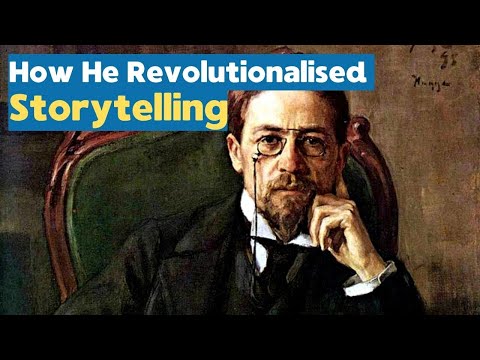
What this covers
This 33-minute video essay from Fiction Beast, narrated by a single unidentified speaker, pairs a biography of Anton Chekhov with a reading of his work. The biographical thread starts with his father's bankruptcy in 1876, which left a teenage Chekhov supporting the family through drawing, comic newspaper pieces and tutoring. It continues through medical school in Moscow, the 1887 story "Steppe" and the play Ivanov, and the Pushkin Prize he won at 26 in 1888. It then follows the Sakhalin journey and the years at Melikhovo, where he practiced medicine and wrote The Seagull and Uncle Vanya. The narrator stresses that Chekhov came from a merchant family with a serf grandfather, unlike aristocratic writers such as Leo Tolstoy.
The second half of the argument is about method and outlook. Chekhov is set against Fyodor Dostoevsky, Tolstoy, Ivan Turgenev and Maxim Gorky, each described as pushing a vision of how Russia should be. The narrator presents Chekhov as the one who declined to offer answers, which is why his stories can feel abandoned. Ivanov is credited as the origin of Chekhov's Gun, and the narrator also treats his attention to silence and pauses, and his training in physical science, as part of his style.
The most contentious turns are philosophical. The narrator compares Chekhov to Camus through shared tuberculosis (TB)) and a belief in small moments of joy, drawing on the Myth of Sisyphus, and brings in Heidegger on finite time. Chekhov's own words are read as a critique of Stoicism (from "Ward No. 6") and of complacent happiness (from "Gooseberries"). "Man in a Case" and The Cherry Orchard serve as worked examples, the second as a whole country in transition shrunk to one family. The video closes on his reception among Joyce, Virginia Woolf, Vladimir Nabokov, Hemingway and Carver, and on the influence of his Sakhalin writings on Murakami and Seamus Heaney.
Anton Chekhov revolutionized storytelling by depicting reality objectively without moral judgment, focusing on mundane life and fleeting moments of joy rather than grand philosophical or political narratives, fundamentally changing how literature captures human experience.
- Chekhov stripped stories of teaching and moralizing unlike Tolstoy and Dostoevsky, instead reporting life as it is with neutral objectivity
- His minimalist style (Chekhov's gun) removes all superfluous elements to focus only on what matters to the story
- He identified a 'will to joy'—arguing humans are driven by temporary moments of joy amid hardship rather than continuous happiness or power, making the mundane profound
This asset isn't compiled yet
You're seeing its claims, ranked. Compile it to build the argument threads, weight them, and check each claim against your library — the full view.
Through writing the play Ivanov, Chekhov learned that he 'couldn't afford to write more or less, but what was needed to tell the story,' which became the foundation for Chekhov's gun—the principle that every object in a story must have purpose and nothing superfluous should be mentioned.
“But most crucially by writing a play, he learnt that he couldn't afford to write more or less, but what was needed to tell the story. This became known as Chekhov's gun. What does it mean? It basically boils down to this that everything in the story should have a purpose.”
Chekhov lived with TB just like Camus, knowing death was looming—and what makes humans distinct from other animals is that 'we anticipate our death. Other animals may understand when it comes to them, but we know our demise from an early period of life,' so Chekhov 'not only anticipated his own death, he saw death on a daily basis as a doctor.'
“It makes sense because Chekhov lived with with an illness himself—just like Camus who also suffered from TB for most of his life— he knew death was looming large. What makes humans distinct from other animals is that we anticipate our death. Other animals may understand when it comes to them, but we know our demise from an early period of life. So Chekhov not only anticipated his own death, he saw death on a daily basis as a doctor.”
One of the first things people notice when reading Chekhov is that he 'never gives you an answer to life's problems'—his stories feel 'abandoned' because he 'just paints life as it is,' without resolution, in reaction to other Russian writers like Tolstoy who moralised and Dostoevsky who had political stances.
“Nothing is resolved. One of the first things you notice when you read Chekhov is that he never gives you an answer to life's problems. It feels as though his stories are abandoned. He just paints life as it is. This was in reaction to other Russian writers who came before him. I would say, in particular in response to Tolstoy who never stopped moralising in his books. Dostoevsky too had a political stance in his novels, especially his anti-western sentiment. So naturally, Chekhov took a neutral stance towards morality, politics and religion. He just looked at reality and reported how he saw it.”
Chekhov emphasizes the unsaid, silence, pauses, and everything in-between: instead of adding more words, he focused on what was unsaid and unverbalised, recognizing that 'human communication is often more non-verbal than verbal,' and 'saying less is more.'
“Chekhov emphasises the unsaid, silence, pauses and everything in-between. Instead of adding more words, he focused on what was unsaid and unverbalised. Human communication is often more non-verbal than verbal, so Chekhov is good at articulating the full spectrum of human communication. And often that means saying less is more.”
Chekhov's comedy is often 'an awkward moment. An inappropriate moment which is paradoxical,' where readers notice 'the little things people do that bring a smile to your face'—'a stranger smiling at you. Someone keeping a door open for you. A cat walking past you'—small moments of grace that we all experience.
“Chekhov's comedy is always an awkward moment. An inappropriate moment which is paradoxical. While reading him, you notice the little things people do that bring a smile to your face. We all experience these things. In the midst of our hectic lives, we often see a little moment of joy. For example a stranger smiling at you. Someone keeping a door open for you. A cat walking past you.”
Martin Heidegger argued that 'the true meaning of life is understanding that we have a finite amount of time'—this awareness gives our lives authenticity—and Chekhov's stories are 'a snapshot of life, moments of tragedy sprinkled with moments of joy. That's real life. No matter who you are. We all live a mundane life and those moments of joy are precious, no matter how miserable life can be.'
“As Martin Heidegger said, the true meaning of life is understanding that we have a finite amount of time. This awareness gives our lives authenticity. So Chekhov's stories are a snapshot of life, moments of tragedy sprinkled with moments of joy. That's real life. No matter who you are. We all live a mundane life and those moments of joy are precious, no matter how miserable life can be.”
Chekhov and Camus 'had a lot in common': both suffered TB, both had deep love for storytelling especially theatre, and both 'shared a philosophy that life is made of little moments of joy'—Camus's Myth of Sisyphus captures this: 'Sisyphus is condemned to push a rock up the mountain. Perhaps his only joy is the short interval between him getting to the top before he has to go back down.'
“Chekhov and Camus had a lot in common. Both suffered the same illness, TB. They also had a deep love for storytelling, specially theatre. They also shared a philosophy that life is made of little moments of joy. Camus's Myth of Sisyphus is precisely that. Sisyphus is condemned to push a rock up the mountain. Perhaps his only joy is the short interval between him getting to the top before he has to go back down.”
Chekhov was 'educated in physical science therefore everything had to be concretised'—for example, 'a man falls in love with a woman for her white teeth or her breasts. Shallow? Yes, but nature is deep and shallow. We all are. That's Chekhov's intuition that saw the paradox of life.'
“He was a doctor, educated in physical science therefore everything had to be concretised. For example, a man falls in love with a woman for her white teeth or her breasts. Shallow? Yes, but nature is deep and shallow. We all are. That's Chekhov's intuition that saw the paradox of life.”
Chekhov made himself 'invisible in his stories'—'His stories are all about the characters. He doesn't care about how the world should be or how we can make things better. All Chekhov was concerned with was to depict the world how it was. Reality. That's it. To the point that sometimes he appears heartless'—depicting 'nature and reality without moral judgement.'
“He made himself invisible in his stories. His stories are all about the characters. He doesn't care about how the world should be or how we can make things better. All Chekhov was concerned with was to depict the world how it was. Reality. That's it. To the point that sometimes he appears heartless. Chekhov depicts nature and reality without moral judgement.”
While Dostoevsky wanted Russia to return to traditional values, Tolstoy wanted Russia to be more just toward the poor, Turgenev wanted liberal values, and Maxim Gorky wanted a socialist society, 'Chekhov however didn't write about how society should be. He wrote about what is. He wrote about life's reality as it is.'
“Dostoevsky wanted Russia to return to its olden traditional values. Tolstoy wanted Russia to be more just towards the poor. Turgenev wanted liberal values to take root in Russia. Maxim Gorky wanted a socialist society that prompted equality for all. Chekhov however didn't write about how society should be. He wrote about what is. He wrote about life's reality as it is.”
In 'Man in a Case,' when Belikov sees Varenka riding a bicycle with her brother, he is scandalized and complains to Kovalenko, who in response throws him down the stairs; Varenka witnesses this and laughs, which is 'too much for Belikov to bear'—he falls ill and dies, but the townspeople revert to the same stagnation, proving that while Belikov took 'living in a case' to the extreme, people confine themselves to 'cases' all on their own.
“One day, Belikov sees Varenka riding a bicycle with her brother; he is scandalised by this and comes to Kovalenko to complain. Kovalenko, however, takes none of his nonsense and throws him down the stairs; Varenka witnesses the end of this scene and laughs at Belikov. This is too much for Belikov to bear; he falls ill and dies soon after, looking happier than ever in his coffin. The townspeople are momentarily relieved to be free of his oppressing presence, but soon find themselves reverting back to the same stagnation that they lived in before – proving that, while Belikov took 'living in a case' to the extreme, people confine themselves to 'cases' all on their own.”
Chekhov's famous quote from 'Gooseberries'—'And such a state of things is evidently necessary; obviously the happy man is at ease only because the unhappy ones bear their burdens in silence... Behind the door of every contented, happy man there ought to be someone standing with a little hammer and continually reminding him with a knock that there are unhappy people'—establishes that happiness is structurally dependent on the silence of the suffering.
“And such a state of things is evidently necessary; obviously the happy man is at ease only because the unhappy ones bear their burdens in silence, and if there were not this silence, happiness would be impossible. It is a general hypnosis. Behind the door of every contented, happy man there ought to be someone standing with a little hammer and continually reminding him with a knock that there are unhappy people, that however happy he may be, life will sooner or later show him its claws, and trouble will come to him-illness, poverty, losses, and then no one will see or hear him, just as now he neither sees nor hears others.”
From 'Ward No. 6,' Chekhov argues that 'A creed which teaches indifference to wealth, indifference to the conveniences of life, and contempt for suffering is quite incomprehensible to the great majority who never knew either wealth or the conveniences of life...All life lies in these feelings, and life may be hated or weary of, but never despised. The teachings of the Stoics can never have a future.'
“A creed which teaches indifference to wealth, indifference to the conveniences of life, and contempt for suffering is quite incomprehensible to the great majority who never knew either wealth or the conveniences of life, and to whom contempt for suffering would mean contempt for their own lives, which are made up of feelings of hunger, cold, loss, insult, and a Hamlet-like terror of death. All life lies in these feelings, and life may be hated or weary of, but never despised. Yes, I repeat it, the teachings of the Stoics can never have a future; from the beginning of time, life has consisted in sensibility to pain and response to irritation.”
When Chekhov's father went bankrupt in 1876 when Anton was 16, rather than face jail (as Dickens's and Cervantes's fathers had), his father fled to Moscow, leaving teenage Chekhov to support the family through drawing, writing funny stories for newspapers, tutoring, and sending money to Moscow while also maintaining family morale.
“When he was 16, his father went bankrupt in 1876. To avoid jail which Charles Dickens's father and Cervantes's father had to endure, Chekhov's father was smart so he fled to Moscow, leaving the little Chekhov to deal with the money issues by selling the household stuff and talking to the bailiffs. Not only that, he managed to work by drawing, writing funny stories for newspapers and tutoring children so he could send money to his family in Moscow. Not just that, he also wrote funny letters to his family to cheer everyone up.”
In 'The Cherry Orchard' (1903), Lyubov Andreievna Ranevskaya returns from Paris to her childhood home where the once-grand estate is now broke and the cherry orchard no longer bears fruit; the family, hopelessly stuck in the past, cannot act to prevent financial ruin, so wealthy merchant Lopakhin (whose ancestors were serfs on the estate) buys it and plans to chop down the orchard for cottages, telling 'the story of an entire country on the verge of transformation' on the scale of one family.
“The play opens with Lyubov Andreievna Ranevskaya returning to her childhood home from Paris. The Ranevsky estate used to be grand and prosperous, and their cherry orchard was a point of fame and pride. But times have changed – the orchard no longer bears fruit, and the family is broke...The family is offered a solution by Lopakhin, a wealthy merchant whose forefathers were serfs on the estate...Lopakhin ends up buying the estate, intending to chop down the orchard to make room for cottages. On the scale of one family and estate, Chekhov tells the story of an entire country on the verge of transformation.”
Unlike most Russian writers, Chekhov was born into a merchant family close to the peasantry with a grandfather who was a serf, so he understood life at the bottom, which contrasted sharply with aristocratic backgrounds of writers like Tolstoy.
“Unlike most Russians writers, Chekhov was born into a merchant family close to the peasantry, and his grandpa was a serf, so he understood life at the bottom.”
At age 19 in 1879, Chekhov managed to join his family in Moscow and simultaneously enter Moscow State Medical University, completing his doctor's qualification in four years (by 1884) without parental financial support.
“In 1879, when he was 19, he managed to join his family in Moscow. Not only that, he managed to enter Moscow State Medical University. The man was a genius. Without help from his parents, he did all of that. It took him four years to get his doctor's qualification from university, so in 1884 he started working for little or no money treating the poor.”
In 1888, Chekhov's collection At Dusk won the prestigious Pushkin Prize at age 26, establishing him as a new artistic genius in Russia at a time when Dostoevsky had recently died (1881) and Tolstoy was aging.
“In 1888, Chekhov's book, At Dusk, a collection of his short stories, won the prestigious Pushkin Prize. Now Russia had a new 26 year old artistic genius in the making. Dostoevsky had died in 1881 and Tolstoy was getting old, so Russia needed younger blood and Chekhov announced himself, not by writing big brick-like novels, but short stories.”
In 1887, Chekhov wrote the short story Steppe after traveling through the steppes of Ukraine, which was published in a literary journal rather than a cheap newspaper, marking his transition to serious literature; that same year he wrote the play Ivanov, which became a huge success for its realism.
“In 1887, while travelling through the steppes of Ukraine, Chekhov was inspired to write a short story titled Steppe that was published in a literary journal, not some cheap newspaper. That same year, he was commissioned to write a play titled Ivanov which became a huge success due to its realism.”
Chekhov formulated the principle 'Remove everything that has no relevance to the story. If you say in the first chapter that there is a rifle hanging on the wall, in the second or third chapter it absolutely must go off. If it's not going to be fired, it shouldn't be hanging there,' establishing the law that every object in a story is required and nothing extra or superfluous should be mentioned.
“Remove everything that has no relevance to the story. If you say in the first chapter that there is a rifle hanging on the wall, in the second or third chapter it absolutely must go off. If it's not going to be fired, it shouldn't be hanging there.—Anton Chekhov. In other words, every object in the story is required. Nothing extra or superfluous should be mentioned.”
Chekhov's Sakhalin writings became incredibly influential not only on human rights issues but also on writers including Haruki Murakami and Seamus Heaney, who dedicated portions of their works to the subject.
“His Sakhalin writing has been incredibly influential, not only on the issue of human rights but also on other writers including Haruki Murakami and Seamus Heaney, both of whom has dedicated something in their own works.”
Upon returning from Sakhalin, Chekhov moved to Melikhovo, a village 80 km south of Moscow, where he spent about 6 years practicing medicine while writing some of his greatest works including The Seagull (1894) and Uncle Vanya (1896).
“So he moved to a village some 80 km south of Moscow, a place called Melikhovo, where he spent about 6 years practising as a doctor but also writing some of his best works. For example in 1894, he wrote The Seagull, one of his greatest plays. Two years later he wrote Uncle Vanya.”
Virginia Woolf critiqued readers who judge Chekhov's stories as 'inconclusive' by questioning 'our own fitness as readers,' arguing that where Victorian fiction provides emphatic endings, Chekhov's unfamiliar tune requires 'a very daring and alert sense of literature' to hear 'those last notes which complete the harmony,' even when resolution is a 'note of interrogation.'
“These stories are inconclusive, we say, and proceed to frame a criticism based upon the assumption that stories ought to conclude in a way that we recognise. In so doing we raise the question of our own fitness as readers...Where the tune is familiar and the end emphatic—lovers united, villains discomfited, intrigues exposed—as it is in most Victorian fiction, we can scarcely go wrong, but where the tune is unfamiliar and the end a note of interrogation or merely the information that they went on talking, as it is in Chekhov, we need a very daring and alert sense of literature to make us hear the tune, and in particular those last notes which complete the harmony.—Virginia Woolf”
All humans irrespective of job or status have an everyday life—'We wake, eat breakfast, put on our clothes, commute to work, sit in the office, talk to colleagues, go home, watch telly and go to bed. There's nothing magical in our lives'—and Chekhov understood the banality of life and made that his muse.
“Ultimately we all, irrespective of our jobs or status, have an everyday life. We wake, eat breakfast, put on our clothes, commute to work, sit in the office, talk to colleagues, go home, watch telly and go to bed. There's nothing magical in our lives. So Chekhov understood the banality of life and made that his muse.”
Our 'little moments of joy' include 'meeting a friend, having a nice meal, sharing a drink, talking to loved ones, getting a nice comment'—whereas 'A long, continuous state of happiness is a myth pushed onto us by fairytales like Cinderella.'
“It's same for all of us. Our little moments of joy is meeting a friend, having a nice meal, sharing a drink, talking to loved ones, getting a nice comment from you beautiful people etc. A long, continuous state of happiness is a myth pushed onto us by fairytales like Cinderella.”
Anton Chekhov was 'funny like Gogol, artistic like Turgenev, profound like Dostoevsky, generous like Tolstoy, but he was different from all of them' because he 'rose from the bottom of the Russian society so he understood real pain and real suffering' and maintained objective distance from his stories rather than projecting opinions or worldview.
“Anton Chekhov was funny like Gogol, artistic like Turgenev, profound like Dostoevsky, generous like Tolstoy, but he was different from all of them. He rose from the bottom of the Russian society so he understood real pain and real suffering. As a dutiful doctor and objective artist he removed himself from his stories.”
Maxim Gorky observed that 'In the presence of Anton Pavlovich everyone felt an unconscious desire to be simpler, more truthful, more himself,' as Chekhov's simplicity made people shed 'their attire of grand bookish phrases, fashionable expressions, and all the rest of the cheap trifles with which Russians...adorn themselves.'
“In the presence of Anton Pavlovich everyone felt an unconscious desire to be simpler, more truthful, more himself, and I had many opportunities of observing how people threw off their attire of grand bookish phrases, fashionable expressions, and all the rest of the cheap trifles with which Russians, in their anxiety to appear Europeans, adorn themselves, as savages deck themselves with shells and fishes' teeth.—Maxim Gorky.”
Chekhov found readers in the west among a new breed of writers including James Joyce, Virginia Woolf, George Bernard Shaw, Ernest Hemingway, Vladimir Nabokov, and later Raymond Carver, who recognized him as a genius who revolutionized storytelling.
“But slowly, he found his readers in the west, especially among the new breed of writers, such as James Joyce, Virginia Woolf, George Bernard Shaw, Ernest Hemingway, Vladimir Nabokov, and later Raymond Carver. Today, Chekhov is recognised as a one of the geniuses of Russia who revolutionised storytelling by focusing on the ordinary and turning them into extraordinary stories.”
Vladimir Nabokov argued that 'Chekhov's genius almost involuntarily disclosed more of the blackest realities of hungry, puzzled, servile, angry peasant Russia than a multitude of other writers, such as Gorki for instance, who flaunted their social ideas in a procession of painted dummies,' and 'the person who prefers Dostoevski or Gorki to Chekhov will never be able to grasp the essentials of Russian literature and Russian life.'
“Chekhov's genius almost involuntarily disclosed more of the blackest realities of hungry, puzzled, servile, angry peasant Russia than a multitude of other writers, such as Gorki for instance, who flaunted their social ideas in a procession of painted dummies. I shall go further, and say that the person who prefers Dostoevski or Gorki to Chekhov will never be able to grasp the essentials of Russian literature and Russian life.—Vladimir Nabokov.”
Unlike Tolstoy, Dostoevsky, and Turgenev, earlier Russian writers romanticized the Russian peasant as 'almost godly and the source of inspiration,' because these writers came from aristocratic backgrounds so felt they had to revere the peasant, but Chekhov 'doesn't paint a rosy picture of the peasants. He saw them just as flawed as the aristocrats. He saw them as dishonest at times as the ruling elite.'
“In Tolstoy's writings and to some extent in Dostoevsky's and Turgenev's writings, they idolise the Russian peasants as almost godly and the source of inspiration. This makes sense because these writers came from an aristocratic background so they felt they had to revere the peasant...Now Chekhov doesn't paint a rosy picture of the peasants. He saw them just as flawed as the aristocrats. He saw them as dishonest at times as the ruling elite.”
In 'Gooseberries' (1898), a veterinarian narrates the story of his younger brother Nikolai, who devoted his entire life to one goal: buying an estate with gooseberry bushes, becoming 'twisted and corrupt' in the process, even starving his elderly wife to save money.
“A veterinarian narrates to his friend the story of his younger brother, Nikolai. Nikolai devoted his whole life to one goal: to buy the estate of his dreams, one with gooseberry bushes. As Nikolai works towards his goal, he becomes twisted and corrupt, even starving his elderly wife to save money for the estate.”
In 'Gooseberries,' Nikolai eventually purchases the estate but it is 'a twisted version of his idealised dream; it is polluted, bare, and corrupt, reflecting the soul of its owner,' yet Nikolai 'fools himself into thinking that his goals have been achieved,' remaining in 'self-satisfied complacency' while ignoring surrounding suffering.
“Nikolai's estate is a twisted version of his idealised dream; it is polluted, bare, and corrupt, reflecting the soul of its owner. Still, Nikolai fools himself into thinking that his goals have been achieved, and the narrator finds himself repulsed by his brother's greed, apathy, and delusional sense of self-importance. Disturbed and disgusted by the encounter, the narrator muses on how easy it is for those who achieve positions of privilege to remain in self-satisfied complacency and ignore the suffering that occurs around them.”
One year after starting work as a physician in 1885, Chekhov contracted tuberculosis but hid it from his family while coughing blood, continuing to write prolifically to earn money for his family to move to a better place.
“But it all had come at a cost to his own health. A year after starting work as a physician, he contracted TB, but he kept it hidden from his family despite coughing blood. All the while, he wrote short stories like crazy to make enough money for his family to move to a better place.”
Anton Chekhov was born in 1860 in Taganrog in the South of Russia, just one year after the Emancipation of Serfs, during a decade that produced Turgenev's Fathers and Sons, Dostoevsky's Crime and Punishment, and Tolstoy's War and Peace.
“Anton Chekhov was born in 1860 in Taganrog in the South of Russia, just one year after the Emancipation of Serfs. Also 1860s is one of the most important decades in Russian literature that produced Turgenev's Fathers and Sons, Dostoevsky's Crime and Punishment and Tolstoy's War and Peace.”
In 1898, Chekhov bought a house and moved to Crimea for warmer climate due to deteriorating health, where he entertained guests like Leo Tolstoy and Maxim Gorky, and wrote major plays including The Cherry Orchard.
“In 1898, he bought a house and moved to Crimea, where he would entertain giant guests like Leo Tolstoy and Maxim Gorky. Here he also wrote some of his best plays like The Cherry Orchard.”
In 'The Seagull' (1895, first performed 1896), Konstantin, a young sensitive playwright living with his uncle on a country estate, is in love with Nina who wants to become an actress, but she falls for Trigorin, a famous writer, leaving Konstantin depressed; two years later, the group reunites and Konstantin, further devastated by Nina's tragic life and failure as an actress, commits suicide.
“It tells the story of Konstantin, a young, sensitive man hoping to become a playwright. He lives with his uncle on a country estate...Kosntantin is in love with Nina, a young girl who lives nearby and hopes to become an actress herself...Nina falls for Trigorin. Two years later, the same group gathers at the very same estate; Nina's life has been tragically marked by her romance with Trigorin (who abandoned her and went back to Arkadina) and her failure as an actress. Konstantin, already depressed, is even further devastated by the encounter with her. The play ends with Konstantin's suicide.”
In 1890, Chekhov traveled to a penal colony on the Island of Sakhalin north of Japan, witnessing extreme human degradation and cruelty, including children as young as six following their chained convicted fathers, which profoundly shaped his understanding of complex humanity.
“In 1890, Chekhov took his gun— just kidding, no gun—and headed east to a penal colony on the Island of Sakhalin, just north of Japan. This trip was an eye-opener for him. He witnessed so many horror stories of how cruel humans can be...He even witnessed the children as young as six following their chained convicted fathers and sleeping in the same room with other criminals.”
In 'Man in a Case' (1898), Chekhov wrote about an absurdly reclusive Greek teacher named Belikov who isolates himself physically with coats, hats, sunglasses, and umbrellas while imposing his fearful presence on an entire town, keeping it in dread and stagnation until new arrivals challenge this dynamic.
“Belikov is someone who takes every effort not only to remove himself from any kind of community, progress, and joy, but ensures that those around him do the same. He isolates himself physically – walking around in a constant shroud of dark coats, hats, sunglasses, and umbrellas, but nevertheless imposes his presence on others, coming to the apartments of his colleagues and sitting there for hours in complete silence.”
Around the time at Melikhovo, Chekhov abandoned religious faith to become an atheist after witnessing so much suffering, especially among children, which shook his faith in God.
“Also around this time, Chekhov said goodbye to god and religion to become an atheist. He had seen so much suffering, especially among children that shook his faith in god almighty sitting pretty while all these kids were dying for no reason.”
Chekhov's stories are full of 'magical moments'—'genuine joy in the midst of misery and hardship. It's these tiny moments that we really cherish in life. Yes we love little moments of joys. That's our energy and that motivates us. Happiness is meaningless because it presupposes that we would be happy for a long period of life. But joy is always temporary which is the truer goal of human existence.'
“Chekhov's stories are full of magical moments. He saw genuine joy in the midst of misery and hardship. It's these tiny moments that we really cherish in life. Yes we love little moments of joys. That's our energy and that motivates us. Happiness is meaningless because it presupposes that we would be happy for a long period of life. But joy is always temporary which is the truer goal of human existence.”
Chekhov was an obsessive gardener who looked after plants, and his short stories treat people 'as if they are plants. Humans are just plants in a garden we call society or country. Some are weak and some are strong. They live in the same garden yet each one has a different existence. Such is the nature of reality.'
“Here is an interesting fact. Chekhov was an obsessive gardener. He looked after plants. His short stories are about people as if they are plants. Humans are just plants in a garden we call society or country. Some are weak and some are strong. They live in the same garden yet each one has a different existence. Such is the nature of reality.”
Schopenhauer said humans are driven by a blind will to life; Nietzsche said humans are driven by will to power; but Chekhov argues we are ultimately driven by a 'will to joy'—temporary moments of joy amid hardship, not long-term happiness.
“Schopenhauer said we are driven by a blind will to life. We work and struggle to continue on living. Nietzsche said we are driven by will to power. We all want to be respected by our competence and power. Chekhov, however, says we are ultimately driven by a will to joy.”
At the time of his death, Chekhov was one of Russia's most famous writers, perhaps only second to Tolstoy, but unlike Tolstoy (who was a count with inherited disposable income), Chekhov 'had to work his arse off' his entire life even as a teenager to feed his family.
“He was one of the most famous writers in Russia at the time, perhaps only second to Tolstoy. But what's remarkable is that Tolstoy didn't have to work a day in his life. I mean to earn a living because he was a count, meaning he had a lot of disposable income passed onto him from his family. Chekhov had to work his arse off to feed his family even as a teenager.”
Chekhov's minimalism is rooted in the principle that 'peasants don't have time to fluff'—to get someone's attention, you must stick to what's important and not digress into things merely related to the story, because 'in the short story world, things are much more brutal. It's survival of the finest.'
“Why? Because peasants don't have time to fluff. Chekhov understood that to get someone's attention, you must stick to what's important. Don't digress and don't talk about things that are related to the story. In novels, you can get away with some fluff or digression but in the short story world, things are much more brutal. It's survival of the finest.”
Chekhov believed 'it is not for writers to solve such questions as the existence of God, pessimism, etc. The writer's function is only to describe by whom, how, and under what conditions the questions of God and pessimism were discussed,' meaning writers should report observed discourse, not attempt philosophical resolution.
“I think that it is not for writers to solve such questions as the existence of God, pessimism, etc. The writer's function is only to describe by whom, how, and under what conditions the questions of God and pessimism were discussed.”
To become a writer with depth, one must see harsh reality of life: Tolstoy fought in the Crimean War of the 1850s, Dostoevsky spent years in a Siberian labor camp as a prisoner, and Chekhov witnessed extreme human degradation on Sakhalin.
“So to become a writer with depth one must see harsh reality of life. Tolstoy fought in the Crimean war of 1850s while Dostoevsky spent years in the Siberian labour camp as a prisoner.”
Chekhov wrote stories about the ordinary and mundane, not about great wars like Tolstoy, philosophical debates like Dostoevsky, or social change like Gogol, making the ordinary extraordinary through intuition—a 'quick, natural response to what we see or experience,' which women often possess in superior measure because they 'notice smaller things while men tend to focus on the bigger things.'
“Chekhov's stories are tales of the mundane. He didn't write about some great wars like Tolstoy did or deep philosophical debates like Dostoevsky or Turgenev did , or social change like Gogol or Pushkin did. Instead, Chekhov wrote about the ordinary. But how can you turn ordinary or banal into a work of art? Here comes intuition. Intuition is often defined as a quick, natural response we have to what we see or experience...normally women claim to have a superior intuition than men because they notice smaller things while men tend to focus on the bigger things.”
Chekhov saw social paradoxes and contradictions between doctor and patient, between men and women, between rich and poor; he recognized that power play between two people is always at play but not always obvious, and as a doctor himself, he saw the powerlessness of patients and crucially the powerlessness of doctors in the face of immense human suffering.
“What Chekhov saw was social paradoxes. He saw the contradictions between doctor and patient, between men and women, and between rich and poor. His stories are tales of juxtaposition between two opposites. We might not notice, the power play between two people is always at play, but not alway obvious. Chekhov as a doctor himself saw the powerlessness of patients but most crucially the powerlessness of doctors in the face of immense human suffering.”
Chekhov is today recognized as the father of the short story and one of the finest Russian writers of all time, having revolutionized storytelling by focusing on the ordinary and turning mundane experiences into extraordinary art.
“Today Chekhov is considered the father of short stories and one of the finest Russian writers of all time.”
Chekhov married Olga but they lived somewhat independent lives with Chekhov in Crimea and Olga in Moscow, a long-distance relationship; around this time he wrote 'The Lady with the Dog,' a famous short story about a love affair between two married people.
“Not just that, he also married Olga but they lived somewhat independent lives, Chekhov in Crimea and Olga in Moscow. The long-distance relationship must have been good and bad, but around this time Chekhov wrote one of his most famous short stories, the Lady with the Dog, about the love affair between two married people, so who knows, he might have had something going.”
Chekhov died on July 15, 1904, aged 44, after traveling to a spa town in Germany from which he would not return alive; his body was taken to Russia and buried in Moscow next to his father.
“He made a trip to a spa town in Germany. He wouldn't return to Russia alive. He died on July 15, 1904, aged 44. His body was taken to Russia and buried in Moscow, next to his father.”
Chekhov read extensively as a teenager including Don Quixote, Oblomov, Fathers and Sons, and Schopenhauer's Will and Representation, while also chasing romantic affairs with older women including a teacher's wife, living as a grown man in experience before his time.
“To pass the time, Chekhov also read a lot of fiction, like Don Quixote, Oblomov, Fathers and Sons, and philosophical books like Schopenhauer's Will and Representation. He was also busy chasing women, having affairs with older women, including the wife of one of his teachers.”
In 'The Seagull,' Chekhov employs his famous gun principle, and the play alludes to Shakespeare's Hamlet through various similarities in its exploration of indecision, family conflict, and tragic suicide.
“It is here that Chehkov's famous gun is at play. Also the play alludes to Shakespeare's Hamlet through various similarities.”