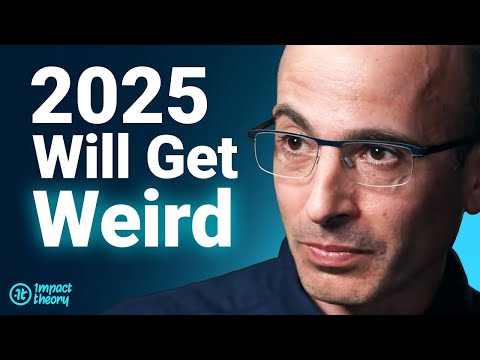
The 2 Most Important Skills For the Rest Of Your Life | Yuval Noah Harari on Impact Theory
What this covers
This is a conversation between Tom Bilyeu and Yuval Harari about what happens when the ability to read the human body meets the computing power to process what is read. Harari separates today's technology from earlier surveillance. The KGB and Gestapo could watch people around the clock, but they lacked the biological knowledge to interpret what was happening inside them and the computing power to make sense of the data. Corporations and governments are starting to have both, through biometric data and biotech paired with infotech. From there the talk moves through what it means for algorithms to know facts about you before you do, and for that knowledge to be used for self-discovery or for persecution depending on where you stand.
The middle of the conversation turns inward. Harari treats identity as a story the mind keeps producing, a narrative identity that is now partly outsourced to Facebook and similar platforms. He gives the example of a vacation photo that hides an argument from five minutes earlier. He also says self-knowledge is painful, because the first thing a retreat turns up is what you would rather not know. Bilyeu pushes on whether a delusional but happy person is a problem, and Harari answers that delusions carry costs for everyone else, up to wars and genocide, a point he ties to his own background in the Middle East.
The wider range includes the claim that art works on human biochemistry, which makes it open to algorithmic manipulation. It also covers early cancer detection through constant monitoring, and a forecast that health will beat privacy when the two collide. Harari predicts repeated disruption of jobs and argues that the best preparation is emotional intelligence, mental balance and a capacity for reinvention rather than narrow technical skill. He calls the political system largely absent from the discussion of AI and biotech, so that science fiction, including Aldous Huxley's Brave New World, ends up as the public's main teacher. He closes with three priorities for every government: nuclear war, climate change and technological disruption.
Harari argues that humans are now 'hackable animals' due to convergent advances in biotech and infotech that enable unprecedented data collection and computational power, creating both existential risks (manipulation, job displacement, loss of privacy) and transformative opportunities (personalized healthcare, self-knowledge), requiring urgent clarity on which technologies and values should guide society's choices.
- The merger of biotech (biological understanding) and infotech (computational power) enables algorithms to understand and manipulate humans better than they understand themselves
- Recurring technological disruption will force continuous career/identity reinvention across lifespans, testing psychological resilience in ways humans have never faced
- Science fiction, not politics or academia, shapes public understanding of AI and biotechnology, making storytellers the de facto educators on humanity's future
This asset isn't compiled yet
You're seeing its claims, ranked. Compile it to build the argument threads, weight them, and check each claim against your library — the full view.
We are now hackable animals because we have both the technology to decipher what humans think and want through biometric data and the computing power to predict human choices and manipulate human desires in ways never possible before in history.
“we are now hackable animals. We have the technology to decipher how humans what you think, what you want, to predict human choices, to manipulate human desires in ways which were never possible before.”
The implications of algorithms knowing important facts about a person before that person knows them about themselves are mind-boggling and multidirectional, ranging from positive self-discovery to persecution depending on context and social location.
“And the implications are really mind-boggling. When an algorithm knows such an important thing about you before you know it about yourself. Now, it can go in all kinds of directions. It really depends on where you live and what you do with it.”
The best educational investment for facing an uncertain future is developing emotional intelligence and mental balance, along with the capacity to keep changing, learning, and reinventing oneself throughout life, rather than specializing in specific technical skills.
“The best investment I would say is in emotional intelligence and in mental balance and these kinds of skills of how to keep changing throughout your life. How to keep learning throughout your life.”
Our identity is fundamentally just a story that we constantly construct and embellish, not a real unchanging thing, and the entire human mind can be understood as a machine that constantly produces stories, especially the central story of 'my story'.
“our identity is really just a story, which we constantly construct and and embellish. I mean, you can say that the the entire human mind is a machine that constantly produces stories, and especially one very important story, which is my story.”
Even when one tries to increase the role of truth in personal narratives, this is extremely difficult and painful because it requires acknowledging many things about oneself that one doesn't want to acknowledge, making truth-seeking in identity an ongoing psychological struggle.
“It's going to be very very painful and and difficult. I think it is worth the effort. But it's just very difficult. We constantly uh we constantly edit the the story.”
There are three big challenges to humankind in the 21st century that should be the top priorities for every country's political agenda: nuclear war, climate change, and technological disruption.
“there are three big challenges to humankind in the 21st century. They're nuclear war, climate change, and technological disruption. And these should be the first three items on the political agenda of every country.”
Even authoritarian regimes like the KGB and Gestapo that conducted 24-hour surveillance could not truly hack humans because they lacked both the biological knowledge to understand what was happening inside people and the computing power to make sense of the data they collected.
“Even if the KGB or the Gestapo followed you around 24 hours a day, eavesdropping on every conversation you had, watching everybody you meet, still they did not have the biological knowledge to really understand what's happening inside you, and they certainly didn't have the computing power necessary to make sense even of the data they were able to collect.”
Algorithms could potentially provide superior personalized healthcare by detecting disease at extremely early stages through 24-hour biometric monitoring, discovering conditions like liver cancer when only a few cells are beginning to split rather than waiting for symptoms to appear years later when the cancer has already spread significantly.
“I want an algorithm that with biometric sensors is monitoring my health 24 hours a day without my being aware of it. It can potentially discover this liver cancer when it is just a tiny, just a few cells are beginning to to to to split and to spread. And it's so easy and cheap and painless to take care of it now instead of 2 years later when it's already spread and it's it's it's a big problem.”
Delusions come at a very high price, not just to yourself but to people around you and to the world as a whole, ultimately leading to things like wars and genocide.
“delusions come at a at a very high price also. Um and not just to yourself, but to people around you, to the world as a whole. I mean, ultimately, this leads to things like wars and like genocide”
What the KGB could not do, corporations and governments today are beginning to be able to do, because of the merger of the biotech revolution (getting better at understanding what happens inside the body and brain) with the infotech revolution (computing power).
“What the KGB couldn't do, corporations and governments today are beginning to be able to do. And this is because of the merger of the revolution in biotech. We are getting better in understanding what's happening inside us, in the body and the brain. And at the same time, the revolution in infotech, which gives us the computing power necessary.”
Harari comes from Israel and the Middle East and is surrounded by millions of people killing each other because of fictional stories and delusions they believe in, which demonstrates the real-world costs of collective narrative falsehood.
“I come from Israel, I come from the Middle East. So, I am surrounded by millions of people who are killing each other because of all kinds of fictional stories and delusions that they believe in.”
One of the biggest battles of the 21st century will be between privacy and health, with health likely to win as most people will be willing to give up significant privacy for substantially better healthcare.
“one of the biggest battles in the 21st century is likely to be between privacy and health. And I guess that health is going to win. Mhm. Most people will be willing to give up a very significant amount of privacy in exchange for far better health care.”
When people look back later at their curated social media narratives, they forget what the actual experience was like and confuse the digital narrative with the lived experience.
“And afterwards, like a year later or 2 years later, you look back and this is what you see. And you forget what was the actual experience like.”
Art fundamentally operates on the human biochemical system, inspiring emotions (joy, sadness, anger, fear) through engagement with sensory signals rather than abstract concepts, making art essentially an instrument for playing on human neurobiology.
“what music and most of art plays on in in the end is the human biochemical system, at least according to the dominant view of art in the modern Western world. We had different views in different cultures, but in the modern Western world, the idea of art is that art is above all about inspiring human emotions. It doesn't necessarily have to be joy. Great art can inspire also sadness, can can inspire anger, can inspire fear.”
People have a fantasy of going to a retreat for a week or two to self-explore and discover their authentic self and true vocation, but when they actually do this work, the first thing they encounter is all the things about themselves they don't want to know.
“People have this fantasy of I don't know, going to some retreat and just taking out a week or two of from life to really observe inside, to really explore who am I? What is my authentic self? And they have this fantastic notion that I will be able to finally connect to my inner child and I will discover my true vocation in life and I will discover all these wonderful things about me. And when you actually do it, the first thing you usually encounter is all the things you don't want to know about yourself.”
One of the most important realizations in Harari's life and scientific career was understanding how little he knows about himself and how little humans in general know about themselves, with many important ideas and facts about human nature remaining unknown to individuals.
“one of the most important things in my life and also in I think in my scientific career was the realization of how little I know about myself and humans in general. There was so many important ideas and important facts we don't realize about ourselves.”
Current cancer diagnosis relies on a person feeling pain or symptoms and then going through a series of doctor visits and tests, which means detection often occurs late in the disease progression after it has already spread, making treatment expensive, painful, and difficult.
“today when you need to diagnose cancer, there are exceptions, but in most cases, there is a crucial moment when you feel something is wrong in my body. And you go to this doctor and that doctor and then you do this test and that test until they finally realize, "Okay, we just discovered you have cancer in your liver or whatever." Um but because it relies on your own feelings, in this case feelings of pain, very often, uh it it it's quite late in the process. By the time you start feeling pain, usually the cancer has spread.”
There is a reason people don't want to know certain things about themselves: psychological avoidance of difficult truths is a protective mechanism, making self-deception a rational psychological defense.
“There is a reason that that that you don't want to know them.”
The scientific community is deeply engaged with AI and biotechnology, but most people don't read scientific publications and would struggle to understand professional jargon, statistics, and technical content even if they tried, making science inaccessible as a source of public understanding.
“The scientific community is, of course, very deeply engaged with it, but most people don't read articles in science or nature. And even if they tried, it would be very difficult for them to understand the professional jargon and and all the the statistics and and and so forth.”
People post vacation images showing themselves smiling in a swimming suit on the beach with a cocktail and their partner, presenting a perfect image, while omitting that they just had a nasty fight with their partner 5 minutes before the photo, creating a false impression for viewers who think the couple had a wonderful time.
“And, you know, you go on some vacation um and you post the the the images from the vacation. So, usually you're smiling in your in your swimming suit on the beach with your girlfriend and boyfriend holding and this cocktail and everything looks perfect and everybody's so envious. But actually, you just had a nasty fight with your boyfriend 5 minutes ago and then this is the image that everybody else is seeing and thinking, 'Oh, they must have such such wonderful time.'”
People are sometimes delusional yet happy, creating a paradox where self-deception can increase happiness while harming collective welfare, raising the question of whether personal happiness achieved through delusion is worth the social cost.
“there's so many studies that talk about the more delusional somebody is, self-delusional, the more likely they are to be happy.”
The dangers of human-hacking systems include the ability of computers and AI to replace humans in more and more tasks, potentially pushing millions out of the job market.
“one of the dangers that we are facing today in the 21st century is that computers and AI would be able to replace humans in more and more tasks and maybe push millions of humans out of the job market as a result.”
Much of the work of constructing identity that was previously done internally in the brain and mind has already been outsourced to platforms like Facebook, where individuals spend hours per day building a narrative identity and become extremely attached to it, often mistaking the digital persona for their authentic self.
“already today, a lot of the work, which previously was done in the brain and in the mind of constructing my identity, my story, has been outsourced to things like Facebook. That you build your Facebook account, and this is actually outsourcing it from the brain, and you are busy maybe for hours every day just building a story and becoming extremely attached to it and and publicizing it to everybody. And you tend to make this fundamental mistake, you think it's it's the This is really me.”
The political system has done an awful job of understanding and preparing society for AI and biotechnology, with almost no meaningful political discussion about these technologies, leaving the gap to be filled by science fiction.
“The political system so far has done an awful job in understanding and preparing us for these kinds of developments. There is almost no talk in the political arena about AI and biotechnology.”
Education should be reconceptualized metaphorically from building a stone house with deep foundations (permanent, stable) to constructing a tent that can be quickly folded and moved to another location, reflecting the need for flexibility over permanence in a world of rapid disruption.
“if in the past education was like building a stone house with very deep foundations, now I would say that education is more like a constructing a tent that you can fold up and move to another location very quickly and easily.”
The percentage of time one smiles in Instagram is significantly higher than the percentage of time one smiles in actual real life, exemplifying how social media creates a systematically distorted image of one's existence through selective curation of moments.
“Like, the percentage of time you smile in your Instagram account is much bigger than the percentage of time you smile in real life.”
The positive potential of human-hacking technology includes enabling the best healthcare in history, where within 30 years even the poorest person on the planet could receive better health care from a smartphone than the richest person today receives from the best hospitals and doctors.
“it can provide us, for example, with the best health care in history. Something which goes far beyond anything we've seen so far. This can mean that maybe in 30 years the poorest person on the planet can get a better health care from her or his smartphone, than the richest person today gets from the best hospitals and the best doctors.”
The AI revolution and automation revolution are commonly imagined as a one-time event with a period of adjustment followed by a new equilibrium, but this scenario is extremely unlikely because we are nowhere near the maximum potential of AI and the speed of development is likely to accelerate.
“people one of the things many people don't realize about the AI revolution and the automation revolution, they imagine it as some kind of one-time event. We have the big AI revolution in 2025. You have all these truck drivers and taxi drivers and doctors and whatever losing their jobs. You have a few difficult years of adjustment. And then eventually, you have the new brave new world of AI with a new equilibrium. And this is an an extremely unlikely scenario. Because we are nowhere near the maximum potential of AI. The speed in which it develops is only likely to accelerate.”
Different people construct their identity stories in different genres: some as tragedies, some as comedies, some as dramas, reflecting fundamental choices about how to narrativize their lives.
“different people have different specialized in different genres. Some people build their stories a tragedy, some people build their stories a comedy or as a drama”
The construction of identity narratives is like filmmaking where disconnected fragments shot at different times and locations are glued together through editing to create a seamless, coherent narrative that obscures the scattered, non-chronological nature of the original material.
“It's a bit like making a movie. Like you watch the movie in the cinema and everything is so seamless. Like, yeah, this is the story. It flows. And then when you actually see how a movie is produced, this is insane. Like you have this tiny bit of a scene, you repeat it 50 times and and sometimes, you know, you shoot this scene this scene scene two comes after scene one, but actually it was filmed long before that. So, sometimes you you you film the breakup of of of the lovers before you film the the first meeting for all kinds of of schedule reasons and locations. So, the the end result is completely seamless and perfect, but it is actually made up from all these tiny tiny disconnected bits that have been, you know, this is from here and this is from there and we somehow glue it together and it looks good.”
A Stanford algorithm demonstrated the ability to predict sexual orientation from three to four photos of a person's face with 91% accuracy, suggesting that algorithms could reveal deep biological truths about people faster than individuals can discover them about themselves.
“So, you said that growing up that it was unclear to you that you were gay, but that now Stanford has developed an algorithm that essentially can look at three or four photos of somebody's face and predict with 91% accuracy whether or not they're gay, which seems impossible.”
Science fiction, rather than politics or academia, is the primary source through which most people understand the potential futures of AI and biotechnology, making science fiction writing the most important artistic genre of the 21st century.
“Our lives in the 21st century more than anything else are going to be new technologies, especially AI and biotechnology. And most people, their understanding of these technologies and their potential for good or for bad, it really comes from science fiction.”
The real question is not economic (whether there will be new jobs) but psychological: Do humans have the mental stability and emotional intelligence necessary to repeatedly reinvent their careers, identities, and skills across a lifespan of 60, 70, or 80 years of forced occupational change?
“The really big question is again, it's psychological. Do Do we as human beings have the mental stability and the emotional intelligence necessary to reinvent ourselves repeatedly?”
People can instruct algorithms with explicit preferences (e.g., 'make me sad, not happy') or can defer to expert recommendation (e.g., 'follow the best psychologist's approach to grief'), giving humans agency over their emotional trajectory rather than passive manipulation.
“ultimately, we can say that the algorithm can follow different kinds of instructions. If you know what kind of emotional state you want to be in, you can just tell the algorithm what you what you want, and it will do it. If you're not sure, you can tell the algorithm follow the recommendation of the best psychologist today.”
Algorithms could analyze music selections in real time and curate playlists that help someone experiencing heartbreak move through the psychological stages of grief, potentially doing this better than any human DJ could.
“you can tell the algorithm follow the recommendation of the best psychologist today. So, let's say you have the five stages of grief. So, okay, walk me with music through this five stages of grief. And the algorithm can do that better than than any human DJ.”
Coca-Cola could deploy a gender-specific commercial showing a shirtless man drinking Coca-Cola to someone algorithmically identified as gay, while Pepsi would make the mistake of showing a woman in a bikini, causing the gay consumer to unconsciously prefer Coca-Cola without understanding why they made that choice.
“Let's say Coca-Cola knows that I'm gay, and I even know it about myself that they know it, and Pepsi doesn't. Coca-Cola will show me a commercial with a shirtless guy drinking Coca-Cola, but Pepsi will make the mistake of showing a girl in a bikini. And next day, without my realizing why, when I go to the supermarket, when I go to the to the restaurant, I will order Coca-Cola, not Pepsi. I don't know why, but they know.”
The ability to hack humans is tempting and difficult to refuse because it offers tremendous positive consequences for healthcare, making it extremely difficult to argue for stopping research in that direction, even though it carries profound dangers.
“the thing about this ability to hack humans is that it has also potentially tremendous positive consequences and this is why it's so tempting. If it was only bad, then it was it would have been like an easy deal to say, 'Okay, we don't want that and let's stop researching or going in that direction.' But it is extremely tempting because it can provide us, for example, with the best health care in history.”
For a young person deciding whether to attend college, the fundamental uncertainty is that nobody really knows what the job market will look like in 20 years, making any specific career advice based on job market prediction unreliable.
“The first thing they should realize is that nobody really knows. Nobody really knows how the job market would look like in 2040. So, they should be suspicious of all these kinds of advices by people who pretend that they know what the job market would need in 20 years.”
Harari's mission is to bring more clarity to public conversation about what's happening in the world, because too much public discussion is focused on the wrong issues or is extremely confused and unclear.
“I want to bring more clarity to the public conversation on what's happening in the world. Um I think that too much of the public discussion is focused either on the wrong issues or is extremely confused and and unclear.”
Reinvention becomes progressively harder with age: at age 20, reinvention is very difficult; at 30, even more difficult; by 40, 50, 60, it becomes increasingly hard because individuals have invested so much in building a career, personality, and skill set that they must let go of completely to start again.
“when you're 20, what you're doing is basically to reinvent yourself or to invent yourself for the first time. And it is very difficult. When you're 30, it's even more difficult, but you sometime but you somehow do it. But when you get to be 40, 50, 60, it becomes more and more difficult. You have more to let go of. I've invested so much in building this career, this personality, these skills to give it all up and start again from from a new. It's so difficult.”
Science fiction as an artistic genre has done an inconsistent job of exploring potential technological futures, with some novels, TV series, and films being truly brilliant and prophetic while others fail to meaningfully engage with the questions at stake.
“some novels and TV series and films are really amazing in the way they explore what's what could what could happen...Some of my favorites are my my all-time favorite is Brave New World by Aldous Huxley, which was written back in the early 1930s, and I think is the most prophetic and profound.”
Ideally, data used for health algorithmic monitoring should be restricted to health purposes and not used for other purposes without informed consent, but achieving this balance between good healthcare and privacy protection is a major political question that may not be solvable.
“we do need to try and and enjoy both worlds to create a system that give us a very good health care but without compromising our privacy. Keeping the Yes, you can use the data to tell me that there is a problem and and and and we should do this or that to solve it, but I don't want this data to be used for other purposes without my knowing it. Whether we can reach such a balance and like, you know, have your cake and eat it, too, that that's a big political question.”
Harari did not realize he was gay until age 21, which he considers remarkable given that an algorithm tracking eye movements could have detected his sexual orientation by age 15, highlighting the gap between algorithmic inference and conscious self-awareness.
“I was 21 when I finally realized I was gay, which is, you know, when you think about it, it's it's absolutely amazing. I mean, it should have been obvious at age, you know, 16, 15. And an algorithm would have realized it very quickly.”
As algorithms gather more and more biometric data about an individual over time, they become increasingly accurate at predicting what emotional responses that person will have to specific stimuli, eventually reaching a precision where they can select the exact song that will elicit joy in that specific person at that moment.
“as time goes on and the algorithm gathers more and more data about me, it will become more and more accurate in reading my biochemical system and knowing how to play on it as if it was a piano. Like, okay, you want joy? I press this button and out comes the perfect song, the only song in the world that can actually make me joyful right now.”
Brave New World by Aldous Huxley, written in the early 1930s, is Harari's all-time favorite science fiction work and represents the most prophetic and profound exploration of technological futures despite being written nearly a century ago.
“Some of my favorites are my my all-time favorite is Brave New World by Aldous Huxley, which was written back in the early 1930s, and I think is the most prophetic and profound.”