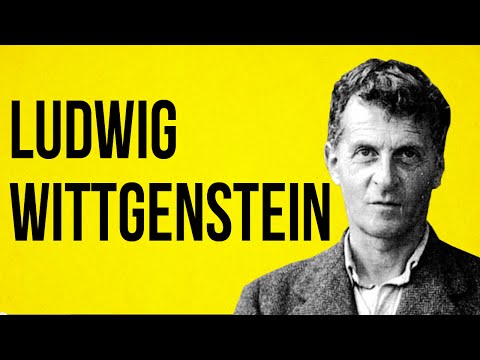
What this covers
This seven-minute School of Life video, inspired by an essay by David Edmonds, is a compressed biography and a tour of two books. It opens with Ludwig Wittgenstein: born in Vienna in 1889, the youngest child of a wealthy, domineering steel magnate, and marked by the suicides of three of his four brothers and by his own suicidal thoughts. The narrator then follows his career in two phases. The early Tractatus Logico-Philosophicus, published in 1921, asks how people manage to communicate ideas at all. The later Philosophical Investigations, which appeared after his death, revises the answer. The narrator ties both to his image of fly bottle, in which philosophy shows the fly the way out of the muddles language creates.
The first half covers the Picture Theory of Language. The video says it came to Wittgenstein from a newspaper report of a Paris court reconstructing an accident with model cars and pedestrians. On this view, a sentence such as "The palm tree is by the shore" sketches a scene in the listener's mind. The video uses that account to explain why communication fails: we form unclear pictures of our own meaning, others form the wrong picture, and sometimes listeners read in more than was meant, as in the example of a partner suspecting infidelity from a remark about a hotel conversation. It also reads the famous dictum Wovon man nicht sprechen kann, darüber muss man schweigen as a plea for more careful speech.
The second half turns to Wittgenstein's return to Cambridge in 1929 and his later view of language as a tool used in "games," which here means patterns of intention. The examples are a parent comforting a frightened child and a partner who says "you never help me" while really asking for reassurance. The video then makes a contrasting point about self-knowledge. Words like "angst," which it credits to Søren Kierkegaard, along with nostalgia and melancholy, are public tools that let us name private moods, so a richer vocabulary means a better understanding of ourselves.
Ludwig Wittgenstein's philosophy demonstrates that most communication failures stem from misunderstanding which 'language game' (pattern of intention) others are playing, and that language itself—as a public tool shaped by centuries of communal development—is essential to understanding both others and ourselves.
- Communication breaks down not from facts disagreeing but from speakers playing different language games (comfort vs. factual assertion)
- Language provides the vocabulary for self-knowledge: words like 'angst' allow us to name and share private experiences that would otherwise remain incommunicable
- Wittgenstein moved from viewing language as picture-making to viewing it as tool-use with context-dependent meaning
This asset isn't compiled yet
You're seeing its claims, ranked. Compile it to build the argument threads, weight them, and check each claim against your library — the full view.
Wittgenstein's second book, the Philosophical Investigations (published posthumously), develops the idea that language is like a kind of tool that we use to play different games, which doesn't literally mean games but rather patterns of intentions.
“And so he began to write a second book published posthumously, and that we know know as Philosophical Investigations. Instead of thinking that language is only just about pictures, he developed the idea that language is like a kind of tool that we use to play different games, which doesn't literally mean games, more patterns of intentions.”
Problems of communication typically originate because we don't have a clear and accurate picture of what we mean in our own heads, causing us to say meaningless, modeled, or unelaborated things that cannot go anywhere in the minds of others.
“Problems of communication typically start because we don't have a clear and accurate enough picture of what we mean in our own heads. We say quite meaningless or modeled or unelaborated things which therefore can go nowhere in the minds of others.”
Working out which language game someone is engaged in is key to good communication, according to Wittgenstein.
“Working out the game in question, is, Wittgenstein realized, key to good communication.”
Wittgenstein's point is that all kinds of misunderstandings arise when we don't see which kind of language game someone is involved in, as when a partner says 'You never help me, you're so unreliable' but is playing the Help and Reassurance Game rather than the Stating the Facts Game.
“Wittgenstein's point is that all kinds of misunderstandings arise when we don't see which kind of game someone is involved in. If one's partner says: 'You never help me. You're so unreliable.' The natural inclination might be to hear this as a part of a Stating the Facts Game; like saying: The battle of Waterloo was in 1815. So one might respond by citing facts about how actually you got the car insurance yesterday, and you bought some vegetables at lunch time, too. But actually, this person is involved in a different language game. They're using words not to capture facts. They're playing The Help and Reassurance Game. So in the language game, they're involved in, 'You never help' means 'I want you to be more nurturing.'”
When a parent says to a frightened child 'Don't worry, everything's gonna be fine,' the parent cannot know it really will be fine; they are not playing the Rational Prediction From Available Facts Game, but rather the Words as an Instrument of Comfort and Security Game.
“So if a parent says to a frightened child: 'Don't worry - everything's gonna to be fine', they can't know it really will be fine. They aren't playing the Rational Prediction From Available Facts Game. They're playing another game: The Words as an Instrument of Comfort and Security Game”
Wittgenstein developed his picture theory of language while reading a newspaper article about a Paris court case where the court reproduced an accident visually using model cars and pedestrians in order to communicate the accident's details more effectively.
“Wittgenstein thought of this while reading a newspaper article about a Paris court case in which, in order to explain with greater efficacy, the details of an accident that had taken place a road junction, the court had arranged for the accident to be reproduced visually using model cars and pedestrians.”
Wittgenstein's revolutionary answer to how communication works is that language operates by triggering within us pictures of how things are in the world.
“And his answer, which felt revolutionary, is that language works by triggering within us pictures of how things are in the world.”
Wittgenstein published the Tractatus Logico-Philosophicus in 1921, a short, beautiful, and baffling work that asks the fundamental question: How do human beings manage to communicate ideas to one another?
“Then he started writing a book published in 1921 called Tractatus Logico-Philosophicus. It was a short, beautiful and baffling work. The big question that Wittgenstein asks in it is: How do human beings manage to communicate ideas to one another?”
We are constantly swapping pictures between ourselves through language, but we are generally very bad at managing to make good pictures in the minds of others.
“We're constantly swapping pictures between us. But the Paris court needed to resort to an actual model for a very important reason. Because on the whole, we're very bad at managing to make good pictures in the minds of others.”
Communication typically goes wrong because other people form the wrong picture of what we mean, and it can take a long time for two people to realize they have divergences over quite basic things.
“Communication typically goes wrong because other people have, as we put it, the wrong picture of what we're meaning. It can take an age for two people to realize divergences over quite basic things.”
A second danger in communication is that we read more meaning into the words of others than they ever intended or than is warranted, as exemplified by a partner misinterpreting an innocent mention of conversation with an interesting person at a hotel reception as suggesting infidelity.
“There's another danger: That we read more meaning into the words of others than they ever intended or than is warranted. You tell your partner you had a conversation with an interesting person at the hotel reception. The picture in your mind is an innocent one. But your partner swiftly forms a very different impression.”
Wittgenstein said that the task of philosophy is to show the fly the way out of the fly bottle, with the particular fly bottle he was interested in being language.
“The task of philosophy, said Wittgenstein, is to show the fly the way out of the fly bottle. The particular fly bottle, he was interested in, was language.”
Wittgenstein's Tractatus is a plea by a taciturn, silent, and precise Austrian philosopher to speak more carefully and less impulsively, encapsulated in his famous dictum in German: 'Wovon man nicht sprechen kann, darüber muss man schweigen' (Whereof one cannot speak, thereof one must be silent).
“The Tractatus is a plea by a very taciturn, silent and precise Austrian philosopher to speak more carefully and less impulsively. As he famously put it: 'Wovon man nicht sprechen kann, darüber muss man schweigen.'”
Words like angst, nostalgia, melancholy, ambivalent, and many others help us to name elusive areas of our own experience, demonstrating that language is a public tool for the understanding of private life.
“Words like angst or also nostalgia, melancholy or ambivalent and many others help us to name elusive areas of our own experience. Language is a public tool for the understanding of private life.”
In the Philosophical Investigations, Wittgenstein wanted to draw attention to how much of our self-understanding depends on the words of others, on languages that have developed publicly and communally over many centuries long before we are born.
“In the Philosophical Investigations Wittgenstein also wanted to draw attention to how much of our self-understanding depends on the words of others, on languages that have developed publicly and communally over many centuries long before we're born.”
On a Sunday afternoon, one might fall prey to a worried, confused mood about the week ahead and everything one has to do, and one's ability to know this private side of oneself and help others know oneself is hugely enhanced by having to hand a word that's been around a while: 'Angst,' a word helpfully formulated by the philosopher Kierkegaard in 19th century Copenhagen.
“For example, on Sunday afternoon I might fall prey to a worried, confused mood as I think about the week ahead and everything I've got to do. My ability to know this very private side of myself and to help others know me will be hugely enhanced if I have to hand a word that's been around a while: Angst. A word which was helpfully formulated by the philosopher Kierkegaard in 19th century, Copenhagen.”
According to Wittgenstein's picture theory, words enable us to make pictures of facts such that saying 'The palm tree is by the shore' paints a rapid sketch that allows another person to see the situation in their mind and understand it.
“In Wittgenstein's view words enables us to make pictures of facts. To say: The palm tree is by the shore, paints a rapid sketch that like the model lets another person see the situation in their mind and understand.”
Much unhappiness in the world originates from our inability to communicate what we mean clearly enough to other people.
“A lot of unhappiness comes about in this world because we can't let other people know what we mean clearly enough.”
The richness of the language we are exposed to is really important to our self-knowledge, with reading many books providing tools with which to help us know who we are.
“The richness of the language we're exposed to is therefore really important to our self-knowledge. Reading many books gives us tools with which to help to know who we are.”
Though a lot of Wittgenstein's philosophy is deeply complicated, it is underpinned by a desire always to be helpful.
“Though a lot of Wittgenstein's philosophy is deeply complicated, it's underpinned by a desire always to be helpful.”
Wittgenstein was initially interested in engineering, and after studying at Cambridge, when his father died and he inherited substantial money, he gave it all away mainly to his already-rich relatives and went to live in spartan solitude in Norway.
“When he was young, he was interested in engineering. After studying at Cambridge, his father died and he inherited a lot of money. He gave it all away, mainly to his already very rich relatives and went to live in spartan solitude in Norway.”
Ludwig Wittgenstein was born in Vienna in 1889 as the youngest child of a wealthy, highly cultured but domineering steel magnate.
“Ludwig Wittgenstein was born Vienna in 1889. The youngest child of a wealthy, highly cultured but domineering steel magnate.”
Three of Ludwig Wittgenstein's four brothers took their own lives, and Ludwig himself was frequently troubled by suicidal thoughts.
“Three of Ludwig's four brothers took their own lives, and Ludwig himself was frequently troubled by suicidal thoughts.”
Upon publishing the Tractatus, Wittgenstein believed somewhat grandly that it was the last work of philosophy that would ever need to be written.
“When he published it, Wittgenstein thought somewhat grandly that the Tractatus was the last work of philosophy that would ever need to be written.”
In 1929, Wittgenstein suddenly returned to Cambridge and to philosophy because he realized he had some new things to say about language and communication.
“Then, in 1929 Wittgenstein suddenly returned to Cambridge and to philosophy because he realized he had some new things to say about language and communication.”
Before his death from cancer in 1951, Wittgenstein managed to let out for us a lot of word flies in ways useful to all.
“And before his death from cancer in 1951, he managed to let out for us a lot of word flies usefully for us all.”
After publishing the Tractatus, Wittgenstein turned to architecture and spent a couple of years designing a house for his sister in Vienna, obsessing over precise details like door handles, radiators, and eventually becoming convinced a room's ceiling was too low, insisting it be raised by three centimeters at immense inconvenience.
“So he looked around for how to fill the rest of his life. He turned to architecture and spent a couple of years designing a house for his sister in Vienna. He spent ages getting the door handles and radiotors right. Very late on in the project, he got increasingly bothered about the ceiling in one of the rooms and came to the conclusion that is was too low. At immense inconvenience to everyone, he insisted on having it raised by three centimeters.”