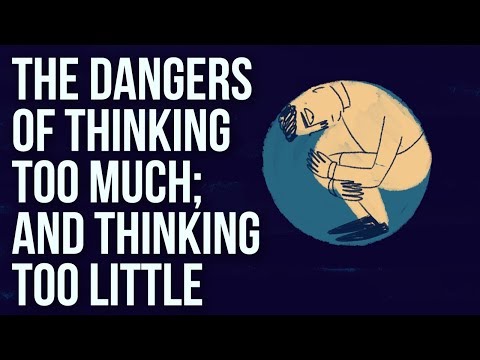
The Dangers of Thinking Too Much; And Thinking Too Little
What this covers
This six-minute School of Life film, delivered by a single unnamed narrator, starts from the claim that thinking about our own feelings, past, desires and hopes is something most of us work hard to avoid. The reason is what we might find. The narrator lists several possibilities: buried fury at people we are supposed to love, guilt over accumulated errors, fantasies that run in "appallingly deviant" directions, and the recognition that our relationships and careers are badly compromised. We are not only holding a lot back, the narrator says, but are "liars of genius", practised at self-deception through techniques we cannot see.
The middle of the film sorts those techniques into two. The first is thinking too much. Expertise on obscure subjects, such as government bonds in the Napoleonic Wars, Chaucer's influence on nineteenth-century Japanese novels, or Epictetus, announces our intelligence while leaving no room for the childhood confusion our personalities grew from. The glamour of being learned protects us from learning anything that hurts. The second is thinking too little). Here brisk common sense, ridicule and the claim that psychology is fuss about nothing keep us from admitting our complexity. The narrator contrasts the practical mood of Monday at nine with the 3 a.m. questioning of the night before, and suggests that radical disquiet may be a central source of insight and not an aberration. Serious intimate inquiry is made to look feeble beside conferences on political strategy or exotic animals.
The final stretch deals with cost. The narrator says neglected inner life shows up as insomnia, impotence, stuttering or depression, described as revenge for thoughts we were careful not to have. That is the most contested claim here. Other people also put up with our irritability, gloom or forced cheer. The case for emotional honesty is framed as cautionary and self-interested, not high-minded: we pay too much for our lies.
Self-deception through avoidance of painful self-knowledge is a fundamental human condition that damages psychological well-being, relationships, and personal growth; emotional honesty is essential not for morality but for sanity and inner comfort.
- We actively avoid self-discovery because it threatens to reveal uncomfortable truths about our feelings, desires, and past behaviors
- We deploy two primary defense mechanisms: thinking too much (filling minds with prestigious ideas to avoid emotional truths) and thinking too little (denying complexity through false common sense)
- Self-deception carries high psychological costs including stunted growth, mental health issues, and damaged relationships; self-knowledge is a precondition for sanity, not a luxury
This asset isn't compiled yet
You're seeing its claims, ranked. Compile it to build the argument threads, weight them, and check each claim against your library — the full view.
Thinking about ourselves, our feelings, our past, our desires and our hopes is a hugely tricky task that most of us spend a good deal of effort trying very hard to avoid because we keep away from ourselves due to the painful things we could discover.
“thinking about ourselves our feelings our past our desires in our hopes is a hugely tricky task that most of us spend a good deal of effort trying very hard to avoid we keep away from ourselves because so much of what we could discover threatens to be painful”
We don't only have a lot to hide; we are liars of genius—meaning we are exceptionally skilled at self-deception through invisible and sophisticated techniques.
“we don't only have a lot to hide we are a liars of genius it is part of the human tragedy that we are such natural self deceivers our techniques are multiple and close to invisible to our worth focusing on”
We might discover that we were deeply furious with and resentful about certain people we were only meant to love, revealing hidden anger beneath supposed affection.
“we might find that we were in the background deeply furious with and resentful about certain people we were only meant to love”
Self-deception is not merely a character flaw but carries a high psychological price: it cuts us off from possibilities of growth, shuts off large portions of our minds, and leaves us creative tension and defensive.
“through our self deceptions we cut ourselves off from possibilities of growth we shut off large portions of our minds and end up on creative tension and defensive”
We harbor fantasies and desires that go in appallingly deviant and errant directions, which contradicts our desired self-image as decent, law-abiding people.
“we wanted to be decent law-abiding people we harbored fantasies that went in appalling ly deviant and of errant directions”
Self-knowledge is not a luxury but a precondition for a measure of sanity and inner comfort.
“self-knowledge isn't a luxury so much as a precondition for a measure of sanity and inner comfort”
Our self-deception and neglect of the awkward sides of ourselves causes those around us to suffer our irritability, gloom, manufactured cheerfulness, or defensive rationalizations.
“while others around us have to suffer our irritability gloom manufactured cheerfulness or defensive rationalizations”
We might discover how much ground there was to feel inadequate and guilty on account of the many errors and misjudgments we've made, revealing our failures and incompetence.
“we might discover how much ground there was to feel inadequate and guilty on account of the many errors and misjudgments we've made”
The neglect of the awkward sides of ourselves 'buckles our very being,' emerging as physical and psychological symptoms like insomnia, impotence, stuttering, or depression—which are revenge for thoughts we've been careful not to have.
“our neglect of the awkward sides of ourselves buckles our very being emerging as insomnia or impotence stuttering or depression revenge for all the thoughts we've been so careful not to have”
We recognize how much was nauseatingly compromised and needed to be changed about our relationships and our careers, implying widespread dissatisfaction we suppress.
“we might recognize how much was nauseatingly compromised and needed to be changed about our relationships and our careers”
When we think too much, we fill our minds with impressive ideas that announce our intelligence to the world but subtly ensure we won't have room left to rediscover long-distant feelings of ignorance or confusion upon which the development of our personalities rests.
“when we think too much in essence we're filling our minds with impressive ideas which blatantly announce our intelligence to the world but subtly ensure we won't have much room left to rediscover long distant feelings of ignorance or confusion upon which the development of our personalities may nevertheless rest”
There is a second habit of thinking too little, where we pretend that we are simpler than we actually are and claim that psychology might be nonsense and fuss about nothing, using robust common sense as defense against acknowledging our awkward complexity.
“then there is our habit of thinking too little here we pretend that we are simpler than we actually are and that too much psychology might be nonsense and fuss about nothing we lean on a version of robust common sense to ward off intimations of our own awkward complexity”
We use the practical mood of Monday morning 9:00 a.m. to ward off complex insights that emerged at 3:00 a.m. the previous night when the entire fabric of our existence came into question under the backdrop of a million stars.
“we use the practical mood of Monday morning 9:00 a.m. to ward off complex insights of 3:00 a.m. the previous night when the entire fabric of our existence came into question against the backdrop of a million stars spread like diamonds on a mantle of black velvet”
We deploy an attitude of vigorous common sense to make our moments of radical disquiet and existential questioning seem like aberrations rather than the central occasions of insight they might actually be.
“deploying an attitude of vigorous common sense we strive to make our moments of radical disquiet seem like aberrations rather than the central occasions of insight they might actually be”
Dense intellectual accomplishments on arcane subjects (government bonds in the Napoleonic Wars, Chaucer's influence on 19th century Japanese novels, expertise on epictetus or the founder of Zen Buddhism) can serve as barriers preventing us from remembering painful emotional memories from childhood.
“we perhaps right dense books on the role of government bonds in the Napoleonic Wars or publish extensively on Chaucer's influence on the mid 19th century Japanese novel we secure degrees from Institutes of Advanced Study or positions on editorial boards of scientific journals our minds are crammed with arcane data we can wittily inform a dining table of guests who wrote the entirety on epictetus or the life and times of dogging the founder of Zen Buddhism but we don't remember very much at all about how life was long ago back in the old house when father left the mother stopped smiling and our trust broke in pieces”
The possibility of deeply consequential intimate inquiry into oneself is deliberately made to seem feeble and superfluous compared to supposedly grander tasks like giving academic conferences on political strategies or the lifecycle of exotic animals.
“the possibility of a deeply consequential intimate inquiry is deliberately left to seem feeble and superfluous next to the supposedly grander task of addressing a conference on political strategies of Dona Maria the first or the lifecycle of the Indonesian octopus”
We lean on the glamour of being learned to make sure we won't need to learn too much that hurts—using intellectual status as protection against emotional growth.
“we lean on the glamour of being learn it to make sure we won't need to learn too much that hurts”
We appeal to the understandable longing for our personalities to be non-tragic, simple, and easily comprehended to reject the stranger but more useful facts of our real, intricate selves.
“we appeal to the understandable longing that our personalities be non tragic simple and easily comprehended so as to reject the stranger but more useful facts of our real intricate selves”
A defense of emotional honesty is not about high-minded morality but is ultimately cautionary and egoistic—we need to tell ourselves more of the true because we pay too high a price for our lies.
“a defense of emotional honesty has nothing to do with high-minded morality it's ultimately cautionary and egoistic we need to tell ourselves a little bit more of the true because we pay too high a price for our lies”
We deploy knowledge and ideas that carry enormous prestige to stand guard against the emergence of more humble but essential knowledge from our emotional past, burying personal stories beneath an avalanche of expertise.
“we deploy knowledge and ideas that carry enormous prestige to stand guard against the emergence of more humble but essential knowledge from our emotional past we bury our personal stories beneath an avalanche of expertise”
We sideline avenues of personal psychological investigation as unduly fancy or weird, implying that lifting the lid on inner life could never be fruitful or respectable.
“we sideline avenues of personal investigation as unduly fancy or weird implying that to lift the lid on inner life could never be fruitful or entirely respectable”
We imply that not thinking very much is at base evidence of a superior kind of intelligence, and we deploy ridicule against more complicated accounts of human nature to dismiss psychological inquiry.
“we imply that not thinking very much is at base evidence of a superior kind of intelligence in company we deploy Bluff strategies of ridicule against more complicated accounts of human nature”