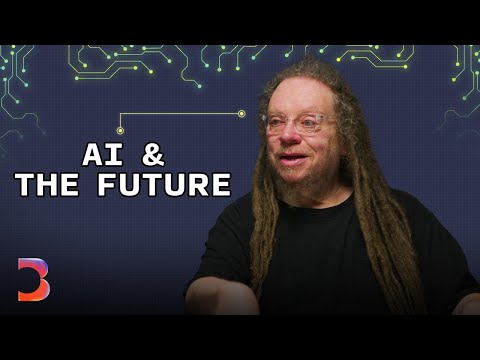
Jaron Lanier Looks into AI's Future | AI IRL
What this covers
This is a 24-minute Bloomberg interview in which a host questions Jaron Lanier, an early Silicon Valley figure who now works inside Microsoft while disagreeing with much of the industry's thinking. Lanier uses the social media era as his main comparison. He notes that algorithmic feeds were already "halfway to big models," that they failed society, and that many of the companies now deploying large language models are the ones that made those mistakes. He also explains why the models work: words are more ambiguous than people assume, and the models run on statistical distributions rather than definitions. Their apparent magic comes from combining recognizers, such as a cat and a hot air balloon, using human-made training data.
The middle of the conversation is about business models and regulation. Lanier says a market economy offers only two arrangements: the user pays, or the user is the product. He argues that companies dependent on the advertising business model, such as Google and Meta, are pushed toward manipulation, and he calls paying for good AI a "freedom fee." He also takes on tech's libertarian reflex against regulation, saying markets need stable rules. He adds that executives have browbeaten lawmakers into timidity.
The most distinctive proposals concern accountability. Lanier rejects AI governing AI, saying it leads to infinite regress because terms like "alignment" are too ambiguous to enforce. His alternative is data provenance, which traces an output back to the dozen or so training examples that mattered most. He presents it as the route to fighting deepfakes, exposing bias, and paying data creators, an idea he calls data dignity. The contested claims include his assertion that open-source release tends mathematically toward monopoly, and his disagreement with Sam Altman's iris-scan coin as compensation for displaced workers. He also recalls opposing the mainstream AI tradition while working under Marvin Minsky, and he expects AI to disrupt democracy and elections.
Lanier argues that AI's societal impact depends critically on transparency (data provenance), ethical business models (subscription over advertising), and regulatory frameworks—and that the tech industry must move away from surveillance capitalism and embrace accountability or risk repeating social media's failures at catastrophic scale.
- Current free-tier AI models funded by advertising create manipulation incentives identical to social media, enabling disinformation at scale
- Provenance tracking (identifying which human sources contributed to AI outputs) is the technical solution to deepfakes, bias, and accountability—but requires societal commitment to implement
- Open-source AI release mathematically tends toward monopoly (network effects) rather than decentralization, making proprietary secrecy worse, not better
This asset isn't compiled yet
You're seeing its claims, ranked. Compile it to build the argument threads, weight them, and check each claim against your library — the full view.
Words are more ambiguous than people assume in ordinary life, which is why large language models work well—they operate on statistical distributions rather than precise definitions.
“words are actually more ambiguous than we think they are we go through life thinking words are precise but they're not which is actually the reason why large models work because they they're a statistical thing in the first place so they work very well with our statistical calculations”
Privacy is not yet well-defined in the context of the internet, despite decades of effort—Lanier helped develop privacy frameworks that became European GDPR, but remains uncertain about what privacy actually means in digital contexts.
“I worked on privacy for a long time I helped start the thing that turned into the Privacy framework in in Europe and um the gdpr and I got to say I'm still not sure we know what privacy is in the context of the Internet it's a very tricky concept”
Open-source code release mathematically tends toward monopoly through network effects, not decentralization—the belief that open-source leads to decentralization is widespread, feels good, but is mathematically false and empirically contradicted by examples.
“the exchange of all that free stuff is going to tend towards Monopoly because of mathematics and so then it'll become the greater glory of something like a Google or whatever it is and so you end up with instead of decentralization you end up with Hyper centralization”
Lanier disagrees with Sam Altman's proposal to use a universal iris-scan-based cryptocurrency coin as compensation once AI displaces jobs, believing criminal organizations will exploit the system regardless of robustness—pointing to crypto's mathematical perfection being undermined by fraud at scale.
“Sam wants to do this thing of a universal I scan based uh cryptocurrency coin yeah to reward people once AI does all the jobs obviously that's not within my my frame of recommendation I I don't think that's a good idea I think that some criminal organization will take that over no matter how robust he tries to make it like look at crypto crypto is mathematically perfect and then at the edge it's all criminals and fraud and incompetence”
Large language models' ability to combine recognizers (e.g., cat + hot air balloon recognizers) to generate coherent novel outputs is the 'magic' of current AI—it relies on statistical combination of human training data.
“you can have a recognizer for cats and a recognizer for hot air balloons and say put a cat in a hot air balloon and in order to meet both recognizers it'll randomly get this thing that does both and all of a sudden you have a cat and a hot air balloon it's fantastic”
Social media's AI-driven algorithmic systems failed society in practice despite being conceptually 'halfway to big models'—major AI companies deploying current large models are often the same organizations that made social media mistakes, so the question is what they have learned.
“social media is a giant one but that precedes the big models I mean it is an AI you can think of social media as being halfway to Big models in that AI I don't like the term but the its algorithms direct people around social media so you can think of it as an aid driven thing and that did not work out well for Society on the whole”
In a market economy, there are only two customer models for digital services: either the user is the customer and pays, or the user is the product and an advertiser/manipulator is the customer—there is no third option.
“there has to be a customer so either the customer is you or it's somebody who wants to manipulate you those are the choices”
Large language models and AI technology will likely disrupt democracy and elections, a concern Lanier articulated starting in the 1990s under the older terminology of 'agents' rather than chatbots.
“back in the 90s you talked about how chatbots at some point could impact democracy and elections and like that was probably like 30 odd years ago and the good days I was writing about this much earlier no in those days instead of chat Bots we called them agents which is sounds scarier”
Current business model inertia—habit, momentum, and transition costs—keeps advertising-dependent companies in place rather than structural necessity, creating a 'stupid' but path-dependent equilibrium.
“so why are we doing it it works kind of but not maximally in my view so like why are we doing it and it's just habit it's momentum it's the hassle of changing but we gota”
A libertarian streak in tech culture creates reflexive skepticism of all regulation, but this is intellectually inconsistent because markets require stable regulatory foundations to function effectively.
“there's a kind of a Libertarian streak in Tech culture too that all regulation must be suspect but it's just clearly not like regulation is that layer upon which we can do free enterprise without that we don't have the order within which we can function otherwise it's just a kind of uh of survival of the fittest which does not lead I mean it leads to Natural Evolution but very slowly”
Markets are faster and more creative than unregulated natural competition, creating a quantitative difference in innovation speed—this is why market economies with regulatory layers outperform unregulated alternatives.
“like the thing Matt you know markets are fast and creative and you don't get that without a stable layer created by regulation”
Perfect agreement with an organization of Microsoft's scale is impossible and unnecessary—disagreement coexists with effective contribution, and demanding perfection before commitment is dysfunctional.
“do I agree with absolutely everything that happens in Microsoft of course not I mean listen it's a big thing it's like it's like it's as big as a country you know and so of course there's all kinds of things and so I don't think being some like sort of pure perfectionist is very functional I don't think it helps anybody um although here in the Bay Area there are many people who attempt to be that way”
Tech companies dependent on advertising models (Google, Meta) are structurally incentivized toward 'weird creepy Darkness'—companies not dependent on advertising (Apple, Microsoft, Amazon) can be held accountable without the same inherent conflict of interest, despite their smaller market caps.
“if you look at the business models of the tech Titans there's really two in the US that are that are true Titans that are dependent on the advertising business model and that would be and alphabeta Google the tech Titans that are not dependent on it we do some of it but they're not dependent on it would be companies like apple Microsoft Amazon you can complain about us you can complain about these other companies and I hope you do I think we we should be accountable so do it do it but but but they don't spew the same kind of weird creepy Darkness into the world”
Currently, the internet operates under the assumption that everything should be mysterious and we should not know the sources of information, which is a poor approach to thinking about AI.
“we're used to this idea that the internet should be mysterious we don't know where things came from but that's a really bad way of thinking about Ai”
AI outputs can be traced to the small number of most important training examples (typically a dozen) that contributed to that specific output, not the billions of total training examples.
“anytime you have an output from an AI of course in some small way it relies on millions or billions of examples from Humanity at large billions of photos billions of examples of text but in any particular example of an output it won't in a particular example there'll be just a few a small number maybe a dozen this my hand is doing this because this is a little hump of statistical yes it's a distribution”
AI-governing-AI governance models fail because language itself is fundamentally ambiguous—words can always be twisted, as illustrated by the ancient genie problem where wishes are always subverted by semantic twisting, and this problem is mathematically irreducible.
“if you say you want the AI to govern the AI and you have this one AI looking at the first Ai and saying don't be all weird stop that stop that stop that it gets hard and the reason it gets hard is because of the limitations of language itself”
Data provenance (tracking which human-generated sources contributed to specific AI outputs) is a technically feasible solution to AI accountability, deepfakes, and bias—it can identify problematic training sources and enable compensation for data creators while maintaining efficiency.
“anytime you have an output from an AI of course in some small way it relies on millions or billions of examples from Humanity at large billions of photos billions of examples of text but in any particular example of an output it won't in a particular example there'll be just a few a small number maybe a dozen”
Data dignity implementation will face resistance because some people prefer contributing data without compensation for ideological or non-economic reasons, requiring careful design of the compensation system.
“it has to be a societal decision to shift to doing that and then you know there's a lot of little psycho dramas where people will say well I don't know if I'd want to get paid I like just being out there or whatever I think there's a lot of room to adjust how how this will work in detail”
Regulation of AI should be based on data provenance rather than AI-governing-AI approaches, because the latter creates infinite regress and relies on undefined terms like 'alignment with human values' that are too ambiguous to enforce.
“if regulation means the genie approach where you say we're going to have AI judge whether the first AI was good or not it becomes an infinite regress if you say it's based on data Providence all of a sudden you have an action you're not you're not using terms you can't Define anymore like nobody knows everybody says AI has to be aligned with human interest but what does that mean it's a very squirly word”
Paying for high-quality AI (rather than using free ad-supported alternatives) is a 'freedom fee' that breaks the cycle of user manipulation and exploitation.
“that fee is your freedom fee it means that the the mechanism that's paying for it is not the manipulation of you”
Provenance (tracking the sources of data used in AI outputs) is the only effective way to combat fraud and deepfakes, as opposed to other regulatory or technical approaches.
“the answer to deep fakes is Providence like um what I was saying before if you know where data came from you no longer worry about deep fakes because you can say where did this come from and the Providence system has to be robust and not fak but it should say oh yeah well this is a combin ation this was somebody from Chinese uh military intelligence that combined this thing and that thing and that thing and like okay great yeah get rid of that you know like Providence is the only way to combat fraud”
Internal corporate speech and public dissent by employees would improve business performance at companies like Google and Meta by bringing external accountability and reducing institutional blind spots.
“I'd like to do is persuade my friends at some of the other tech companies at a little bit of speech in their in their situations might actually be healthy might be good for them I think it would really actually improve the business performance of companies like Google and meta”
AI is not fundamentally different from people working together through masks—the entire AI-as-artificial-entity framing is conceptually confused, and Lanier opposed the mainstream AI research tradition from the beginning despite working under Marvin Minsky, one of its architects.
“AI is just a way for people to work together it's just people and masks we're just confusing things why are we trying to build this you know entity this like artificial God or something”
Data dignity aims to create a 'creative class' of people who earn money by providing high-quality data for AI training, rather than displacing workers onto universal basic income.
“I don't want to create more people who are just dependent on state payout to survive I want to create more if you like creative classes of people who are really good at providing fresh data that makes the models work better so everybody benefits”
Tech industry leadership routinely browbeat lawmakers with claims that politicians are too ignorant to understand technology, which has had the effect of making regulatory bodies timid and deferential—this dynamic may actually harm tech companies by leaving insufficient guardrails.
“there was a thing that we in Tech culture did for too long where we'd go to Congress or a parliament somewhere else in a different country and we'd browbeat the people there we'd say oh you senator and congressmen or you know you don't understand Tech you're you're idiots we're the Smart Ones you can't say a thing you know and and there this always happened and it was like this constant like you wouldn't believe what an idiot that Senator was and um this went on for years and years and years and I think we browbeat them to the point where they became timid in a way that actually hurts us”
Lanier enjoys participating in market economies where customers pay directly for products, and sees this as preferable to surveillance or manipulation-based models.
“I like the idea of making something that somebody likes enough to pay you money for it that to me is the market economy I want to I like that economy I enjoy participating in it”
Compensation for data creators through provenance tracking should replace universal basic income models because UBI concentrates resources in a single state payer, which historically tends toward authoritarianism—starting with Bolshevik ideals and ending in Stalinism as 'the worst people want to control that Central thing.'
“instead of saying oh we're just going to displace all these workers and they're going to have to go on universal basic income setting a trajectory for I think a bad outcome because whenever you have everything concentrated in some Single Payer Society it becomes a temp you start with Bolshevik you end up with stalinists because the worst people want to control that Central thing”
Current lack of data provenance tracking is a societal choice, not a technical limitation—the infrastructure to calculate and present provenance efficiently and effectively exists, but implementation requires collective commitment to shift practices.
“it doesn't right now I mean in order to do it we have to calculate and present the Providence of which human sources were the most important to a given AI output and we don't currently do that we can though we can do it efficiently and effectively it's just that we're not yet it it has to be a societal decision to shift to doing that”
Google and Meta are structurally undervalued because their advertising business model is suboptimal—they could be more successful by switching to subscription models, and authoritarian platforms like TikTok are already outcompeting them by adopting different incentive structures.
“meta and Google are undervalued because they have the wrong business model like they do a lot they should actually be more successful like I I I believe this is a stupid business model and an an author authoritarian run platform is going to overtake us which is exactly what's happening with Tik Tok so why are we doing it it works kind of but not maximally in my view”
Lanier has created an 'existence proof' that employees can speak publicly without corporate censorship at Microsoft while maintaining strong business performance—demonstrating that internal free speech can coexist with profitability and stock value.
“I've tried to create an existence proof of that where I can say things that are not official Microsoft I'm still look I spend all day working on making Microsoft stuff better and I really am proud that people want to buy our stuff and want to buy our stock I like it I like our customers I like working with them”
True optimism requires fierce, courageous criticism—acquiescence and acceptance of the status quo represent not pragmatism but abdication of responsibility to improve systems.
“to be an optimist you have to have the courage to be a fearsome critic it's the critic who believes things can be better the critic is the true optimist even if they don't like to admit it even if they don't want to feel soft and Squishy the critic is the one who says this can be better and that means optimism it's the acquiescence it's like no this is it those people are kind of useless”
Regulators should proactively request that tech companies like Microsoft, OpenAI, and others come before them and propose regulatory frameworks, rather than waiting for crises.
“I actually think what should happen is Regulators should be involved so all of us Microsoft open AI everybody goes in front of of regulators all over the world says regulate us this is important so the question is how”
Lanier has not identified a clear line in the sand for leaving Microsoft because circumstances and trade-offs are context-dependent.
“what would make you walk away I don't know I mean of course you can always come up with some scenario I don't know what it would be but do you have kind of like a a a Line in the Sand I you know this is like I don't it would have to be very much based on the circumstances of the moment and the trade-offs I don't think you can really draw a line in something like this it and it's very personal”
Lanier observes that perfectionism is common among Bay Area technology workers but is functionally ineffective for generating positive outcomes.
“although here in the Bay Area there are many people who attempt to be that way and whatever but I I I really I I think you have to just always try to find the balance and it's never perfect”
Tech culture has matured since social media's integration into politics, with engineers showing increased awareness of potential harms, though this is partially negated by reduced controls/corrections in large tech companies.
“the last round of social media getting into politics left a lot of people with um various forms of fear and concern that have actually had the result of reducing certain levels of controls and and Corrections within the big tech companies so in a sense we might be worse off but in another sense I feel the um Tech culture or just the collective sensibility of the engineers who actually do everything has matured a lot”
Lanier takes responsibility for helping create the first deepfake technology in the 1990s through a Machine Vision startup, which was later used in the film 'Minority Report' to block scenes with minority actors.
“can I mention a small May culpa on that way back in the 90s some friends and I had a little Machine Vision startup company and I think we made the first deep fakes of tra so you're to blame I'm absolutely to blame yeah and I actually um we use the very first deep fake uh system to block scenes of minority reporting with the Guinness yeah year I actually brought that into the script”
Lanier believes it is premature to assess whether AI leaders have learned from past mistakes because major AI-driven harms have not yet manifested at large scale.
“I hope so I mean we haven't really had mistakes to learn from yet I mean what about social media well so no social media is a giant one but that precedes the big models”
Jaron Lanier was a pioneer of virtual reality in the 1980s and sold multiple companies to Google, Adobe, and Oracle before joining Microsoft.
“jiren laner is among the OG Silicon Valley utopians who had Grand visions of what the internet could be long before we had PCS cell phones or social media he was the pioneer of virtual reality in the '80s sold multiple companies to Google Adobe and Oracle and now works of Microsoft”
Lanier has been consistently critical of social media and its implementation, and remains critical of how digital technologies have been deployed.
“I have been very critical of the way we did social media I have been very critical of a lot of things I remain so”
Social media did not work out well for society overall, though it worked well for some people—it's a complicated story with mixed outcomes.
“did not work out well for Society on the whole it works out really well for for some people and some you know like it's a very complicated story”
Current AI industry leadership across major companies now wants regulation, representing a shift in the tech industry's historical opposition to oversight—this suggests genuine concern about systemic risk.
“and now everybody in AI of of any scale is going and saying actually we kind of do want to be regulated this is a place where regulation makes sense”
The line between 'cozy' government-tech relationships and genuine regulatory partnership is ambiguous—recent AI hearings feel cozy at times but not entirely, suggesting the dynamic is evolving and complex.
“I mean that panel that hearing with Sam Alman and and and people at the it was a c hearing wasn't it you know I mean it it felt cozy at times but not all the time”
Despite disagreement on specific proposals, Lanier and Altman have more agreement than outsiders might expect—close working relationships can contain substantive disagreement while maintaining collaboration.
“I I won't speak for Sam certainly you know um I am very comfortable with working with people with whom I don't have total agreement but you know we have more agreement than you might think”
Lanier knows most major AI leaders personally and believes the tech industry is in a 'pretty lucky place' regarding trustworthiness of those leading major AI models.
“well I know most of them and um perhaps I that might bias me but I think we're in a pretty lucky place on that”