The Worst Economic Collapse In History Is Starting Now: Be Prepared
What this covers
This is a single-narrator YouTube video from March 2020, recorded as markets fell and the COVID-19 shutdowns spread. It opens by comparing the 2008 crash, which unfolded over 517 days, with a roughly 20% drop in 21 days. The argument is built as a chain of causes. China's manufacturing shutdown delays a large share of global production, and the car industry is the worked example, with tool, die and machinery delays and sales down as much as 80% in some countries. Falling revenue passes down through suppliers and raw-material industries, then turns into layoffs, bankruptcies and a higher unemployment rate. The speaker also cites a lag of 2 to 24 months between a sales slowdown and the worst of the damage, using the Great Recession's 15 months as the example.
The middle of the video surveys the sectors hit at once. Airlines and cruise lines are close to the edge: WestJet is expected to lay off 20–50% of its flight attendants and American Airlines is cutting international flights by 75%. Restaurant bookings are reported down 30–65% in some cities. Sports leagues, concerts and conferences have shut down, and the speaker stresses the arena workers and small hourly employees who get less attention than players and owners. Nike and Apple can keep paying staff through closures, but small restaurants may not survive.
The video then turns to policy. It covers the Federal Reserve's emergency interest rate cuts to near zero, the $1.5 trillion lent through the repo market, small-business loans and airline bailouts. The speaker treats the airline bailouts as a rare justified case, since the damage comes from travel restrictions and not from industry incompetence. The comparison is the contentious part. The speaker says 2008 was a failure of the financial system and 2001 is the closer analogue, but argues this recession will be worse because consumer debt is high and volatility is at pre-2008 levels.
The 2020 economic collapse, triggered by COVID-19 supply chain disruptions and business shutdowns, will likely cause a severe recession worse than 2001 despite government intervention measures, because the fundamental slowdown in economic activity cannot be prevented until normal life resumes.
- Supply chain disruptions from Chinese manufacturing shutdown cascade through all industries, causing layoffs and debt defaults
- Multiple industries (airlines, restaurants, retail) are simultaneously experiencing catastrophic revenue declines with 2-24 month lag before worst effects
- Government measures (interest rate cuts to 0%, $1.5T repo lending, business loans) can only mitigate short-term consequences, not prevent the fundamental economic slowdown
This asset isn't compiled yet
You're seeing its claims, ranked. Compile it to build the argument threads, weight them, and check each claim against your library — the full view.
When companies see drops in sales and revenue, suppliers also see drops in revenue, which cascades to raw material industries, creating a ripple effect where effects radiate to all companies connected to the affected industry.
“This effect trickles down. You see, if car companies are seeing a drop in sales and revenue, then so will its suppliers. And if the suppliers see a drop in revenue, then so will the raw industries that work with the suppliers. And this effect radiates to all other companies that are connected to the automotive industry.”
When companies experience drops in sales or revenue, layoffs and bankruptcies typically follow, which increase unemployment, reduce consumer purchases, decrease business sales, and create a self-reinforcing cycle until the economy hits a low point like the Great Recession or Great Depression.
“What else happens when a company sees a drop in sales or revenue? Well, we tend to see things like layoffs or even bankruptcies. And those things lead to a higher unemployment rate, which would lead to less purchases being made by consumers, which would lead to less sales being made by businesses. And this cycle continues until the economy hits a low point like the Great Recession or the Great Depression.”
China is the global supply chain of the world; when China experiences delays in production, the entire world's economy experiences delays as well because roughly 1/3 of all products are made in China.
“Now, that wouldn't be a problem if 1/3 of all products weren't made in China. You see, China is the global supply chain of the world, so when China experiences delays in production, the entire world's economy experiences delays as well.”
The Federal Reserve is lending 1.5 trillion dollars to Wall Street and big banks through the repo market to help banks get through economic downturns when treasuries are less liquid; this injection can stabilize markets but its failure would cause a giant collapse like 2008.
“Another tactic, for whatever reason that no one has mentioned so far, is the Federal Reserve is lending at 1.5 trillion dollars. Yes, that was a trillion with a T. They're lending this money up to Wall Street and the big banks. Now, there is a complex reasoning behind this called the repo market, and that would take an entire video to explain properly, but here's a quick overview. The United States banks have taken out 1.5 trillion dollars worth of loans in order to help get them through tough economic times where treasuries are less liquid. It's essentially a loan to help stabilize the market. Now, if the market does stabilize with this injection, that's a good thing, so the banks and market might not collapse. But, if the market does not stabilize with this injection, all of a sudden, you will see a giant collapse on Wall Street, which was what happened in 2008.”
The Federal Reserve initially did an emergency rate cut to 1.25%, but within minutes of recording, did another emergency cut to essentially 0%, matching the deepest parts of 2008 recession and using the Fed's 'last bullet in the chamber' that they wanted to preserve for worse economic scenarios.
“Now initially when I recorded this video, I talked about how the Federal Reserve just did an emergency rate cut down to 1.25%. But in the last few minutes, they just did another emergency rate cut down to essentially 0%. That is something that you only saw during the deepest parts of the 2008 recession. And so when I initially recorded this, I was going to say that they didn't want to lower it down to 0% because they wanted to have one more bullet in the chamber to potentially help out the economy when things start to get really bad. But now they just used that last bullet unless they want to go to negative interest rates, which I don't know if they do.”
There is typically a 2 to 24 month lag between the time companies begin experiencing sales slowdowns and when massive layoffs, loan defaults, and bankruptcies occur, with the Great Recession providing a 15-month example (December 2007 slowdown to March 2009 trough).
“typically from the time that we begin to see a slowdown in sales from worldwide companies to the time where we experience massive layoffs, defaults on loans and bankruptcies, it can be anywhere between 2 and 24 months. I mean, think about this. The Great Recession began in December of 2007, but it took until September of 2008 in order for the worst parts of the recession to begin to be felt, and it was in March of 2009 when things were at their worst. That's a period of about 15 months in order for the recession to hit rock bottom.”
The car industry is very dependent on tools, dies, and machinery manufactured in China, and each of these necessities is experiencing 1 to 3-month delays because of the Chinese manufacturing shutdown, causing car companies to miss launching their new annual vehicles on time and losing billions of dollars in sales.
“The car industry is very dependent on tools, die, and machinery in order to manufacture their cars. But each one of these necessities for the car industry is experiencing a 1 to 3-month delay because of the Chinese shutdown of the manufacturing sector. Now this means that car companies will not be able to launch their new annual vehicles on time, therefore missing out on billions of dollars worth of sales.”
The airline and cruise line industries are on the brink of bankruptcy and facing potential massive layoffs if air travel does not return to normal within weeks or months, with examples including WestJet planning to lay off 20-50% of flight attendants and American Airlines cutting international flights by 75%.
“There are also two giant industries right now in the airlines and the cruise lines that are actually on the brink of bankruptcy and no one is really talking about this. In fact, I'm almost certain that if people aren't able to travel again in the next few weeks or a couple months, then we will see at least one major airline go bankrupt or get bailed out. In fact, it might even be all of them. And what is strange that this might be one of the only bailouts that I've 100% agreed with because it's due to an unpredictable change in traveling laws and regulations and not due to the incompetence of the industry.”
Using the repo market lending (Federal Reserve's $1.5T emergency injection) as the last-resort method to stabilize markets and prevent collapse indicates how serious the situation is, as this method is typically only used during the worst crises.
“And if that didn't worry you enough, this method of lending to banks is kind of viewed as the last resort to help stabilize a market and prevent a collapse.”
The 2001 recession was triggered by rapid drop in stock prices after a half-decade bull market, a crisis (9/11) that slowed the world economy, and a temporary ban on air travel in many countries, causing an 8-month economic downturn that doubled unemployment to about 6%.
“You see, in 2001, there was a rapid drop in stock prices after half-decade-long bull market. There was also a crisis that slowed down the world's economy, which was 9/11. And there was a temporary ban on air travel in many countries throughout the world. Now, these aren't the exact same as to what we're seeing today, but it is the most comparable recession in terms of causes. And in 2001, what we saw is that the effects of the recession caused an 8-month economic downturn and doubled the unemployment rate to about 6%.”
Restaurant booking apps Resy and OpenTable are reporting that restaurant covers (tables booked) are down between 30-65% in areas like New York and Washington, indicating severe demand collapse in hospitality industry.
“Let's take the restaurant business for example. There apps like Resy and OpenTable which are used to book tables at restaurants. And they're reporting that covers are down between 30 and 65% in areas like New York and Washington.”
Automotive sales in countries like China have dropped by 80% because people are being asked to stay inside and are trying to be cautious by working from home, which reduces both travel demand and wages.
“And also because people are being asked to stay inside, they're missing out on some wages, they're trying to be cautious and work from home as possible. Because of those things, we've seen an 80% drop in automotive sales in countries like China.”
American Airlines is cutting its international flights by 75%, and Air Canada generates roughly 70% of revenue from international and US flights that are either empty or not happening, putting both airlines in severe financial distress.
“There's another industry titan in American Airlines that said it will be cutting down its international flights by 75%. There's also Air Canada that gets roughly 70% of their revenue from international and US flights and those flights are either empty or just not happening right now.”
The airline and cruise line industries are not the only industries being hit; businesses involving large gatherings (NBA, NHL, MLB, MLS, concerts, comedy shows, conferences) are simultaneously shutting down, and these multiplied simultaneous shutdowns amplify economic damage in ways that aren't immediately obvious.
“And as I mentioned earlier, the airline industry is not the only industry getting hit right now. Of course, you probably heard about a lot of the other shutdowns, like the businesses that involve large gatherings of groups of people. These are the businesses like the NBA, NHL, MLB, MLS, concerts, comedy shows, conferences, and much more. And even though each one of these businesses is much smaller than some of the bigger industries that we've already talked about. Having all of these industries take a hit at the same time will begin to add up in ways that you don't think about.”
WestJet, a fairly large airline with 14,000 employees, is expected to lay off between 20-50% of flight attendants in the next few weeks if air travel does not return to normal, with an internal memo to the union stating 'Our airline's well-being has become grave overnight.'
“In fact, if you want to know how bad airlines are getting hit right now, take WestJet for example. They're a fairly big airline with 14,000 employees, but they are expected to lay off between 20 and 50% of their flight attendants in the next few weeks if air travel does not return back to normal. There was actually an internal memo sent to the WestJet Union that said, 'Our airline's well- being has become grave overnight.'”
There are ways to mitigate some short-term recession consequences, including: interest-free loan programs for small businesses (Canada and US), bailouts for core infrastructure companies like airlines, and Federal Reserve lending to Wall Street and banks.
“But, this does not mean that a horrible recession is for sure coming. You see, there are ways to at least mitigate some of the short-term consequences of a recession. For example, one action that several countries have done, like Canada and the United States, they've set up a loan program where small business owners are able to take out interest-free loans in hopes to prevent their businesses from shutting down during the next 6 to 12 months. Another thing is, as mentioned earlier, using taxpayer money to help bail out core infrastructure companies such as airlines might help prevent large companies from going bankrupt.”
Major retail companies like Nike and Apple have shut down all stores to prevent virus spread; while these large companies can continue paying workers through shutdowns, many smaller businesses cannot pay hourly workers their expected wages during prolonged closures.
“Yes, there's even different kinds of companies that don't draw in large or dense crowds that are still shutting down for several weeks at a time. The best two examples are Nike and Apple who have shut down all of their stores in hopes to stop the spread of the virus throughout the world. And even though these are big companies that will be able to get through the shutdown while still being able to pay all of its workers, there are still many businesses who are shutting down temporarily or who are limiting store hours who will be unable to pay their hourly workers their expected wage.”
Even though government measures (interest rate cuts to 0%, $1.5T repo lending, business loans) might help prevent companies from going bankrupt or doing mass layoffs, these measures cannot prevent the economic slowdown that has already occurred and will likely continue for the foreseeable future.
“And even though these measures might help prevent some companies from going out of business or having to do mass layoffs, the one thing that can't be prevented is the slowdown of the economy that we have already experienced in the last few weeks. And this will likely continue for the foreseeable future.”
Arena workers, who are expecting stable weekly paychecks from NBA games, will be severely affected by NBA shutdowns, even though most people focus only on players and owners; however, NBA players and owners have partially mitigated this by funding arena workers until the NBA returns.
“You might think that the only people who will get hurt are the players, the owners, maybe the broadcasters, but that isn't true. Because the people that will be most affected are the arena workers who are expecting to have a stable weekly paycheck, but all of a sudden have no source of income. Now, luckily, many NBA players and owners have offered to give some help to the arena workers by funding them until the NBA comes back.”
The only real way to prevent or minimize the recession is to have life return to normal for the average person, but that might not happen for quite a while, so people should prepare for a difficult economic period ahead.
“You see, governmental action can only get you so far during a recession. At the end of the day, the only real way that we can prevent or minimize this recession is to have life return well, back to normal for the average person. But that might not happen for quite a while. So buckle up, be prepared because we might be in for a tough one.”
The 2020 economic downturn is not directly comparable to the 2008 Great Recession because 2008 was caused by flaws in the financial system (banks, insurance companies, investors), whereas 2020 is caused by external supply and demand shocks, making the 2001 recession a more apt comparison.
“So, the Great Recession might not be the best comparison for what we're going through today because that was caused by a combination of banks, insurance companies, and investors that created massive flaws in the financial system. The most comparable economic downturn to the one that we are seeing today was probably the recession of 2001, except the one that we're going through today is on a much larger scale.”
Airline bailouts are justified in this crisis because they result from unpredictable regulatory changes (travel restrictions), not industry incompetence, making this potentially 'the only bailout' the speaker fully agrees with, unlike the 2008 financial crisis bailouts.
“And what is strange that this might be one of the only bailouts that I've 100% agreed with because it's due to an unpredictable change in traveling laws and regulations and not due to the incompetence of the industry.”
The 2020 downturn is much more extreme than the 2001 recession because multiple negative economic indicators are present: consumer debt is at higher levels than even 2008, stock market volatility matches pre-2008 crisis levels, and major industries (airlines and cruise lines) are on the brink of bankruptcy.
“But again, the thing is that what we're seeing today is much more extreme than what we saw back then because today we are seeing many more negative economic indicators. For example, today consumer debt is at a higher level than it was during the recession of even 2008, meaning that any economic downturn might cause people to miss payments on their debt and in turn create massive losses for lenders, similar to what happened in 2008. Today, stock market volatility, which is usually a sign of investors being uncertain about an incoming economic collapse, is actually at the exact same level as it was right before the 2008 recession, which was extremely high. There are also two giant industries right now in the airlines and the cruise lines that are actually on the brink of bankruptcy and no one is really talking about this.”
Local mom-and-pop restaurants that were barely able to pay bills before the outbreak are now at risk of going out of business because reduced demand from people staying home will force closures.
“picture all of the mom and pop local restaurants and businesses that are just being able to get by and pay the bills, and all of a sudden this disease outbreak happens and they might go out of business because everyone is staying at home.”
Although the 2020 downturn will not experience negative consequences immediately, there will almost certainly be some sort of negative economic consequences within the next 24 months.
“So, what I'm trying to say here is that even though we may not experience an economic downturn in the next few weeks, we will almost certainly experience some sort of negative consequences in the next 24 months.”
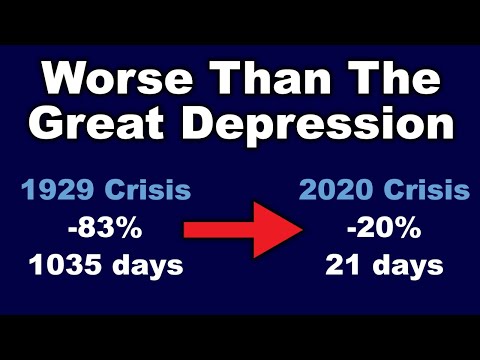
Over the course of just 21 days during the 2020 economic collapse, the stock market has dropped by roughly 20%, suggesting the economy is on the worst economic trajectory in history.
“Now, this is the 2020 economic collapse so far. Over the course of just 21 days, the market has dropped by roughly 20%. The world has seemingly shut down, and we just might be on the worst economic trajectory in history.”
Reducing interest rates is a standard economic policy that makes debt cheaper and promotes spending to kick-start economic recovery; interest rates typically rise during good times and fall during bad times.
“This is a very simple way to make debt cheaper in hopes of promoting spending that will kick start to the economy. And typically what you see is that when times are going to be good, interest rates go up. And when times are going to be bad, interest rates go down.”
Over the course of 517 days during the 2008 financial crisis, the stock market dropped by more than 56%, causing millions of people to lose their jobs, homes, and life savings.
“This is a chart of the 2008 financial crisis. Over the course of 517 days, the stock market dropped by more than 56%. Millions of people lost their jobs, their homes, and their life savings.”
Every single shutdown of a business will have an economic impact on more people than initially apparent, and most people aren't thinking about these indirect effects.
“But, the point here is that every single shutdown of a business will likely have an economic impact that most people aren't thinking of.”
Christoph Hanibel, representing AirTransat, stated 'We are currently assessing the impact on our operations and expect the government to help airlines and travel companies weather these extraordinary circumstances,' indicating industry expects government bailout.
“And because of this downturn in air travel, there have been spokespeople like Christoph Hanibel, who represents AirTransat, who have said, 'We are currently assessing the impact on our operations and expect the government to help airlines and travel companies weather these extraordinary circumstances.'”
If you get COVID-19, you will almost certainly be fine, but it is disproportionately bad for the elderly and those with underlying health conditions; therefore, it is good to be cautious on a social level but there is no need to panic on an individual level.
“my position on this is that if you get the disease, you will almost certainly be fine, but it is disproportionately bad for the elderly and those with underlying health conditions such as myself. So, it's good to be cautious on a social level, but also there isn't a need for you to panic on an individual level.”
There is potential for negative interest rates as a further policy tool, though the speaker is uncertain whether the Fed will pursue this option.
“unless they want to go to negative interest rates, which I don't know if they do.”
Toilet paper sales have increased by almost 50% for some companies like Kimberly-Clark Tissue because hoarding consumers are buying 100 rolls at a time while large retailers cannot restock shelves fast enough, but there is no actual shortage.
“The drop in sales that I talked about will apply to virtually every other industry in the world, except the toilet paper industry because that's actually manufactured in a bunch of different countries around the world. Yet sales have increased for some companies like KP Tissue by almost 50% in the last few weeks. So there is no shortage everyone. It's just a bunch of hoarders buying 100 rolls at a time and large retailers just can't restock the shelves fast enough.”