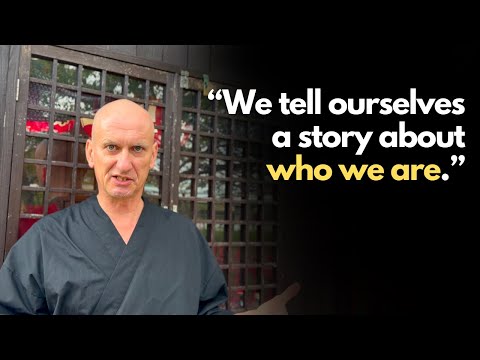
Zen Master Explains The Ego And Buddha Nature
What this covers
This seven-minute clip comes from an interview for the film Freedom From Suffering. The speaker is described by the publisher as Muho Nolke, a German Soto Zen teacher and former abbot of Antaiji in Japan. It begins with ego, defined as the script a person tells about "this person I call myself," with that character placed at the center of the story. The problem, as the speaker frames it, is social: everyone casts a different person as the lead, so nobody else shares your estimate of your importance, and the result is a chronic sense of being under-appreciated.
The second half turns to Buddha nature, which the speaker says is hard to explain because any explanation makes it a concept inside the constructed story rather than the ground that precedes it. The speaker uses a movie metaphor, in which Buddha nature is the screen and not the characters or plot. This is tied to the claim, which the speaker says modern psychology would accept, that the cars, trees and sky we see are mental constructions built up over years, an idea related to constructed perception.
The speaker then works through scriptural material. In a well-known koan, a monk asks whether a dog has Buddha nature. The textbook answer is yes, but the Chinese master answers "Mu." The speaker reads this as an instruction to drop the theory and touch whatever is seeing, hearing and tasting right now. The Heart Sutra line "no eyes, no ears, no nose" gets two readings: literal negation, or a pointer to the senses as Buddha nature's own perceiving. The speaker also departs from the traditional meaning of Buddha nature as future potential for awakening, and treats it as present awareness. When the speaker speaks, Buddha nature speaks. Several of these claims are marked as contested.
The speaker argues that ego is a constructed self-narrative that becomes problematic when identified as the center of reality, while Buddha nature is the pre-conceptual awareness underlying all experience—accessible not through theory but through direct engagement with what is actually perceiving in the present moment.
- Ego is the story we tell about 'this person I call myself' and the clash arises because everyone privileges their own constructed narrative while others don't validate it equally
- Buddha nature is not a concept to understand but the screen or substrate of awareness itself—what is seeing, hearing, sensing before any conceptual overlay
- The Zen teaching method (exemplified by Mu) instructs practitioners to release theoretical understanding and directly experience the perceiving awareness itself
This asset isn't compiled yet
You're seeing its claims, ranked. Compile it to build the argument threads, weight them, and check each claim against your library — the full view.
The fundamental problem with ego is that each person believes the self they identify with is the most important character in the story, but because everyone constructs different stories and identifies with different persons, nobody shares this assessment—no one else thinks your constructed self is the most important.
“the reason that the ego can become a big problem is that everybody thinks that this person that I identify with is well the most important one the whole movie the whole story is about this person but because we all identify with different persons and also we construct different stories um well we clash with each other nobody except ourselves thinks that this person is the most important”
Using the metaphor of a movie or story, Buddha nature is the screen on which the movie appears, not the characters or plot—it is the substrate or ground that must exist before any constructed world can appear.
“using the metaphor of the story or the movie Buddha nature would be the screen where the movie takes place Buddha nature is what becomes before you construct the world but what needs to be there for a world to appear in the first place”
The paradoxical point of the Mu koan is to instruct practitioners to let go of the theoretical concept of Buddha nature they have formed and instead become one with the ungraspable, living reality of perceiving awareness in the present moment.
“the point of the Quran is of course something that you shouldn't explain but if I explain it just a little moo means uh let go of this theoretical concept that you have of the Buddha nature and become one with well moo and mo in this case would be the ungraspable start trying to grasp Buddha nature but rather get in touch with that which is watching and seeing and smelling and tasting feeling being conscious in this moment”
The fundamental problem of ego is that everyone identifies with different persons and constructs different stories, so we clash with each other; nobody except ourselves thinks that our constructed self-person is the most important, so nobody appreciates us the way we would wish to be appreciated.
“the reason that the ego can become a big problem is that everybody thinks that this person that I identify with is well the most important one the whole movie the whole story is about this person but because we all identify with different persons and also we construct different stories um well we clash with each other nobody except ourselves thinks that this person is the most important um so um nobody appreciates us the way we would wish to be appreciated”
The fundamental difficulty with explaining Buddha nature is that any explanation turns Buddha nature into a conceptual object or part of the constructed story/map, which defeats the purpose since Buddha nature is what precedes and enables all conceptual mapping.
“the difficulty with Buddha nature is when you explain it like this you make Buddha nature already into something so mdha nature becomes part of the story becomes part of the map”
The meaning of the Master's 'Wu' (no) answer to the koan about the dog's Buddha nature is an instruction to let go of the theoretical concept of Buddha nature and instead become one with the ungraspable—to stop trying to grasp Buddha nature conceptually and instead get in touch with that which is watching, seeing, smelling, tasting, and being conscious in this moment.
“the point of the Quran is of course something that you shouldn't explain but if I explain it just a little moo means uh let go of this theoretical concept that you have of the Buddha nature and become one with well moo and mo in this case would be the ungraspable start trying to grasp Buddha nature but rather get in touch with that which is watching and seeing and smelling and tasting feeling being conscious in this moment what is it what is it what is it”
The phrase 'no eyes, no ears, no nose, no tongue, no body, no consciousness' can be understood paradoxically as simultaneously asserting that those sensory organs ARE the eyes, ears, and nose of Buddha nature itself in this very moment—Buddha nature is the actual perceiving.
“you could also say actually those eyes and ears and nose and tongue those are the eyes and ears and no and tongue of Buddha nature right here in this moment Buddha nature is seeing hearing smelling tasting”
The consequence of ego's self-centrism is that nobody except ourselves appreciates us the way we would wish to be appreciated, leading to a chronic dissatisfaction with how others regard us.
“well nobody except ourselves thinks that this person is the most important um so um nobody appreciates us the way we would wish to be appreciated that's ego”
The teaching method of the Zen koan instructs to stop trying to grasp Buddha nature intellectually and instead get in direct touch with that which is watching, seeing, smelling, tasting, and being conscious in this very moment—the immediate perceiving awareness itself.
“start trying to grasp Buddha nature but rather get in touch with that which is watching and seeing and smelling and tasting feeling being conscious in this moment what is it what is it what is it”
Ego is the story or script that a person tells about themselves, specifically the narrative about 'this person I call myself' that one constructs and identifies with as the central character.
“ego is basically the story that I tell myself about well this person on the stage that I constructed or kind of the script that I write for that person”
The fundamental difficulty with explaining Buddha nature is that any explanation turns Buddha nature into something conceptual, making it part of the constructed story or map rather than the pre-conceptual reality itself.
“the difficulty with Buddha nature is when you explain it like this you make Buddha nature already into something so mdha nature becomes part of the story becomes part of the map”
Buddha nature is what exists before and as the condition for any constructed world to appear—it is the ground prior to all conceptual overlay and constructed perception.
“Buddha nature in my view is what what becomes before that”
The Heart Sutra, a foundational Zen text, contains the phrase stating there are no eyes, ears, nose, tongue, body, or consciousness, and nothing to see, hear, smell, taste, feel, or be conscious of—no constructed reality—and Buddha nature is what exists before this constructed reality.
“in the heart Sutra which is a very basic text in Zen um there's this phrase which says there's no eyes no ears no nose no tongue no body no consciousness and there are no things that you can see nothing to hear nothing to smell nothing to taste nothing to feel nothing to be conscious of um the whole reality that you constructed it doesn't really exists Buddha nature in my view is what what becomes before that”
A famous Zen koan asks whether a dog has Buddha nature; the textbook answer in Buddhist tradition is yes, all living beings including dogs have Buddha nature, but a Chinese Master (Wu) answers 'no' or 'nothing'.
“in Zen one of the famous qurans is about the Buddha nature of a dog a monk asks his teacher does even a dog have Buddha nature and the textbook answer would be yes of course all living beings have Buddha nature even dogs and cats have Buddha nature but uh the Chinese Master his answer is or Japan Chinese Wu means well no or nothing there's no Buddha nature”
Ego is the story and script we tell ourselves about the person we identify with—the presumption that this constructed person is the most important entity and that the whole story or movie of existence is centered on this person.
“ego is basically the story that I tell myself about well this person on the stage that I constructed or kind of the script that I write for that person”
Modern psychology would agree that none of the things we see around us exist exactly the way we see them; they are mental constructions formed over several years—cars, trains, trees, grass, the sky are ideas we form about external things, not the things themselves.
“none of the stuff that I see around me exists exactly the way I see it it's an idea I have of the things an idea that I need several years to form of for example cars trains trees grass the sky um but I see it well the way I grasp it um so we construct the world”
An alternative interpretation of Buddha nature is that one's current reality—right now in this very moment when speaking and listening—is already Buddha nature itself, not a future potential but present awareness.
“in then you don't understand it that way in then you would say right now your reality the reality you're living right now is Buddha nature already this moment when I speak Buddha nature speaking this moment when you watch and listen Buddha nature is watching and listening”
Using the metaphor of a movie, Buddha nature is the screen on which the movie takes place—the ground or substrate that must exist before a world can appear and be constructed within it.
“using the metaphor of the story or the movie Buddha nature would be the screen where the movie takes place Buddha nature is what becomes before you construct the world but what needs to be there for a world to appear in the first place”
You can interpret the Heart Sutra's 'no eyes, no ears' phrase in two ways: literally (no sensory faculties or consciousness exist), or as a pointer to the fact that the eyes and ears and nose and tongue are the seeing, hearing, smelling, and tasting of Buddha nature itself in this present moment.
“you can say there's no eyes no ears no nose and so for but you could also say actually those eyes and ears and nose and tongue those are the eyes and ears and no and tongue of Buddha nature right here in this moment Buddha nature is seeing hearing smelling tasting”
In traditional Buddhism, Buddha nature means the potential of each living being to eventually become a Buddha, but the speaker reinterprets this as referring to the reality being lived in the present moment—Buddha nature as the perceiving awareness itself in this very instant.
“Buddha nature traditionally in Buddhism Buddha nature means uh the potential of each living being to become a Buddha at one point in then um you don't understand it that way in then you would say right now your reality the reality you're living right now is Buddha nature already”
Buddha nature is the perceiving awareness—what is seeing, hearing, and listening—in the present moment, illustrated by the claim that when the speaker speaks, Buddha nature is speaking, and when the listener listens, Buddha nature is listening.
“this moment when I speak Buddha nature speaking this moment when you watch and listen Buddha nature is watching and listening”
The Heart Sutra, a foundational text in Zen Buddhism, states that there are no eyes, ears, nose, tongue, body, or consciousness, and nothing to see, hear, smell, taste, or feel—meaning the entire constructed reality doesn't actually exist in the way we perceive it.
“in the heart Sutra which is a very basic text in Zen um there's this phrase which says there's no eyes no ears no nose no tongue no body no consciousness and there are no things that you can see nothing to hear nothing to smell nothing to taste nothing to feel nothing to be conscious of um the whole reality that you constructed it doesn't really exists”
In Zen Buddhism, there is a famous koan in which a monk asks his teacher whether a dog has Buddha nature, and the textbook answer from the sutras is yes, all living beings including dogs have Buddha nature.
“in Zen one of the famous qurans is about the Buddha nature of a dog a monk asks his teacher does even a dog have Buddha nature and the textbook answer would be yes of course all living beings have Buddha nature even dogs and cats have Buddha nature”
A Chinese Zen Master, when asked whether a dog has Buddha nature, answered 'Mu' (meaning 'no' or 'nothing'), contradicting the textbook Buddhist answer that all living beings have Buddha nature.
“but uh the Chinese Master his answer is or Japan Chinese Wu means well no or nothing there's no Buddha nature”
Modern psychology and Buddhism agree that the world we perceive is not exactly as it exists outside us, but rather constructed as an idea we form over several years through experience with objects like cars, trains, trees, grass, and sky.
“Buddhism says that basically this world which we live in is a world that we constructed and probably modern psychology would agree that none of the stuff that I see around me exists exactly the way I see it it's an idea I have of the things”
In traditional Buddhism, Buddha nature means the potential of each living being to become a Buddha at some point in time.
“Buddha nature traditionally in Buddhism Buddha nature means uh the potential of each living being to become a Buddha at one point in then”