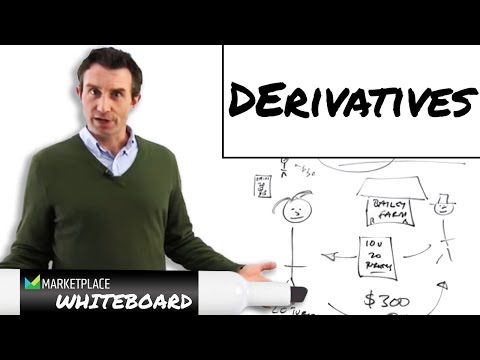
Derivatives | Marketplace Whiteboard
What this covers
This Marketplace Whiteboard explainer, presented by Paddy Hirsch, builds its case from a single running example: a customer named Terry pre-ordering Thanksgiving turkeys. Terry agrees with Mr. Bailey to receive 20 turkeys at $15 each before the holiday, which stands in for a forward or futures contract. From there the video widens to the actual vocabulary of the field, noting that the underlying asset can be gold, wheat, interest rates, credit spreads, foreign exchange, equities, mortgages, or even weather.
The middle of the video works through the main instrument types. An option appears when Terry pays $50 to Mr. Jones for the right, but not the obligation, to buy 20 turkeys at $15 before November 23rd. If Terry doesn't use it, the premium is simply lost. A swap is explained through a bank and a customer trading a floating interest rate that moves between 3.5% and 7.5% for a fixed rate of 5%, with the bank absorbing the risk of unfavorable moves. The video also separates contracts traded on an exchange with public prices from over-the-counter deals made bilaterally, with no central oversight.
The closing stretch turns to why derivatives have a bad reputation. Because contracts can be resold, Terry could sell his turkey contract for $400 after paying $300 if supplies tightened, and Hirsch observes that most traders care about the contract's price rather than the underlying asset. Two risks follow. One is leverage: borrowed money lets small price moves erase a trader's principal. The other is counterparty risk, shown when Mr. Bailey's farm fails and Terry must buy turkeys elsewhere at higher prices. The option from Mr. Jones is then recast as a hedge, a backup source of supply if the primary party defaults.
Derivatives are fundamentally contracts whose value is derived from underlying assets, and the primary risks come from leverage and counterparty default rather than the complexity of the instruments themselves.
- A derivative is a binding contract agreement based on something else (an underlying asset like commodities, interest rates, or credit)
- The three main types—futures, options, and swaps—all share the same structural element: they derive value from an underlying instrument
- Most derivative trading focuses on the contract itself rather than the underlying asset, creating speculative leverage and counterparty exposure
This asset isn't compiled yet
You're seeing its claims, ranked. Compile it to build the argument threads, weight them, and check each claim against your library — the full view.
Most traders in derivative markets are not interested in the underlying asset itself (commodities, interest rates, etc.) but rather in trading the contract itself for profit, speculating on price movements.
“most of the people who are trading them aren't really interested in what's underlying at all they aren't interested in the the interest rates they aren't interested in the Commodities they're interested in the contract and the fact that they can trade that contract up or trade that contract down”
Because derivatives are contracts that can be traded, they can be sold to third parties at prices different from their original cost, with profits or losses depending on market conditions for the underlying asset, as when Terry could sell his turkey contract for $400 instead of the $300 he paid if turkey supplies were tight.
“he can trade this note he can go to his neighbor and say look uh the week before Thanksgiving say look you know I I need to sell this I've got these turkeys coming but I can't use them can you use them and the neighbor might say okay well yeah I I can use them I'll pay you $150 for it okay so clearly he's losing money on the deal but on the other hand he might go to his neighbor and say if there's like a if there's a problem with turkey Supply that year as there was the year that he went to the supermarket he can go to his neighbor and he can say you know there's not very many turkeys this year how about um I sell you these 20 turkeys I give this note for these 20 turkeys and you can um you can pay me $400 for it”
Options can serve as hedges against counterparty risk by providing an alternative source of the underlying asset if the primary counterparty fails, as when Terry's option with Mr. Jones provides a backup supply of turkeys if Mr. Bailey cannot deliver.
“so that's an option often often used by as as a hedge by people okay so that's the second type”
A derivative is fundamentally a contract whose value is derived from an underlying asset, making it simple in concept despite the enormous world of financial instruments that exist under this category.
“a derivative is at its Essence a very simple concept but uh the bad news is that it sort of encompasses this enormous world of financial instruments so each derivative is kind of slightly different although it does have a single kind of binding element that makes it similar”
Without hedging protection, counterparty default in derivative contracts can leave the exposed party in a dire situation where they still need the underlying asset but have no way to obtain it, forcing them to source it elsewhere at potentially much higher prices.
“perhaps he hasn't covered himself with an option in that situation that counterparty risk is caught Terry and that means it's going to leave him very badly needing a Thanksgiving drink”
A swap is a derivative where one party exchanges a floating interest rate for a fixed interest rate with another party, with the bank absorbing the risk that interest rates will move unfavorably, such as when interest rates fluctuate between 3.5% and 7.5% monthly but the customer pays a fixed 5%.
“the third type is called a swap okay and that's when you have say an instrument that has a floating interest rate so month to month depending on where the underlying interest rate is say Lio or whatever you don't know what the interest rate is going to be on the loan that you have or the bond and what a lot of people like to do is they like to to take that floating rate where there's uncertainty and swap it for a fixed rate”
Derivatives can be traded on exchanges with publicly listed prices or over-the-counter as bilateral agreements between two parties, with no centralized market oversight in the OTC case.
“derivatives are traded in two places they're either traded on an exchange okay so traded on an exchange kind of like um you know the exchanges in Japan or the exchanges or the S&P 500 any of these exchanges or they can be traded over the counter and the over the-counter case is whenever it's an an agreement between one person and another so in an exchange you have this exchange that's working where you use the exchange to trade through and you can see the prices listed in an over the counter market it's just an agreement”
The first major risk with derivatives is that traders often use leverage—borrowed money—which means small adverse price movements can wipe out all of their principal very quickly, as opposed to investing with only your own capital where losses are limited by the amount invested.
“firstly because people use leverage when they talk when they're using derivatives okay which means you're using borrowed money which means that you know if you if the price of the uh the contract goes up then you know you make money there's no problems but if the price of the contract goes down it means you can lose all of your money because you've borrowed a whole bunch means you can lose all of your principal very very quickly”
The second major risk with derivatives is counterparty risk—the possibility that the other party to a bilateral derivative contract will fail to deliver, as when Mr. Bailey's farm could go under and leave Terry without the contracted turkeys, forcing him to source alternatives at higher prices.
“the second is because is the counterparty risk we talked about Mr Bailey's problems here clearly Terry is not a risk to Mr Bailey because Mr Bailey's already got his $300 so that counterpart is taken care of but Mr Bailey is a risk to Terry which is why he took out this option because if Mr Bailey goes uh if Mr Bailey has a problem or his his his farm goes under it means that Terry's got this note for 20 turkeys he's got to feed 200 people okay he's got no turkeys coming in because Mr Bailey is not going to be supplying him perhaps he hasn't covered himself with an option in that situation that counterparty risk is caught Terry and that means it's going to leave him very badly needing a Thanksgiving drink”
Derivatives derive their entire value and utility from the underlying assets and instruments they are based on, making the underlying the fundamental binding element that defines what makes different derivatives similar despite their superficial differences.
“a contract that's based on the underlying instrument which is in fact the bond or the loan that you're talking about so hence once again we're talking about this underlying”
An option is a derivative that gives the buyer the right (but not the obligation) to buy or sell an underlying asset at a specified price within a specified time period, as when Terry pays $50 to Mr. Jones for the right to buy 20 turkeys at $15 before November 23rd.
“the second type we have is called an option and an option is the option gives the buyer the option to buy or sell something okay so say in this case turkey”
The underlying assets for derivatives can include commodities (gold, silver, soybeans, wheat), interest rates, credit spreads, foreign exchange, weather, equities, mortgages, and many other categories of assets.
“well in this case we've got turkeys and turkeys are a commodity okay Commodities can include gold silver soybeans wheat whatever in the swap case the was an interest rate and interest rates in fact are one of the the biggest um underlyings in the in the in the business of derivatives so interest rates what else have you got well you've got we have um we have credit derivatives credit for swaps so credit is an underlying what else have we got uh we have can have foreign exchange Forex we can have um we can have the weather okay we got the weathers in there equities mortgages and on and on and on and on there's all sorts of things that you can have as your underlying instrument in your derivative”
A forward or futures contract is a derivative where one party agrees to deliver an underlying asset at a future date for a price agreed upon today, as exemplified by Terry's contract with Mr. Bailey to deliver 20 turkeys at $15 each before Thanksgiving.
“this is the first type so three types really of uh of of derivative and this is the first which is the future or forward okay because in the future Mr Bailey will be delivering 20 turkeys to Terry hence it's a future or a forward contract”
An option can expire worthless if not exercised; in Terry's case, if he doesn't exercise his option to buy turkeys from Mr. Jones by November 23rd, he loses the $50 premium he paid, receiving no value in return.
“but that option can expire or will expire on the 23rd if he doesn't exercise it if he doesn't buy those turkeys doesn't exercise it he's paid $50 which he never sees again”