Investing Politics: Making Sense of Trump, Tariffs and Tesla!
What this covers
This is a single-speaker session in which Aswath Damodaran treats the market turmoil around Donald Trump's tariff policy as a symptom of something larger. He first traces the winners and losers of globalization, then moves to disruption, and finally to what both mean for interest rates, equity risk premiums and company valuation. He closes by applying the framework to Tesla.
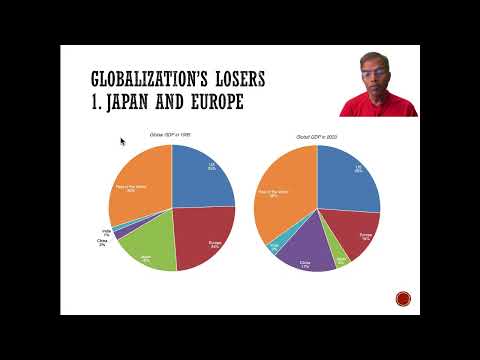
The globalization section leans on numbers. China went from 1.67% of global GDP in 1980 to 16.76% in 2023, while Japan fell from 18% to 4% between 1995 and 2023 and Europe from 24% to 15%. US manufacturing employment dropped from about 20 million in 1979 to 13 million in 2024. Consumers gained through lower prices, and blue-collar workers and small businesses lost. Financial centers and global institutions gained influence, and the small-firm return premium has disappeared. He dates the peak to 2008 and reads Brexit, the European far right and Trump's two elections as the Backlash to Globalization. His forecast, which is contested, is that globalization will not reverse but will become a world with more friction.
The disruption half lays out the Disruption Playbook: target large, inefficient incumbents, attack their weakest links, scale before turning a profit, and bet that regulators will arrive too late. Damodaran notes that it has stalled in healthcare and education. He applies it to the US government, arguing that a broken budget process gives disruption a case but that the stakes are higher when Medicare and Social Security recipients depend on the systems being broken. On markets, he warns that a rising equity risk premium pushes prices down even without a recession, and doubles the losses if a recession follows. Technology has the most foreign revenue, at 59%, which leaves it most exposed to trade conflict. He recommends moving away from big tech toward smaller companies and other sectors. The Tesla valuation turns on a weakened electric-vehicle narrative and competition from BYD, which outsold it in 2024.
Damodaran argues that globalization and disruption—two major forces reshaping the world since the 1980s—have created winners and losers whose backlash is now driving political upheaval and forcing investors to rethink company valuations and sector positioning.
- Globalization peaked in 2008 and triggered a backlash visible in Brexit, Trump's election, and the rise of populist movements driven by worker and small-business losses
- Disruption, which succeeded in business markets, is now entering government and politics with mixed results and higher stakes because vulnerable populations depend on government systems
- Investment implications require shifting away from big tech winners of the last 20 years toward smaller companies and other sectors as anti-globalization forces reshape markets
This asset isn't compiled yet
You're seeing its claims, ranked. Compile it to build the argument threads, weight them, and check each claim against your library — the full view.
The US government is broken in its budget system and Congress is incapable of fixing it through normal means, creating a legitimate need for disruption, but simultaneously breaking systems affects vulnerable populations dependent on government (Medicare, Social Security), making rapid fixes essential to avoid catastrophic damage.
“on the one side I do believe the US government is broken the budget system is broken and Congress seems incapable of fixing it it it plays with the edges the Legacy problems are too deep so clearly there is a need for disruption that said I'm not sure breaking everything at the same time doing what you do at a company works with the US government why because there are lots of people who are dependent on the US government vulnerable people you know people on Medicare and Social Security”
The disruption playbook, perfected over 25 years by tech companies, targets large inefficient businesses with dissatisfied stakeholders, attacks their weakest links (profitable products subsidizing unprofitable ones), moves quickly to scale before profitability, breaks rules, and operates under the assumption that by the time regulators act, the disruptor has become too entrenched to be stopped.
“the best way to think about disruption is to look at the disruption Playbook that the tech company's perfected over the last 25 years it always starts with the business to disrupt the business you want to disrupt should be a large business lots of dollar spent it should be inefficient at its core and have lots of dissatisfied players...disruptors go after those profitable products which essentially subsidize the rest the third thing that disruptors do is they move quickly because they know recognize that the status quo is often slow to move and they scale up really fast with access to Capital...many disruptors in their playbook seem to break rules and ask for permission later because they've discovered that by the time the regulators and the rulle makers get around to acting it's often too late there is no alternative”
Manufacturing employment in the US peaked at approximately 20 million workers in 1979 and has since declined to 13 million by 2024, representing a loss of 7 million jobs primarily due to globalization.
“the number of manufacturing workers in the US peaked in 1979 about 20 million and over the over the past few decades you can see the loss in jobs from 20 million down to 13 million kind of plateaued off at 13 million but clearly we've lost jobs to globalization”
China has been the biggest winner of globalization, increasing its share of global GDP from 1.67% in 1980 to 16.76% in 2023—a tenfold increase—and contributed approximately 38% of global GDP growth between 2010 and 2023.
“China has gone from 1.67% of GDP a tiny slice of GDP to 16.76% it's increased its share 10-fold”
The small firm effect—the tendency for small firms to make higher returns than larger companies—has disappeared over the last four decades, with globalization being one potential cause.
“the decline of the small firm effect where small firms that used make higher returns in larger companies and markets that small firm effect has disappeared over the last four decades lots of reasons but one of them might have been the the the the growth of globalization”
Financial markets and the cities where they are centered—Tokyo, New York, London, Frankfurt—have gained wealth and power at the expense of other parts of the world, with market reactions increasingly shaping government tax and economic policy.
“financial markets have become more Central to our lives more companies are listed in markets and what happens in markets seems to drive policy in fact many you know many governments with tax and economic policy check out what Market reaction is before they adopt them and the and the cities where these financial markets have been centered Tokyo New York London Frankfurt have gained in the expense of the rest of the world”
Globalization will not be reversed even though it is experiencing backlash, as the structural changes it introduced (such as China's economic dominance) are irreversible; instead, a friction-filled world with more barriers will emerge.
“to those who know you know who see this backlash as playing out as a return to Old Times that's not going to happen we're not putting this globalization Genie back to the bottle so even if we see a backlash it's not like China is going to go back to being 1.67% of global GDP that Europe and Japan are going to reclaim the their their their positions that they had before globalization came along now globalization I think has found itself into so much of what we do that it's not going to go away but the world that emerges after this backlash is going to be a world with more frictions and globalization”
Global institutions (World Bank, IMF, the EU, and regional agreements like NAFTA) have gained power and influence as a result of globalization, becoming more central to policy-making.
“Global institutions have benefited the World Bank and the IMF have been with us for decades but their power has been amped up with globalization and we've created new institutions along the way new treatments new agreements the na in North America we had we had NAFTA in the 1990s Europe created the EU”
Japan lost the most share of global GDP from globalization, declining from 18% in 1995 to 4% in 2023—a drop of more than 75%—while Europe dropped from 24% to 15%.
“Japan and you can see what they've lost by looking at the share of global GDP that they commanded in 1995 Japan had had had 18% Europe was 24% and look at their shares in 2023 Japan in particular has fallen off the cliff from 18 to 4% Europe has dropped from 24 to 15%”
Disruptors have been the biggest winners from disruption in terms of market valuations and founder wealth, while consumers are secondary winners through access to low-cost or below-cost products and services.
“the biggest winners from disrupt disruption have been the disruptors and not so much in terms of money made because disruptors often scale up before they make money but it has you know markets have rewarded them with huge market capitalizations and it's made its Founders incredibly wealthy people investors and employees also wealthy so disruptors have clearly been winners the clearest and consumers are secondary winners too because in the process of scaling up these disruptors of often provided their products and services at low prices and often below cost”
Consumers have been primary beneficiaries of globalization through increased choice and lower prices for goods across categories like food, apparel, and furniture, representing a significant change from 40-50 years ago.
“consumers have benefited from globalization from having more choice and lower prices you walk into a grocery store you can buy food from around the world that's the and that's a big change from where we were 40 50 years ago when you buy a pear you're buying it at much lower prices than you paid otherwise because it's made in other parts of the world”
Blue-collar workers and factory workers in developed markets have been the biggest losers from globalization due to job losses and wage pressures from offshore competition.
“blue colar workers Factory workers in developed markets in the graph that you see below you see the number of manufacturing workers in the US from 1939 to 2024 with a percentage change each year the number of manufactur ing workers in the US peaked in 1979 about 20 million and over the over the past few decades you can see the loss in jobs from 20 million down to 13 million”
Brexit, the rise of the far right in Europe, and the election of Trump in 2016 and 2024 are manifestations of the backlash to globalization that began accelerating over the past decade.
“the initial reactions were incremental know in elections of new governments in you know in the post2 2008 era but it kind of kicked into high gear over the last decade the brexit in the UK where UK voters chose to leave the EU the rise of the far right as it's called in Europe the election of trump in 2016 and again in 2024 I think a big factor in those events was the was the backlash to globalization”
Globalization peaked in 2008, and the financial crisis triggered widespread questioning of whether experts truly understood economic systems, leading to loss of trust in institutions that persists today.
“globalization at least in my view peaked in 2008 and 2008 was a trigger to people re-evaluating the benefits of globalization why because in 2008 I think we started questioning whether experts really knew what they were doing know it led to a loss of trust in institutions and governments and experts and I don't think we we're going to get that trust back soon”
Investors should shift away from big technology companies (winners of the last two decades) toward smaller companies and other sectors in anticipation of winners becoming losers and losers becoming winners as the backlash to globalization plays out.
“for investors I think that'll require you know that might mean that shift away from the big winners of the last couple of decades big technology companies toward smaller companies perhaps to other sectors now I'm not quite ready ready to make a sector bet but I think that we are going to see a reversal of some of the things that we've seen for the last 20 years winners becoming losers and losers becoming winners and we have to be ready for that”
The primary winners from disruption are the disruptors themselves, who gain huge market capitalizations and make their founders, investors, and employees wealthy, while consumers are secondary winners through low-price offerings, and the primary losers are legacy companies, their employees, investors, and regulatory agencies that become viewed as failures for not stopping the disruptors.
“the biggest winners from disrupt disruption have been the disruptors and not so much in terms of money made because disruptors often scale up before they make money but it has you know markets have rewarded them with huge market capitalizations and it's made its Founders incredibly wealthy people investors and employees also wealthy so disruptors have clearly been winners the clearest and consumers are secondary winners too because in the process of scaling up these disruptors of often provided their products and services at low prices and often below cost the biggest losers from disruption is the status quo no as Legacy companies scale down there's a whole host of side losers right their employees the people who've invested in them and The Regulators”
Small businesses lost from globalization because they faced competition from foreign companies with much cheaper production, while larger businesses could adapt by moving production elsewhere.
“small businesses that had nice domestic markets found themselves competing against foreign companies that had you know you know much cheaper production you know you're saying know why weren't all businesses affected because larger businesses had more adaptability they could move their production elsewhere”
Financial market centers (Tokyo, New York, London, Frankfurt) and the companies listed in those markets have gained wealth and power from globalization, while non-financial center regions have lost relative wealth and influence.
“the cities where these financial markets have been centered Tokyo New York London Frankfurt have gained in the expense of the rest of the world gained in terms of wealth maybe not in living ability in terms of wealth and power”
If the equity risk premium continues to climb, stock prices must fall even without a recession; if it climbs and a recession occurs, stock losses will be doubled.
“the F factor is clearly winning out over the last two weeks and that number will bear watching because one way to think about what will happen over the rest of the year is to think about this Equity risk PR premium and what it might continue to do if it continues to climb I think there's no way around it but stocks have to go down if it continues to and that's true even if you don't have a recession if it continues to climb and you have a recession you've doubled the potential damage”
China's share of global GDP increased from 1.67% in 1980 to 16.76% in 2023, a 10-fold increase, making it the largest beneficiary of globalization.
“China has gone from 1.67% of GDP a tiny slice of GDP to 16.76% it's increased its share 10-fold”
According to The Economist's measure, 60 countries in 2024 have authoritarian regimes, representing 39% of the global population, and the trend in democracy has declined between 2006 and 2024.
“in 2024 60 countries of according to the economist were in authoritarian regimes 39% of the glob of the global population more than half of the global population at least according to the economist is you know lives under non-democracies”
Disruption has not worked well in healthcare and education despite both being large, inefficient, and having many dissatisfied stakeholders, with examples including startups and Amazon's healthcare initiatives that have not successfully scaled.
“you take health care it's Health Care should be ripe for disruption right it's big it's inefficient and nobody's happy hospitals doctors patients and disruption has not worked that well I know that there are you know there are startups like Mark Cuban startup in the farm of business or Amazon tried its healthc are startup but they've not really taken off education big inefficient lots of unhappy players again you know disruption has not worked that well”
Among S&P 500 sectors, technology has the largest percentage of revenues from outside the US at 59%, while utilities and healthcare have the least exposure at 9-14%, meaning tech companies are most exposed to tariff and trade war risks.
“the sector that gets the largest percentage of revenues from the rest of the world for for us among the S&P 500 companies is technology 5 9% of revenues come from outside the US this the sector that gets the least percentage of revenues outside then this answer might be obvious is utilities and but healthcare too is a low number it's 14%”
Tesla's story has experienced roadblocks: (1) the narrative of inevitable transition to electric vehicles has shifted as hybrids and gas cars persist and electric cars' environmental benefits are questioned; (2) BYD has emerged as a serious competitor, selling more electric cars than Tesla in 2024 and offering better pricing.
“the first is this notion that we were on this this Pathway to electric cars that electric cars were in you know everybody was going to own an electric car in 10 or 15 years which is a story that was being promulgated a couple of years ago that story seems to have changed you know part of it I think is I think the acceptance that hybrids and gas cars are here to stay and that they're not going to go away and that electric car are not the unmixed blessing for the environment”
Democracy has been hurt by globalization because of the perception that elected governments cannot control policies that are determined by forces outside their borders, reducing the perceived benefit of choosing one's government.
“one of the biggest selling points for a democracy is that people get to choose governments that do their bidding that if a government does not act in their interest at least in theory people can throw them out and replace them with a new government with globalization there is at least this perception that you can elect a new government but the policies get adopted somewhere outside it might be a perception it might be flawed but that perception I think has driven down the desirability of democracy”
Advocates for globalization made a strategic mistake by not addressing the concerns of losers and by treating them with disdain (calling them 'nativist' or 'ignorant'), which contributed to the current backlash.
“one of the mistakes that the advocates for globalization have made was while they were selling the world on its benefits they didn't want to talk about the losers in fact they treated the losers often with disdain now calling them nativist or ignorant when they brought up issues with what democ what globalization was doing to them so in a sense we reap what we s”
If equity risk premium continues to climb, stock prices must decline, and this is true even without a recession; if an equity risk premium climb coincides with a recession, the potential damage to stocks is doubled.
“if it continues to climb I think there's no way around it but stocks have to go down if it continues to and that's true even if you don't have a recession if it continues to climb and you have a recession you've doubled the potential damage”
The key drivers of company value are revenue growth, margins, efficiency of growth delivery, and how risk affects the cost of capital and failure risk—these are the factors through which tariffs and trade wars will impact company valuations.
“as I wrestle with how all of this play out on company valuations I went back to the basic drivers of value that I've used before the revenue growth margins and how efficiently you deliver growth driving my cash flows and risk driving both the cost of capital that I used to Discount these cash flows and failure risk so I looked at Trump's the the tariffs and tariff Wars and and and trade Wars I'm sorry tariffs and trade Wars and what it might do to my valuation through those drivers”
Companies with capital-intensive production or supply chains reliant on cheap foreign labor that have moved production offshore over the last four decades are more exposed to trade wars than companies that are not capital-intensive and not reliant on cheap foreign labor.
“Capital intensive bases companies which are dependent on cheap labor which have over the last four decades moved their factories or their production offshore are going to be more exposed to trade Wars than companies that are not Capital intensive and not as reliant on cheap labor”
Legacy automakers (traditional car manufacturers like Toyota, General Motors, Ford) were initially unable or unwilling to challenge Tesla's EV market position before BYD emerged; the disruption playbook's success in EVs enabled Tesla's dominance for 15+ years.
“until two years ago it was Tesla or Tesla using Legacy automakers seem to be in no position to challenge Tesla”
Globalization peaked in 2008 and the 2008 financial crisis triggered a reassessment of whether experts actually knew what they were doing, leading to a loss of trust in institutions, governments, and experts from which trust will not soon recover.
“globalization at least in my view peaked in 2008 and 2008 was a trigger to people re-evaluating the benefits of globalization why because in 2008 I think we started questioning whether experts really knew what they were doing know it led to a loss of trust in institutions and governments and experts and I don't think we we're going to get that trust back soon”
The backlash against globalization will not reverse globalization itself—China will not return to 1.67% of global GDP and Japan/Europe will not reclaim their former positions—but the world that emerges will have more friction and barriers than the previous global order.
“to those who know you know who see this backlash as playing out as a return to Old Times that's not going to happen we're not putting this globalization Genie back to the bottle so even if we see a backlash it's not like China is going to go back to being 1.67% of global GDP that Europe and Japan are going to reclaim the their their their positions that they had before globalization came along now globalization I think has found itself into so much of what we do that it's not going to go away but the world that emerges after this backlash is going to be a world with more frictions and globalization”
Consumers have lost control over product sourcing from globalization—they don't know where products are made and cannot easily pressure the responsible parties when dissatisfied.
“consumers gained in terms of choice and price but they've also lost in terms of control now when you buy a product you're not quite sure where it's made and when you don't like it you're not sure what to put pressure on so we've lost some control in where we get our products from and that's and that makes consumers uncomfortable”
Small businesses in developed markets lost competitive advantage against foreign competitors with cheaper production, while larger businesses could adapt by moving production offshore, contributing to the disappearance of the small firm effect over the past four decades.
“small businesses that had nice domestic markets found themselves competing against foreign companies that had you know you know much cheaper production you know you're saying know why weren't all businesses affected because larger businesses had more adaptability they could move their production elsewhere now earlier in one of my updates for this year I talked about the decline of the small firm effect where small firms that used make higher returns in larger companies”
Historically, valuations of US and European companies could exclude government from the story except as tax collector and regulator, but that is no longer true—government must now be considered as a potential ally or adversary in company valuations.
“historically when you valued us or european companies the luxury of keeping the government out of your story other than in their role as tax collectors and Regulators now I think those days might be done I think that um you know that the government might be in play a part of the story of many companies even in the US and Europe and you might have no choice but to talk about that effect in your Val”
Consumers have lost control and transparency regarding where products are made and how to exercise pressure on companies when dissatisfied, creating consumer discomfort despite price and choice gains.
“we talked earlier about how how consumers gained in terms of choice and price but they've also lost in terms of control now when you buy a product you're not quite sure where it's made and when you don't like it you're not sure what to put pressure on so we've lost some control in where we get our products from and that's and that makes consumers uncomfortable”
Company valuations can be analyzed as 'a bridge between stories and numbers,' where the story (narrative about what the company will become) must pass the three-P test: is it Possible (can it happen), Plausible (is it reasonable), and Probable (how likely is it).
“every valuation is a bridge between stories and numbers and you've got to stop and make sure your story passes the three p test is it possible plausible and probable”
The fundamental forces driving current market uncertainty and investor discomfort (globalization backlash, disruption in government) have been building for years and will continue to play out in markets, politics, and commerce regardless of whether Trump's tariff threats materialize.
“we can blame the market uncertainty and Trump and tariffs and trade Wars but I think that the forces that have led us here have been building for years and they're not going away so even if Trump withdraws his talk of tariffs and um the trade Wars don't manifest the forces of anti-globalization have been Unleashed and they're going to continue to play out in markets and politics and in global Commerce”
Japan's share of global GDP collapsed from 18% in 1995 to 4% in 2023, while Europe's fell from 24% to 15%, making them the two biggest geographic losers from globalization.
“Japan and Europe and you can see what they've lost by looking at the share of global GDP that they commanded in 1995 Japan had had had 18% Europe was 24% and look at their shares in 2023 Japan in particular has fallen off the cliff from 18 to 4% Europe has dropped from 24 to 15%”
BYD has emerged as a viable competitor to Tesla, selling more electric cars globally than Tesla in 2024 and making foray into markets outside China, often competing head-to-head against Tesla with better pricing.
“there's a rise of a competitor I mean until two years ago it was Tesla or Tesla using Legacy automakers seem to be in no position to challenge Tesla but byd has risen as a potential competitor in fact in 2024 byd sold more electric cars than Tesla did and the company is making foray into markets outside China and often going head-to-head against Tesla offering better pricing”
According to The Economist, 60 countries as of 2024 were classified as having authoritarian regimes, with 39% of the global population living under non-democracies, representing a decline in global democracy.
“The Economist has uh as a measure where they look at the percentage the number of countries and the percent of countries which have full democracies flawed democracies hybrid regimes which are kind of democracies and and a mix of authoritarian and and purely authoritarian regimes in 2023 I'm sorry in 2024 60 countries of according to the economist were in authoritarian regimes 39% of the glob of the global population”
Among S&P 500 sectors, Technology has the highest exposure to tariff risk with 59% of revenues coming from outside the US, while Utilities have the lowest at a figure Damodaran doesn't specify, and Healthcare also has low exposure at 14%.
“the sector that gets the largest percentage of revenues from the rest of the world for for us among the S&P 500 companies is technology 5 9% of revenues come from outside the US this the sector that gets the least percentage of revenues outside then this answer might be obvious is utilities and but healthcare too is a low number it's 14%”
The electric vehicle market narrative that was promoted a couple of years ago—that everyone would own an electric car in 10-15 years—has changed as hybrids and gas cars have proven to be persistent, and electric cars have proven to be less of an unmixed environmental blessing than previously thought.
“we were on this this Pathway to electric cars that electric cars were in you know everybody was going to own an electric car in 10 or 15 years which is a story that was being promulgated a couple of years ago that story seems to have changed you know part of it I think is I think the acceptance that hybrids and gas cars are here to stay and that they're not going to go away and that electric car are not the unmixed blessing for the environment that we might have thought they were just a few years ago”
The number of manufacturing workers in the US peaked in 1979 at about 20 million and has declined to 13 million over subsequent decades, representing a clear loss to blue-collar workers from globalization.
“the number of manufactur ing workers in the US peaked in 1979 about 20 million and over the over the past few decades you can see the loss in jobs from 20 million down to 13 million kind of plateaued off at 13 million”
Disruption has recently entered government and politics, starting in Latin America with figures like Javier Milei and Nayib Bukele in El Salvador, who have applied the disruption playbook to government reform.
“but disruption has come to government and Latin America seems to be the starting point for this Javier Malay and nael in El Salvador Javier Malay in Argentina have both brought the play the disruption Playbook to government”
Advocates for globalization made a strategic error by not engaging with the concerns of globalization's losers and instead treated them with disdain by labeling them as nativist or ignorant, which contributed to the current backlash.
“one of the mistakes that the advocates for globalization have made was while they were selling the world on its benefits they didn't want to talk about the losers in fact they treated the losers often with disdain now calling them nativist or ignorant when they brought up issues with what democ what globalization was doing to them so in a sense we reap what we s”
Brexit, the rise of the far right in Europe, and the elections of Trump in 2016 and 2024 all represent manifestations of backlash against globalization that accelerated over the last decade.
“if you look at much of what's happened since 2008 you see the backlash to globalization playing out the initial reactions were incremental know in elections of new governments in you know in the post2 2008 era but it kind of kicked into high gear over the last decade the brexit in the UK where UK voters chose to leave the EU the rise of the far right as it's called in Europe the election of trump in 2016 and again in 2024”
Politics and investing have become intertwined and cannot be discussed separately; attempting to remove political perspective from investment analysis is impossible and attempts to do so are 'always going to be impossible.'
“politics and investing have kind of twin together and you can't talk about one without talking about the other”
In 1984 when Damodaran taught his first class, the world was dollar-centric with most data and case studies from the US, and most students went into domestically-focused companies—but by now his classroom is more globally distributed with students going into globally-spanning companies.
“I taught my first class in 1984 and was a very dollar Centric world that I taught it much of the data that that I use came from the US almost all of the cases and books in classrooms came from the US my students were primarily going into domestic to companies go to work for companies that were domestic in their focus...today when I look at my classroom I have more foreign students than us students and many of them go to work for companies which are which which have their supply chain stretching across the world and their markets spread out across the world”
Treasury rate movements reflect two competing views among investors: Trump supporters interpret falling rates as a sign that inflation is declining, while Trump opponents interpret the same data as a sign that the market sees a recession coming.
“if you're a trump supporter you're going to point to those rates coming down and and and point to it as good news that inflation is coming down after all rates reflect inflation and real growth if you're a trump opponent of course you're looking at the same drop in Rat see the recession is coming and the market sees it”
Disruption follows a consistent playbook: target large, inefficient businesses with dissatisfied players; attack the most profitable segments that cross-subsidize less profitable ones; move quickly and scale with capital; break rules and ask forgiveness later rather than asking permission upfront.
“the best way to think about disruption is to look at the disruption Playbook that the tech company's perfected over the last 25 years it always starts with the business to disrupt the business you want to disrupt should be a large business lots of dollar spent it should be inefficient at its core and have lots of dissatisfied players”
Speaker liquidated much of his Tesla position right after the election because he is not comfortable investing in a company where politics becomes the key driver of stock price, regardless of political perspective or business fundamentals.
“I did you know liquidate much of my Tesla position right after the election partly because not because I you know it's not a question of political perspective I just am not comfortable investing in a company where politics becomes the key driver of the stock price now”
Disruption in business has worked well in retail (Amazon), advertising, and car services (ride-sharing), but has failed to gain traction in healthcare and education despite those sectors meeting all disruption criteria (large, inefficient, with unhappy players).
“you saw this play out with Amazon and the retail business you saw it play out with the online advertisers with the advertising business and right sharing with the car service business name to name just a few now of course the question is disrupted created winners and losers obviously the biggest winners from disrupt disruption have been the disruptors”
Democracy has been hurt by globalization because the primary selling point of democracy—that people can choose governments to do their bidding—is undermined when elected governments cannot implement desired policies due to external constraints from globalization.
“one of the biggest selling points for a democracy is that people get to choose governments that do their bidding that if a government does not act in their interest at least in theory people can throw them out and replace them with a new government with globalization there is at least this perception that you can elect a new government but the policies get adopted somewhere outside it might be a perception it might be flawed but that perception I think has driven down the desirability of democracy”
The United States has held its own share of global GDP despite globalization, likely because the second major force of 'disruption' has allowed it to maintain market share where traditional economies like Japan and Europe have lost ground.
“notice again the US has held its own and you know you know part of it is it might have benefited from globalization but I think the other Force disruption can explain why it held its own”
Every valuation is a bridge between stories and numbers, and valuations pass the three-P test only if the story is possible, plausible, and probable.
“every valuation is a bridge between stories and numbers and you've got to stop and make sure your story passes the three p test is it possible plausible and probable”
The implied equity risk premium—the extra return investors demand beyond the Treasury rate reflecting investor hopes and fears—was 4.29% around the election, stayed relatively stable through March at 4.35%, but in the two weeks before the interview jumped to 4.68%, the highest level since the start of 2024.
“I take the level of the index and I back out of it what investors are demanding as an extra return over and above the treasury rate so think of this as your receptacle for your hopes and fears that number leading at the time of the election was know 4.29% and since and for for most of the you know all the way through March that number didn't budge by very much it dropped between November and December it went up again but kind March of 202 5 is 4.35% not that different from where you started right after the election in the 2 weeks in March clearly something has changed because that Equity risk premiums jumped from 4.35 to 4.68% that's a highest number we've seen since the start of 2024”
Between November 2024 and March 2025, US Treasury rates have remained relatively flat—20-year, 10-year, and longer-term rates have come down slightly, while shorter-term rates have stayed flat, and the yield curve has become flatter.
“if you look at us treasury rates between November 2024 and March 2025 the effect has been relatively muted so in this graph you've got 20 year rates 10 year rates five you know 5e 2E and 3 month 3mon EES have pretty much flat line so that's a black line right down the middle you know 10 10e rates and 20e rates have actually come down since the start of the year”
The implied equity risk premium (the additional return investors demand above treasury rates for stocks) has been relatively stable from November 2024 through most of March 2025 at around 4.3-4.35%, but jumped to 4.68% in the last two weeks of March, the highest level since the start of 2024.
“that number leading at the time of the election was know 4.29% and since and for for most of the you know all the way through March that number didn't budge by very much it dropped between November and December it went up again but kind March of 202 5 is 4.35% not that different from where you started right after the election in the 2 weeks in March clearly something has changed because that Equity risk premiums jumped from 4.35 to 4.68% that's a highest number we've seen since the start of 2024”
Disruption has come to government in Latin America as a starting point, with Javier Milei in Argentina and Nayib Bukele in El Salvador applying the disruption playbook to government reform, potentially helped by the fact that their respective governments were viewed as so broken that citizens adopted a 'what could be worse' mentality.
“disruption has come to government and Latin America seems to be the starting point for this Javier Malay and nael in El Salvador Javier Malay in Argentina have both brought the play the disruption Playbook to government and they've probably been helped by the fact that both those countries were the governments were viewed is so broken that the reaction of people was hey what can be worse”
Elon Musk and DOGE are applying the disruption playbook to the US government—moving at hyper speed, breaking age-old systems, and pushing laws and norms to breaking point—with mixed prospects for success.
“as you watch Elon Musk and Doge play play out in the US government clearly they're bringing the disruption Playbook to government they're moving at hyp speed breaking age-old systems pushing laws and Norms to Breaking Point and Beyond and the question is is it going to work”
Politics has entered the Tesla story in very real terms as consumers choose not to buy Tesla cars because they disapprove of Elon Musk or his politics, with effects visible and growing in Europe and the US.
“there's no denying the fact that politics has entered the Tesla story it's entered in very real terms in terms of people choosing not to buy Tesla cars because they don't like musk or musk's politics that you're seeing the effects gr up in Europe and and even in the US and as musk Remains the center of news stories I think that that backlash will continue to play out both in markets and in business”
In 2019, large Chinese tech companies were valued with the understanding that the Chinese government shifted from being an ally to an adversary, and this shift showed up in their valuations—a pattern that will increasingly apply to US and European companies.
“I've written about this in the context of companies valued in 2019 when I talked about the big Chinese tech companies and the Crackdown that the Chinese government put on them and how that showed up in value I talked about how their value was being affected by the the Chinese government going from being an ally to an adversary”
Tesla is the company where the interplay between politics, government, and business is most visible, with the stock price experiencing a roller coaster ride during 2024 that was less about Tesla as a business and more about investor expectations that Elon Musk's political involvement would pay off economically.
“of course the company where you're seeing this interplay between politics government and business the most in the center of the storm is Tesla and you know a company I valued repeatedly over time most recently in February in in late January of 2024 when I valued about10 around $180...the Tesla story has had a roller coaster ride during 2024 in markets the stock price you know surg from one from 170 to over 400 just after the election but a big portion of that surge had less to do with Tesla the company and more to do with the politics of the of the day people were investors seem to be building into Tesla's market cap the expectation that um that the that musk's foras into politics would pay off in terms of economics for Tesla”
Tesla is the company where the interplay between politics, government, and business is most visible and central to valuation; speaker valued Tesla at ~$180 in late January 2024 and bought at $170 a few weeks later.
“the company where you're seeing this interplay between politics government and business the most in the center of the storm is Tesla and you know a company I valued repeatedly over time most recently in February in in late January of 2024 when I valued about10 around $180 in fact I bought Tesla when it hit 170 a couple of weeks later a few weeks later”
Damodaran liquidated much of his Tesla position immediately after the election because he is not comfortable investing in a company where politics becomes the key driver of stock price, despite not being a political perspective issue but a valuation comfort issue.
“I did you know liquidate much of my Tesla position right after the election partly because not because I you know it's not a question of political perspective I just am not comfortable investing in a company where politics becomes the key driver of the stock price”
For investors, the bottom line implication of globalization backlash and disruption is that they may need to shift away from the big winners of the last couple of decades (big technology companies) toward smaller companies and other sectors.
“for investors I think that'll require you know that might mean that shift away from the big winners of the last couple of decades big technology companies toward smaller companies perhaps to other sectors”
Global institutions including the World Bank, IMF, and new agreements like NAFTA and the EU have gained power and influence as a result of globalization, with their reach and decision-making authority amplified.
“Global institutions have benefited the World Bank and the IMF have been with us for decades but their power has been amped up with globalization and we've created new institutions along the way new treatments new agreements the na in North America we had we had NAFTA in the 1990s Europe created the EU”
Globalization in its current form traces back to the 1980s, marked by a shift from dollar-centric, domestically-focused business to globally-distributed supply chains and markets.
“in its current form I think you can trace it back to the 1980s”
Consumers have benefited from globalization through expanded choice and lower prices on food, apparel, and furniture, with goods now sourced from around the world at significantly lower cost than domestically-produced alternatives.
“I think consumers have benefited from globalization from having more choice and lower prices you walk into a grocery store you can buy food from around the world that's the and that's a big change from where we were 40 50 years ago when you buy a perel you're buying it at much lower prices than you paid otherwise because it's made in other parts of the world”
Company valuation depends on three drivers: revenue growth, profit margins, and the efficiency of converting growth into cash flows (all affecting cost of capital and failure risk), and all are affected differently by tariffs and trade wars.
“I went back to the basic drivers of value that I've used before the revenue growth margins and how efficiently you deliver growth driving my cash flows and risk driving both the cost of capital that I used to Discount these cash flows and failure risk”
Damodaran's new Tesla valuation is approximately $150 per share, down from his valuation of $180 one year ago, reflecting smaller market opportunity due to BYD competition and the modified EV adoption story while keeping other elements of the Tesla narrative intact.
“in my end game I think that you now are more likely to see a two companies dominating you know one in the premium electric car market where I think Tesla will still remain the big winner but in the mass market auto business especially with Asia is the big market for that I think there's a very real chance that byd could win that market so my my expectations of revenues for Tesla have come down a little bit I've left the bulk the rest of my story intact because I don't think that that the the margins I'm aspiring to and the Other Stories We were telling about Tesla about automated driving or about software and energy those stories are still there the value that I got is about $150 for share”
Tesla stock at $220-225 is overvalued relative to speaker's revised $150 intrinsic value, even after recent price declines, making it unattractive from a pure business fundamentals perspective.
“and it's still below the stock price of you know even after the hammering that Tesla's stock price has taken in the last few weeks stock price is 220 225 so the stock looks overvalued now”
Treasury rates reflect two competing views about the economy: the optimistic view (that inflation is coming down) and the pessimistic view (that a recession is coming), with the true market signal ambiguous.
“if you're a trump supporter you're going to point to those rates coming down and and and point to it as good news that inflation is coming down after all rates reflect inflation and real growth if you're a trump opponent of course you're looking at the same drop in Rat see the recession is coming and the market sees it but the treasury rates reflect I think those two competing views about inflation and the real economy”
The yield curve, which many investors use as a recession indicator, is very flawed and unclear in what it is signaling, making it a problematic tool for macro forecasting.
“the yield curve has become pretty flat you know for those of you who use that as an indicator it's very you know it's a very flawed indicator know it's not clear what it's signaling”
The speaker sees the world in shades of gray rather than black and white absolutes, which may make him unpopular in a world of increasing polarization where most people expect tribal affiliations or clear stances.
“the first is I see the world in Shades of Gray and in a world where more and more people see black and white and absolutes that might make me not just an exception but not that popular”
Damodaran's micro-level focus on company valuation is primary; his macro work on equity risk premiums for the S&P 500 serves the purpose of enabling better company-level analysis rather than making macroeconomic judgments.
“much of the work I do is in the micro setting I value companies I look at how they make corporate financial decisions and the work I do in the macro world is primarily to help me in the micro indice that I have so it's true I estimate Equity risk premiums for the S&P 500 the start of every month but I do it because not because I want to pass judgment on the market but because I need it to Value companies”
Damodaran sees the world in shades of gray rather than black and white, which may make him unpopular as polarization increases, and he approaches discussions of Trump and tariffs by trying to keep his political thoughts from pervading his investment decisions.
“I see the world in Shades of Gray and in a world where more and more people see black and white and absolutes...I also am not that comfortable talking about politics but...I'm going to try not to to let my political thoughts kind of pervade my decisions because I think there is a tendency then to make bad decisions”
Speaker's macro work (such as estimating equity risk premiums) exists primarily to serve his company valuation work in the micro setting, not as an end in itself or for market timing purposes.
“much of the work I do is in the micro setting I value companies I look at how they make corporate financial decisions and the work I do in the macro world is primarily to help me in the micro indice that I have so it's true I estimate Equity risk premiums for the S&P 500 the start of every month but I do it because not because I want to pass judgment on the market but because I need it to Value companies”
The speaker is off-balance and reactive for much of 2025; stepping back to gain perspective on big picture issues and returning to basics help him regain equilibrium and make better investment decisions.
“I've been feeling off balance for much of this year and I'm sure I'm not alone because the world as we know it seems to be changing under us and when I'm off balance I find myself being reactive reacting to events on the ground and that's not good for me as an investor so two things I find myself uh doing whenever I'm off balance that help me one is to step back and gain perspective look at the big picture the others to go back to basics”
US Treasury rates between November 2024 and March 2025 have been relatively flat or declining, with 10-year and 20-year rates dropping since the start of the year, and the yield curve becoming very flat, making it an unreliable signal.
“between November 2024 and March 2025 the effect has been relatively muted so in this graph you've got 20 year rates 10 year rates five you know 5e 2E and 3 month 3mon EES have pretty much flat line so that's a black line right down the middle you know 10 10e rates and 20e rates have actually come down since the start of the year”