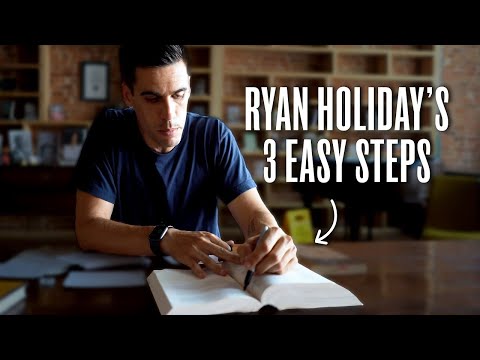
Ryan Holiday's 3-Step System for Reading Like a Pro
What this covers
This eight-minute video from Daily Stoic is Ryan Holiday alone on camera, walking through how he reads and what he does with what he reads. It follows three stages, matching the chapter markers: how to read, how to organize what you read, and how to use it. He frames authors as professional readers who run their reading through annotation and a commonplace book that feeds their daily work, and he argues that the Commonplace Book System is not just for writers. Anyone will meet information or wisdom that has no use today but may later.
The first stage is physical. Holiday marks books by pen, writing in margins, highlighting, and folding pages. He treats this as a conversation with the author: flagging words to look up, stories he likes, historical examples, and anything that catches his attention. He says he does not speed read and deliberately reads slowly. The second stage comes after a book has rested for a couple of weeks or a month. He copies the marked passages by hand onto note cards and sorts them by theme. He admits this is tiring for the hand, but he holds that the repetition builds muscle memory and fingertip feel for the material, a claim that is more contested than the rest. His model is Robert Greene's note-card method.
The third stage is use. Holiday describes the system as a backup hard drive for the brain, and says each of his books started as a small section in a card box that grew into its own box. He traces The Obstacle Is the Way to a line in Meditations, later reinforced by Pierre Hadot's idea of turning obstacles upside down. He also says almost every story in his Read to Lead course came from his archive. The video closes on urgency: the best time to start was twenty years ago, and the next best is now. It also includes promotional notes about the Daily Stoic email list and the reading challenge.
Ryan Holiday argues that systematic reading combined with a commonplace book system—a structured method of physical annotation, note extraction, and topic-based organization—creates durable knowledge retention and enables better writing and decision-making across any domain.
- Physical reading with annotation forces repeated engagement with material, building 'fingertip feel' and muscle memory
- The commonplace book acts as an external memory system organized by theme, allowing patterns to emerge and ideas to compound over time
- Starting the practice immediately yields long-term compound returns; the best time to begin is now, not after waiting for perfect conditions
This asset isn't compiled yet
You're seeing its claims, ranked. Compile it to build the argument threads, weight them, and check each claim against your library — the full view.
Writing in margins, highlighting, folding pages, and marking passages during reading serves as an active conversation with the author, where readers identify words to look up, stories they like, historical examples, and moments that catch their attention.
“as i was reading it it occurred to me that i think i'd read it another time about five or six years ago looking at a project so you'll see in the margins the things i'm sometimes it's a word that i want to look up sometimes it's a story that i like sometimes it's an example a moment in history that i know nothing about that it's catching my attention”
The commonplace book system is not exclusively a tool for writers; anyone in any profession will encounter wisdom or information in the course of their life that is not relevant or useful immediately but will be useful in the future, making it worth investing time now in organizing and storing.
“this isn't just a tool for writers it doesn't matter who you are or what you do chances are you're coming across wisdom or information in the course of your life that isn't relevant or of use to you just yet but in the future it likely will be so what you're doing is investing now you're putting in the time now and you have to trust that in the future you'll be able to put this to some good use”
Authors are professional readers who organize information through reading, annotation, and commonplace book systems that they use on a daily basis to inform their actual work.
“i guess i'm a professional reader that's really what authors are having written 11 books now i've read a lot of books so what i thought i'd do today is explain my method for reading for organizing what i read and keeping what they call a commonplace book that organizes all that information in a system that i can refer to in the course of my actual life and do on an almost daily basis”
The practice of physically writing note cards by hand from marked passages, though labor-intensive and causing hand fatigue, is essential because it forces repeated engagement with the material that builds muscle memory and 'fingertip feel' for the content.
“there's a reason i do it long is that it's helping you create kind of a muscle memory and i could just read these on kindle highlight them and send them to my evernote but it's actually reading it once going back through it writing it by hand organizing it this forces me to go through the material over and over and over again until it's locked in my brain i've now interacted with the material so many times that i have kind of a fingertip feel for what it is what it means and how i might use it”
The commonplace book functions as a 'backup hard drive of your brain'—a system for storing things you cannot possibly remember verbatim, but have a vague sense of and think might be usable in the future.
“really what a commonplace book is it's kind of like a a backup hard drive of your brain it's it's things you couldn't possibly remember but you kind of have a vague sense of them but that you think might be usable in the future”
The perfect time to start a reading and commonplace book practice was 20 years ago, but the second-best time is now; delaying the start until conditions are perfect is counterproductive—one should begin immediately.
“you might be looking at this and go that took a lifetime that took forever i can't possibly catch up but there's that great expression like the best time to plant a tree is 20 years ago but when it's the second best time the second best time is now if you're not reading if you're not keeping the common place book it's not too late start not tomorrow not next week start now”
Robert Greene's note-card system served as the model for Holiday's own commonplace book method, as Greene famously builds his books around organizing and collecting note cards on various topics.
“it's not in a black hole i keep what is called a common facebook so commonplace books historically were done in journals you know you can see thomas jefferson's commonplace book there's commonplace book of montana they would just write down things that they they like i do it on note cards because this is what i learned from robert green robert green famously builds his books about note cards”
Physical books with pen-based annotation and margin notes create a two-way conversation between reader and author, fundamentally different from digital reading methods.
“when i meet people who have read my books and they show me all the dog-eared copies and that they beat the crap out of it i take that as praise”
Each of Holiday's books begins as one small section of note cards collected in a box, which eventually expands into its own dedicated box as material accumulates, demonstrating how ideas grow from initial notes into full book projects.
“you can see here my book the obstacle is the way began as just one little section of note cards in this box and then eventually it spreads out to its own box”
The process of reading, marking, writing note cards, and organizing them by theme creates a feedback loop of refinement—raw material from books is progressively refined, organized, and cross-referenced until patterns emerge and eventually culminate in usable ideas for writing or other projects.
“again it starts with the raw material and it's about the refining and the organizing and the checking and the finding patterns that eventually culminates into some usable idea”
The concept of 'The Obstacle Is the Way' originated from reading Meditations and discovering the Stoic principle that 'the impediment to action advances action which stands in the way becomes the way,' then being reinforced by Pierre Hadot's concept of 'turning obstacles upside down' in 'The Inner Citadel,' eventually becoming a full book.
“the obstacle is the way for me as i said began as just a single note card first i read meditations so i read the quote there the impediment to action advances action which stands in the way becomes the way so i first read the quote there then i read pierre-edo's the inner citadel and it's in this that he calls that exercise turning obstacles upside down so i went through it i marked it turned it into a note card started a new category here in the commonplace book this book leads me to this book which leads me to note cards which leads me eventually to write this book”
After completing a book, letting it sit for a couple of weeks or a month before extracting notes allows for a period of consolidation before the labor-intensive process of transferring marked passages to note cards.
“when i finish a book like this i let it sit i put it on the shelf behind my desk and i just let it sit couple weeks a month and then now's the hard part especially on a book like this i know my hand is going to ache by the time i finish but what i do is i sit down with it and i break it apart and i take all the things that i like and i put it on note cards”
Speed reading is not Holiday's practice; he deliberately reads slowly and carefully, spending substantial time with each book.
“i don't read fast speed reading is um but as i as i went through and read i'm folding the pages that i like”
Almost every story in the Read to Lead course originated from Holiday's commonplace book archives, demonstrating the practical utility of the system in creating content.
“almost every story in it ironically came from the archives of my commonplace book”
Holiday has heard from thousands of people over the years who have started their own commonplace book practice because of his advocacy for the system.
“i've heard from thousands of people over the years who've started their own process because of it”
The commonplace book practice has had an immense impact on Holiday's life, and he cannot overstate its importance as a method for personal development and intellectual work.
“i can't rave about this process enough i can't overstate the impact it's had on my life”
The Daily Stoic email reaches over 300,000 subscribers, making it the largest community of Stoics in the history of the world.
“the email takes five minutes to read over 300 000 people get it that's the largest community of stoics ever in the history of the world”