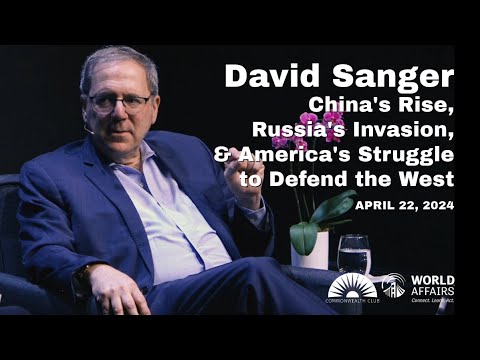
David Sanger | China's Rise, Russia's Invasion, and America's Struggle to Defend the West
What this covers
This is a conversation at the Commonwealth Club World Affairs of California between David Sanger, the New York Times national security correspondent, and Philip Yun, the club's co-president. It is organized around Sanger's book New Cold Wars. Sanger walks through how the U.S. handled Russia and China across several administrations, drawing on interviews with senior officials. A recurring theme is that American leaders projected their own priorities onto both countries and kept being surprised by what they did.
The China material centers on Xi Jinping. Sanger describes secret speeches in January 2013 that signaled a nuclear buildup, and says Joe Biden spent a great deal of time with a Xi who was not the one who took power. He covers the Made in China 2025 push for self-sufficiency in chips, AI, and quantum computing, which Western officials misread as mere design theft. He also covers the 2016 hack of the Office of Personnel Management and Xi's Rose Garden pledge not to militarize the South China Sea. China's arsenal growing from 200 to 500 weapons, and Beijing's response to Trump's arms-control demands, get specific attention.
On Russia, Sanger revisits Vladimir Putin's 2007 Munich speech, the 2014 Crimea response, and George Kennan's warnings about NATO expansion. He treats expansion as a decision with costly long-term consequences. He describes the October 2022 scare over tactical nuclear weapons, which prompted an emergency mission by Bill Burns, and says top officials put the odds of use at roughly even if Russia faced defeat.
The talk also turns to the Trump years, with H.R. McMaster and Matt Pottinger building a more adversarial China policy while Rex Tillerson focused on State Department restructuring. Other threads include the single U.S. artillery-shell factory, Starlink and cloud services in Ukraine, and the recurring failure of American isolationism.
Sanger argues that post-Cold War U.S. policymakers fundamentally misread both Russia and China, mistakenly believing economic integration would liberalize them and prevent their emergence as great power competitors; this strategic failure to understand their actual hierarchies of values—territorial ambition over prosperity—has led to the current era of renewed superpower competition with far less predictability than the original Cold War.
- U.S. leaders projected their own economic priorities onto Russia and China, assuming markets would override territorial ambitions
- Xi Jinping executed a secret plan to build nuclear forces and dominate the Indo-Pacific that U.S. intelligence completely missed despite Biden spending more time with him than any other leader
- The combination of Russia-China partnership, unpredictable leadership, and proliferation of technology-enabled private sector power creates strategic chaos unlike the predictable Cold War era
This asset isn't compiled yet
You're seeing its claims, ranked. Compile it to build the argument threads, weight them, and check each claim against your library — the full view.
Joe Biden and Xi Jinping traveled together and spent more time together than Biden had spent with any other world leader, but Biden was spending time with a different Xi Jinping than the one who became president—missing Xi's secret speeches to build up nuclear forces, crack down on Hong Kong, suppress free press, and build up against Taiwan.
“When Xi Jinping was vice president, they assigned our own vice president, a guy named Joe Biden, to go out, develop a relationship with him. She traveled in the United States. Biden went traveled around remote parts of China together. And as Biden himself will say, he spent more time with Xi Jinping than any other leader in the world. Unfortunately, he was spending time with a different Xi Jinping than the one who ultimately became president of China...We miss his decision to crack down on Hong Kong and basically throw out the agreements that they had made with the British. We missed his crackdown on free press. We missed his build up against Taiwan.”
In Ukraine, U.S. intelligence detected Russian invasion preparations through multiple channels, but a key final indicator came from software engineers monitoring malware activation in Ukrainian government systems rather than from spy satellites or human intelligence in the Kremlin, illustrating the new role of corporate intelligence in detecting state actions.
“In the run up to the war in Ukraine, the US collected pretty exquisite intelligence to suggest that Russia was getting ready to invade...some of the final indicators that the Russians were really ready getting getting ready to roll didn't come from our spy satellites, didn't come from some spy sitting, you know, in the Kremlin. It came from some software engineers who were watching the Russians activate malware that they had put in the Ukrainian government systems.”
The U.S. had only one factory producing 155 millimeter artillery shells before the Ukraine war; this single factory was located two miles from the house where Joe Biden grew up in Scranton, Pennsylvania, illustrating how hollowed out America's defense industrial base had become.
“We have one factory in the United States, this being the Ukraine war that turned out 155 millimeter artillery shells, because who was going to go fight an artillery war in Europe? Again, it's about two miles from the house where Joe Biden grew up in Scranton, Pennsylvania. It's the only one.”
Xi Jinping gave secret speeches in January 2013 signaling he would build up China's nuclear force to match Russia and the U.S. levels; this represented a fundamental shift in Chinese strategy from minimum deterrence to strategic parity, contradicting U.S. intelligence assessments that predicted Xi would focus on domestic economy rather than confront the U.S.
“We miss Xi's secret speeches to build up their nuclear force to the level of Russia and the US...the intelligence reports all said that they expected him to focus on the domestic economy and not confront the United States.”
Western policymakers mistakenly believed China was primarily engaged in stealing Western designs like the F-35 fighter jet, missing that China had actually launched the Made in China 2025 program to achieve self-sufficiency in semiconductors, battery technology, biological products, artificial intelligence, and quantum computing—the same areas Congress later decided the U.S. needed to fund.
“We captivated ourselves in the thought that they were there mostly just to steal our designs...But then we got ourselves stuck in the thought that all the Chinese do is steal and imitate, when in fact they had started up the Made in China 2025 program quite openly to get to be self-sufficient in semiconductors, battery technology, biological products, artificial intelligence, quantum computing, all the areas that two years ago Congress came around to the thought that maybe we ought to be funding as well.”
Microsoft and Amazon moved the entire Ukrainian government into cloud infrastructure within one week of Russia's invasion because Ukraine was required by law to keep servers within Ukraine; once Russian missiles destroyed the physical server farms as expected, cloud access and communication with the U.S. military became dependent on satellite connectivity, which Elon Musk controlled through Starlink.
“Microsoft and Amazon World Systems, eight of us in one week's time put the entire Ukrainian government into the cloud, their pension records, their ability to communicate back and forth between military units...Ukraine was operating out of server farms that were in Ukraine by law, had to keep all the information about Ukraine in Ukraine...the Russians did take out the server farms...they didn't have a way to communicate up to the cloud, they weren't going to get their own data right? And it was Elon Musk who came along and sort of saved the day on that.”
Throughout U.S. history, isolation movements have periodically emerged arguing the world is too complicated and the U.S. should retreat, build walls, and let other nations fight while defending only direct threats; this strategy has consistently failed because other nations are interested in U.S. interests, and events inevitably suck America back into world affairs.
“we've seen this movement revived live. We've had it many times in our history to say the world's too complicated. Let's just all retreat back to the United States, build big walls. Anyone comes for us, we're going to make them pay a price, but let them all fight it out...And you know, we've tried this at various times in history, and it's always turned out the same way, which is we may not be interested in the rest of the world. They're interested in us and our interests get sucked in sooner or later.”
Multiple U.S. officials including the Secretary of State, Secretary of Defense, and Joint Chiefs Chairman believed that if Russia felt it was losing in Ukraine and about to be pushed out, the probability of tactical nuclear weapons use was approximately 50-50 (not 5.5%), representing a dramatic increase in nuclear probability assessment.
“Everybody from the secretary of state to the secretary of defense to others said to me at that moment, they thought if the Russians felt they were losing and they were about to be pushed out of Ukraine...People were talking about a significant victory on the part of the Ukrainians...That's the situation in which they thought it was 5050.”
NATO expansion into former Soviet republics, particularly Poland and others, was a decision with negative long-term consequences; while George Kennan warned it would force Russia to lash out, the U.S. felt compelled to honor these countries' democratic choice to join, creating conditions that enabled Putin's later actions.
“There were people at the time, including George Kennan, who was still alive, saying this is a really bad idea, that this is going to create the conditions that will force the Russians at some point to lash out. My own view is having told these countries that were newly freed, it would have been really hard for them for us to say if you've met the conditions to join NATO, you can't do it.”
China previously had only 200 nuclear weapons in minimum deterrence posture; the country has now increased to 500 weapons, and when Trump rejected arms control agreements with Russia unless China joined, China offered two options: either build up to U.S. numbers or the U.S. could cut down to Chinese numbers—a diplomatically brilliant play since neither option was acceptable to the U.S.
“They actually had until a few years ago, Just 200. Yes, two. Hundred. They are now at 500. Yeah. And President Trump kept saying, well, I'm not going to re-up my our arms control agreements with Russia until China joins in. And the Chinese came back and said, well, I'll tell you what, we'll do this one of two ways. Either we'll build up to your numbers, which Trump administration thought maybe was a great idea...Or you guys can cut your arsenals down to our numbers, which it turned out that we weren't willing to go do either.”
Biden entered office wanting to pivot U.S. focus away from the Middle East to Asia, but Middle East crises pulled him back in; he also planned to manage Russia's soft decline without major engagement, but the Ukraine invasion forced him to fund and fight a proxy war, demonstrating that rising powers will impose their priorities regardless of U.S. strategic preferences.
“Biden had wanted to move the US out of the Middle East so he could do the pivot to Asia that has been talked about but not executed through ten years. And the Middle East has dragged him back in. He wasn't planning on doing anything with Russia other than managing its disruptions and let it go into sort of soft decline when suddenly he finds himself having to go fund and fight a war in Ukraine.”
H.R. McMaster brought in Trump's first national security strategy focused on shifting U.S. policy from the age of terrorism to the age of great power competition, but Trump had not read the strategy and gave a speech about counterterrorism instead, illustrating the disconnect between strategic planning and presidential priorities.
“McMaster...came in determined to write the national security Strategy...he use it to try to turn the U.S. government away from its focus on the age of terrorism and toward an age of great power competition...when they sent President Trump out to announce it, it turned out he hadn't read it. And he gave a really good speech about counterterrorism.”
Matt Pottinger, a former Wall Street Journal reporter and Marine who spoke Mandarin, served as Trump's National Security Council advisor on China and began restructuring U.S. policy toward China as more adversarial and zero-sum; this represented quality strategic work that was undermined by broader Trump administration chaos.
“Pottinger, who was in the Security Council, who was on China. Probably the most impressive member of of President Trump's national security staff and stayed on through until he left on January 6th...was a former reporter to...Former Wall Street Journal reporter, former Marine...really interesting and Mandarin speaker.”
Rex Tillerson as Secretary of State spent his early months examining the State Department's organizational structure and proposing 30% staff reductions based on his Exxon experience, rather than engaging with the geopolitical implications of Russia-China relations or substantive policy issues.
“Tillerson...spent his first couple of months as he later told me in the State Department, examining its reporting structure and figuring out if you could reduce the staff by 30% because he had done that at Exxon and it had brought about significant cost and efficiency savings...But he decided to spend his time on the org chart.”
Xi Jinping is highly secretive with no real indication of his direction until after he became president; despite this opacity, he clearly had a comprehensive plan to build up the Chinese state and take on the U.S., which was missed by Western observers.
“G On the other hand, highly secretive, never gave any real indication of where he was going, but clearly had a plan in his mind to build up the state and and take on the U.S.”
China hacked the U.S. Office of Personnel Management in 2016, stealing 22 million security clearance files containing complete financial histories, relationship records, and information about every foreigner individuals had met; these files were sent unencrypted to interior department systems where they received the same security protections as 'bison migration in the west' and were shipped out for a year before detection.
“after China had gone into the Office of Personnel Management, the world's most boring bureaucracy, and stolen 22 million security clearance files. Including. Mowers. Yeah. Yes, it was really good reading. Phil Yeah, And and these are not just as you remember, from filling out the forms. This is not just like, you know. No, no, it's not. This is your entire financial history. It's every relationship you've ever been in, every foreigner you've ever met. Yeah, You know, it's pretty fulsome stuff. We them unencrypted and inside the computer systems of the Interior Department where they got the same protections as, say, bison migration in in the west. And they shipped them out for a year before we noticed.”
When Xi Jinping visited the Rose Garden during the Obama administration after the OPM hack, he publicly stated 'I have no intention of militarizing the South China Sea' while, in fact, he was simultaneously constructing military hangars and conducting military exercises with fighter jets on islands in the South China Sea.
“He came to the Rose Garden in a visit to Clinton and a visit to Obama in around 2016 or 2017...she stood in the in the Rose Garden one day and he said, I have no intention of militarizing the South China Sea. Right. Right. A year later, we're running satellite photographs of military hangars being built and then of Chinese fighter jets flying wingtip to wingtip on these islands in the South China Sea. So he has no problem stating outright something that he knew at the time completely contradicted his plans.”
To restart ammunition production, the U.S. had to recruit retired workers to train younger workers on how to use 30-year-old machinery, indicating how severely the defense industrial base had atrophied and how dependent the U.S. had become on assumptions of perpetual peace.
“They had to go find these old retired guys and bring them back in to show some younger workers how to actually use this machinery to make the artillery.”
In October 2022, the 60th anniversary of the Cuban Missile Crisis, the U.S. intelligence community detected Russian generals discussing the movement of tactical nuclear weapons for use against Ukraine for the first time, prompting Bill Burns to be sent for emergency talks and a major national security crisis.
“There was a remarkable moment and a remarkable month in October of 2022. It happened, Phil, to be the 60th anniversary that week of the Cuban Missile Crisis. Right? Right. And the US picked up through intelligence. You'll read about in the book intercepts of Russian generals who were discussing for the first time moving tactical nuclear weapons.”
Following George Kennan's warnings about NATO expansion, Russia has since acted out exactly what Kennan predicted: NATO expansion would force Russia to lash out, establishing a causal link between Western post-Cold War policy choices and contemporary Russian aggression.
“There were people at the time, including George Kennan, who was still alive, saying this is a really bad idea, that this is going to create the conditions that will force the Russians at some point to lash out.”
In 2007, Putin gave a speech at the Munich Security Conference stating that parts of old Russia needed to be reunified; U.S. media and policymakers largely missed the significance of this speech despite Bob Gates warning he was not in the mood for a second Cold War.
“In 2007, five years after that float down, the Never River, he shows up at the Munich Security Conference...And he gives a speech and that says there are parts of period of great old Russia that need to be reunified. Bob Gates, then the defense secretary, stood up and said, I been through one Cold War...I'm not really in the mood to do a second...but people moved on. We didn't even put this on the front page.”
When Russia annexed Crimea in 2014, the U.S. response of sanctions took a year to organize and only intensified after a civilian airplane was shot down; this weak response signaled to Putin that the West would not seriously contest Russian territorial expansion, encouraging further aggression.
“Seven years later, he takes Crimea and Obama looks and says, Look, I'm not going to war over a Russian speaking peninsula that Khrushchev gave back to Ukraine in the late 1950s...The sanctions that ultimately were put on Russia for that, it took a year to put them together and then only when that airplane was shot down...So what is Putin supposed to conclude from this that the West doesn't really care about Ukraine, that they'll do sanctions that will make them feel good but won't affect his life very much?”
Trump prioritized one-time trade deals over strategic thinking about China; when Xi offered concessions on trade, Trump granted concessions on Hong Kong and other strategic issues, undermining the coordinated approach being developed by McMaster and Pottinger to limit Chinese influence through allied partnerships and reducing U.S. semiconductor dependence.
“He's he's I mean, partly because he didn't want to go focus on it, but partly because he was always in pursuit of that one time deal that he thought would make him look good. So at there, there are phone calls that he has with Xi Jinping where he basically says, I'm not going to give you a hard time about Hong Kong. Go do what you need to do. As long as I can get my trade deal.”
U.S. leaders across administrations mistakenly believed that Russia's and China's territorial ambitions would be outweighed by their desire to sell into Western markets and maintain economic development, causing policymakers to project their own economic priorities and assume both countries would ultimately adopt Western institutions, values, and rule of law.
“we fundamentally convinced ourselves that at the end of the day, they would consider the expansion of the Chinese economy, the ability to sell into this market, and both in this market and in Russia's case, the ability to sell oil and gas around the world would outweigh their territorial ambitions, their ambitions for to express their power and influence in other ways, and that they would essentially sign on to Western institutions, Western values, Western rule of law, because it would be too important to them to keep those markets developing.”
Biden gave what his staff called his 'Armageddon speech' at a fundraiser at James Murdoch's townhouse in New York, stating 'We are facing right now the first possibility of the use of a nuclear weapon since Hiroshima and Nagasaki' not in some distant future but 'in the next two weeks,' citing parallels to the Cuban Missile Crisis.
“Biden comes in and says, We are facing right now the first possibility of the use of a nuclear weapon since Hiroshima and Nagasaki and he didn't mean like at some point in the distant future, he meant like in the next two weeks and we're facing a situation we haven't seen since the Cuban Missile crisis, because I'm convinced if there is the beginning of the use of battlefield nuclear weapons, you don't stop the pathway to getting to Armageddon. His staff came to call this Biden's Armageddon speech.”
A significant portion of the $60 billion Ukraine aid package flows toward replenishing U.S. stocks of weapons rather than directly to Ukraine, but the aid package's passage sends a critical signal to European allies that the U.S. remains committed to Ukraine despite internal Republican and Democratic Party divisions about the commitment.
“A good chunk of that money just goes toward replenishing our own stocks back. To the earlier question you got. So not all this is flowing through to the Ukrainians, but it also sends a signal that we're sticking with it.”
The Internet, promoted by Bill Clinton as a tool to liberate the Chinese people and undercut Communist Party authority, instead became an instrument of exquisite control that enabled facial recognition, surveillance, dissent tracking, and repression of Muslim minorities and Tibetan populations.
“he went to Beijing University and gave an absolutely brilliant speech on how the Internet would not only set the Chinese people free, but how it would undercut the authority of the Communist Party...it turned out in the end that the Internet and other digital technologies turned out to be the instrument of exquisite control that has kept the Communist Party in place...It enabled them to track down dissidents. It enabled them to put facial recognition to work so that they could make sure they knew where every single human being was...It became a way to repress the Muslims leaders. It became a subject of repression in or tool of repression in Tibet.”
This technology dependence through choice of communications infrastructure is the essential argument for regulating TikTok; while China does not allow Facebook, Google, or Apple Networks in China, the U.S. created a new 'information space Iron Curtain' by allowing Chinese-controlled information algorithms to reach American users.
“this is the essential argument over Tik Tok. Yeah, right, right. So Tik Tok is interesting because name for me, another piece of Chinese software that is used ubiquitously by American consumers there is not. Right. Right. And we've never really managed it. But why are we worried about Tik tok?...China, of course, does not allow Facebook does not allow Google does not allow Apple Networks in China. So what we have created in the information space is essentially a new Iron curtain. There's a physical one that we were thinking about in the old Cold War. In the new Cold War is you have to think about that as an information space.”
Elon Musk refused Ukraine's request to turn on Starlink around Crimea for targeting Russian ships because he was told doing so would start a nuclear war; this decision, which would normally be made by a Secretary of Defense or National Security Adviser, was made by an entrepreneur, illustrating unprecedented private sector power in geopolitical decisions.
“the Ukrainians call him and ask him to turn on StarLink around Crimea so that they can target it some Russian ships that are around there with their own missiles. And Musk refuses to do it because somebody had told him if they take out those ships that's going to start a nuclear war, it's going to start Russia using nuclear weapons...Suddenly, an entrepreneur is making a decision that you would normally expect, maybe the secretary of defense or the national security adviser to make.”
Mark Milley, former Joint Chiefs chairman, articulated 'the Nuclear Paradox': the better the U.S. does at defeating Russian ambitions in Ukraine, the higher the likelihood Russia will use nuclear weapons, creating a cruel strategic dilemma.
“It's in a chapter that nuclear call in there called the Nuclear Paradox, which is a phrase from Mark Milley, the former chairman of the Joint Chiefs, who said to me over lunch one day, you know, David, the the nuclear paradox at work here is the better job we do at defeating the Russians ambitions in Ukraine, the higher the likelihood they use nuclear weapons.”
A sustainable U.S. strategy toward great power competition requires consistent long-term approach that does not change every four years or even every two years, and must be debated openly within presidential campaigns; the U.S. has lost this capacity to debate grand strategy as a central campaign issue.
“To have that strategy, we need a consistent approach in the United States, not something we're super well known for. And it doesn't change every four years or for that matter, every two years. That's right. And we have lost the ability fill in. This really bothers me the most to debate these strategies as part of a presidential campaign.”
Tactical nuclear weapons are small battlefield weapons that can be shot from artillery cannons; Russia was preparing to move these weapons for potential use against Ukraine (a non-nuclear state), representing a threshold that had never been crossed since nuclear weapons were created.
“moving tactical nuclear weapons. These are small battlefield nuclear weapons that you could sort of shoot out of an artillery cannon essentially, and using them against Ukraine.”
It was not in Putin's economic interest to invade Ukraine, and it was not necessarily in Xi Jinping's economic interest to crack down on Hong Kong, yet both leaders chose territorial and political control over economic benefit, demonstrating their hierarchy of values differs fundamentally from Western assumptions.
“It was not in Putin's economic interest to invade Ukraine. It was not necessarily in Xi Jinping's economic interest to crack down on Hong Kong. The one place that has long been the interchange point between the West and and yet what we've learned time again and again is their hierarchy of values was different than ours.”
The U.S. misunderstood that countries take every small moment of cooperation and blow it out of proportion, leading to inflated expectations about Russia and China eventually integrating into Western systems, when in fact their leaders had different long-term strategic plans.
“we took every small moment when we were all working together and blew it out of proportion...What happened over the next 15 years and this occupies the beginning part of the book was that with in both Russia's case and China's case, Phil, we took every small moment when we were all working together and blew it out of proportion.”
Putin views the restoration of Peter the Great's Russia, not the Soviet Union, as his strategic objective; his office contains a bust of Peter the Great but no photos of Communist leaders, indicating his ideological orientation toward imperial Russian history rather than Soviet communism.
“He thinks the people who ran the Soviet Union were idiots. Okay? Who gave too much power and independence to the socialist republics like Ukraine...he says what he needs to restore is the Russia and Greater Russia of Peter the Great. And you go in his office, I've only been in it once. There are no photos, there are no photos, no paintings of the great Communist leaders. There's a bust of Peter the Great. It's not so subtle.”
Given China's importance as a central adversary to the U.S. and its goal to be the dominant military, political, and economic power by 2049 (the anniversary of Mao's creation of the People's Republic), the intelligence failure regarding Xi Jinping was particularly consequential compared to other intelligence mistakes like Iraq's weapons of mass destruction.
“To my mind, given the import of China as the central adversary to the United States, the competitor of the United States, the country that wants to be the dominant military, political, economic power by 2049, the anniversary of of Mao's creation of the People's Republic, getting this one wrong was really bad.”
H.R. McMaster's concept of 'strategic narcissism' describes the assumption that it is within U.S. power to shape everything happening in the world; as other powers rise, American relative influence will shrink, requiring careful battle selection rather than assuming unilateral control over global events.
“The strategic narcissism piece of it was the assumption that it's within our power to shape everything that's happening in the world. And when you have the rise of other powers, not just China, but but others as well, our relative influence is going to go shrink. And you have to pick your battles carefully.”
The Solomon Islands case exemplifies Chinese strategy: nations cannot build two separate communication systems, so choosing Chinese technology infrastructure creates permanent dependence on Beijing for telecommunications and thus all connected infrastructure.
“don't you think China is doing the same thing there? And they're doing it with Belt and Road, right. And they're doing it with Weiwei, Right. And you don't build two communication systems in your country. It's a little expensive, right? So you're either going to wire it up with a Western system or you're going to wire it up with the Chinese system and you wire it up with the Chinese system. Guess where the central control comes from?”
Microsoft, Amazon, and Google were forced to sign on to Ukraine support by the geopolitical imperative; tech companies can no longer afford to claim neutrality in international politics as they have sufficient infrastructure and power to participate in military outcomes.
“the companies can no longer afford to say, I'm going to stay above international politics. So here's a question...the companies signed on Microsoft, Amazon, Google with Ukraine. They took sides right away. yes, the companies can no longer afford to say, I'm going to stay above international politics.”
Rather than thinking about Ukraine by its current borders (which have changed over the years), strategic analysis should focus on Ukraine's actual needs: the ability to protect Kyiv, ability to protect industrial cities that are the core of the economy, and a pathway to the sea to export wheat.
“What I argue at the end of the book is we have to think about Ukraine, not by its current borders, which have changed the years, to think about what does Ukraine need. And I see three things They need to be able to protect Kiev. They need to be able to protect industrial cities that are the core of the economy and they need a pathway to the sea to export their wheat.”
The mechanism for preventing Russia-China alignment is a strategy learned from Nixon and Kissinger's opening to China, which was specifically designed to prevent Russia and China from aligning; reimplementing this strategy is essential for U.S. security in the current era.
“We need a strategy in which we're thinking about how we're going to get in the way of that. The reason that Nixon and Kissinger did the opening to China was to prevent Russia and China from coming together. And Kissinger talked about this a little bit at the end of his life, that this was coming to pass.”
Unlike the original Cold War which had predictability (knowing weapon counts, launch authorities, and clear spheres of influence), the new Cold Wars era combines Russia and China in unpredictable partnership, new military technologies, private sector power over strategic decisions, and emerging technologies like AI that create unknown risks.
“The old Cold War had a certain predictability to it. We knew how many weapons they had. They knew how many weapons we had. We knew who had launch authority and so forth. In this new era, we are seeing now a combination, a combination of Russia and China in an uneasy partnership”
Americans have lost the capacity to imagine debates like the Kennedy-Nixon debates, where substantive strategic arguments about containing the Soviet Union could be conducted in a way that the public would sit still for; the 30-year holiday from superpower conflict atrophied strategic thinking capacity.
“could you imagine Americans sitting still for that same argument today? Probably not. Probably not. Right. And that is because the 30 year holiday we had from thinking about superpower conflict, we somehow our ability to think strategically about what we want the United States to be.”
The $60 billion aid package to Ukraine that Congress passed would give Ukraine 'a shot in the arm' but would not be sufficient for Ukraine to win; rather, it is necessary for them to stay in the game, and without it, Ukraine would likely lose the war by the end of the year according to CIA Director Bill Burns.
“the passage of the additional $60 billion in aid will give a shot in the arm. Yes. To the Ukrainians. I don't think it is sufficient for them to win, but it is necessary for them to stay in the game. And had they not gotten it, Bill Burns said outright last week at a talk he was giving in Connecticut, high chance they would plain old lose the war by the end of the year.”
When it comes to advanced technology, Secretary of Commerce Gina Raimondo stated that nations cannot be in both China's camp and America's camp simultaneously; they must choose, reflecting a new technological bifurcation of the world system.
“I went to go talk to Gina Raimondo, the secretary, who's been one of the most fascinating activist members of this...She said. When it comes to advanced technology, David said, you can't be in China's camp and be in the American camp. You have to choose.”
The current era of great power competition combines Russia and China in an uneasy partnership (not a formal alliance), with significant divisions even within the Biden administration about whether the Russia-China alignment was real; by the end of his first term, Biden appears to have revised his initial skepticism about the partnership.
“we are seeing now a combination, a combination of Russia and China in an uneasy partnership, not an alliance. There was a lot of division even in the Biden administration, about whether that was for that was for real. I had the number three in the Pentagon. Tell me day he thought it was actually real and he was on the record about it. The next day I asked Biden at a press conference and he said, I don't think these guys can ever get along right. Okay. My guess is he's revised his view.”
Putin's personality is driven by insecurity; his anger at Hillary Clinton's 2012-13 public suggestion that he had rigged parliamentary elections motivated the Russian 2016 presidential election interference targeting Trump against Clinton as an act of retaliation for her challenge to his authority.
“Insecurity strikes me with with Putin. You know, first and foremost, it drove him crazy in 2012 and 2013 when Hillary Clinton publicly suggested that maybe he had fixed the election...And that led to protests which he then claimed had been American inspired. And I'm absolutely convinced that the reason that they went in and did the 2016 election so far and try to fix it against Hillary, but for Trump was in part out of his anger at what she had done in 2012.”
The U.S. forced nations globally to make binary choices between Chinese or American technology systems through what Sanger calls 'salami slicing tactics'; Microsoft invested $1.5 billion in the UAE AI company G42 as part of a White House strategy to prevent Chinese technological foothold in the Middle East and Africa.
“we are going around the world and basically forcing nations to choose...there was a little interesting corporate announcement...which was a microsoft investment of $1.5 billion in a UAE company that does artificial intelligence called G42. This deal was conceived of inside the White House, not inside Microsoft. Okay? It was conceived of there out of the fear that China was gradually getting a foothold in artificial intelligence in the Mideast and spreading on to Africa”
Kissinger recognized at the end of his life that his strategy of using China to contain Russia was itself coming to pass—meaning Russia and China were achieving alignment anyway—suggesting the original Cold War strategy has become obsolete.
“And Kissinger talked about this a little bit at the end of his life, that this was coming to pass.”
The strategic thinking under McMaster and Pottinger included preventing allied and neutral nations from adopting Huawei 5G systems (which would create dependence on Beijing), reducing American dependence on Taiwan for semiconductors, and building up U.S. semiconductor industry—comprehensive strategy that could never be fully executed because Trump would not commit to it.
“if you dangled the trade deal in front and so there was none of the strategic thinking that would have put together the good work being done underneath underneath they were thinking about how do you make sure that our allies and even countries that are debating between China and the United States don't adopt Weiwei and build their their 5G systems around? Weiwei technology? Because once they do, they're going to be dependent on Beijing for their telecommunications and thus everything else. How do you begin to lower American dependance on Taiwan, on and on China for the most advanced semiconductors? How do you build up the industry here?”
TikTok initially crept up on the U.S. as a parenting problem rather than a national security problem, presented as dance videos; by the time its strategic importance became apparent, it had achieved ubiquity among young people who get their news from the platform, making it politically difficult for any president to regulate without losing youth voter support.
“Tik Tok crept up on us, right, in 2017...And then, you know, it came as dance videos like really, this is a net, you know, And I just wrote in The Times last week and a big series of stories we had. I came to Tik Tok. It was a parenting problem, not a national security problem...They get their news from it. It is unbelievable...if you are currently sitting as president of the United States and your approval ratings weren't like super impressive...you're going to turn around and rip tic tac out of their phones between now and the election? Yeah, I don't think so.”
Internal Republican and Democratic party divisions on Ukraine aid, despite Biden's status as a committed Cold War-era strategist, sent a message to Europeans that U.S. support was not guaranteed, forcing Ukrainians to fight on a constrained budget while thinking about war sustainability rather than military victory.
“The delay, the debate, the fracturing inside the Republican Party and frankly, some fracturing inside the Democratic Party from the progressives who were hesitant on this as well, does send a message to the Europeans that even with a committed old cold warrior like Joe Biden or somebody who grew up in the Cold War time, like Joe Biden in office, it was not a sure thing that we were going to go stick with Ukraine.”
Divisions within the Republican Party between traditional Republicans and others, and divisions within the Democratic Party that aren't being debated openly in campaigns, represent a failure to conduct the internal strategic debate about what U.S. foreign policy should be in the age of great power competition.
“you're seeing that in the divisions in the Republican Party right now between, you know, traditional Republicans and a gr we need to be able to debate out internally to the parties, but also among the candidates that issue that I'm not sure we really have a candidates debate in this election.”
In his first term, Trump selected officials based on appearance and superficial qualifications (Rex Tillerson looked like what Trump thought a Secretary of State should look like); in a second Trump term, loyalty rather than foreign policy expertise would likely be the primary hiring criterion, creating a less capable foreign policy apparatus.
“Trump was determined to get people who he thought looked like they should be in the job. He kept saying, you know, Rex Tillerson looked like what he thought a secretary of state should look like...In the first term...he managed to hire some people who we thought were, you know, serious foreign policy and military policy types. My guess is that a next term is more likely to look like his last year in office, where loyalty, not your foreign policy chops are going to be the key element.”
In 2015, during intensive Iranian nuclear talks, China and Russia sat at the negotiating table on the U.S. side with Europeans; if a new nuclear agreement were attempted today, China and Russia would likely sit on the opposite side of the negotiating table from the U.S., indicating a fundamental shift in strategic alignment.
“In 2015, I covered the Iranian nuclear talks intensively for a year, year and a half. China and Russia were sitting on our side of the table with the Europeans. If we ever got those talks going...they would not be sitting there. They would be on the other side.”
Ukraine will likely need to negotiate with Russia at some point, but any negotiation must come from Ukraine itself; Trump's claim that he could solve the Ukraine problem in 24 hours almost certainly means carving up parts of Ukraine to give to Russia, which violates Biden's principle of 'nothing about Ukraine without Ukraine'.
“My own view is at some point they're probably going to have to negotiate with the Russians, but it's got to come from them right? When President Trump says, I will solve this problem in 24 hours, I don't know exactly what he has in mind, but I can't think of a way to do it other than go in and carve up parts of Ukraine and say, this belongs to Russia and this belongs to Ukraine. Biden has said nothing about Ukraine without Ukraine, but it's really hard to imagine Selenski surviving a situation in which he voluntarily goes into negotiation to give up territory.”
Part of Sanger's motivation for writing the book was to try in his own small way to spur debate about grand strategy and great power competition in the U.S. political system.
“But part of why I wrote this book was to try in my own small way, to spur that debate.”