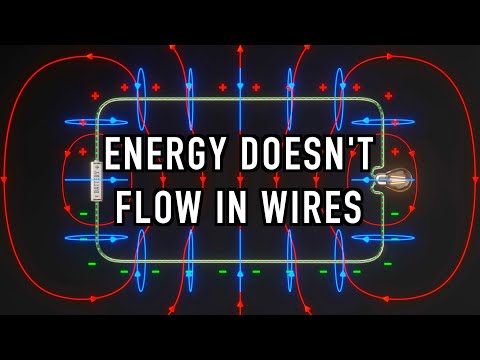
The Biggest Misconception About Electricity
What this covers
This Veritasium video, written and presented by Derek Muller, takes apart the standard picture of a circuit in which electrons carry energy around a loop and hand it to a bulb. It starts with a thought experiment: a battery, a switch and a bulb one meter away, connected by wires 300,000 kilometers long. Muller argues the bulb would light in roughly 1/c seconds, which is nanoseconds, not the second or so the electron picture would suggest. It would not get the battery's full voltage at first, only a fraction set by the impedance of the transmission lines and the bulb. The video then dismantles three claims of the electron model: that electrons hold potential energy, that they are pushed through a continuous conducting loop, and that they dissipate that energy in the device. It notes that electron drift is about a tenth of a millimeter per second and that power lines have real gaps, such as transformers.
The middle of the video builds the replacement account. John Henry Poynting, a student of James Clerk Maxwell, reasoned that local energy conservation lets you trace where energy goes. The Poynting vector, built from a cross product of the electric field and magnetic field, gives the direction of energy flux. Muller applies the right-hand rule around a battery and along the wires, showing surface charges and currents setting up fields so that energy enters the bulb from all around it. The alternating current (AC)) case is the sharpest test: electrons slosh both ways, but the fields reverse together, so energy still flows one way, from source to load.
The history is a separate thread. The failed 1858 transatlantic telegraph cable, with its smeared dots and dashes, becomes a dispute between William Thomson's water-in-a-tube view and the field-based view of Oliver Heaviside and Fitzgerald. The cable's conductive iron sheath, and the reason modern power lines hang high above damp ground, are both explained in terms of fields.
Electrical energy in circuits is not transmitted by moving electrons through wires, but rather by electromagnetic fields propagating through space around the conductors, as described by Poynting's vector.
- Electrons in AC circuits oscillate back and forth and never actually travel from source to load, yet energy flows one direction
- The Poynting vector (E × B) shows energy flux flows perpendicular to both electric and magnetic fields, through the space surrounding wires rather than within them
- Historical telegraph cable failures were solved by understanding that electromagnetic fields, not electron flow, carry signals
This asset isn't compiled yet
You're seeing its claims, ranked. Compile it to build the argument threads, weight them, and check each claim against your library — the full view.
In a circuit with extremely long wires (300,000 kilometers each, reaching halfway to the moon), if electrons carried energy, the light bulb would take approximately one second to turn on as the field propagates down the wire, but this is incorrect.
“after I close this switch, how long would it take for the bulb to light up. Is it half a second, one second, two seconds, 1/c seconds, or none of the above.”
The common explanation that electrons flow through wires like water through a tube, getting pushed and pulled by a power station 60 times per second to deliver energy, is fundamentally wrong.
“Now, this is a great story, I think it's easy to visualize, and I think my students understood it. The only problem is, it's wrong.”
There is no continuous conducting wire from a power station to a house because there are physical gaps and breaks in power lines, such as in transformers where one coil of wire is wrapped on each side of a gap, making electron flow between the two impossible.
“For one thing, there is no continuous conducting wire that runs all the way from a power station to your house. No, there are physical gaps, there are breaks in the line, like in transformers where one coil of wire is wrapped on one side, a different coil of wire is wrapped on the other side. So, electrons cannot possibly flow from one the other.”
If electrons carried energy from the power station to a device, then when those same electrons flow back toward the power station, they should also carry energy back from the house to the power station, yet energy clearly only flows one direction, which contradicts the electron-flow model.
“Plus, if it's the electrons that are carrying the energy from the power station to your device, then when those same electrons flow back to the power station, why are they not also carrying energy back from your house to the power station? If the flow of current is two ways, then why does energy only flow in one direction?”
When a battery is connected to a circuit, its electric field extends through the circuit at the speed of light, pushing electrons to accumulate on some conductor surfaces (making them negatively charged) and depleting them elsewhere (leaving surfaces positively charged), creating small electric fields inside the wires that cause electrons to drift preferentially in one direction.
“When the battery is connected into the circuit, its electric field extends through the circuit at the speed of light. This electric field pushes electrons around so they accumulate on some of the surfaces of the conductors making them negatively charged, and are depleted elsewhere leaving their surfaces positively charged. These surface charges create a small electric field inside the wires, causing electrons to drift preferentially in one direction.”
Using the right-hand rule to apply Poynting's vector around a battery in a circuit, the electric field points down and the magnetic field points into the screen, so the energy flux points to the right (away from the battery), and in fact all around the battery the energy is radially outward into the electromagnetic fields.
“Around the battery for example, the electric field is down and the magnetic field is into the screen. So, you find the energy flux is to the right away from the battery. In fact, all around the battery, you'll find the energy is radially outwards. Energy is going out through the sides of the battery into the fields.”
Along the wires in a circuit (both top and bottom), the Poynting vector shows energy flowing to the right, but at the filament (light bulb), the Poynting vector is directed inward toward the light bulb, with energy coming in from all around the bulb, taking many paths from the battery to the bulb but always transmitted by the electric and magnetic fields.
“Along the wires, again, you can use the right hand rule to find the energy is flowing to the right. This is true for the fields along the top wire and the bottom wire. But at the filament, the Poynting vector is directed in toward the light bulb. So, the light bulb is getting energy from the field. If you do the cross product, you find the energy is coming in from all around the bulb. It takes many paths from the battery to the bulb, but in all cases, the energy is transmitted by the electric and magnetic fields.”
Even though electrons in AC circuits go two ways (away from and toward the battery), using the Poynting vector shows that the energy flux only goes one way from the battery to the device, and this proves it is the fields and not the electrons that carry the energy.
“So, there are a few things to notice here. Even though the electrons go two ways away from the battery and towards it, by using the Poynting vector, you find that the energy flux only goes one way from the battery to the bulb. This also shows it's the fields and not the electrons that carry the energy.”
When an alternating current source is used instead of a battery, the direction of current reverses every half cycle, but the electric and magnetic fields flip at the same time, so the Poynting vector still points in the same direction (from source to load) at any instant, meaning the same field-based energy flow analysis applies to AC as to DC.
“Now, what happens if in place of a battery, we use an alternating current source? Well then, the direction of current reverses every half cycle. But this means that both the electric and magnetic fields flip at the same time, so at any instant, the Poynting vector still points in the same direction, from the source to the bulb. So the exact same analysis we used for DC still works for AC.”
Today, power lines are suspended high up in the air specifically to maintain a large insulating gap of air to separate the wires from the ground, because the damp earth acts as a conductor and would interfere with the propagation of electromagnetic fields if the wires were placed closer to it.
“This is why today, most power lines are suspended high up. Even the damp earth acts as a conductor, so you want a large insulating gap of air to separate the wires from the ground.”
In AC power lines carrying electricity from power plants to homes, electrons in the wires oscillate back and forth rather than traveling from source to destination, but oscillating electric and magnetic fields travel from the power station to homes, and the Poynting vector shows energy flux going in one direction from source to load.
“And this explains how energy is able to flow from power plants to home in power lines. Inside the wires, electrons just oscillate back and forth. Their motion is greatly exaggerated here. But they do not carry the energy. Outside the wires, oscillating eclectic and magnetic fields travel from the power station to your home. You can use the Poynting vector to check that the energy flux is going in one direction.”
In the telegraph cable failure debate, William Thomson (the future Lord Kelvin) believed electrical signals moved through submarine cables like water flowing through a rubber tube, while others like Heaviside and Fitzgerald argued it was the electromagnetic fields around the wires that carried energy and information, and the field-based view ultimately proved correct.
“To account for the failure, there was a debate among scientists. William Thomson, the future Lord Kelvin, thought electrical signals moved through submarine cables like water flowing through a rubber tube. But others like Heaviside and Fitzgerald, argued it was the fields around the wires that carried the energy and information. And ultimately, this view proved correct.”
The first transatlantic telegraph cable failed because the central copper conductor was coated with insulation and then encased in an iron sheath, which was intended to strengthen the cable but as a good conductor interfered with the propagation of electromagnetic fields by increasing the line's capacitance, causing signal distortion.
“To insulate and protect the submarine cable, the central copper conductor had been coated in an insulator and then encased in an iron sheath. The iron was only meant to strengthen the cable, but as a good conductor, it interfered with a propagation of electromagnetic fields because it increased the capacitance of the line.”
The three core claims of the electron-flow model—that electrons have potential energy, that they are pushed or pulled through a continuous conducting loop, and that they dissipate their energy in the device—are all false.
“These are the lies you were taught about electricity, that electrons themselves have potential energy, that they are pushed or pulled through a continuous conducting loop and that they dissipate their energy in the device. My claim in this video is that all of that is false.”
The drift velocity of electrons in a conductor is extremely slow, approximately one-tenth of a millimeter per second, yet this slow drift of charge is what constitutes the electric current (defined as positive charge flow opposite to electron motion).
“Note that this drift velocity is extremely slow around a tenth of a millimeter per second. But this is current, well, conventional current is defined to flow opposite the motion of electrons, but this is what's making it happen.”
In the giant circuit thought experiment with 300,000-km wires, after closing the switch, the light bulb will turn on almost instantaneously in roughly 1/c seconds (where c is the speed of light), which is approximately nanoseconds for a one-meter-distant bulb, because electromagnetic fields propagate at light speed through the space around the wires rather than electrons traveling along them.
“So, what is the answer to our giant circuit light bulb question? Well, after I close the switch, the light bulb will turn on almost instantaneously, in roughly 1/C seconds. So, the correct answer is D.”
The bulb will not receive the entire voltage of the battery immediately, but rather some fraction that depends on the impedance of the transmission lines and the impedance of the bulb itself.
“Now, the bulb won't receive the entire voltage of the battery immediately, it'll be some fraction, which depends on the impedance of these lines and the impedance of the bulb.”
John Henry Poynting, one of Maxwell's former students, realized that if energy is conserved locally in every tiny bit of space, one should be able to trace the path that energy flows from one place to another, leading him to develop Poynting's vector equation for describing energy flux.
“But in 1883, one of Maxwell's former students, John Henry Poynting, is thinking about conversation of energy. If energy is conserved locally in every tiny bit of space, well, then you should be able to trace the path that energy flows from one place to another.”
Engineers and scientists learned that energy is transmitted by fields rather than electron flow the hard way when the first transatlantic telegraph cable, laid in 1858, failed after only about a month and never worked properly, with signals becoming severely distorted and lengthened, making it hard to differentiate dots from dashes.
“people learned this the hard way when they started laying undersea telegraph cables. The first Trans Atlantic cable was laid in 1858. It only worked for about a month, it never worked properly. There are all kinds of distortions when they try to send signals. Enormous amounts of distortion. They could work it at a few words per minute.”
Poynting's equation applies not only to light but to any situation where electric and magnetic fields coincide; wherever both fields exist together, electromagnetic energy flows, and the Poynting vector can be used to calculate that flow.
“But the kicker is this, Poynting's equation doesn't just work for light, it works anytime there are electric and magnetic fields coinciding. Anytime you have electric and magnetic fields together, there is a flow of energy and you can calculate using Poynting's vector.”
In the context of light, Poynting's equation shows that electromagnetic energy flows perpendicular to both the electric and magnetic fields, and in the same direction as the light is traveling, confirming that light does carry energy from its source to its destination.
“So, what this shows us about light is that the energy is flowing perpendicular to both the electronic an the magnetic fields. And it's in the same direction as the light is traveling, so this makes a lot of sense. Light carries energy from its source out to its destination.”
When a battery is isolated and not connected to a circuit, it has an electric field but no magnetic field (because no charges are moving), so the battery does not lose energy.
“To illustrate this, let's consider a simple circuit with a battery and a light bulb. The battery by itself has an electric field but since no charges are moving, there is no magnetic field so the battery doesn't lose energy.”
The surface charges on conductors in a circuit create a small electric field inside the wires, and the current inside the wires creates a magnetic field outside the wires, so together there is a combination of electric and magnetic fields in the space around the circuit through which energy flows according to Poynting's vector.
“The charge on the surfaces of the conductors also creates an eclectic field outside the wires and the current inside the wires creates a magnetic field outside the wires. So, now there is a combination of electric and magnetic fields in this space around the circuit.”
The cross product E × B of the electric and magnetic field vectors is calculated by multiplying their perpendicular magnitudes, and the direction is determined using the right-hand rule: point fingers in the direction of the first vector (electric field), curl them toward the second vector (magnetic field), and the thumb points in the direction of the resulting energy flux vector.
“Now, E X B, is the cross product of the electric and magnetic fields. Now, the cross product is just a particular way of multiplying two vectors together, where you multiply their perpendicular magnitudes and to find the direction, you put your fingers in the direction of the first vector, which in this case is the electric field, and curl them in the direction of the second vector, the magnetic fields, then your thumb points in the direction of the resulting vector, the energy flux.”
The Poynting vector is defined as S = (1/μ₀)(E × B), where E × B is the cross product of the electric and magnetic field vectors, and the result gives the direction and magnitude of electromagnetic energy flux (energy per unit area per unit time).
“Poynting works out an equation to describe energy flux, that is, how much electromagnetic energy is passing through an area per second. This is known as the Poynting vector and it's given the symbol S. And the formula is really pretty simple, it's just a constant one over mu naught, which is the permeability of free space times E X B.”
Electrons are extremely immobile in AC circuits, barely moving at all, so they cannot possibly be the delivery mechanism for the energy that reaches our homes essentially instantaneously.
“How far do the electrons go in this little thing you're talking about, they barely move, they probably don't move at all.”
In the 1860s and 1870s, James Clerk Maxwell discovered that light is made up of oscillating electric and magnetic fields that oscillate perpendicular to each other and are in phase, meaning when one field reaches its maximum, the other simultaneously reaches its maximum.
“In the 1860's and 70's, there was a huge breakthrough in our understanding of the universe when Scottish physicist, James Clerk Maxwell, realized that light is made up of oscillating electric and magnetic fields. The fields are oscillating perpendicular to each other and they are in phase, meaning when one is at its maximum, so is the other wave.”
Energy from the sun travels through space for eight minutes in the form of electromagnetic radiation, during which the energy is stored and transmitted in the oscillating electric and magnetic fields of the light wave.
“So, think about the energy that comes to us from the sun, during those eight minutes when the light is traveling, the energy is stored and being transmitted in the electric and magnetic fields of the light.”
The idea that electromagnetic energy flows through space around conductors rather than through the wires themselves is counterintuitive for most people, but understanding this principle is important for thinking about electricity.
“For most people, and I think to this day, it's quite counterintuitive to think that the energy is flowing through the space around the conductor, but the energy is, which is traveling through the field, yeah, is going quite fast.”
The speaker consulted several physics experts about the giant circuit question and received different answers, but all experts agreed on the main points about how field propagation governs the outcome.
“Now, I asked several experts about this question, and got kind of different answers, but we all agreed on these main points.”