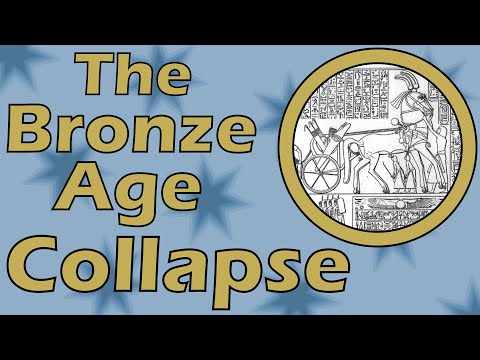
The Bronze Age Collapse (approximately 1200 B.C.E.)
What this covers
This 24-minute Historia Civilis video, narrated by a single unidentified voice, surveys the collapse of the Late Bronze Age world around 1200 BCE. It begins with how the region got there: a move from priest-ruled city-states to large empires, supported by agricultural surpluses and international trade. It then follows the sources, including the Medinet Habu inscription in which Ramses III describes waves of invaders over some thirty years. Letters from the King of Ugarit to the King of Cyprus, reporting burned cities and an army posted far away, and a plea from Emar about famine, give the period a human voice. The description credits Eric Cline, Robert Drews, and others as sources.
The range is wider than the invasion story. The video explains why bronze made the system fragile: copper from Cyprus was plentiful, but tin was scarce, and the sources lay in distant Afghanistan or Cornwall. It also covers the chariot, a costly weapon that dominated warfare and fed a chariot arms race. Against it the video sets the Sea Peoples, described as a mixed coalition traveling with families, whose mobile infantry fought in a way chariots could not handle. Paleoclimate evidence, including pollen records from Syria and Cyprus, points to prolonged drought. There is also evidence of earthquakes and of unrest in Greece before the collapse, including palace fires that suggest uprisings.
Some of these claims are contested. These include the earthquake evidence, in particular the observation that Egypt, the one major survivor, was relatively spared. They also include the identity of the Sea Peoples and the old theory that northern European famine set off southward migrations. The video notes that Egypt won its final battle at the Nile mouth yet was permanently weakened. It closes by saying the root causes are still theories, though recent research may yield firmer answers.
The Bronze Age Collapse around 1200 BCE resulted not from a single cause but from a cascading systems failure in which climate-induced famine, seismic activity, internal political instability, trade disruption, and Sea Peoples invasions created multiplicative crises that simultaneously overwhelmed multiple civilizations.
- Bronze Age states were simultaneously stressed by environmental drought, widespread earthquakes, crop failures, and internal uprisings before the Sea Peoples arrived
- The Sea Peoples' novel foot-based tactics with longswords and javelins rendered the chariot-dependent warfare of Bronze Age militaries obsolete
- Disruption of international tin and copper trade networks collapsed the entire basis of Bronze Age technology and military capacity
This asset isn't compiled yet
You're seeing its claims, ranked. Compile it to build the argument threads, weight them, and check each claim against your library — the full view.
The Sea Peoples fought on foot using longswords and javelins with unmatched aggression in a highly mobile style described as 'runners'—exploding outward in unexpected bursts and able to get cut off from main groups—which made them 'chariot-killers' because chariots couldn't outrun 10, 100, or scattered groups attacking from multiple directions, and couldn't turn quickly enough, so one wrong move allowed the Sea Peoples to overwhelm and destroy a chariot.
“A much better word that I've seen used is 'runners.' The Sea Peoples were runners. They were highly mobile, and weren't locked down into tight little groups like the spearmen were. Instead, their way of fighting was to explode outwards in unexpected bursts.”
Tin is extremely rare and unevenly distributed across Earth, with a tiny mine in Anatolia controlled by the Hittites producing insufficient supply, the next major source in Afghanistan over 3,000 kilometers away making transport expensive and dangerous, alternative mines in Italy and Spain unable to meet demand, and the only other comparable source being in Cornwall, Britain—a risky but profitable voyage.
“That brings us to tin. Tin is funny, because it's actually extremely rare, and it's not evenly distributed across the Earth.”
Disruption of international trade by Sea Peoples attacks slowed bronze production and weakened every state in the region through a vicious cycle in which more attacks meant less trade, less trade made everybody more vulnerable to additional attacks, and as Bronze Age states collapsed, the situation grew progressively worse.
“So as you can see, any disruption in this supply chain meant that it was no longer possible for Bronze Age civilizations to produce bronze. Which by very definition was a problem. So the argument goes that the Sea Peoples attacks disrupted international trade, slowed down the production of bronze, and weakened every state in the region. It was a vicious cycle.”
Similar environmental changes have been found in the Levant, Anatolia, and Greece, with evidence in Greece showing plants evolving over hundreds of years to survive desert-like environmental conditions.
“Similar things have been found in the Levant, Anatolia, and Greece. In fact, in Greece there's evidence that over hundreds of years, plants that were evolving to survive a desert-like environment.”
Pollen samples from northern Syria indicate a 'dry event' lasting 300 years beginning just before the Bronze Age Collapse, while pollen samples from Cyprus show environmental changes so severe that rainfall was insufficient to sustain basic agricultural activity, which would have been catastrophic.
“We now have ancient pollen samples from northern Syria, which seem to point towards a 'dry event' lasting for 300 years, beginning just before the Bronze Age Collapse.”
If reports of the environmental emergency are true (and experts believe they are), Bronze Age civilizations may have been in a state of crisis before the Sea Peoples even arrived, undermining the previous assumption that the invasions were the primary cause of collapse.
“If these reports of an environmental emergency are true, and we think they are, the Bronze Age civilizations may have been in a state of crisis before the Sea Peoples even arrived.”
The King of Ugarit wrote to the King of Cyprus reporting that enemy ships had set fire to his cities, but his entire infantry and chariot forces were stationed far away at Khatte and Lukka respectively, leaving the land defenseless, and that Ugarit was subsequently sacked with its food supplies and vineyards destroyed.
“Some time around the beginning of the 12th century, the King of Ugarit, a city in the Hittite Empire, wrote a letter to the King of Cyprus. 'My father, now the ships of the enemy have come. They have been setting fire to my cities and have done harm to the land.'”
Within a single generation around 1200 BCE, nearly all of Earth's most technologically advanced civilizations—Egypt, Cyprus, the Mycenaeans, the Hittites, Assyria, and Babylonia—faced an existential crisis, and most of them failed, resulting in a collapse comparable in scope to the fall of the Roman Empire.
“Within the short span one generation, the majority of Earth's most technologically advanced civilizations faced an existential crisis. Nearly all of them failed the test.”
Greece was plagued by internal instability for the last hundred years before the collapse, with evidence of massive fires intermixed with arrowheads and weapons indicating series of battles where defenders were defeated, smaller fires confined to palace structures indicating popular uprisings where local kings were overthrown, and other cities showing signs of abandonment due to famine or natural disaster.
“For the last hundred years, the Mycenaeans had been plagued by internal instability. There are signs of destruction everywhere.”
Bronze Age warfare in Western Asia was completely organized around the use of chariots, which typically consisted of two horses and two humans (a driver and archer), could move roughly twice as fast as a human running, and wielded composite bows that could punch through 3 inches of metal, making experienced chariot teams capable of defeating armies 10 times their size.
“Bronze Age warfare in Western Asia was all about chariots. In the Early Bronze Age they were primarily used for transportation, but by the Intermediate Bronze Age the militaries of every major state in the region were completely designed around the use of the chariot.”
Bronze is made by combining 9 parts copper with 1 part tin, with copper being relatively common but difficult to mine, and Cyprus containing abundant easily-mined copper that made it a fabulously wealthy hub of international trade.
“Bronze Age civilizations needed bronze. Obviously. Without a constant supply, many of their cutting-edge technologies began to deteriorate. Bronze is made by combining 9 parts copper with 1 part tin.”
In the final battle at the mouth of the Nile, Egypt's armies had become predominantly based on spearmen and archers rather than chariots, with the Egyptians protecting the Nile mouth with a wall of ship-mounted archers and positioning every spearman in Egypt to defend against the Sea Peoples landing on shore, resulting in Egyptian victory but devastating damage to Egypt despite the military success.
“Clearly the bulk of the fighting was among the spearmen and archers. In writing we are told that the Egyptians protected the mouth of the Nile by making a wall out of ships, each loaded with archers. We're also told that every spearman in Egypt was in position and waiting for the Sea Peoples to landed on shore.”
The Bronze Age world of Western Asia began as a transition from oppressive totalitarian priest-ruled city-states to a new world of vast, sweeping empires with new religions, systems of government, cultures, and technologies, enabled by agricultural revolutions producing food surpluses that allowed the rise of large multicultural cities and dynamic international trade systems.
“When the Bronze Age began in Western Asia, it brought to an end an old world of tiny city-states ruled by an oppressive class of totalitarian priests. The new world that came after was one full of possibilities.”
There is evidence of earthquakes destroying cities in Greece, Anatolia, the Levant, and Cyprus, with Greece suffering the most severely, while Egypt was relatively unaffected—an interesting fact considering Egypt was the only major state that survived.
“There's at least some evidence of earthquakes destroying cities in Greece, Anatolia, the Levant, and Cyprus. Greece seems to have got the worst of it. Egypt got off easy, which is an interesting fact considering that they were the only major state left standing.”
Chariots were extremely expensive to produce and maintain, requiring horses to be specially bred and trained at great cost, hand-crafted artisan equipment costing at least twice the price of horses, and the loss of a single chariot was catastrophic, so chariots went into battle protected by thousands of inexpensive spearmen and archers in defensive lines.
“But they were expensive as hell. Horses had to be specifically bred and trained, which cost a small fortune. The equipment was all hand-crafted by artisans, and cost at least twice as much as the horses did.”
An inscription at the Egyptian temple of Medinet Habu records that Egyptian Pharaoh Ramses III described several waves of foreign invaders—the Sea Peoples—arriving over 30 years, with the inscription stating 'the foreign countries made a conspiracy in their islands. All at once the lands were removed and scattered in the fray. No land could stand before their arms.'
“This inscription was discovered in an Egyptian temple in Medinet Habu. It changed our understanding of the Late Bronze Age forever.”
Even in its military victory against the Sea Peoples, Egypt suffered so severely that it became a second-rate power and had not fully recovered even after a thousand years.
“After so many incredible successes, the Sea Peoples were finally defeated in Egypt. But even in victory, Egypt suffered. From this moment forward Egypt was a second-rate power, and even after a thousand years it had not yet fully recovered.”
A letter from the nearby city of Emar written during one of the later invasions states 'there is famine in [our] house; we will all die of hunger. If you do not quickly arrive here, we ourselves will die of hunger. You will not see a living soul from your land.'
“There's another letter from the nearby city of Emar, written during one of the later invasions. It reads, "there is famine in [our] house; we will all die of hunger. If you do not quickly arrive here, we ourselves will die of hunger. You will not see a living soul from your land."”
The migration of the Sea Peoples coincided with a 50-year period where Western Asia was riddled with massive earthquakes, which may have economically devastated the region, with some mysteriously abandoned cities possibly having been abandoned after seismic events rather than other causes.
“According to experts, the migration of the Sea Peoples coincided with a 50-year period where Western Asia was riddled with massive earthquakes. I'm no scientist, but that seems bad.”
Cyprus was under simultaneous attack around the same time as the mainland, with several larger cities especially on the western coast burned and many smaller inland cities abandoned, with wealthy residents burying valuables expecting to return but never doing so.
“Cyprus was under attack at around the same time. Several larger cities, especially on the western coast, were burned, and many of the smaller cities further inland were simply abandoned. Wealthy residents buried their valuables, with plans to return once the crisis had blown over. They never returned.”
The Sea Peoples were a loose coalition of groups from across the Mediterranean, likely including most people from Sicily, Sardinia, Crete, and the Aegean coast, who wore different clothing styles—some feathered headdresses, horned helmets, kilts, tunics, body armor, or fought shirtless—unified by their migration to the region traveling on boats and wagons with families and possessions.
“Historians have simply taken to calling them the Sea Peoples. We now think that the Sea Peoples were loose coalition of groups from all across the Mediterranean. We can't be 100% sure of this, but we can say with some confidence that most of them were from Sicily, Sardinia, Crete, and the Aegean coast.”
Scholarship on the Bronze Age Collapse remains ongoing with significant breakthroughs occurring within the last 10 years, meaning we may see definitive answers in our lifetimes, but we do not currently know the root causes with certainty—we only have theories.
“Scholarship in this area is ongoing. There have been significant breakthroughs just within the last 10 years. We may see some definitive answers in our lifetimes. But for now, we don't know.”
By the Late Bronze Age, the region was in the midst of a chariot arms race, with states continuously increasing the size and cost of their military establishments in an attempt to maintain military dominance through chariot superiority.
“As we get into the Late Bronze Age, the region was in the midst of a chariot arms race. And then the Sea Peoples came.”
A long-standing scholarly theory held that famine in northern Europe caused a domino effect of southward migrations culminating in the Sea Peoples migrating across the Mediterranean, which made sense on paper but had very little evidence to support it until recently.
“For a long time, scholars guessed that some kind of famine in northern Europe caused a domino effect of southward migrations, culminating with the Sea Peoples packing up and fleeing across the Mediterranean Sea. This always made sense on paper, but there was very little evidence to support this theory. Until now.”