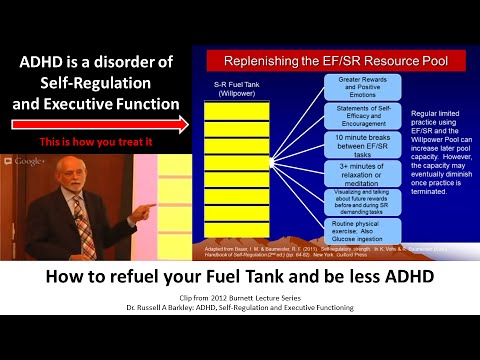
This is how you treat ADHD based off science, Dr Russell Barkley part of 2012 Burnett Lecture
What this covers
This is a 14-minute excerpt from the end of the second part of Russell Barkley's 2012 Burnett Lecture, just before the Q&A. He speaks alone, and the segment works as a closing on treatment. It follows his theory of executive functions and describes how the disorder reaches into money management, driving, friendships and family life. He casts ADHD as an intention deficit and time-blind behavior disorder and compares it to driving, a layered system that runs through the whole day. He also frames it as a chronic disease needing daily management, "the diabetes of psychiatry". On persistence, he says roughly one in six to one in three people outgrow it and about two-thirds do not.
The treatment argument rests on where help has to be delivered. Because time blindness leaves information with no controlling value over behavior, he says skills training in an office or classroom falls short. Support has to arrive at the point of performance, through a prosthetic environment built from external scaffolding. One of his more contentious positions is that people with ADHD should not be excused from consequences. Accountability should be tightened, with consequences made closer in time and more frequent, even artificial ones. He also argues that keeping a child in from recess to finish homework backfires.
The segment draws on the executive function fuel tank metaphor. Blood glucose, aerobic exercise, rewards and self-efficacy statements are all said to refill or enlarge it. He doubts that practicing working memory improves real-world outcomes. He calls medication neurogenetic therapy and describes ADHD as highly treatable, with a response rate of about 90 percent. He names three programs from Russ Ramsey, Steve Safren and Mary Santo as boosting medication effects in adults. He ends on undertreatment, which he says is the real problem, not overtreatment.
ADHD is fundamentally an executive function disorder, not an attention disorder, requiring environmental scaffolding and medication as neurogenetic therapy rather than skill-building interventions alone.
- The brain separates knowledge (back) from performance (front); ADHD splits these, creating an intention deficit disorder where people know what to do but cannot execute it
- Executive deficits require external environmental redesign (physical information, time externalization, consequence proximity) not knowledge transfer
- ADHD is the most treatable psychiatric disorder with 90% medication response rates and effective psychosocial interventions, yet 40-90% of cases go untreated
This asset isn't compiled yet
You're seeing its claims, ranked. Compile it to build the argument threads, weight them, and check each claim against your library — the full view.
ADHD is an executive function disorder, not an attention disorder, with the problem residing in the ability to perform known behaviors rather than in acquiring knowledge
“you have a disorder of performance not knowledge you know what to do but can't do it you have a disorder of the when and the where not the what and the how your problem is not with knowing what to do it's with doing what you know”
ADHD is described as 'the diabetes of psychiatry' - a chronic disorder that must be managed every day to prevent secondary harms, with no cure and variable rates of persistence into adulthood
“ADHD is the diabetes of Psychiatry it's a chronic disorder that must be managed every day to prevent the secondary harms it's going to cause but there is no cure for this disorder”
ADHD is caused by neurogenetic deficits, making medication (neurogenetic therapy) absolutely justifiable as part of treatment
“all of this in ADHD is due to neurogenetic deficits and that means that medication is absolutely justifiable after all if you have a neurogenetic disorder then neurogenetic therapies have a role to play in your disorder”
Regular aerobic exercise boosts the executive function fuel tank, creates a bigger tank, and benefits ADHD more than any other psychiatric disorder
“physical exercise routine aerobic exercise boosts the tank refuels it and creates a bigger tank everybody with ADHD should be involved in an exercise program because research shows it benefits this disorder better than any other psychiatric disorder”
Blood glucose (sugar in the bloodstream) in the frontal lobe is directly correlated with executive function capacity; therefore, maintaining elevated blood glucose during executive-demanding tasks is beneficial for ADHD
“the fuel in the tank is sugar in the bloodstream in the frontal lobe blood glucose in the frontal lobe is directly correlated with executive abilities what does that mean if you have an extensive task involving your executive brain like an exam that you have to do you better be sipping on some lemonade or a Gatorade or a sports drink”
The executive system in ADHD is not a single level of cognition but a complex multi-level system similar to driving, which extends throughout daily life and affects all dimensions of functioning
“the executive system is a very complex multi-level system like driving it is not one level of cognition and that's all it is it's multi-level it's complex and it extends into our daily life”
ADHD interferes with all seven executive functions and creates time blindness, preventing people from directing their behavior toward future goals and self-care
“it's going to put all five of those levels at risk because it interferes with all seven executive functions and you're going to have time blindness and you won't be able to aim your behavior toward the future to care for yourself as effectively as other people are able to do”
The primary problem with ADHD is undertreatment, not overtreatment: 40% of children and 90% of adults with ADHD are not recognized or treated for their disorder
“the biggest problem is most people don't get treatment 40% of children and 90% of adults with adht are not recognized or treated for their disorder that's the problem not that we're overtreating we are undertreating and we're undertreating the most treatable disorder in Psychiatry”
People with ADHD have difficulty in all dimensions of executive functioning affecting money management, driving, friendships, family relationships, and getting along with others
“people with ADHD have problems in all dimensions of executive functioning in their daily life and that is going to lead them to have great difficulty in getting along with other people building up friendships networks cooperatives subordinating their interest to others all the things in that involve executive functioning from money management to driving to friendships to families and so on are at grave risk”
There is no convincing evidence that training working memory through practice improves real-world outcomes in ADHD, though the possibility exists
“you might be able to train up some of these executive functions we don't know that yet we don't know whether practicing working memory actually helped you in life there's no evidence that it does at this point at least convincingly but there's a possibility”
Rewards and positive emotions boost the executive fuel tank; self-efficacy statements ('I can do this', 'I know I can do this') also boost motivation similar to a locker room pep talk before a game
“there are lots of things we have discovered to boost the tank the use of rewards and positive emotions the use of self- statements of Effectiveness I can do this I know I can do this this is the locker room pep talk before the game helps to boost motivation”
Interventions for ADHD must be deployed at the point in the environment where the person is failing to execute known behavior, not in the office or classroom where knowledge transfer occurs
“all interventions must be out at that place in the environment where you're not doing what you know to help you show what you know I have to create scaffolding around you”
Three tested programs have been shown to boost medication effects in adults with ADHD: Russ Ramsey's cognitive behavioral therapy program, Steve Safren's program based on executive functioning model, and Mary Santo's program for training executive functioning
“there are various approaches on the market for adults and college students with ADHD that incorporate these ideas Steve's or Russ Ramsey's program which is cognitive behavioral therapy does a pretty good job of it...Steve saffron's program even better because it's based on this model of executive functioning...the most recent one came out this March it is the most heavily executive in nature it is Mary Santo's program for training executive functioning in adults with ADHD these are the three tested programs that have been shown to boost medication effects”
ADHD is the most treatable psychiatric disorder with 55% of people on medication achieving normalization, 90% showing response to medication, effects three times greater than anxiety drugs and antidepressants, and many effective psychosocial treatments
“it's the most treatable dis disorder in Psychiatry there is no disorder that we treat that has as many medications and as many psychosocial treatments that are as effective as these are for as many people producing more change than any other medications and psychosocial treatments for these individuals do you know that 55% of people on medication are normalized 90% of them respond do you know that the effects of ADHD medications are three times that of anxiety drugs and anti-depressants”
Helping people with ADHD requires designing 'prosthetic environments' around them using environmental scaffolding combined with medication as neurogenetic therapy to compensate for executive deficits
“we are going to have to help people with ADHD build the scaffolding around them and use the medication as neurogenetic therapy with them in order to compensate for these executive deficits we're going to have to design prosthetic environments around them”
Approximately 80% of people with ADHD will be on medication at some point in their life, and medication is the most effective treatment available for the disorder
“80% of people with ADHD will be on medication at some point in their life and good thing it's the most effective thing we have”
Approximately one in six to one in three people with ADHD may outgrow it, but the vast majority (approximately two-thirds) will continue to have ADHD into adulthood
“about one in six people might outgrow it maybe as many as one and three not sure yet but the vast majority two-thirds are going to continue to be ADHD in adulthood”
Teaching skills to people with ADHD is inadequate because they understand instructions but fail to implement them in real-world situations; the information has no controlling value over their behavior
“teaching skills is inadequate it won't work you can sit down with somebody with ADHD and tell them what they need to do good luck right it's not even going to leave your office it act like they're stupid they're not they know what to do they know what you're telling them to do right they're not going to do it when they get out there that information has no controlling value over their life”
People with ADHD should not be excused from consequences of their behavior because their problem is not with consequences themselves but with the delay between action and consequence
“we are not to excuse you from your mistakes because the problem you're having is not with consequences so why would I excuse them the problem you're having is with the delay to the consequence”
The solution to executive deficits is to tighten accountability by bringing consequences closer in time and making them more frequent and artificial if necessary, rather than reducing accountability
“the solution to anybody's problem with an executive deficit is to tighten up accountability to make you more accountable more often to other people with more consequences artificial as they may need to be but I need to bring consequences very close to you in time”
Keeping ADHD children in from recess when homework is incomplete is counterproductive because it removes the opportunity to refuel the executive tank, worsening subsequent performance
“what does it say about keeping Kids In For Recess when they don't get all their homework done you just shot yourself in the foot”
Important social consequences are delayed consequences, and ADHD creates a problem with the temporal delay between actions and their social outcomes
“all important social consequences are delayed consequences and that's your problem time”
ADHD is a performance/intention deficit disorder characterized by time blindness and inability to aim behavior toward future goals, not a disorder of knowing what to do or how to do it
“you have intention deficit disorder you have a disorder of performance not knowledge you know what to do but can't do it”
ADHD disrupts executive systems through behavioral innovation (generating excessive alternative behaviors) and elimination of competing executive abilities, putting people at risk across all functional domains
“ADHD disrupts that system through behavioral Innovation and wiping out all the other executive abilities which puts you at risk for failing in your executive activities in your daily life”
Sugar (in fluid form delivered quickly to the brain) helps rather than hurts people with ADHD during cognitive tasks, contrary to common belief
“this is the opposite of what people once thought sugar hurts people with ADHD no it does not and never did but it may well help them if it's in fluid form that can get into the brain very quickly”
Behavior Disorder (BOD) interventions work by placing artificial consequences throughout the environment, and their success depends on the willingness of stakeholders in the natural environment to implement these changes
“BOD allows me to sprinkle artificial consequences all throughout the environment to improve your functioning and that means that the success of my intervention is based on the willingness of other people in the natural environment to make those changes if they're not willing to build ramps so to speak to build the scaffolding it's not going to work the stakeholders have to be involved”
The first intervention for ADHD is to externalize mental information by making it physical through cues, signs, charts, reminders, and to-do lists placed in the visual field
“you have to make mental information physical you must externalize the information because working memory is shot that means we have to use cues signs charts reminders doist I got to put stuff in your visual field to remind you of what needs to be done right here right now make it external”
Time must be made physical and external through clocks, timers, counters, and watch reminders so that people with ADHD can see time passing and judge their performance against it
“I have to do is make time physical real through clocks timers counters watch minders anything I can enlist that is going to put time outside of you so that you can see it passing and judge your performance relative to it because you have no clock we got to put one in in your visual field”
Long assignments spanning extended time periods should be broken into small quotas and baby steps completed frequently, because people with ADHD cannot manage delays and will not complete lengthy projects independently
“I'm going to have to take lengthy assignments because they involve spans of time and get rid of time make them small quotas little baby steps over the bridge in time a little bit of work done frequently over time and will get you there but you will not do book reports and science projects and other things on your own you can't those involve delays and you can't handle delays”
Motivation must be made external because people with ADHD cannot generate internal motivation and are dependent on environmental incentives; consequences must be immediate or they will be ineffective
“you have to make motivation external they can't create internal motivation they are dependent on the environment for their motivation you must put the consequences in the now or they will not work for you”
Parents must negotiate explicit deals with ADHD children that specify what is in it for them (rewards, points, tokens, privileges) as consequences for completing tasks
“you've got to create motivation you're going to start to have to make a deal with your kids what's in it for them what are you putting in it for them what are you creating what's the reward what's the points what's the token What's the sex the drugs and the money whatever it is you're going to have to negotiate a deal there has to be a consequence or it isn't going to get done”
People with ADHD cannot perform mental manipulations (like reversing digit sequences) as well as others due to working memory limitations, so manual/external problem-solving aids should be provided
“you have to make problem solving manual remember they cannot do mental manipulations like other people this is why they can't do digit span backward but it has nothing to do with digit span they can't hold things in mind and move them around as well as other people so don't make them do it put it in their hands”
The executive system has a limited 'fuel tank' that depletes with continuous use, and if the tank is empty in the next situation, the person will have no self-control
“the executive system has a limited fuel tank and you can spend it out real quick every time you use an executive function and you use it continuously you empty the tank and if you get to the bottom of the tank in the next situation you will have no self-control this is the ADHD child after school gone”
Taking frequent 10-minute breaks (following a 10 and 3 rule: 10 minutes work, 3 minute break) allows the executive fuel tank to refuel; avoiding breaks causes depletion and dysregulation
“you need to take 10-minute breaks very often indeed more often you need to break pass down into smaller units and take frequent breaks and during those breaks a little relaxation and meditation helps to refuel the tank...10 minutes of work three minute break 10 and three 10 and three but you can't do more than 10 you're starting to empty the tank”
Knowledge and performance are separate brain systems, with the back of the brain (knowledge/learning) separate from the front (performance/doing), and ADHD splits these systems apart
“you have a brain the back part of it is where you learn the front part is where you do knowledge performance knowing doing and ADHD splits them apart”
Even a 'brightest kid in the world' will not succeed with ADHD if knowledge cannot be converted to performance, because knowledge without performance is worthless
“I don't care what you know you won't use it you can be the brightest kid in the world not going to matter”
Video games are more effective than homework at sustaining effort in people with ADHD because games provide external continuous reinforcement while homework relies on internal motivation
“this is what video games do and what homework does not which is why they can play video games for hours and not do their homework for more than a few minutes video Games provide external continuous reinforcement homework does nothing video games do not need ex or internal motivation whereas homework does”
Visualizing and discussing future rewards boosts the executive fuel tank and helps sustain motivation over time
“visualizing and talking about the future rewards will help you boost the tank”