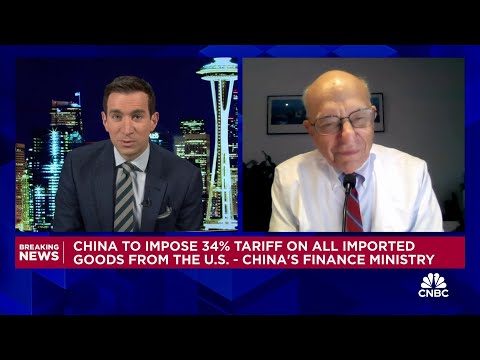
Wharton's Jeremy Siegel on Trump tariffs: This is the biggest policy mistake in 95 years
What this covers
This is a short CNBC "Squawk Box" interview in which Jeremy Siegel, Wharton professor emeritus and WisdomTree's chief economist, answers questions from the hosts about the market and economic fallout from Donald Trump's sweeping new tariffs. A news host also interjects with a report that China's finance ministry will impose an additional 34% tariff on US goods starting April 10th. Most of Siegel's case rests on a historical parallel with the Smoot-Hawley Tariff of 1930. He notes that a thousand economists urged Herbert Hoover to veto it, that the Republican Senate's own website now calls it among the most catastrophic acts in congressional history, and that voters removed Republicans from the House, Senate, and presidency by 1932. He also suggests Trump may not have absorbed that lesson.
The interview then moves from history to the present. Siegel argues that trade matters far more to the global economy now than it did 95 years ago, so the damage could be worse. He calls the tariffs a self-inflicted wound and an unforced error, and says the nightmare is retaliation (in trade context)). The host adds that nobody wants to go first, but once China does, others may follow.
On monetary policy, Siegel says the Fed learned from its failure to supply liquidity in 1930-32, which he credits with keeping 2008 from becoming a depression. He now expects rate cuts, possibly as early as May, a reversal of his earlier view. He expects higher short-term inflation to be tolerated, citing Powell's statement at the March FOMC (Federal Open Market Committee)) meeting that the Fed would "see through" it. The remarks on investing are brief: market timers tend to do badly, and long-term investors should stay put because tariffs won't last forever. The Smoot-Hawley comparison and the rate-cut forecast are the most contestable claims.
Jeremy Siegel argues that Trump's tariff policy represents a catastrophic policy mistake comparable to Smoot-Hawley, but the Fed will likely cut rates in response and long-term investors should remain invested despite near-term market volatility and the nightmare scenario of retaliatory tariffs.
- Trump's tariffs are compared unfavorably to Smoot-Hawley, which the Republican Senate itself labeled 'among the most catastrophic acts in congressional history'
- The Fed learned from 1930-32 mistakes and will cut rates to mitigate the shock, preventing a depression-like scenario
- Long-term investors should stay in markets as tariffs are temporary and American economy remains fundamentally strong
This asset isn't compiled yet
You're seeing its claims, ranked. Compile it to build the argument threads, weight them, and check each claim against your library — the full view.
The Smoot-Hawley Tariff resulted in consequences so disastrous that the American public voted the Republicans out of the House, Senate, and the presidency two years later (by 1932).
“And then it goes on saying the results were and to use their words disastrous. So disastrous that the American public voted the Republicans out of the House, the Senate, and the presidency two years later.”
The Federal Reserve made serious mistakes in 1930-1932 by not flooding banks with liquidity during the crisis, a lesson it has now learned and will not repeat, which is why the 2008 Great Financial Crisis did not turn into a Great Depression.
“To be fair, the Fed screwed up badly afterwards as the economy sunk as a result of this. And they're not going to do that again because they've learned that lesson. I don't know why Trump didn't learn the lesson of the Smoot Holly tariff because I know the Fed learned the lesson of its mistakes in 1930 31 and 32. That's one reason why the great financial crisis did not turn into a great depression. We flooded the the banks with liquidity which we did not do 95 years ago.”
The Republican-controlled US Senate's own website characterizes the Smoot-Hawley Tariff (passed June 13, 1930) as 'among the most catastrophic acts in congressional history,' despite a thousand economists writing to President Hoover urging him to veto it.
“on the Republican Senate's website, so if you go to senate.gov um and look up tariffs, this is what they say. It was on June 13, 1930 that the Senate passed the Smoot Holly tariff, describing it as among the most catastrophic acts in congressional history. Now, this is the Republican controlled US Senate and it said despite the fact that a thousand economists wrote a letter to Hoover saying veto it, he did not veto it.”
The Republican public response to Smoot-Hawley was so negative that voters removed Republicans from the House, the Senate, and the presidency just two years later in 1932.
“So disastrous that the American public voted the Republicans out of the House, the Senate, and the presidency two years later.”
A thousand economists wrote a letter to President Hoover urging him to veto the Smoot-Hawley tariff, but he did not veto it, and the Republican Senate later acknowledged the results were 'disastrous.'
“a thousand economists wrote a letter to Hoover saying veto it, he did not veto it. And then it goes on saying the results were and to use their words disastrous.”
Trade is a much larger and more important part of the global economy now than it was 95 years ago when Smoot-Hawley was enacted, meaning the implications of current tariffs are potentially much worse than the 1930s tariffs.
“trade is a much more important part of the global economy than it was 95 years ago when the Smoot Holly tariff was put on. So the implications are potentially a lot worse.”
Other nations are unlikely to immediately retaliate against US tariffs because 'nobody wants to go first,' but once one nation (like China) goes first, it emboldens other countries to follow with their own retaliatory measures.
“I think the bigger question is does that embolden other nations to do the same? Um, perhaps it does. Um, uh, nobody wants to go first, but yeah, I mean, they go first and that could do that. Um, embolden others.”
Market timing as an investment strategy fails for approximately 95% of non-market timers, so most investors are better served by buy-and-hold strategies than by attempting to time market entry and exit points.
“if you're a trader, there are storms ahead... uh if you're a market timer which I don't advocate as we all know they 95% of non-market timers do very badly.”
Trade is a much more important part of the global economy now than it was 95 years ago during the Smoot-Hawley period, making the implications of current tariffs potentially worse than the historical precedent.
“by the way um you know trade is a much more important part of the global economy than it was 95 years ago when the Smoot Holly tariff was put on. So the implications are potentially a lot worse.”
Market timers perform badly, with 95% of non-market timers doing very poorly, making market timing an ineffective strategy during volatility.
“if you're a market timer, which I don't advocate as we all know they 95% of non-market timers do very badly.”
Trump's tariff policy represents the biggest policy mistake in 95 years, comparable to the Smoot-Hawley tariff of 1930 which the Republican-controlled Senate itself described as 'among the most catastrophic acts in congressional history.'
“I think this is the biggest policy uh mistake in 95 years. And what is interesting is on the Republican Senate's website, so if you go to senate.gov um and look up tariffs, this is what they say. It was on June 13, 1930 that the Senate passed the Smoot Holly tariff, describing it as among the most catastrophic acts in congressional history.”
The Federal Reserve made serious mistakes in 1930-1932 by not flooding banks with liquidity, a lesson they have learned and will not repeat, which is one reason the 2008 financial crisis did not turn into a Great Depression.
“To be fair, the Fed screwed up badly afterwards as the economy sunk as a result of this. And they're not going to do that again because they've learned that lesson... We flooded the banks with liquidity which we did not do 95 years ago. But very honestly... That's one reason why the great financial crisis did not turn into a great depression.”
The Federal Reserve will lower interest rates in response to the tariff-induced global shock, even though this will produce higher inflation in the short term, because Powell himself stated at the March FOMC meeting that the Fed will 'see through' the inflation impact.
“I think the Fed is going to be lowering interest rates. I think they have to lower interest rates uh as a result of this global shock and um yes there will be higher inflation to be sure um but uh this is a you know you know Jo described as a self-inflicted wound unforced error like um did not have to happen supply shock uh Powell himself said at the March FOMC meeting you know uh We're we're going to see through the inflation impact of this.”
The Federal Reserve will lower interest rates in response to the global shock created by tariffs, which will produce higher inflation as a side effect, but Fed Chair Powell has already signaled (at the March FOMC meeting) that the Fed will 'see through' the inflation impact.
“I mean, I think the Fed is going to be lowering interest rates. I think they have to lower interest rates uh as a result of this global shock and um yes there will be higher inflation to be sure um but uh this is a you know you know Jo described as a self-inflicted wound unforced error like um did not have to happen supply shock uh Powell himself said at the March FOMC meeting you know uh We're we're going to see through the inflation impact of this.”
Trump's tariff policy represents the biggest policy mistake in 95 years, comparable to the Smoot-Hawley Tariff of 1930.
“I think this is the biggest policy mistake in 95 years.”
The tariffs represent a 'self-inflicted wound' or 'unforced error'—a policy mistake that did not have to occur, in contrast to exogenous economic shocks.
“this is a you know you know Jo described as a self-inflicted wound unforced error like um did not have to happen supply shock”
Federal Reserve Chair Powell explicitly stated at the March FOMC meeting that the Fed will 'see through' the inflation impact of tariffs, meaning the Fed is willing to tolerate temporary tariff-driven inflation rather than tightening policy in response.
“Powell himself said at the March FOMC meeting you know uh We're we're going to see through the inflation impact of this.”
China's finance ministry is imposing additional tariffs on US goods starting April 10th at a rate of 34%.
“China's finance ministry saying it will impose additional tariffs now on US goods. That's going to start on April 10th at a rate of 34%.”
The nightmare scenario for tariff policy is when the targeted country (China) retaliates, which can embolden other nations to also retaliate, escalating the trade war beyond bilateral US-China conflict.
“I think you bring up this very good point about this being the nightmare scenario with China responding. I think the bigger question is does that embolden other nations to do the same? Um, perhaps it does. Um, uh, nobody wants to go first, but yeah, I mean, they go first and that could do that. Um, embolden others.”
The probability of a Federal Reserve rate cut in May has increased dramatically as a result of the tariff announcement and Chinese retaliation, reversing Siegel's earlier assessment that a May cut was unlikely.
“At first I thought there was no chance of a May uh cut in rates. Uh now, I think that that chance has uh been in increased dramatically.”
Trump may not have learned the lesson of Smoot-Hawley despite the clear historical record of its catastrophic consequences, suggesting he either ignored expert economic analysis or is unaware of the historical precedent.
“I don't know why Trump didn't learn the lesson of the Smoot Holly tariff because I know the Fed learned the lesson of its mistakes in 1930 31 and 32.”
Chinese retaliation through tariffs is the 'nightmare result' and represents a dangerous escalation scenario that could trigger broader retaliatory trade measures from other nations.
“I'm staying in the market. If you're a trader, there are storms ahead as long as these uh tariffs remain. And I mean, this is what what just happened what 10 minutes ago is is the nightmare result, the retaliation.”
The tariff policy represents a self-inflicted wound and unforced economic error that did not need to happen.
“this is a you know you know Jo described as a self-inflicted wound unforced error like um did not have to happen supply shock”
Long-term investors should stay in the market despite current tariff volatility because tariffs will not remain in place forever and the American economy will continue to be the world's greatest economy over the long term.
“If you're a long-term investor, you're staying in the market. I'm staying in the market... If you're a long-term investor, you know, these tariffs are not going to be forever by by any means. Uh and uh you know, there will be brighter days uh to be sure and uh you know, the American economy is is is basically going to be the greatest economy in the world as it has been over the last 20 or 30 years.”
Trump may eventually reverse or reduce his tariff policy after consulting opinion polls that show public disapproval, allowing him to declare a tactical victory while backing down from the full tariff threat.
“I think the bigger question is does that embolden other nations to do the same? Um, perhaps it does... Trump might have to wait until public opinion polls come out on this. I don't think they're going to be favorable. Uh maybe he'll reverse himself. Um declare a little victory. He can get some phone calls to some and he's going to get some, you know, selective reductions saying, 'Oh my goodness, this is a mistake. Uh you know, let me let me try to declare victory.'”
Short-term market conditions will be very stormy as long as tariffs remain in place, but this should not deter long-term investors from maintaining their market positions.
“Um and by the way um you know trade is a much more important part of the global economy than it was 95 years ago when the Smoot Holly tariff was put on. So the implications are potentially a lot worse. So short run very stormy uh if you're a market timer which I don't advocate as we all know they 95% of non-market timers do very badly.”
Short-term traders face volatile markets ('stormy') as long as tariffs remain in place, but long-term buy-and-hold investors should remain invested because tariffs are unlikely to be permanent and the American economy will eventually return to growth.
“Short run very stormy uh if you're a market timer which I don't advocate as we all know they 95% of non-market timers do very badly. um you know, you you you keep your powder dry. Um if you're a long-term investor, you know, these tariffs are not going to be forever by by any means. Uh and uh you know, there will be brighter days uh to be sure and uh you know, the American economy is is is basically going to be the greatest economy in the world as it has been over the last 20 or 30 years.”
China's finance ministry is imposing additional tariffs on US goods starting April 10th at a rate of 34%.
“China's finance ministry saying it will impose additional tariffs now on US goods. That's going to start on April 10th at a rate of 34%.”
The Dow Jones index has declined approximately 1,000 points on the day in response to the tariff announcement, and this decline accelerated after the Chinese retaliation announcement.
“the Dow has continued to to tumble. We're now down close to a,000 points on the Dow and and that's picked up steam. That was about half of what it was almost uh literally 15 minutes ago.”
Trump may reverse the tariff policy if public opinion polls become unfavorable, allowing him to declare a political victory by negotiating selective tariff reductions.
“I think the bigger question is does that embolden other nations to do the same? Um, perhaps it does. Um, uh, nobody wants to go first, but yeah, I mean, they go first and that could do that. Um, embolden others. As you said, many of the European nations have sort of wait and see. Uh uh you know I mean when this will end, who knows? We might Jeremy Trump might have to wait until public opinion polls come out on this. I don't think they're going to be favorable. Uh maybe he'll reverse himself. Um declare a little victory.”
In a normal recession, the stock market exhibits bear market characteristics, but the current market environment is not yet a bear market despite tariff-induced volatility.
“So let let me warn short sellers that uh you know it's it's also a very risky proposition but staying as it is if if you're in a recession a normal recession produces a bare market. We are not in a bare market”
The probability of a Federal Reserve rate cut in May has increased dramatically as a result of the tariff shock, whereas Siegel initially thought there was no chance of a May rate cut.
“At first I thought there was no chance of a May uh cut in rates. Uh now, I think that that chance has uh been in increased dramatically.”
Jeremy Siegel is a professor emeritus of finance at the University of Pennsylvania's Warden School of Business and serves as chief economist at Wisdom Tree.
“Jeremy Seagull, professor memerred at finance at the University of Pennsylvania's Warden School of Business and chief economist at Wisdom Tree.”
Short sellers face significant risk in current market conditions because even if tariffs deepen the downturn, a recession-normal bear market is different from what the market is currently experiencing, suggesting short positions may not perform as expected.
“So let let me warn short sellers that uh you know it's it's also a very risky proposition but staying as it is if if you're in a recession a normal recession produces a bare market. We are not in a bare market”
Trump may attempt to remove the Republican Senate's condemnation of Smoot-Hawley from the Senate website because it contradicts his tariff policy.
“I wouldn't be surprised if, you know, President Trump uh scrubs uh this uh passage out of of uh the website because this is on the Senate Republican website.”