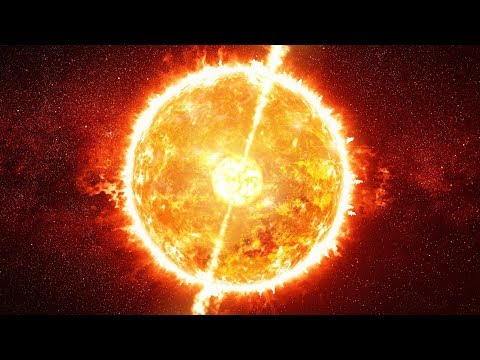
Emily Levesque Public Lecture: The Weirdest Stars in the Universe
What this covers
Emily Levesque's public lecture at Perimeter Institute moves from the history of stellar astronomy to the odd objects astronomers study now. She starts with how massive stars live and die: they build onion-like layers of fusion products until the core reaches iron, which can't be fused profitably, and then the core collapses in a supernova. Supernova 1054, recorded by Arabic and Chinese astronomers as a "guest star," leaves the Crab Nebula behind. The endpoints are a neutron star, held up by neutron degeneracy pressure, or a black hole. She illustrates the density with a star the size of Waterloo whose teaspoon of material outweighs a mountain, and she covers pulsars, first found by Jocelyn Bell Burnell and nicknamed "Little Green Men."
The middle of the talk is built around her own work. At Kitt Peak National Observatory she measured temperatures for 75 red supergiants from the strength of titanium oxide absorption in their spectra. She then sets this against the Hertzsprung-Russell diagram), where evolutionary tracks for massive stars all stop near the same temperature, so the observed stars appear where theory says they shouldn't stably exist. She also describes how Kip Thorne and Anna Żytkow contacted her around 2010 about Thorne-Żytkow objects, a 1970s prediction never observed. Their rapid proton capture should leave distinctive spectral excesses of molybdenum, rubidium, and lithium, which gave her team something to search for.
The lecture also covers the practical side of observing: weather, closed domes, and heavy processing to strip out sky glow and electronic noise. Two cautionary stories involve false signals. At Provence Observatory, strong potassium "flares" turned out to come from observers lighting cigarettes with matches, which Berkeley) researchers tested by striking matches in a dome. Microwave ovens explained the detections at Parkes Observatory. She ends on time-domain astronomy and the August 17, 2017 neutron star collision, which produced both gravitational waves and a gamma-ray flash.
Massive stars exhibit fascinating and extreme phenomena—from red supergiants that dwarf planetary orbits to neutron stars and gamma-ray bursts—that reveal the universe's most violent processes and serve as laboratories for understanding stellar evolution and exotic physics.
- Red supergiants reach sizes 900 times the Sun's diameter, with surface convection creating dramatic visible roiling
- Neutron stars and black holes represent quantum-physics-supported stellar remnants with densities and timescales revealing extreme physical regimes
- Detection of gravitational waves alongside electromagnetic counterparts from neutron star collisions opens a new observational window on cosmic violence
This asset isn't compiled yet
You're seeing its claims, ranked. Compile it to build the argument threads, weight them, and check each claim against your library — the full view.
The rapid proton-capture and beta-decay cycling in Thorne-Żytkow objects should produce very distinctive chemical signatures: large excesses of elements like molybdenum, rubidium, and lithium—elements that would NOT be expected in normal red supergiant atmospheres—providing a diagnostic signature for identifying Thorne-Żytkow objects via spectroscopy.
“this is a type of reaction that we can't expect in any other type of star and it should produce a very distinctive chemical signature we should see huge excesses of things like molybdenum and rubidium and lithium things that we would not normally expect to see a lot of in a red supergiant atmosphere so we decided to use this odd predicted chemical signature to look for thorns at gob objects”
Weather conditions at observatories dramatically affect observation quality; poor visibility (clouds, fog) makes it impossible to open telescopes as it is unsafe for instruments, while clear nights yield high-quality data that requires significant post-processing to remove sky background glow and electronic noise before becoming usable science data.
“you hope that the night looks like this you hope that it's beautiful and clear and you can get amazing data of whatever you're wanting to observe the night might look like this this is an actual photo that I took when I was trying to observe at Keck and when you can't see the building that's like 30 feet away your odds of detecting something in deep space or getting really bad you can't even open a telescope when it's this crummy out it's unsafe for the telescope and the instruments...take observations and you get gorgeous data...there's a lot that has to be done too data before it can be finalized you have to account for things like the background glow of the sky electronic noise from the instruments on the telescope so there's a lot of effort that goes into eventually turning this into science”
Levesque learned about Thorne-Żytkow objects around 2010 when Kip Thorne and Anisette Żytkow emailed her about their theoretical models from the 1970s, which predicted these objects but had never been observed; this prompted Levesque's team to search for them.
“I found out about these for the first time around I think the year 2010 I've been working on red supergiant's for years publishing papers on them and noticing some strange red supergiant's or red supergiant's that we couldn't perfectly explain and in response to one of those emails or one of those papers I got an email from anisette cough saying years ago Kip Thorne and myself invented these theoretical models of stars which is just fascinating all on its own and asking if we were interested in trying to look for them so Thor injective objects predict this neutron star core surrounded by a big cold puffy outer layer they had predicted these back in the 1970s but they'd never actually seen one”
Gravitational waves are compression waves traveling through space-time that squeeze and stretch space-time as they propagate, in contrast to transverse waves like those on a slinky; when a gravitational wave reaches Earth, it causes space-time to compress and stretch.
“gravitational waves aren't quite this these are waves traveling through space time and what they're doing is something more a compression wave so if you took the slinky and shortened one hand and kicked off something like this those compression waves travel through space-time and impact space-time along the way and when a gravitational wave reaches Earth we see something like this so this is a wildly exaggerated effect but you can see Earth sort of getting squeezed and then stretched as a gravitational wave propagates by and squeezes and stretches the space-time that Earth is in”
When other observatories tried to reproduce the potassium flare observations, they could not find any potassium flares except at the Provence Observatory telescope; this lack of reproducibility suggested an instrumental or observational issue rather than a real physical phenomenon.
“but it got better to more potassium flare stars were discovered in those discoveries that we started to see a little bit of a problem nobody else was finding potassium flare stars except for this team and they were only finding them at this telescope”
Time-domain astronomy is a discipline that focuses on studying fleeting and quick phenomena, representing the closest that astronomy gets to movie-style action in real scientific work.
“so this gets into a type of astronomy called time domain astronomy I love this discipline it focuses on trying to study things that are very fleeting and very quick it's the closest I think that we get to sort of movie style astronomy”
Neutron stars are supported by neutron degeneracy pressure, a quantum physics principle: neutrons that are similar to one another and occupy similar quantum states cannot be squeezed too close together and will resist squeezing to the extent that they can support themselves against gravitational collapse.
“neutron stars are absolutely fascinating they aren't working like the normal stars that I've described these stars that have to fuse something in their cores to maintain a balancing act with gravity these stars are actually supported by principles of quantum physics they're supported by something called neutron degeneracy pressure hence why they're called neutron stars and the basic principle behind this is that neutrons that are very similar to one another they have similar quantum properties they occupy a similar state cannot be squeezed too close together they will literally resist this to the extent that they're able to support themselves against gravitational collapse”
Polaris, the North Star, is a yellow supergiant, making it a relatively rare type of massive star given the short lifetimes of yellow supergiants.
“we actually have an amazing example of yellow CLO supergiant that we all know really well our North Star Polaris is a yellow supergiant this is actually pretty surprising because stars like this are rare since their lifetimes are so short”
When red supergiant spectra were observed, they plotted on the Hertzsprung-Russell diagram in a position where they shouldn't be able to stably exist according to stellar physics theory, creating a problem that needed explanation.
“for a long time if we observed red supergiant's if we measured their temperature and we measured their brightness and we tried to put them on this diagram the stars would land here in exactly the place that they don't belong this bothered us for a very long time we were trying to understand what was wrong with our stellar physics what was wrong with our theory of how these stars evolved”
On August 17, 2017, gravitational wave detectors registered a signal from two colliding neutron stars orbiting in a binary system and spiraling inward; unlike black hole collisions, neutron star collisions produce both gravitational waves and a brief flash of gamma-rays, enabling multi-messenger astronomy with both gravitational and electromagnetic signals.
“but last year on August 17th we detected something else so these are two neutron stars the same stars that I talked about before they're orbiting one another in a very close binary they're spiraling in spiraling in getting ready to collide when they collide they emit a very short flash of gamma-rays even shorter than the kind I talked about before and they emit gravitational waves we thought that this was going to happen for quite a long time and on August 17th a gravitational wave signal from two colliding neutron stars was detected so now we had something else exciting to do when two black holes collide we don't think there should be any light emitted by that process but these neutron stars are emitting gamma rays they're emitting light throughout the magnetic spectrum”
In the 1960s at Provence Observatory in France, astronomers observed a star showing a stellar flare with extremely strong potassium emission in its spectrum, which had never been observed before; this discovery excited the community as it suggested a new type of physics or flare mechanism not predicted by standard theory.
“in the 60s at provence observatory in france some astronomers were observing and taking data on a bunch of stars and analyzing the data as it came in and they were extremely surprised by one of the results that they found they saw a star that in its spectrum appeared to show a stellar flare that was very strong in a specific element it was very strong in the element potassium nobody had ever seen this before this wasn't a prediction of normal stellar flares and they were really surprised they were going wow we found a new type of physics we found a new type of flare”
At the Provence Observatory, the detector room was a separate location where observers could take breaks during the night, and potassium flares were discovered to be artifacts caused by researchers striking matches to light cigarettes during breaks; potassium is the strongest element in match spectra.
“it's the 60s it's France maybe you're taking a break and you decide to have a smoke break and strike a match potassium is the strongest element in the spectrum of match so people at Berkeley figured out that this might be what was going on they had an amazing research paper where they tried to debunk this and it essentially involved running around the dome of one of the telescopes playing with matches and striking matches to see if they could reproduce a potassium flare”
Researchers from Berkeley investigated the potassium flare claim by systematically testing various types of matches in a telescope dome to reproduce the effect; they found no spectroscopic difference between French and American matches and documented their findings in a research paper, even acknowledging the director's permission for this unorthodox investigation.
“they acknowledged in their paper George Preston who was the director at the time for authorizing their unorthodox use of the 120 inch code a spectrograph the paper is amazingly thorough by the way they check book matches they check kitchen matches safety matches they contacted the people in France who were you know perhaps a little surprised that this was the explanation but scientists at their core and they said hey let's try our matches there's a line in the paper explaining that there is no spectroscopic difference between French and American matches and we now have our research paper that includes data on you know the spectrum of a match”
Parkes Observatory researchers tested all three microwaves on site by microwaving ceramic mugs full of water repeatedly to understand microwave design and confirm that microwave emissions explained the perytton detections.
“so again there is a delightful research paper showing how this happened they tested all three microwaves on site there's a paragraph where they probably learned more about microwave design that I think they ever wanted to in their lives microwaving a ceramic mug full of water microwaving the same thing every time but ultimately determining that yes that was what these Perry tongs were”
Evolutionary tracks on the Hertzsprung-Russell diagram show the path a star will take during its lifetime; every stellar physics evolutionary track for massive stars (12, 15, 20, 40 solar masses) appears to stop at approximately the same temperature around 3,000 degrees Celsius, suggesting that stars should not be able to stably exist to the right of this boundary.
“this is an evolutionary track for a 15 solar mass star but we can take a bunch of evolutionary tracks like that and draw them on a hertzsprung-russell diagram we can look at what a 12 solar mass star will do what a 20 solar mass what a 40 solar mass star will do and to get a good sense of what normal massive star evolution looks like so there's something you might notice on this diagram and it has to do with how cold the stars get every one of these evolutionary tracks was computed using our understanding of stellar physics and every single one seems to stop at about the same temperature every one is not really getting any colder than about 3,000 degrees Celsius or so to the right is this region where we don't think stars should be able to stable exist everything we know about stellar physics suggests that stars should not sit in as part of the diagram”
Levesque's first research project involved observing 75 red supergiants in the Milky Way at Kitt Peak National Observatory using the 2.1-meter telescope, during which she had five perfectly clear observing nights and measured their temperatures using titanium oxide absorption features.
“this was actually my very first research project as an astronomy student I worked on this after my sophomore year at MIT I got to go to Kitt Peak National Observatory in southern Arizona I had my very first observing run you can't tell from this image but I'm unbelievably excited because they're letting me open the dome of the 2.1 meter telescope and I'm gazing up going ha ha we had five perfectly clear nights this was wonderful observers beginners like and this has never happened to me again and we got spectra of 75 red supergiant's in the Milky Way we used that technique looking at those titanium oxide bytes in the spectrum to measure their temperatures”
When a massive star exhausts all fusion fuel in its core, it undergoes a supernova—a core collapse where the iron core implodes, material from outer layers falls onto the collapsed core, bounces back, and produces an unbelievable explosion that we observe as a core collapse supernova.
“to understand why a supernova happens it helps to look at what's going on inside the star right before the supernova massive stars started out their lives fusing hydrogen into helium then they moved on and fused helium into carbon and they progressed fusing heavier and heavier elements by the time they reached the ends of their lives if you were to slice one of these stars in half it would look like the inside of an onion with layers of every single element that it's been using for fusion or as the product of fusion inside this star gets into trouble when it starts to try and fuse iron this fusion happening in the core of the star serves a very important purpose it helps the star maintain this very delicate balancing act between the inward press of gravity and the outward press of that fusion as long as that balance is maintained the star is going to be alive and it's going to be just fine using iron disrupts this process because fusing something like hydrogen or helium or carbon produces energy if you try to fuse iron you need energy so at this point that delicate balancing act has been disrupted”
Massive stars build up onion-like layered structures during their lives, with each layer representing a different fusion process (hydrogen, helium, carbon, etc.), and the star progresses through these fusion stages before reaching iron, which cannot be profitably fused.
“massive stars started out their lives fusing hydrogen into helium then they moved on and fused helium into carbon and they progressed fusing heavier and heavier elements by the time they reached the ends of their lives if you were to slice one of these stars in half it would look like the inside of an onion with layers of every single element that it's been using for fusion or as the product of fusion”
Supernova 1054 occurred on July 4, 1054, was visible in the daytime sky for two weeks, was observed and recorded by Arabic and Chinese astronomers who called it a 'guest star,' and left behind the Crab Nebula as its supernova remnant.
“this supernova went off on July 4th 1054 and was in our own galaxy it was very nearby it was so bright that you could see it during the daytime sky for two weeks we have historical records of it from Arabic astronomers from chinese astronomers they called it a guest star because it appeared stayed for a little while and then left this actually left behind what we now know as the Crab Nebula the Crab Nebula is the remnant of that 1054 supernova”
Some neutron stars are pulsars, which emit light from their magnetic poles; as the star rotates, the beams of light sweep around like an emergency light on a fire truck or police car, creating a flash effect that we detect.
“you also sometimes see something interesting from a neutron star this is an artist's rendition and you'll notice those lines sort of poking out of the star in opposite directions those are showing the magnetic field lines of the star and illustrating that some neutron stars can be what we call a pulsar in some cases these stars will emit light out of their magnetic poles now we know on earth that our geographical Pole the actual pole that the earth rotates around is different than our magnetic poles in an extreme case like our neutron star what you'll get is a beam of light flinging around as the star rotates and sort of causing a flash as it goes by the best analogy that I've been able to find is looking at something like an emergency light on top of a fire truck or a police car those are two beams of light pointing out in opposite directions and as you spin it it appears as though something is flashing that flash is what we detect when we see something like this a pulsar”
If a neutron star gains additional mass or if the core has sufficient mass, it can collapse further into a black hole, which is the other possible endpoint of massive star death beyond neutron stars.
“if that collapse goes one step further if we have more mass in the core or if that neutron star gains mass with time we instead produce something else we produce a black hole I apologize for the artist rendition you understand these stars will produce black holes as part of their deaths”
Neutron stars are unbelievably dense and small: one is the size of the city of Waterloo, but one teaspoon of its material would weigh more than a mountain.
“neutron stars are unbelievably dense and unbelievably small one of these stars is the size of the city of Waterloo but if you took just one teaspoon of it it would weigh more than a mountain”
LIGO (Laser Interferometry Gravitational Observatory) consists of two arms set at perfect right angles, each exactly four kilometers long, with a laser and beam splitter at the center; on normal days, laser beams sent down both arms arrive at the same time and cancel each other out, but when a gravitational wave passes, it squeezes space and causes the laser signals to arrive at slightly different times, creating a detectable signal.
“they consist of these two arms set at perfect right angles to one another so each of those arms is exactly four kilometres long there is a laser and a beam splitter in that central building and what you can do on a normal day on a day when there is not a gravitational wave is fire a laser beam using the beam splitter down both of those arms at once with each arm being exactly four kilometres long the laser will travel the length of the arm will be reflected off a mirror at the end come back and the two laser signals will have traveled the exact same distance in the exact same time they'll cancel each other out and you know okay there's no gravitational wave now imagine a gravitational wave actually happening in squeezing space-time and squeezing the detector what I've just done is squeezed the picture so that the arm on the left is now a little bit shorter now if you send lasers along those arms they will arrive at slightly different times the one on the Left had a slightly shorter trip than the one on the right because of the effects of gravitational waves we now see a signal and we can confirm that we've detected a gravitational wave”
Pulsars were first discovered by Jocelyn Bell Burnell in the 1960s in radio observations; she detected multiple objects with perfect, regular pulsations that were initially nicknamed LGM 1, 2, 3, and 4 (for 'Little Green Men') as a tongue-in-cheek reference to how regular and artificial-seeming the signals were.
“Pulsar were actually discovered in a pretty interesting manner they were detected by a woman named Jocelyn Bell Burnell in the 1960s in the radio she actually detected first one and then two and eventually got up to four objects like this their pulsations were perfect it sounded like you were almost hearing a heartbeat from these stars they temporarily nicknamed the objects LGM 1 2 3 and 4 and lgm was an abbreviation for little green men and they were they were mostly kidding but it was a sort of tongue-in-cheek nod to the fact that this was such a perfect and regular signal that maybe maybe somewhere little green men were making this it turned out that wasn't the case at all and instead it could be explained by a neutron star that was specifically emitting this light and detectable as a pulsar”
Red supergiant spectra contain distinctive dips or absorption features caused by titanium oxide molecules in their atmospheres; these dips become stronger as a star cools, allowing temperatures to be estimated by measuring the strength of titanium oxide absorption.
“something you notice right away is that there are these strange sort of bites taken out of the spectrum there's these little dips that show up periodically as we go from blue to red all of those dips represent light that has been taken out of the spectrum on its way to us that's light that's been absorbed by something in the atmosphere of the red supergiant in this case that is light being absorbed by titanium oxide molecules these stars are so cold that molecules are able to form in their atmospheres it makes the spectrum look interesting and as it turns out it's also a really good tool for measuring temperatures if you look at a simulated spectrum of a red supergiant and you cool the star off at 4000 Kelvin you really don't see that many titanium oxide absorption signs at all as you cool the star off they suddenly appear and they get stronger very quickly”
Supernova 2009 IP appeared in 2009, faded as expected, then reappeared in 2010 and 2011, with a dramatic eruption occurring in 2012; this star is an example of a luminous blue variable rather than a true supernova, as it survived the eruption.
“we saw this thing get very bright we watched it fade away and we thought well perfect another supernova doing its supernova thing and then it reappeared in 2010 it reappeared again in 2011 in 2012 we finally saw a very dramatic eruption from this star and we think that this star might now be dead although people are still keeping an eye on it and looking here just in case this was an example of a star that from our perspective was just pretending to explode”
Fast radio bursts (FRBs) are phenomena featuring brief radio emissions on rapid timescales, which were initially mysterious until some detections were identified as 'peryttones,' artifacts from microwaves in nearby buildings.
“another good example of this happened at Parkes Observatory which is a radio telescope in Australia and this has to do with phenomena called fast radio bursts and something called a parrot on so during observations with this radio tape telescope they did did a brief burst of radio emission this was surprising this was very interesting we've seen gamma-ray bursts but a radio work burst like this and especially one on that rapid time scale was really puzzling now when they put this out some responses started coming in going oh a flash of radio is out we see those all the time there's lots of these this is probably something really cool we should figure it out and they started digging into the data as a whole to see what these were no those other detection zhh were nicknamed perry tongs and it was a sort of tongue-in-cheek nickname saying maybe these aren't entirely celestial maybe we have some other explanation for this but we don't yet know what it is”
Spica is a blue supergiant star with a temperature of about 22,000 degrees Celsius, approximately 10 times the mass of the Sun, and fuses hydrogen into helium in its core, remaining in this phase for approximately 10 million years before the hydrogen runs out.
“this is a massive star in the first phase of its life it's fusing hydrogen into helium in its core it's very hot it's about 22 thousand degrees Celsius that's about that's much hotter than our Sun our Sun is 5,500 degrees Celsius it's about seven times the mass of our Sun and it's about ten times the mass of our Sun in about seven times the size a star like Spica will stay in this part of the HR diagram for maybe ten million years fusing hydrogen into helium”
Gamma-ray bursts were discovered accidentally by the Vela satellites, which were launched in the mid-1960s following the nuclear test-ban treaty to monitor Earth for signs of nuclear weapons testing (which would produce gamma-ray flashes); instead of detecting nuclear tests, the satellites detected gamma-ray flashes coming from all over the sky.
“those flashes of gamma rays that we see from stars like this were actually discovered by accident so these are the vaillar satellites it's a sketch of these satellites that were launched in the mid 1960s following the signing of the nuclear test-ban treaty so the job of the satellites was to orbit the Earth monitor the planet and look for signs that somebody was violating the treaty and performing a nuclear test which would have shown up as a flash of gamma rays the satellites worked great and they detected many flashes of gamma rays and fortunately for world peace none of them were coming from Earth instead they were coming from all over the sky”
When Levesque's team compared their candidate Thorne-Żytkow object's spectrum to theoretical predictions of what such an object should look like, the fit was beautiful, providing strong evidence that they have identified the first candidate for a Thorne-Żytkow object.
“so we now have what we think is the first candidate for detecting a foreign Jadhav object I'm very careful to use the word candidate here the existence of Thor injective objects would have really profound implications for stellar astronomy the fact that you can have a stable star with a neutron star for a core is really surprising it gives us a new understanding of how stable stellar interiors could work”
Betelgeuse is a red supergiant in the constellation Orion that was born with 15-20 times the mass of the Sun but has expanded to 900 times the Sun's size; if placed where our Sun is, it would stretch well past Mars's orbit and approach Jupiter's orbital size.
“fatal juice is an excellent example of a red supergiant which are one of my research specialties and a particularly fascinating type of massive star what's interesting about a star like baitul juice is that as it has cooled off and moved across the hertzsprung-russell diagram it's also button enormous Li big this star was born with maybe 15 or 20 times as much mass as the Sun but it's 900 times the sun's size so I want to try and put that into context this is the orbit of the earth that one dot in the center it shows up as a couple pixels on the on the projector is our Sun if we back up a little bit we lose sight of the Sun but you can see the size of Earth's orbit relative to things like Jupiter's orbit and Saturn's orbit if we were to put baitul juice where our Sun is it would stretch out to well past the orbit of Mars it would begin approaching the size of Jupiter's orbit”
Gamma-ray bursts are produced by a specific subset of stars that form black holes when they die; in these systems, a massive star (40-50 solar masses) with its outer layers stripped away collapses into a rapidly rotating black hole that consumes the star, producing high-energy jets of material perpendicular to the black hole's rotation that ignite gamma rays detectable on Earth.
“I have an animation of what this looks like this is a massive star something like 40 or 50 times the mass of our Sun now you'll notice it's blue it's not red the outer layers of this star have actually been ripped off over the course of its life exposing some of the hot inner layers when this star dies its core collapses into a very rapidly rotating black hole that black hole starts consuming the star and almost shattering the star from the inside out and it ignites these unbelievably high energy Jets of material shooting out perpendicular to how that black hole is rotating it consumes the star collisions in those beams produce the gamma rays that we detect here on earth”
Levesque became interested in astronomy at age two when her older brother Ben was assigned to observe Halley's Comet in 1986; after being initially bothered by the darkness, when pointed toward the comet, she was fascinated, and astronomy remained a consistent interest alongside other childhood aspirations.
“I think I knew I wanted to be an astronomer and I was about to and I remember why I have a reason so I was two years old in 1986 which was the last time that Halley's Comet made a close pass of Earth I have an older brother Ben who was 12 when I was 2 and he had a school assignment to observe Halley's Comet so me and him and my parents all went tromping out into the backyard and I'm sure I was a slightly fussy two-year-old who was a bit bothered by the dark until they sort of pointed me up and apparently I was fascinated”
Supernovae in the Milky Way occurred in 1054, 1572, and 1604, with no supernovae observed in the Milky Way since 1604; every modern supernova studied has been in another galaxy.
“we had a supernova like this in 1054 there was a supernova in 1572 one in 1604 and we haven't had one since every modern supernova that we've studied has been in another galaxy”
The Swift spacecraft is a dedicated gamma-ray burst observatory featuring a gamma-ray detector, x-ray, ultraviolet, and optical telescopes; when Swift detects a gamma-ray burst, it immediately sends a notification to astronomers on Earth so they can rapidly follow up with other telescopes before the burst fades.
“so we've now put up dedicated telescopes whose job it is to look for gamma-ray bursts and to tell us when one has happened as quickly as possible so we can try and study them so this is the Swift spacecraft it's a tailored telescope for detecting these sorts of gamma-ray flashes that flat-panel that you see on the front is a gamma ray detector and then under what looks like a baseball cap but is actually a Sun shield our x-ray and ultraviolet and optical telescopes that try to observe these objects as fast as possible what Swift will do is it will sit there orbiting the earth waiting for a gamma-ray burst to go off somewhere in its field of vision it'll spot a gamma-ray burst off the corner of its eye ago oh my god turn and start taking data on the gamma-ray burst as quickly as possible when it does that it sends a notification down to earth to astronomers saying a gamma-ray burst has just happened”
Thorne-Żytkow objects are theoretical stellar objects combining a red supergiant's enormous outer envelope with a neutron star core; a neutron star can spiral into a red supergiant in a binary system, settle into and replace the helium-fusing core, creating a stable star with a neutron star for a core.
“there is really only one way that you could possibly make these weirder and it's to stick them together so if you imagine a red supergiant and a neutron star in a binary system these are two stars that are orbiting one another and perhaps interacting with one another exchanging mass in spiraling closer and closer kind of like those two neutron stars that we saw making a gamma-ray burst there's a really fascinating thing that can happen in a system like this that neutron star can effectively be swallowed by the red super time it can spiral in settle into and eventually replace the core of the red supergiant and make something called a Thorne cough object”
If a galactic supernova (comparable in brightness to supernova 1054) occurred tonight, it would initially cause panic as an unexplained brightening in the sky, but once identified as a supernova rather than a threat, it would generate enormous public interest, hashtag trends, continuous media coverage, and excitement from astronomers worldwide, potentially inspiring widespread public engagement with astronomy.
“I mean at first it might actually cause a little bit of panic you're seeing something bright in the sky it's slowly getting brighter and brighter I think depending on the current like deal with geopolitical situation you might get a little nervous but once we'd established that it was definitely a supernova and nothing else it would be really interesting it would immediately get a hashtag nighttime hosts on shows would be talking about it every cell phone in the hemisphere would probably have a photo of it that somebody snapped and I guarantee you that every stellar astronomer would just up and lose their minds including me I really hope that we get the chance to see something like this happen”
The surface of the Sun exhibits granules, which are the visible tips of a convective layer where hot gas rises, cools at the surface, and sinks back down, similar to bubbles boiling in water.
“these are called granules what we're seeing are the very tips of a convective layer in the top near the surface of the Sun what we're seeing is gas that starts out hot rises to near the surface of the Sun cools off and then follows back it's not unlike watching bubbles boil in a pot of water”
In a stellar spectrum, light from an object is sorted by wavelength from bluest on the left to reddest on the right, with brightness represented on the y-axis, allowing determination of a star's color composition at a glance.
“the way that will do this is to take light from a red supergiant and sort it out into something called a spectrum so in a spectrum you observe light from an object and you sort it out according to its wavelength so the very bluest light will be on the left side of the diagram and the very readily will be on the right the brightness is still represented on the y-axis so you can tell at a glance that this is sort of a spectrum of a reddish star because we're seeing more red light than blue”
There is a fundamental equation in astronomy relating luminosity (L), radius (R), temperature (T), and constants (π and σ): luminosity equals the product of 4π, the Stefan-Boltzmann constant (σ), the radius squared, and the temperature to the fourth power, which allows calculation of stellar radii if luminosity and temperature are known.
“there's a very handy equation this is the only equation that I use in the talk but it's a very important one to have there's an equation in astronomy that relates how luminous a star is and how cold or hot it is to how big it is and I can walk through what everything in this equation means L stands for the luminosity how bright the star it's well we already knew that we know how much for is we know how much pi is that's just a constant and we know how much Sigma is that's another constant we had measured temperatures so now all that was left was the radius”
Stellar flares are eruptions of material from a star's surface that appear as small brightenings; they are fairly typical phenomena and have been studied for years, with observations at distances where the flare must be very bright to be detected.
“we know that our Sun will produce what we call solar flares it's this eruption of material from the surface of the star and it shows up to us like a little tiny brightening other stars will also behave this way stellar flares are fairly typical and at the distances of the stars that we're talking about the flare has to be very bright”
Massive stars are at least eight times the mass of the Sun and are located at the top of the Hertzsprung-Russell diagram, occupying the supergiant region.
“the weird stars that we'll be focusing on tonight are at the very top of this diagram so these are the super Giants these are massive stars they're stars that are at least eight times the mass of our Sun or more”
A Cassegrain telescope uses a primary mirror at the bottom that bounces light up to a secondary mirror, which bounces it down to a detector; a Coudé design is more complex, bouncing light off additional mirrors and routing it to a detector in a completely separate room, improving image quality and potentially allowing the detector room to serve other purposes.
“this is a very typical telescope design it's known as a Cassegrain light will come down onto the primary mirror depicted in the bottom it will bounce up to a secondary and then bounce from the secondary down to the detector that we're showing in blue this can be a photographic plate this can be a digital camera like we have now it's a fairly straightforward way of gathering light from a telescope the telescope that was being used in France was taking advantage of something called a coup de design in this case we're bouncing off a couple of other mirrors along the way and were actually sending light to a detector in a completely separate room there's good reasons for this that traveled that the light has to go through actually improves the quality of the image and sometimes it's nice to have the detector in a completely separate room”
Levesque majored in physics in college as the starting path to becoming an astronomer and did not look back from that direction.
“and then when I went to college I majored in physics knowing that that was the starting path to becoming an astronomer and did not look back from there”