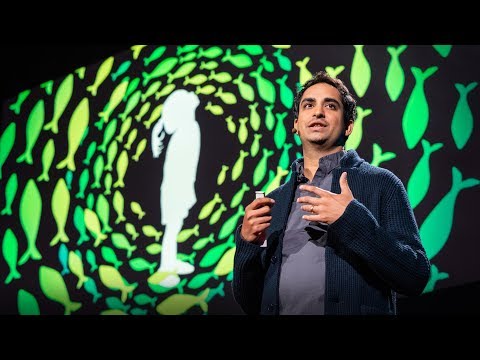
Four billion years of evolution in six minutes | Prosanta Chakrabarty
What this covers
This six-minute TED talk is delivered by ichthyologist and TED Fellow Prosanta Chakrabarty, who walks through the history of life in compressed form. He starts from a single-celled common ancestor about four billion years ago, which at first gave rise only to other single-celled organisms. Multicellularity arrives roughly a billion years later, and with it fungi, plants, and animals. From there one fish lineage comes onto land, producing mammals and reptiles, with some reptiles becoming birds and some mammals becoming primates. The talk repeatedly corrects the textbook image of evolution as a line running from "primitive" forms up to humans, and replaces it with the branching Tree of Life.
The middle of the talk is a set of corrections. Humans did not descend from monkeys or chimpanzees; both are equally evolved branches that share an ancestor with us. He argues evolution is a fact, comparable in standing to gravity, and points to traits like bellybuttons shared with placental mammals, backbones shared with other vertebrates, and DNA shared with all life as evidence of common descent. He also gives a short account of natural selection as the survival and reproduction of the best-fitting organisms, and notes that competing theories of evolution persist or fade according to how well they fit the data.
The talk turns more pointed when it moves from biology to attitude. Archaea and Bacteria are still evolving, may be the most successful organisms on the planet, and will probably outlast us, so calling them primitive strikes him as hubris. Most species last only a few million years, which makes most living things about as old, evolutionarily, as humans. The most contested claim is causal: that misreading evolution has distorted how people treat other life and each other, including views on race and gender. He closes by describing humans as fish that learned to walk and talk, and says the relationships among species are still being worked out.
Humans are fish, not primates descended from monkeys, and understanding this evolutionary fact correctly is essential to avoiding misconceptions about human nature, our relationship to other species, and how we should treat each other.
- All vertebrates, including humans, are technically fish because the first animals to develop backbones were fishes and all subsequent vertebrate lineages descended from them
- Misunderstanding evolution—portraying it as a linear progression toward humans rather than a branching tree—has led to harmful views about race, gender, and our superiority over other life
- Humans are young leaves on an ancient tree of life, no more special or primitive than the millions of other species that share four billion years of evolutionary history
This asset isn't compiled yet
You're seeing its claims, ranked. Compile it to build the argument threads, weight them, and check each claim against your library — the full view.
All vertebrates, including humans, are technically fish because the first animals to develop backbones were fishes, and all subsequent vertebrate lineages including mammals, reptiles, and humans descended from that original fish lineage.
“The first animals to develop a backbone were fishes. So technically, all vertebrates are fishes, so technically, you and I are fish.”
The common educational portrayal of evolution as a linear progression from primitive organisms through increasingly complex forms culminating in humans is incorrect; life evolves in a branching pattern, not a line, and does not culminate in humans.
“life doesn't evolve in a line, and it doesn't end with us. But we're always shown evolution portrayed something like this, a monkey and a chimpanzee, some extinct humans, all on a forward and steady march to becoming us. But they don't become us any more than we would become them.”
Evolution is a fact, not merely a theory, comparable in its evidentiary status to the theory of gravity, and can be proven by examining shared physical traits like bellybuttons shared with other placental mammals, backbones shared with vertebrates, and DNA shared with all life.
“Evolution is a fact as much as the 'theory of gravity.' You can prove it just as easily. You just need to look at your bellybutton that you share with other placental mammals, or your backbone that you share with other vertebrates, or your DNA that you share with all other life on earth.”
Monkeys and chimpanzees do not evolve into humans, nor do humans evolve into them; rather, humans and monkeys share a common ancestor and both represent equally evolved branches of the primate lineage.
“we didn't evolve from monkeys, but we do share a common ancestor with them”
Archaea and Bacteria, which make up most of single-celled organisms, are still evolving today and may be the most successful organisms on the planet, and are likely to persist well after humans.
“some would say the Archaea and Bacteria that make up most of this group is the most successful on the planet. They are certainly going to be here well after us.”
Humans are not the goal of evolution, and this misconception about humans being the pinnacle or endpoint of evolutionary progress is a central error in how evolution is commonly understood.
“We're also not the goal of evolution.”
It is hubris and self-centered to think that plants and bacteria are primitive while humans are special, given that humans have existed for only an evolutionary minute and other organisms represent four billion years of evolution.
“So it's hubris, it's self-centered to think, 'Oh, plants and bacteria are primitive, and we've been here for an evolutionary minute, so we're somehow special.'”
Most species on Earth exist for only a few million years before going extinct, meaning most of the life we see today is approximately the same evolutionary age as humans.
“Most species just last for a few million years. So you see, most life on earth that we see around us today are about the same age as our species.”
Misunderstanding evolution has led to convoluted and corrupted views on how to treat other life and how to treat each other in terms of race and gender, making correct understanding of evolution ethically important.
“Misunderstanding it has led to many convoluted and corrupted views of how we should treat other life on earth, and how we should treat each other in terms of race and gender.”
All eight million species on Earth represent four billion years of evolution and should be understood as young leaves on an ancient and gigantic tree of life, all connected to each other and to extinct ancestors.
“Think of life as being this book, an unfinished book for sure. We're just seeing the last few pages of each chapter. If you look out on the eight million species that we share this planet with, think of them all being four billion years of evolution.”
Humans are fish that learned to walk and talk, but still have much to learn about who we are and where we came from, implying humility about human understanding and self-knowledge.
“Perhaps it's better still to think of us as a little fish out of water. Yes, one that learned to walk and talk, but one that still has a lot of learning to do about who we are and where we came from.”
There are many theories of evolution, not just one, and the theories that best fit the empirical data are the ones that survive in scientific discourse, just as in evolution itself.
“For instance, we're taught to say 'the theory of evolution.' There are actually many theories, and just like the process itself, the ones that best fit the data are the ones that survive to this day.”
Darwinian natural selection is the process by which organisms that best fit their environment survive and reproduce, while those that are less fit slowly die off, and this simple mechanism is the essence of evolution.
“The one we know best is Darwinian natural selection. That's the process by which organisms that best fit an environment survive and get to reproduce, while those that are less fit slowly die off. And that's it. Evolution is as simple as that, and it's a fact.”
Shared traits like bellybuttons, backbones, and DNA in humans did not originate in humans but were passed down from different ancestors to all their descendants, not just humans, proving common descent.
“Those traits didn't pop up in humans. They were passed down from different ancestors to all their descendants, not just us.”
Approximately three billion years ago, multicellularity evolved, giving rise to fungi, plants, and animals.
“About three billion years ago, multicellularity evolved. This includes your fungi and your plants and your animals.”
Some primates became monkeys with tails, and others became great apes, including various human species, with humans not evolving from monkeys but sharing a common primate ancestor.
“some primates become monkeys with tails, and others become the great apes, including a variety of human species”
A biologist is still learning with others how all species are related to each other and who is related to whom, indicating that evolutionary relationships are not fully resolved and understanding them remains an active research area.
“As a biologist, I'm still trying to learn, with others, how everyone's related to each other, who is related to whom.”
Approximately four billion years ago, a single-celled organism was the common ancestor of all life on Earth and initially gave rise only to other single-celled organisms.
“So let's go back four billion years. This is the single-celled organism we all came from. At first, it gave rise to other single-celled life”
One fish lineage came onto land and gave rise to mammals and reptiles, with some reptiles becoming birds and some mammals becoming primates.
“One fish lineage came onto land and gave rise to, among other things, the mammals and reptiles. Some reptiles become birds, some mammals become primates”
Understanding that humans are fish—technically vertebrates descended from fish ancestors—is important to students understanding their evolutionary origins, as this is a teaching goal for the speaker's evolutionary biology classes.
“when my students finally understand why I call them fish all the time, then I know I'm getting my job done”