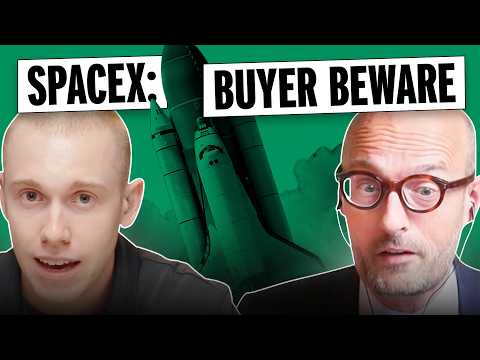
The Biggest IPO In History Isn’t What You Think It Is
What this covers
This episode of Prof G Markets is a three-part show hosted by Ed Elson. The first and longest segment is a conversation with Patrick Boyle about the coming SpaceX IPO. Next, Sid Jain of GQG Partners discusses emerging markets, and Elson closes with a short breakdown of the renegotiated Microsoft and OpenAI arrangement.
The SpaceX segment looks at both the mechanics of the listing and the price. Boyle notes that a $75 billion public float would more than double Saudi Aramco's $29 billion record. He says Musk pressed Nasdaq to fast-track index inclusion after 15 days instead of the usual seasoning of about a year. He argues that Nasdaq had its own fee incentives to agree, and that benchmarked funds would then be pushed into a roughly 4.5% position whatever the valuation. On fundamentals, they discuss the 125x sales multiple against Google's 10x at its IPO, the concentration of profit in Starlink, and the fact that about two-thirds of launch capacity serves SpaceX itself. Boyle also questions projections of 1.2 billion Starlink customers and the physical feasibility of cooling data centers in orbit. Elson adds a point about the way speculative holdings reach ordinary investors through an index fund.
The second segment turns to emerging markets. Jain describes a structural improvement since the "fragile five" label of 2015, including India's move from roughly flat dollar earnings growth in 2010–2019 to low-to-mid-teens growth now. He reads the rally as rebalancing after years of the TINA trade), not as a "sell America" move. He also cautions that TSMC, Samsung, and SK Hynix account for almost 70% of the MSCI index's year-to-date earnings growth, so the index is effectively a bet on AI chip spending, and he is skeptical that this can hold through an oil shock. The closing segment treats the Microsoft–OpenAI deal as a mutual win: Microsoft stops paying revenue share, and its exclusivity gets an end date of 2032.
Ed Elson argues that SpaceX's upcoming IPO at $2 trillion valuation represents a systemic market failure driven by index inclusion mechanics and regulatory capture, where Nasdaq rule changes force passive investors to overpay for a company with lottery-ticket assets and questionable growth assumptions.
- Nasdaq changed precedent rules to allow 15-day index inclusion instead of standard ~1-year seasoning period, creating artificial demand from passive funds unable to avoid holding 4.5% of their portfolio in an unvetted stock
- SpaceX trades at 125x sales (vs. Google's 10x at IPO despite 240% growth), with core profitability dependent on Starlink which may be approaching market saturation at ~10M customers and uses 2/3+ of SpaceX's own launch capacity
- The valuation requires assumptions about space data centers and AI integration that are technically dubious (cooling challenges), creating vulnerability to downside revisions once passive buying pressure subsides
This asset isn't compiled yet
You're seeing its claims, ranked. Compile it to build the argument threads, weight them, and check each claim against your library — the full view.
The valuation at 10 times sales is economically nonsensical because to return investor capital in 10 years while maintaining 10x sales, a company would need to pay all sales as dividends while paying no staff, no R&D costs, and no manufacturing costs—a mathematical impossibility referenced by Sun Microsystems CEO Scott McNealy in 2002.
“There's a famous quote from I think around 2002 where Scott McNealy, who was the CEO of Sun Microsystems, spoke about you know, the the price that people had invested in Sun Microsystems and he said, 'Well, you you know, what were they thinking? They invested at 10 times sales.' And he said, 'You know, if you put your money in a 10 times sales, in order for me to return it to you in 10 years time, I have to pay all of the sales out as dividends and that assumes that I'm not paying any staff, that I've no R&D cost, that there's no manufacturing costs.' He said there was no way people were going to get a return on investment at 10 times sales.”
Emerging markets (defined as countries that are less developed or earlier in their financialization) have structurally improved over the past 10 years compared to 2015 when Morgan Stanley called them 'the fragile five,' and growth is returning after a prolonged period of stagnation.
“by and large, I would say a lot of these emerging markets have structurally improved versus what was the case 10 years ago. 10 years ago, these economies were in a funk. Morgan Stanley called had a term called a fragile five for a lot of these countries, but as these cycles go, they've turned around and growth is finally coming back after a long time.”
Elon Musk negotiated directly with Nasdaq, threatening to list on NYSE instead unless Nasdaq agreed to fast-tracked 15-day index inclusion, coercing the exchange to violate its own standards.
“Reuters reported that this is because Elon Musk negotiated with Nasdaq and said, you know, we can we can list this thing on the NYSE, we can list it on the Nasdaq, we can list it wherever we want. If you want it on the Nasdaq, you have to go with fast-tracked index insertion.”
From 2010 to 2019, India's earnings growth was basically zero on a dollar basis, but now India is experiencing low to mid-teens earnings growth, representing a fundamental change from pre-COVID dynamics.
“for example, if you take in India, from 2010 to 2019, India earnings growth was basically zero on a dollar basis. Now you're getting low to mid-teens earnings growth and so there's a fundamental change versus what was the case before.”
A good company can be a terrible investment if overpaid for, and a bad company can be a good investment if purchased at a low enough price—the quality of the investment depends on the price paid, not on the quality of the company itself.
“the question isn't whether it's a good or a bad company. A bad company can be a good investment if you get in at a low enough price and an amazing company can be a terrible investment if you overpay for the stock.”
In efficient markets theory, a good company that grows earnings will outperform the market only if it surprises to the upside beyond expectations; if market expectations are correct about the company's quality, it should deliver market-average returns, not outperformance.
“in the long run, a good company that grows earnings will go up and and but of course, in order to go up more than the market, it needs to surprise to the upside, right? Like a company needs to be better than people thought it was to perform better than the market. If it's if people are right about how good the the company is, well, then it would expect to get uh you know, standard stock market returns.”
Trump is considering a proposal from Iran to end the blockade and open the Strait of Hormuz as a resolution to the geopolitical conflict.
“The major indices were mixed as Trump considered a proposal from Iran to end the blockade and open the Strait of Hormuz.”
Saudi Aramco's $29 billion IPO previously represented the largest IPO in history; SpaceX's $75 billion public float would more than double this record.
“because before that we had Saudi Aramco, where they did I think they they did a $29 billion IPO. They're talking about 75 billion for for this you know, the public float.”
SpaceX is simultaneously the world's largest space launch provider and its own largest customer, with approximately 2/3 or more of its launch capacity dedicated to deploying its own Starlink satellites, meaning the addressable market for external customers may not be substantially larger than current launch volumes.
“SpaceX's launch, they are the biggest launch provider in the world. Like, they take the most stuff into space, but I think around 2/3 of what they bring into space, if not more, is Starlink satellites. Like, it's their own stuff they're putting up there. So, in terms of like how big the market is for other companies that want to put stuff in space, it's not obvious that it's a whole lot bigger than what's being launched right now.”
SpaceX's core profitability is concentrated in Starlink, which currently has around 10 million paying customers, yet some analysts project it will reach 1.2 billion customers—an unrealistic assumption given that 1 billion people on the planet earn $35 per day (under $12,000 annually) and cannot afford $150/month internet access.
“66% of the profits um at least as far as we know of SpaceX come from Starlink, you know, the satellite internet company. And they have at the moment around 10 million paying customers, I believe. You know, there's some analysts out there and they said that that uh that they would reach 1.2 billion customers. Now, that's quite an amazing number when you look at the population of the planet who are like there's 1 billion people on the planet who earn $35 a day, which comes to a bit under $12,000 a year. They will not be paying for, you know, $150 a month internet access, right?”
Investors have realized that they are underexposed to the rest of the world due to 15 years of US dominance in earnings growth (the 'TINA' trade—'There Is No Alternative'), and the current emerging market rally represents a rebalancing toward global diversification rather than a 'sell America' phenomenon.
“I wouldn't characterize it as sell America, but rather just people just realizing how underexposed they are to the rest of the world because for the better part of 15 years they were the best earnings growth by far was in the US. There really was not many other options. The Tina trade so to speak, there is no alternative. That's kind of over.”
SpaceX is being forced into the NASDAQ 100 index almost instantly after going public, with a 15-day delay before inclusion, which is unprecedented compared to the normal requirement of approximately one year for a company to be seasoned in the market before index consideration.
“the thing that's quite questionable about the way this IPO is being done is just the way that it is being forced into the NASDAQ 100 index almost instantly. I think there's going to be a 15-day delay”
SpaceX's space-based data center concept faces severe physical constraints: cooling requires massive radiative fins spanning miles-square that would create the largest man-made object in space (larger than existing cooling arrays), making the concept technically possible but difficult to manufacture and deploy in a timely manner.
“everyone says well, space is cold, but it's also a vacuum and you need air blowing over something or water or whatever to cool it via convection. If it has to cool radiatively, you need these massive massive cooling fins on it.”
At a $1.75-2 trillion valuation, SpaceX would become one of only five US companies larger than that valuation, giving Nasdaq substantial exchange fees and trading revenue incentives to list it, making them financially motivated to change their rules.
“Well, it's a huge it's going to be a huge company especially if it if it goes public at what 1.75 to 2 trillion dollars. It will be I think there's only five US companies bigger than that right now. You're talking about like Google, Microsoft, Nvidia like you know, they they will be listing a big company. There's all sorts of exchange fees, trading fees, whatever that they earn off of this. It would not be they would be unhappy if it ended up on the NYSE for example.”
The AI semiconductor companies have taken another big leg up on the back of Intel earnings, and if the view is that AI is structural, these companies could theoretically grow through any energy shock, although Jain finds it skeptical that companies can grow when their customers are struggling.
“For example, these companies took another big leg up on the back of Intel earnings couple of days ago. And so, if your view is that AI is structural, these companies in theory can grow through any sort of energy shock, although we find it skeptical if a lot of their customers are struggling, the people using AI or the people spending on digital advertising, there will be a ripple on effect to the capex you see.”
TSMC, Samsung, and SK Hynix alone are driving almost 70% of the entire MSCI Emerging Markets Index's earnings growth on a year-to-date basis, meaning the index has become a one-way bet on AI semiconductor capex rather than a diversified emerging market exposure.
“if you look at it on a year-to-date basis, those three semiconductor companies, TSMC, Samsung, SK Hynix, are driving almost 70% of the entire index's earnings growth. So, this has basically become a one-way bet on the capex build-out that you're seeing.”
SpaceX is being valued at 125 times sales, which is extraordinary compared to comparable companies like Google, which went public at 10 times sales while growing at 240% annually, whereas SpaceX analysts expect only 25% growth next year.
“analysts expect it to grow 25% next year. That's not good enough.”
Index funds and quasi-active managers who benchmark against the Nasdaq cannot afford to avoid owning a 4.5% position in SpaceX once it's included, because being underweight a mega-cap stock that large creates unacceptable tracking error and performance risk, effectively forcing them to buy regardless of valuation.
“there will be just a bunch of portfolio managers who say, 'I can't afford to take the risk of not owning a stock that's 4 and 1/2% of the Nasdaq if I'm being judged against the Nasdaq.'”
Microsoft's renegotiated deal with OpenAI represents a mutual win where both sides benefit: Microsoft eliminates revenue share payments to OpenAI while retaining exclusive cloud sales of OpenAI products, and simultaneously gains a defined end-date (2032) to its exclusivity obligation, converting indefinite exclusivity into a fixed-term contract.
“this is also a win for Microsoft. In the old agreement, for example, Microsoft had to pay a percentage of that cloud revenue to OpenAI because of this exclusive OpenAI offering that they got to sell to their customers. Well, now they don't have to pay revenue share to OpenAI. And while it's no longer exclusive, they still get to sell OpenAI's products to all of their customers. In other words, Microsoft's cloud revenue just went up.”
Efficient markets theory predicts that if SpaceX IPO price is irrational, investors should reject it immediately and the stock should plummet, but private market negotiating dynamics allow CEO to 'just say $2 trillion' with less resistance than public markets would provide.
“Well, it's a huge it's going to be a huge company especially if it if it goes public at what 1.75 to 2 trillion dollars... I mean when it goes public, you could imagine a world if we lived in efficient markets world, you could imagine a world where investors would say '$2 trillion, that's ridiculous. I'm not buying.' And the stock immediately plummets... in the private markets, there seems to be a little bit more BS available and you can command these kind of ridiculous valuations, I guess because the negotiations are a little bit more entrenched and Elon just says $2 trillion and we say whatever and we sign the contract.”
The strategy to keep the SpaceX valuation elevated involves multiple tactics: talking about speculative future technologies (data centers in space), acquiring AI companies (xAI, Cursor) to justify AI narrative, merging them into SpaceX, and fast-tracking index inclusion to create forced buying pressure from passive investors.
“the markets will decide what the valuation is, but thus far they have taken a few kind of shortcuts to achieve this valuation. And it seems that some of those shortcuts would include talking about data centers in space and talking about the future and then merging xAI and putting that into the company and then buying cursor and putting another AI company into the thing so that you have to keep on growing and growing and growing and then the other point that you make, which I up until now hadn't thought properly about, is the idea of just shortcutting your way into the Nasdaq, which I assume immediately puts more buying pressure on the stock because it's essentially inserted into people's portfolios”
In the private markets, speculative bets on companies like MicroStrategy (a Bitcoin treasury company) are transparent to investors who deliberately buy in, but when those companies are added to indices, ordinary investors via index funds are unknowingly forced to hold high-risk, speculative assets they may not understand or intend to own.
“It used to be that this was just a guy who had this Bitcoin treasury company and it was kind of a bunch of BS, but if you bought it you bought it and that's okay. But as soon as we systematized it, suddenly you're putting it into people's hands who don't even know what it is or what they're actually buying”
Critical questions hanging over the SpaceX IPO include: can space-based data centers actually work at scale, what happens to Elon Musk's control once the company goes public, and can the $2 trillion valuation be sustained in the public markets.
“there are real questions hanging over what would be the market's biggest event in years, such as can space-based data centers actually work at scale? What happens to Elon Musk's control once the company goes public? And ultimately, can that $2 trillion valuation be sustained in the public markets?”
AI excitement as a structural theme currently outweighs oil supply shock concerns in market pricing, with the perception that a chip shortage is a worse constraint than an oil shortage, despite Brent crude trading at $110/barrel and refined products near $200/barrel.
“the AI excitement has thus far overcome any potential down implications from this Iran conflict because the view is AI is a structural theme and the comp huge shortage, so to speak, is worse than the oil shortage. That's the market perception.”
AI is embedded throughout all global markets and asset classes—equity indices, corporate debt, emerging markets—making AI exposure inescapable for any diversified investor and creating systemic concentration risk.
“we talk a lot on this podcast about how AI is essentially the US stock market at this point and you can't If you're investing in any index fund, it doesn't could even be you could be even investing in in corporate debt, you are exposing yourself to AI. I hadn't fully considered how much that is also true of emerging markets, too, of markets around the world. AI is literally everywhere. You cannot escape it.”
In non-AI countries within emerging markets (like India, Malaysia, Philippines), earnings are being cut due to oil shock concerns, showing that the oil shock is already affecting non-semiconductor economies.
“in a lot of the non-AI countries, so to speak, you are seeing earnings get cut and there is, like for example, in India, Malaysia, Philippines, where there is quite a bit of nervousness when you talk to other market participants on the implication energy shock.”
2025 was a fantastic year for South American equity markets, particularly Brazil, driven by electoral cycles where countries are shifting from left-wing to right-wing business-friendly governments, creating a favorable policy environment for stocks.
“2025 was a fantastic year for pretty much every country in South America. Brazil being another large winner, not just in 2025, but year-to-date, where the countries are actually doing quite well, economies are improving, the stocks are incredibly cheap, and an important catalyst has been electoral cycle where the countries are moving from the left on the spectrum to more of a right-wing business-friendly environment.”
Microsoft stock is currently undervalued relative to comparable hyperscalers, trading at 22x forward earnings compared to Alphabet at 30x and Amazon at 32x, and remains an attractive investment despite the OpenAI deal uncertainty.
“Microsoft is trading at 22 times forward earnings, Alphabet's trading at 30, Amazon's trading at 32. So, we land where we landed last week. And that is that Microsoft stock still looks pretty attractive.”
Jain's view is that the straits (Strait of Hormuz) are still very much closed, oil (Brent crude) is close to $110 per barrel, and refined products (gasoline, diesel, jet fuel) are trading closer to $200 per barrel, leading to observable economic slowdown across most Asian countries.
“Our view is that the straits are still very much closed. Oil, Brent oil is close to $110 per barrel. And if you look at the refined products, so gasoline, diesel, jet fuel, they're closer to $200 per barrel. And you're already seeing an economic slowdown across most Asian countries.”
South Korea and Taiwan are leading the emerging markets rally driven by AI chip demand, specifically from semiconductor companies benefiting from AI capex build-out.
“South Korea and Taiwan are leading the move driven by AI chip demand.”
Emerging markets index hit a new all-time high yesterday, surpassing its February peak, and is up about 16% year-to-date, roughly three times the gains of the S&P 500.
“Emerging market stocks are on a tear right now. The MSCI Emerging Markets Index hit a new all-time high yesterday surpassing its February peak. The index is up about 16% this year. That's roughly three times the gains of the S&P 500.”
Russell Brand's appearance on Piers Morgan's show to discuss his book 'How to Become a Christian in 7 Days' involved Brand struggling for 90 seconds on air to find his favorite Bible quote before giving up.
“Today's number? 90. That's how many seconds Russell Brand spent trying to find his favorite Bible quote live on Piers Morgan before he finally gave up. The former comedian was on the show to discuss his new book, 'How to Become a Christian in 7 Days.'”
S&P and Nasdaq hit new records on the day, while the Dow fell slightly, and oil prices rose while Microsoft stock fell on news of a renegotiated OpenAI deal before later recovering to end in the green.
“The S&P and the Nasdaq edged up to new records, while the Dow fell slightly. Meanwhile, oil prices rose and Microsoft stock fell early on the day on a renegotiated deal with OpenAI. The stock later recovered to end in the green.”
Ed Elson bought Microsoft stock at $400, bought again at $380, and the stock is now at $425, indicating a profitable position and validating his assessment that the stock was undervalued at those prices.
“I bought it when the stock hit $400, and I bought again when it hit $380. It's now up to $425.”