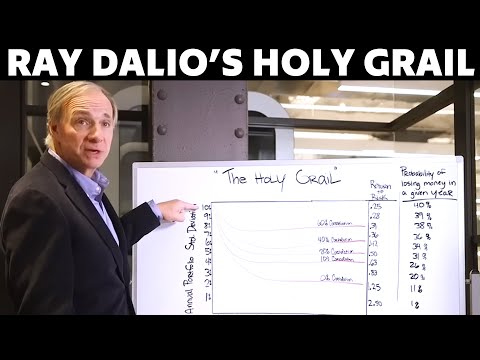
Ray Dalio Breaks Down His "Holy Grail"
What this covers
This five-minute Investopedia clip presents Ray Dalio explaining what he calls his "Holy Grail" of investing, a worked argument about how diversification behaves once you account for how assets move together. The speaker is not identified in the transcript, so the material is a single voice laying out the logic step by step rather than a conversation. It starts from a simple setup: assets with the same expected return of 10%, differing only in their correlation structure, and asks what happens to risk as more are added.
The central turn is that the marginal benefit of each added asset depends on average correlation, not on count. Assets correlated at 60% give little risk reduction even if you add a thousand of them, while the same number with low correlation cuts risk sharply. Expected portfolio return stays at 10% throughout, so the gain is lower risk with no sacrifice of return. Standard deviation is accepted as the right risk measure here because it captures the volatility that correlation management can reduce.
The talk then turns to numbers and prescription. A portfolio of 15 to 20 assets with zero or near-zero correlation reaches an information ratio of about 1.25, which corresponds to an 11% annual probability of losing money, against 40% for a single asset. That amounts to roughly a fivefold improvement in return-to-risk, which the speaker contrasts with what stock-picking can realistically deliver in an efficient market. The practical advice for portfolio construction follows: look for 15 to 20 uncorrelated or low-correlation return streams, each only modestly good, with a decent probability of profit, rather than hunting for one exceptional investment.
Portfolio diversification's power derives primarily from correlation structure, not individual asset selection; finding 15-20 uncorrelated return streams with moderate individual quality produces superior risk-adjusted returns compared to attempting to identify exceptional individual investments.
- Correlation levels determine risk reduction magnitude far more than the number of assets added
- A portfolio of 15-20 uncorrelated assets achieves 5x improvement in return-to-risk ratio versus single-asset selection
- Low-correlation diversification reduces annual loss probability from 40% to 11% through portfolio construction, not superior picking
This asset isn't compiled yet
You're seeing its claims, ranked. Compile it to build the argument threads, weight them, and check each claim against your library — the full view.
The marginal benefit of adding assets to a portfolio depends critically on the average correlation between assets, not just the number of assets added; assets with 60% correlation provide minimal risk reduction even at scale (adding 1000 assets), while the same number of assets with low correlation produces dramatic risk reduction.
“if it has a 60% correlation and you have three or four you will get a reduction that maybe is about 15% and you could add in a thousand if there's 60% correlated and you're not going to reduce your risk much okay that's important”
You can improve a portfolio's return-to-risk ratio by a factor of five through proper diversification and asset correlation management, whereas individual asset selection cannot realistically achieve a 5x improvement in an efficient market.
“you can improve your return to risk ratio by a factor of five by five times the expected return for that unit of risk you can't pick any investments that it probably nobody's humanly capable in an efficient market probably to pick investments that are five times as good individually”
A portfolio of 15-20 assets with zero or near-zero correlation achieves an information ratio (return-to-risk ratio) of approximately 1.25, which corresponds to an 11% annual probability of losing money, compared to 40% for individual assets.
“if I can get zero correlation and I have 15 to 20 I'll have an information ratio a return to risk ratio of 1.25 that means my probability of losing money in a year is only 11% okay as this thing from 40% with any one of us”
The optimal portfolio construction strategy involves identifying 15 to 20 uncorrelated or low-correlation return streams with modest individual quality (good probability of profit, but not exceptional), rather than attempting to identify single exceptional investments.
“the magic is in only you only need to do this simple thing the simple thing is to find 15 or 20 good uncorrelated return streams things that are probably gonna make money but you don't know but they have a good probability making money and that but you have that are uncorrelated that have low correlation that told me that's what I have to go after right that's the key”
Adding multiple assets with identical expected returns (10%) but different correlation structures maintains the expected portfolio return at 10% regardless of diversification benefits, because diversification reduces risk without sacrificing expected returns.
“you're not going to lose the 10% because you're still going to have that 10 percent return but you're going to then have a reduction and that's the reduction in risk”
Standard deviation is an appropriate measure of risk for portfolio diversification analysis because it captures the volatility component that can be reduced through correlation management.
“let's assume you have make it simple a return something that has a 10% risk we'll call risk standard deviation”