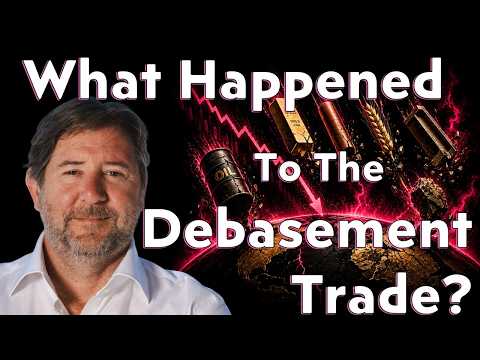
The Secret Mechanics behind the Debasement Trade Unwind...
What this covers
Episode 173 of Milkshakes, Markets, & Madness has Brent Johnson working through a sharp reversal. The dollar, which most of the market had been shorting, climbed from a four-year low to a 13-month high above 101 in roughly four months. Gold, silver, copper, crude, wheat and corn all sold off. Gold fell about 25-28% from its January peak of $5,500-$5,600. Goldman Sachs and JP Morgan had been calling for the dollar index (DXY)) to reach the low 90s. Johnson treats the episode as a test of path rather than direction.
Most of the discussion is mechanical. Central banks sell gold, their best-performing reserve asset, to raise dollars in a squeeze, because the system still settles in dollars. Johnson reads that as gold doing its job as insurance, not failing. He describes a global dollar carry trade, with foreign borrowers carrying a second, local-currency carry trade on top, and he calls the DXY a liquidity valve and weather vane. He also argues that a rising dollar drives de-dollarization by squeezing dollar debtors, while a falling one re-dollarizes. The same flows can turn into Stairway Up, Elevator Down price action. Supporting points include gold falling in both 2008 and 2020 and the dollar rising alongside inflation in 2022.
Several threads are more contested. Central banks now hold more gold than treasuries, which Johnson attributes to post-COVID buying, the freezing of Russian reserves, and losses on bonds as rates rose. He says credit contractions are built into debt-based systems and can derail the debasement trade. He also notes that half the Federal Open Market Committee (FOMC)) came to favor hikes even though Trump wanted cuts. The practical message is for investors. Silver has a history of broken hearts, including a failed $300 call, and late buyers have turned into anxious traders. Johnson says that only someone who never needs to touch their portfolio can ignore the volatility.
The debasement trade is directionally correct over decades, but the path is non-linear and dangerous; understanding dollar mechanics—particularly how carry trades unwind during dollar strength—is essential to avoiding catastrophic drawdowns in commodities and hard assets.
- Dollar strength forces foreign debtors to liquidate reserves (including gold) to service dollar obligations, causing commodity sell-offs despite long-term currency debasement
- Foreign economies face dual carry trade pressures (global dollar and local currency) that create cyclical reversals outside a sustainable band
- A 28% gold drawdown or 40% silver decline proves the debasement thesis correct in direction but wrong in path, ruining investors with leverage or short time horizons
This asset isn't compiled yet
You're seeing its claims, ranked. Compile it to build the argument threads, weight them, and check each claim against your library — the full view.
Governments deliberately use fiat currency that loses value rather than gold-backed currency because currency debasement benefits government fiscal operations and policy flexibility.
“Governments like that fiat currency loses value over time. That's not a failure of fiat. It's actually a success of fiat. Because if governments wanted a currency that did not lose value...they would just use gold. But they don't want to use gold. They want to use fiat because that helps them”
Credit contractions are a structural feature of debt-based monetary systems, and carry trades (borrowing at a cost to invest at higher yields) get unwound when credit contractions occur, causing debasement trades to be delayed or derailed.
“credit contractions are a are a feature or or or a characteristic of a debt-based monetary system and that is what we have. And as a result, carry trades, where money is loaned into existence, and then tried to place in some kind of an economic activity that that can out outperform the carry, or the cost of capital, or the interest rate, um that is that is the system that we live in. And carry trades get unwound when credit contractions take place. And when credit contractions take place, the debasement trade can get at at a minimum delayed, if not completely derailed”
Gold becoming a larger portion of central bank reserves (now exceeding treasuries in the last 12 months) is due to three factors: post-COVID central bank gold purchases, freezing of Russian reserves demonstrating political risk in treasuries, and treasury bonds losing value as interest rates rose while gold prices doubled.
“gold has overtaken treasuries in the last 12 months...largely due to central banks purchasing it post COVID and post United States freezing Russian reserves. It also has to do with the fact that treasury bonds have lost value while interest rates have gone higher. And it has to do with the fact that the price of gold has more than doubled over the last year”
Dollar index can rise while inflation is simultaneously rising, contradicting the common assumption that inflation must cause currency weakness, as demonstrated in 2022.
“This episode that's going on right now is going on while inflation is ticking up again. And so again, people are some people have said we're going to have inflation, therefore the dollar index must fall. No, the dollar index can rise while we have inflation. If you have any doubts about this, just go back to 2022”
Asset prices go up and to the right over 10, 20, 30, 40, 50, or even 100-year timeframes due to three factors: population growth increasing demand for goods, technological innovation improving efficiency and profits, and fiat currency losing purchasing power over time.
“if you look back if you zoom out and just look at asset prices over a long period of time, whether it's 10, 20, 30, 40, 50, even 100 years, asset prices go up and to the right. Now there's a few reasons for that. Number one, more people are born, more people come into the world, there's more people scrambling for the goods that exist...Another reason is that humans become more innovative...The other reason that asset prices go up into the right over long periods of time is because fiat currency loses value over time”
Gold price fell during crises in both 2008 and 2020, establishing a pattern that contradicts common wisdom that gold always rises in crises.
“This happened in 2008. It happened in 2020. This is not the first time this has happened. So, all of the people that tell you that gold will rise in a crisis, it might. I'm not saying that it won't, but it often doesn't and it often gets initially sold for this exact reason”
Markets don't go in straight lines and it's important to understand why, which is true regardless of whether rate hikes or cuts occur in the near term.
“The point is is that things do not go in a straight line, and it's important to understand why they don't. Markets do not go in a straight line, and it's important to understand why they don't.”
Silver has been historically the asset that 'has broken more hearts than any asset in history' due to repeated cycles of enthusiastic bull calls followed by harsh reversals, most recently with predictions of $300 by summer 2024 that proved completely wrong.
“silver has broken more hearts than any asset in history that I can think of...as it went higher, a lot of people were saying this is it. It's a total paradigm shift...some of these people were calling for 300 bucks by summer. And of course, now they'll say they never said it, but they did say it and there's proof that they said it...Rather than going to 300, it's below 60 bucks”
The paradox of de-dollarization is that rising dollar index (DXY) actually causes de-dollarization by creating pressure that defaults on dollar debt and makes entities want to escape the dollar system, while falling DXY causes re-dollarization by expanding dollar debt supply.
“as the dollar rises, that's actually de-dollarization, because that puts pressure on the rest of the world, defaults happen, debt gets destroyed, when debt gets destroyed, dollars get destroyed, and it...increases the desire to get out from under the dollar...When the dollar falls, when the DXY falls, that is the re-dollarization of the world, because that is the rest of the world accumulating even more dollar debt”
The debasement thesis is correct over decades but can 'completely ruin the investor' if they enter at the wrong time, use leverage, have a short time horizon, or misunderstand path mechanics; a correct long-term direction does not guarantee short-term survival.
“the debasement thesis can be completely right and still ruin the investor if they get in at the wrong time or if they get in at the wrong side or if they just don't understand the mechanics...the destination may be certain, but the path is not. And the path holds a lot of danger”
The debasement trade—betting that fiat currency loses purchasing power and hard assets appreciate—is correct in direction but has been wrong in path, as gold fell 25-28% from its peak of $5,500-$5,600 in January despite ongoing currency debasement.
“the debasement trade is not wrong, it's just not easy”
Many analysts and banks (including Goldman Sachs and JP Morgan) were calling for the dollar index to reach the low 90s, but the dollar instead rallied from a 4-year low to a 13-month high above 101 within approximately 4 months.
“many many banks uh, and analysts had the low 90s or the high 80s as their target price for the dollar index...the dollar turned around and went uh, to its 13-month high over the subsequent 4 months. And that's where we sit today. Uh, I think it closed a little over 101”
When a crisis or liquidity squeeze occurs, central banks sell gold (their highest-returning reserve asset over recent years) to obtain dollars because the global financial system still settles primarily in US dollars, not gold.
“the world still runs on dollars. Whether you like it or not, the world still runs on dollars...you still need dollars to operate on the global stage”
The world operates on a global US dollar carry trade (borrowing dollars and investing in higher-yielding assets), but foreign countries face an additional burden: a dual carry trade problem where they must manage both the global dollar carry trade and their local currency carry trade.
“the whole world runs on a US dollar global carry trade, which means you borrow in dollars and then you try to go invest in something that gets a higher return than the cost of dollars...The United States does it and the rest of the world does it. But, the rest of the world...also has to deal with their own local carry trade”
The same flows that pushed commodity prices up in the debasement trade rally can work in reverse, creating 'stairway up, elevator down' price patterns where assets climb slowly over time but crash suddenly when conditions reverse.
“the same flows that powered the trade to the upside can now work to the downside...commodity prices will go up over a long period of time at a relatively slow rate, but then it's it's it's like the stairway up and the elevator down, right?”
The dollar index functions as a liquidity valve and weather vane indicating when credit conditions are tightening globally, not as an investment itself, but as a diagnostic tool for understanding carry trade dynamics.
“think of the dollar index as a liquidity valve or a weather vane...it's not that you're investing in the DXY. The whole dollar milkshake theory has never said to invest in the dollar. It's to understand the dollar and what the dollar is telling you”
If you have a secure income source and liquid reserves such that you never need to tap your portfolio, you can ignore short-term path volatility and benefit from pure long-term debasement; most people do not have this privilege.
“if you have the ability to just have a second source of income and have a sec- a secure source of liquidity, you never ever have to tap your portfolio or your reserves, then you can just go buy gold, sit on a mountain top for the next 10 years and come back and it'll probably be higher. But if that's not you...consider yourself very lucky”
Understanding dollar mechanics and the band range within which it can trade is essential to predicting when debasement trade corrections will occur and their severity.
“if you want to understand when these corrections are coming or how they can come or why they come and the severity with which they can come, you have to understand the dollar”
Each new dollar that enters the system through foreign borrowing increases the stock of dollar liabilities on global balance sheets, making the world more, not less, dependent on the dollar over time.
“every new dollar that arrives and increases supply increases the amount of dollar liabilities in the world. Increasing dollar liabilities in the world is dollarization. It is not de-dollarization.”
President Trump wanted rate cuts coming into power, yet half the Federal Open Market Committee came to believe rate hikes were necessary, showing that market dynamics override political intentions.
“despite everybody saying that we were going to have all these rate cuts because Trump was coming into power, and that's what he wanted, you know, half of the Federal Open Market Committee thinks that we're going to have rate hikes”
Many people who bought precious metals and commodities late in 2023 through early 2024 at peak prices (silver at $85-$100, gold at $4,800-$5,500) are now experiencing 15-28% drawdowns that have psychologically shifted them from long-term investors to worried short-term traders.
“There's a lot of people who started to get interested in gold and silver...late last fall, earlier this year, in the first quarter of this year, when everything was at its highs...some people didn't buy at $18 silver or $38 silver or $48 silver. Some people bought at $90 and some people bought at $100...Some people bought gold at 4,800. Some people bought gold at 5,500”
Gold selling during a crisis is not evidence of gold failure but rather gold fulfilling its intended function as insurance; the ability to liquidate gold to cover liabilities during a crisis is precisely how gold provides the hedging protection it is meant to deliver.
“Gold getting sold in a crisis is not gold failing. Gold getting sold in a crisis is actually gold doing exactly what it's supposed to do. Gold is supposed to provide insurance in some kind of an adverse scenario. The fact that you can sell it in a crisis and get liquid to cover whatever liabilities you have is gold acting as the insurance it is supposed to do.”
If you don't understand that relative levels of fiat currencies matter, you do not understand macroeconomics, politics, geopolitics, or capital markets—these domains are inextricably tied to currency dynamics.
“If you think the relative level of the dollar does not matter, you do not understand macro. You do not understand politics, you do not understand geopolitics, you do not understand capital markets...if you're interested in any of those things, then you have to understand the dollar index”
Nothing about the recent commodity sell-off breaks the long-term debasement case, but it makes executing the trade difficult, as demonstrated across oil, gold, silver, copper, wheat, and corn.
“Nothing in the sell-off breaks the long-term case, but it makes it hard, right? Um and all you have to do is look over the last three or four months and this is a very good example. You can look in oil, you can look in gold, you can look in silver, you can look in copper, you can look in wheat, you can look in corn, all of this stuff”
Despite the system's debt accumulation and carry trade vulnerabilities, the monetary system is much more robust than many de-dollarization proponents believe, which is why the dollar is not going away anytime soon.
“the point is is you know, you this system is much more robust than many people believe it to be...why this system is so much more robust than many people have previously understood and why the dollar is not going away anytime soon”
Nobody should be surprised that the dollar broke above 100 when many people predicted it was 'going away for good,' as this follows the predictable pattern of the dollar being consistently underestimated by consensus.
“I'm not surprised at all that we see the dollar back above 100 when many people told me it was going away for good this time”
Buying hard assets should not be done with one's entire portfolio and should be approached with awareness of path risk, not as a guaranteed linear appreciation play.
“Fiat still erode, hard assets win across the full cycle. So, buy hard assets, hold on to them. Don't do it with your whole portfolio and don't think that it's easy, right?”
Nobody who claimed to understand the market and said the debasement trade was a one-way trade has been correct, because they were not accounting for liquidity cycles and dollar mechanics.
“everybody said who said they understood the market and they knew where it was going and this is a one-way trade, were completely wrong.”
The speaker recently wrote an 80-page research report on dollar mechanics and the band theory explaining this content in much greater detail, available at research.santiagocapital.com to premium and pro-level subscribers.
“I recently wrote the longest paper I've ever written on the dollar...we just put out this piece a couple weeks ago. If you go to research.santiagocapital.com, you can find the report the band there...It's an 80-page report...we're making this available to everybody who subscribes either the premium or the pro level”
Gold and silver are probably due for a bounce because they have become extremely oversold, though the speaker explicitly does not know where the bottom is and no analyst actually knows despite claiming to.
“it might go lower. I don't know, maybe. I mean, it's everything's pretty oversold now. Gold and silver are probably due for a bounce here uh because it's gotten so oversold, but the point is we don't know exactly where it's at. And everybody said who said they understood the market and they knew where it was going and this is a one-way trade, were completely wrong”