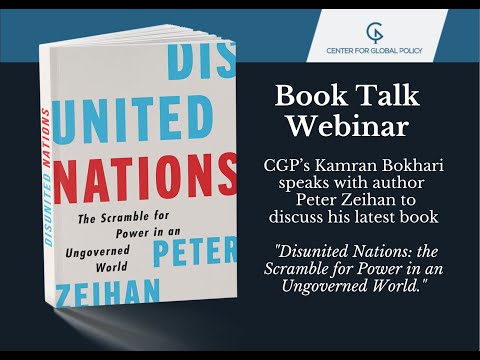
What this covers
This is a webinar conversation hosted by Kamran Bokhari for the New Lines Institute, built around Peter Zeihan's book Disunited Nations. Zeihan is the only speaker the material credits. He begins with a long historical frame: sedentary agriculture, deep-water navigation, and industrialization each favored different geographies. He argues that the American-built order was an anomaly because it spread power around the world instead of extracting resources the way empires did from roughly 3000 BC to 1945. He also contends that no single technology can now give a country a British-style monopoly, since a technological suite this broad can be copied within months.
The discussion then goes region by region, and China gets the most attention. Zeihan describes an export-dependent economy, a debt load he puts near triple GDP, and a party that will not make the political reforms Taiwan and South Korea did. He also argues that China has no outlet by land or sea. He calls the conventional US-China naval war scenarios unrealistic and says the Taiwan question traps Beijing. Russia is covered through its terminal demography, with ethnic Russians possibly no longer a majority by 2050.
The forecasts are the most contested part. In the Middle East he expects Turkey to dominate, Iran to be squeezed after overreaching, Saudi Arabia to export through the Red Sea, and Saudi Arabia and Israel to work as a de facto security partnership. He picks Japan, France, and Southeast Asia as likely winners, expects the dollar to become the default currency, and predicts the European Union will break apart. Climate comes in as a smaller point: the same warming produces opposite outcomes in Australia and Wisconsin, so regional effects are hard to forecast.
The American-led global order created after World War II is ending as the US withdraws from global commitments, triggering a transition to regional competition where geography and demography will determine which countries thrive or collapse, with most current powers facing severe vulnerabilities while unexpected winners like Japan, France, and Turkey will emerge.
- The post-1945 American order was fundamentally a security arrangement, not an economic one—the US subsidized allies' prosperity to contain Soviet expansion, creating artificial global interconnection that masked underlying geographic and demographic constraints
- As American security guarantees evaporate, countries dependent on global trade (China, Germany, Russia) face demographic collapse and resource constraints that make their economic models unsustainable, while island and internally-focused powers with young populations (Japan, France, Turkey) gain relative strength
- The transition will compress into the 2020s because COVID-19 has accelerated timelines—countries facing economic restructuring have lost 2+ years of adaptation capacity, pushing crises into a narrow window where regional conflicts and state failures will spike globally
This asset isn't compiled yet
You're seeing its claims, ranked. Compile it to build the argument threads, weight them, and check each claim against your library — the full view.
Climate change effects will vary dramatically by region in ways that are difficult to forecast without high-resolution data—Australia and Wisconsin both experienced the same temperature increase but had opposite outcomes: Australia faces continent-wide forest fires while Wisconsin gains longer frost-free seasons enabling double-cropping
“australia and wisconsin have experienced roughly the same increase in temperature but have had very different outcomes in australia most of that temperature rise has occurred during the day particularly in the summer and as a result we're seeing catastrophic continent-wide forest fires...in wisconsin most of the temperature increase has occurred at night which means we're having longer frost-free seasons”
Japan is the country to bet on for the next several decades because it is an island nation with a world-class navy and geographic insulation from the mainland, has the world's second-largest expeditionary navy outside the US, and because its aging population has made it relocate industrial capacity to other countries, creating a manufacturing base that serves local markets directly without requiring East Asian security
“you've got a country like japan which has actually the world's second largest expeditionary navy and because the population is aged so much it's not nearly as dependent upon the flow of trade in and out as the chinese are and it's physically positioned further out from the mainland so it's less vulnerable to interdiction”
China has become one of the countries most dependent upon the American-led security structures just to keep their economy at an even keel because the one child policy has made consumption-led growth impossible, debt-driven infrastructure-led growth is exhausted, leaving only export-led growth, which China cannot sustain without resources it does not have and without American security guarantees protecting its shipping lanes
“40 years after the one child policy consumption consumption-led growth in china is now completely impossible 60 years after a debt-driven policy infrastructure-driven growth is now impossible all that is left for china is export-led growth and they don't have enough resources to fuel that on their own so china has become one of the countries most dependent upon the american-led security structures”
All the Americans really have to do if they want to wreck the Chinese economy is go home, because China lacks the economic structure, financial reach, and military capacity to protect its own system, and this is something the Americans can manage even in the current political climate
“all the americans really have to do if they want to wreck the chinese is go home that's something the americans can manage even in the current political climate china utterly lacks the economic structure the financial reach and the most importantly the military capacity to protect its own system”
Turkey will dominate the Middle East in the next 30-40 years because it is the only remaining regional power (Iran contracting, Saudi Arabia can only burn things down, Egypt locked in Nile valley, Russia focused on Europe, Germany not present) and it controls the straits connecting the Aegean and Black Sea, making it the linchpin of regional trade once globalization ends
“if these two powers which are kind of defining the fight of the day if neither of them can do it you have to look at who else is in the region...you're not going to have any sort of european push through the balkans that just leaves turkey...turkey is going to rise significantly as a power...because everyone who studies turkey knows it has a european aspect it has an accidental aspect it has a caucasian aspect”
Saudi Arabia and Israel have formed a functional alliance that shares intelligence, provides energy resources, provides training, and has replaced some of what the Americans used to do; this alliance between the keepers of the mosques and the Zionists is now the foundation of security in the Middle East.
“the saudis have done that too israel we now have a functional alliance between the two powers that shares intelligence that provides energy resources that provides training that has replaced some of what the americans used to do and that alliance between the keepers of the mosques and the zionists is now the foundation of what security looks like in the middle east and some countries are okay with that some countries think it's awful but that is the new reality that has emerged in the region”
China's borders provide no escape routes—south leads to Vietnam (which defeated them in 1979), southwest to India (nuclear-armed and separated by impassable Himalayas), west to Kazakhstan (worthless), north to Russia (which has threatened nuclear response), and out to sea where their navy cannot project force beyond 1,000 kilometers, making expansion impossible and containment inevitable
“their borders there's no place that they can go to kind of fix this if they go south they go into vietnam and the last time the chinese tried that which was in 1979 they got treated to the same sort of gentle welcome as the americans...you go southwest you hit india and even if you could get past the himalayas which you can't india's nuclear power...and then if you go out into the water the chinese maybe may be large and it may have a lot of cruise missiles but it's not long range only about 10 of their vessels or surface combatants of a size that can matter that actually can go more than a thousand miles”
Russia's demography is terminal—between WWI, WWII, collectivization, and Brezhnev's mismanagement, the ethnic Russian population (75-80% of the Russian population) faces collapse, making Russians unlikely to remain a majority in their own country as soon as 2050, and forcing the only viable strategy to be complete physical lockdown of the country
“between world war one world war ii collectivization brezhnev's mismanagement and the post-soviet collapse we have a terminal demography across the russian system across the russian ethnicity which is about 75 80 percent of the russian population which means that the russians are unlikely to remain as a majority in their own country as soon as 2050”
Sedentary agriculture, deep water navigation, and industrialization are three great technological revolutions that each favored different geographies; technologies migrated to geographies that could use them better, with industrialization ultimately favoring the United States because of geography and timing after World War II.
“sedentary agriculture deep water navigation and industrialization are three great technological revolutions and each one tends to favor a different sort of geography so whoever figures those texts out first has a great run but then those technologies tend to evolve and mature and migrate to other geographies that can actually use them better”
Saudi Arabia has shifted its crude exports from the Persian Gulf to the Red Sea (west coast), giving it multiple export options that Iran lacks, and closing the Persian Gulf would not achieve what Iran is after because the saudis can shift exports while Iran cannot.
“saudi doesn't need to win the middle east for iran to lose saudi's power comes from holding the holy cities and comes from oil exports and it has a variety of export options that iran doesn't have so even closing the persian gulf down right now for iran would not achieve what they're after because the saudis can shift their crude out to the west coast to the red sea iran doesn't have another option”
The global order created by the United States was anomalous in human history because it distributed power globally rather than establishing an empire that siphoned resources from conquered territories, representing a unique break from the imperial pattern that dominated from roughly 3000 BC to 1945.
“the united states did not establish an empire remember an empire siphons resources from the territory it controls the united states did the opposite whether it be a financial aid or military protection the united states distributed its power on a global scale”
The British were able to control most of the world with only 3 percent of the world's population because they developed industrialization technology first and maintained a technological monopoly for a century or two—but this advantage cannot be replicated today because no single technology can overwhelm the existing global technological suite, and even if China dominated AI, software can be stolen and applied globally in less than six months
“the brits with only three percent of the world's population were able to control most of everything is they literally brought a gun to a knife fight for a century and there were very few countries that could stand up to that...but there is no technology right now that can overwhelm the technological suite that currently exists so even if the chinese managed to dominate ai which by the way is software so it can be stolen and applied anywhere in the world in less than six months that's not a century advantage”
If China were to conquer Taiwan, it would sever all its trade connections because no one would trade with an actively militarily aggressive China in the South China Sea, making Taiwan conquest simultaneously economically suicidal and politically necessary for the CCP to maintain domestic legitimacy
“if the chinese really start shooting in the east and the south china seas no one's going to trade with them no one's going to sell a super tanker to china under those and under that sort of environment so everything about the chinese system today will fail”
In the Western economic system, money is an economic good with intrinsic value, so capital flows based on expected returns and creditworthiness; in China, capital is a political good that flows to entities that serve state goals like mass employment, which is why China can fund economically unviable projects like the Belt and Road Initiative with negative interest rate loans
“in the west in general and in the united states in specific money is considered an economic good so the idea is that cash has a value so if you want to get a mortgage loan your house is used as collateral...that doesn't apply in china and china economic or in china capital is considered a political good it exists to serve the state's political goals which for the most part are social placidity via mass employment”
China's total debt, including local debt, is probably about triple GDP, whereas for a country at China's development level one would normally expect a debt load of about one quarter GDP, and every other company that has followed this model has eventually collapsed, with only Taiwan and South Korea managing transitions by abandoning authoritarianism and implementing democracy
“best guess total debt especially once you include the local stuff is probably about triple gdp and for a country at china's level of development you'd normally expect a debt load of something like one quarter that china hasn't collapsed yet obviously but every other country every other company that has ever followed this model...has eventually ended”
Iran is facing collapse in its regional position because it overextended beyond the mountain core into Iraq, Syria, and Lebanon, and now faces pressure from Egypt, Turkey, and Saudi Arabia—each more powerful or better-positioned than Iran, while Saudi Arabia's strategy of burning everything down through proxy militants prevents Iran from winning even locally
“one of the problems that iran has always had going back to antiquity is if you start expanding out from the mountain core there's no clear place to stop and so they've become the preeminent power in iraq and in syria and in lebanon and now what they are now facing pressure from egypt from turkey and from saudi arabia and saudi arabia to be perfectly blunt has much deeper pockets”
Israel will be fine in the post-American order because it has already cut a deal with Saudi Arabia for energy security, unlikely to face Turkish military pressure, has food import agreements with Europe, and faces a region where the main challengers (Syria, Lebanon) are already failed states—creating a nearly ideal position despite being geographically small
“israel is probably fine uh they've already cut a deal with the saudis so they don't have to worry about any sort of energy shortages...i think it's highly unlikely that the turks are going to have any sort of long-term tif with the israeli...the biggest problem that the israelis actually have is food supply...luckily for the israelis the europeans are a mass exporter”
The US dollar will become de facto global currency as euros weaken (due to Brexit and policy dysfunction), the pound loses store-of-value status, Canadian currency faces internal rebellion between prairies and Eastern Canada, and Chinese currency remains controlled—leaving only the dollar and Australian dollar as alternatives, but Australia exports commodities that will lose value in global collapse, so dollarization accelerates
“we're moving into a world with less global structure we basically are entering a world of de facto dollarization...the european union as the euro has kind of become a joke...the pound is no longer perceived as a store of value...the chinese keep their system under a complete lockdown...the us dollar is not going anywhere we're seeing a de facto dollarization of the system right now”
Southeast Asia has a bright future because its population is young and growing, its industrial base is integrated into Chinese, Japanese, and American supply chains that can be easily retooled, it is self-sufficient in energy and food, and with Australian raw material exports nearby it can experience an economic boom similar to China's but with sounder foundations
“southeast asia i'm very bullish on...its population structure for the most part is young and growing its industrial plant is right now integrated...it's going to be relatively easy to retool...these countries are broadly as a unit self-sufficient in energy and food stuffs...they'll be able to experience kind of an echo of the panda boom of china”
The CCP's primary goal is to maintain power regardless of economic damage, so they will not implement the political reforms (like those undertaken by Taiwan and South Korea) necessary to transition from a debt-driven model to a sustainable economic system, making collapse inevitable.
“with the ccp the options for those transitions are very limited because the ccc the ccp's primary goal here is to mean power maintain power and they really don't care what the economic damage is so long as they can do that”
Most scenarios about US naval conflict with China assume absurdly that the American navy must be able to operate without impunity within sight of the Chinese coast while simultaneously safeguarding all Chinese trade—if the US and China fought, America would simply stop Chinese shipping and conduct targeted strikes, which would be an easy war, but it won't happen because the Chinese are not stupid
“most of these scenarios that i've read about how the americans couldn't win a naval war with china assume hilariously two things number one that the american navy has to be able to operate without impunity within sight of the chinese coast at all times...if in the incredibly unlikely scenario that the americans and the chinese actually cross swords the americans would do the same thing...we'd just stop shipping in and out of the country...it would be over”
The global order achieved a freezing of military conflicts around the world that had been endemic, allowing peoples to attempt nation states on the French model even in places where local geography would not suggest success, and also prevented more powerful countries from venturing out and conquering parts of the world.
“one of the many things that the global order achieved was a freezing of military conflicts around the world that had been endemic and it meant that con peoples could attempt to have a nation state on the french model to a certain degree even in places where the local geography would not suggest that it's very likely to succeed and it also prevented the more powerful countries of the old imperial cores from venturing out and conquering parts of the world”
Turkey has European, Asian, Caucasian, and Mediterranean aspects to its power and must choose which direction to concentrate its efforts; all of Turkey's neighbors are trying to get Turkey locked into a quagmire somewhere so it cannot focus on them, with Syria being a likely candidate.
“the question is which direction does it go because everyone who studies turkey knows it has a european aspect it has an accidental aspect it has a caucasian aspect sometimes it's interested in the mediterranean and as powerful as turkey is compared to all of its neighbors it's not more powerful than all of its neighbors so it has to choose to concentrate its efforts in one direction or the other and i think everyone in turkey's sphere of influence agrees that they don't want the turks focusing on them so whether it is armenia or germany or egypt or israel or russia everyone is trying to get the turks locked into some sort of quagmire somewhere”
France will emerge as the dominant European power after the EU disintegrates because it has a young population, robust independent infrastructure, doesn't rely on trade, doesn't border problem countries or spheres of influence of problem countries, and has the world's third-most powerful navy, allowing it to become the broker of Europe by providing the security and access other countries need
“compare that to france young population relatively robust independent infrastructure not really trade driven they've kept their market to themselves even within the european system they also don't border problem countries...it has the world's third most powerful navy it can go out and get the things that the rest of europe needs and become what it's always wanted to be the broker of europe”
Geography is the single most important factor determining long-term national power—you cannot grow crops in deserts and naturally occurring water systems provide free transportation that determines development—but it is not the only factor because demography and leadership also matter significantly, as shown by South Korea becoming a top exporter despite minimal resources
“well one it's really hard to argue that geography isn't the single most important factor affecting countries over the long run...it's not the only thing now i would underline two other issues number one is demography...and second leadership does matter”
Russia's current deployment to the Middle East is only about 9000 troops, which shouldn't be able to achieve what it's doing, but because local state capacity is so low and outside powers are barred under American order, a small deployment can make a mark.
“what's the total russian deployment to all places in the middle east combined it's like what nine thousand that's not a lot that shouldn't be able to achieve what it's doing but the local powers are a step down and places like syria and libya honestly wouldn't be able to exist at all without the americans barring the empires”
The size of the global consumption base is probably going to be about a third to a half smaller in 2030 than it is now because of global demographic shifts, which means there is nothing about the Chinese system that works in the midterm
“the size of the global consumption base is probably going to be about a third to a half smaller in 2030 that it is right now”
The American aircraft carrier will become obsolete within 25 years not through combat but through changing strategic requirements—the US will pivot to smaller destroyer-shaped vessels armed with cruise missiles, special forces, and armed drones that can patrol for a month at a time, as the need for power projection platforms disappears
“the ford class which are very cool pieces of hardware...is probably going to be the america last american carrier class so i think the current plan is to have three of those total and then that's it after that the us will probably be segueing into smaller vessels that are roughly destroyer shaped that just carry scabs and scats and scats and cats of cruise missiles...the era of the aircraft carrier as important as that is and as long as it's lasted is going to end in the next 25 years”
Australia has not had a recession in 30 years largely because of price-insensitive Chinese purchases, but this will end in the next couple of years, causing Australia to probably experience something nearly on the catastrophe level of the Great Depression, though with good geography Australia will be able to grow again after housing problems are sorted.
“australia i haven't had a recession in 30 years largely because of price insensitive purchases of the chinese that is going to end in the next couple of years there is going to be a global adjustment aka a depression during the interregnum there is no way that the australians get out of that without a hell of a lot of pain so they're going to probably experience something nearly on the catastrophe level of the great depression”
Sub-Saharan Africa is not experiencing fast consumption growth but rather demographic youth fueled by capital flows from retiring Westerners; this infrastructure boom will end in two years when Western retirement savings stop flowing, making Africa a special case unless projects are completed and self-sufficient by then
“africa's growing because of the baby bust in the developed world there's a huge number of people in the rich world that are in their late 50s and early 60s on the edge of mass retirement their investments for retirement have pushed down the cost of capital some of that capital has made it's into sub-saharan africa...but that is done in two years”
COVID has knocked down the megacity trend of concentrating populations in cities for better services at lower cost, because metro systems become vectors for disease; New York will be one of the last metro regions to recover because everyone needs to use the metro to get around and nobody wants to.
“kovid's certainly knocked it down um the idea that you concentrate populations in order to have better city services at a lower cost you know it's just basic economics it doesn't work with covet at all new york is probably going to be one of the last metro regions in the united states to recover simply because everybody has to use the metro to get around and nobody wants to get into it”
Manufacturing supply chains will regionalize toward points of consumption rather than maintain the current long-distance, fragmented international arrangement because international transport will no longer be cheap or safe, favoring countries like Mexico, Turkey, India, and the United States.
“in manufacturing you get a breakup of the long gangly supply chains we've become used to as international transport is no longer safe for cheap that argues for regionalization of supply chains much closer to points of consumption that would argue to do very well for places like mexico or turkey or india or the united states”
Hungarian nationalist fantasies about partitioning Romania with Russian help are not credible because Hungary lacks the military capacity to do it alone, and even if Russia tried to support it, Turkey would cut a deal with Romania and Bulgaria to establish a hard line through the Balkans to prevent Russian and Hungarian expansion that would threaten Turkish interests
“hungarian nationalists have always been cartographically creative...the fact that they have to partner with another power gives you an idea of what their local strength is...if the russians did start moving in that direction probably the first thing you would see is that the turks would cut a deal with both bulgaria and romania”
Roughly half to two-thirds of the food currently produced globally can only be produced in current volumes because of internationally traded inputs that are relatively low-cost, so when global trade breaks down, food production will collapse and approximately a billion people will starve because production falls below sustainable levels
“agriculture probably half maybe two-thirds of the food that is produced right now can only be produced in the volume that it's being produced because of internationally traded inputs...a billion if so people are going to starve because of a lack of production”
Refugee flows will become considerably worse as states fail across sub-Saharan Africa, North Africa, Middle East, and Asia due to trade collapse, demographic breakdown, security collapse, and agricultural failure—with particular concern for Egypt, which is hugely overpopulated, barely feeds itself, and could generate Egyptian refugee flows as large as the Syrian refugee crisis if only 1% of population flees
“considerably worse one of the things that has prevented refugees from being a major factor in the global system for the last 70 years is most wars were preempted or blocked by the united states...unless you have the financial capacity of dealing with this sort of environment...you're going to be genuine refugees so i'm particularly concerned about egypt despite its geographic isolation it's hugely overpopulated”
The U.S. will not be involved in meaningful strategic military ventures for at least another 20 years because it is retreating and consolidating; the U.S. has already reduced troops abroad to the lowest level since the 1920s and will continue this withdrawal.
“america right now has fewer troops stationed abroad than at any time since the 1920s and as our policy catches up to the strategic reality i'm really not worried about the type of exposure the americans are going to have when sailing within sight of the asian mainland because they're not going to be sailing within sight of the asian mainland much longer”
The United States can continue running deficits like it has under Trump and Obama for at least another 40 years before reaching a crisis point because the US dollar is the global currency and foreigners continue to buy US Treasury bonds during crises, whereas Japan has twice the US national debt but cannot sustain it because the yen is not a reserve currency
“as long as the u.s dollar is the global currency uh that that really doesn't matter...if there's anything that covett has shown us it's even in a time of moderate geopolitical distress everyone puts their money here...japan right now has a national debt that's about twice that of the united states and they're not the global store of currency so the us continue can continue running deficits like it has under trump and obama for at least another 40 years”
New Zealand is uniquely well-positioned because it has no security threats, is the lowest-cost food producer globally with productive land, has a strong population and beautiful geography, but its small population (5 million) prevents it from being a regional leader despite its advantages.
“new zealand is unique in so many ways it has no security threats it's land is so productive that it's the lowest cost producer for almost every food stuff that it generates and then of course the people are wondering from wonderful in the country is beautiful there are only five million people however so the leading a leader in the region they cannot be”
The Americas will largely escape the chaos of the transition from the American order because geography, demography, and self-sufficiency in energy and food insulate the United States, and the U.S.-Mexico integration buys the North American region at least two extra decades before facing the worst pressures.
“the us geography is great the population structure is stable it doesn't need trade relations with very many countries... the united states is going to do just fine... the united states can basically leave the world and not feel the difference”
Turkey might even seize Crimea from Russia in a matter of days if Russia tried to expand into the Balkans because Turkey has the sealift capacity, air cover, and allies necessary, and controlling Crimea would guarantee Russia remains unanchored in the Eurasian steppe forever, accelerating Russian collapse
“you'd probably see turkish troops uh conquering the yalta or sorry the crimean peninsula in a matter of days they've got the sea lift capacity they've got the air cover necessary and they would have the allies that they would need and if you can get a turkish footprint there you can guarantee that the russians were remain unanchored in the eurasian step forever”
Germany will likely need to rearm on the pace of what we saw in the late 1930s in order to survive because without military capacity it ceases to exist in an environment where it no longer has American security protection
“we're going to see a rearming in germany on the pace of what we saw in the late 1930s because without that germany ceases to exist”
The world has been living in an era of 'more' since the Columbus expeditions, where every year and generation brought more interconnectivity, resources, consumption, and larger populations; this decade all of that flips to an era of 'less' with fewer connections, smaller populations, less consumption, and less interconnectivity, and the world lacks frameworks for operating in this environment.
“everything we know about economic history is an argument over how to parcel out more more is over this decade we flip and we deal with an era of less fewer connections smaller populations less consumption less interconnectivity we don't have a framework for how to do that”
As the American global order ends, the era of wars prevented by American dominance will end, and countries with regional military capacity will use it; wars among regional powers will become endemic, and new military capacities will be built rapidly across regions with resources to do so.
“countries that have military capacity use it we're going to see countries that don't have military capacity develop it all in just a few years”
The U.S. will remain engaged in a few remaining vestigial commitments on the way out (primarily in the African Sahel with French partnerships) but will abandon most other regions, particularly the Middle East and Levant, leaving these regions to sort themselves out.
“there are some what's best way to put this on our way out the door issues because you can't withdraw in a day where the americans are going to remain a little bit involved just for to for vestigial regions uh reasons that's not going to be in the persian gulf that's not going to be in the levant in the case of islamic terrorism it's probably going to be in the african sahel and that's mostly because we have partners there that the americans really trust most first and foremost the french”
Urbanization trends of people moving to cities will reverse when agricultural shortages begin because people in cities cannot grow their own food and will be forced back to the countryside, reducing urban food supply spirals and forcing countries to consider collectivization-style policies to maintain modernity without the population to support it
“people who live in sydney's all have one thing in common they can't grow their own food and if we start to have agricultural shortages then a lot of the people who kind of live on the margins have no choice but to move back to the countryside in order to grow their own food...no country is going to do that willingly so there are some questions”
Iran is a natural ally for the United States from a geopolitical perspective—its ability to expand is limited by mountains, it is more cosmopolitan and tolerant of ethnic diversity than the Arab world, and historically it has been a successful power that can manage its own population—but the American-led order created a artificial dependence that made Iran's survival contingent on selling oil into American-protected markets
“iran's geography normally would not be successful it's mountainous there's no navigable rivers of any length the climate is variable to say the least but because the geography of everyone around it is even worse it has been a power that stretches back to antiquity...iran's actually a natural ally...its ability to expand is relatively limited...most of its military has to be used to contain its own population and it's more tolerable of ethnic variety than the arab world with large”
The clash between different economic 'isms' that happened from 1870-1940 (nazism, communism, capitalism) over how to allocate 'more' will be dwarfed by the conflicts of 2020-2040 when the dominating question becomes how to manage 'less' in a world where multiple regions are industrialized and armed with modern weapons
“the last time we had this sort of churn in the global strategic environment was the period from the 1870s to the 1940s when a number of different isms nazism communism for example clashed over what the correct economic model was we now get to see that happen in a world where more than one region is industrialized and if we clashed so vigorously back in that period over the concept of more imagine what's going to happen when the dominating theory is the concept of last”
The United States is likely to be one of the few countries that is a net beneficiary of climate change because while most of the world deals with climate stress, demographic collapse, security collapse, and economic competition, the United States will experience bigger crop yields and continued economic growth
“if most of the rest of the world is dealing with climate stress at the same time it's dealing with demographic collapse and security collapse and economic competition whereas the united states is just kind of like ho humming going along with bigger crop yields it would seem to argue that the united states is going to be one of the country few countries it's actually a net beneficiary of the changes”
If the US had followed the Clinton-era fiscal prudence policy instead of running deficits under Bush and Obama, the US would have paid off the national debt by now and funded the entire baby boomer retirement, leaving the economy 15 trillion dollars larger today, though this is an opportunity cost, not a national disaster given current fiscal capacity
“if we had stuck to the clinton era program of fiscal prudence uh we not only would have paid off the national debt by now we would have paid for the entirety of the baby boomer retirement our the u.s economy would probably be 15 trillion dollars larger now than it was then”
Geography, demography, structure, and technology are the four factors that determine geopolitical outcomes, and these were masked for decades by the global order which made them artificially irrelevant by keeping everybody connected in one system, but now that system is ending and these bedrock factors are reasserting themselves
“geography structure technology demography how those four interact is what determines everything and one of the things that has been the the geography piece and the demography piece have basically vanished for most model building in recent decades and that's because of the global order”
China's economic model is fundamentally predatory because it needs open markets to shove its products out, whereas the American model subsidized everybody—imagine the Chinese protecting rival economic shipments that would hurt their own corporate interests, which they would never do
“can you imagine the chinese protecting rival economic shipments that would hurt their own corporate interests no china's a predatory economic power china needs open markets so it can shove their products out if that gets shut off it doesn't work”
The question of whether American foreign policy opposes terrorism or opposes Iran is unanswerable because the countries that most excel at sponsoring transnational Islamist terrorism are the countries that oppose Iran, and the countries that most excel at dehumanizing humans are America's most lucrative trading partners—meaning contradictory policies reflect genuine conflicts between security, trade, and human rights goals
“is it american foreign policy to oppose terrorism or to oppose iran because the countries that do the most to generate transnational islamist terrorism are the countries that do the most to oppose iran is it america's goal to pursue human rights or expand trade because many of the countries who most excel at dehumanizing humans are among the most lucrative trading partners”
India is static geopolitically—it has been for 1,500 years and will remain so because it is blocked by mountains, jungles, and deserts from expanding, and its low capital availability combined with rapid population growth creates endemic poverty, but it never really joined the American-led order so when global trade ends, it has less far to fall than countries dependent on exports
“india is very static in geopolitical terms...india never really joined the american-led order they were too statist...which means that when global trade goes away they don't have that far to fall...india is kind of it's in its own little pocket”
The United States did not create the global order so it could trade with the world—it already had a continent-sized economy at home—but specifically to fight the Cold War by sharing its infrastructure, consumption, and military forces with allies to allow them to export their way back to affluence
“we did that specifically to fight the cold war by sharing our infrastructure and consumption and military forces with our allies we were able to allow them to export the way back to affluence but that was always a security policy”
The Trump administration has managed to hammer out trade deals with Korea, Japan, Canada, and Mexico and will complete one with the UK by year's end, accomplishing roughly half the US trade portfolio in a way that allows the US to leave the global system and function independently without significant disruption
“say what you will build the trump administration and there's so much to say about the trump administration it has managed to hammer out trade deals with korea japan canada and mexico already and we'll have them with the united kingdom by the end of the year that's half the trade portfolio”
Americans picked up contradictory global goals in the 1990s—opposing terrorism, expanding trade, pursuing human rights—and never sorted them out because they were subordinated to Cold War anti-Soviet strategy, but now that organizing principle is gone, American policy will shake itself out as the US withdraws and focuses on interests where they actually align
“americans really need to sort their out uh one of the things about the cold war that was kind of simple was that when you lived with fear of atomic destruction you kind of focus the minds and everything else was a secondary position americans aren't in that position anymore so we picked up kind of all these anticipatory goals in the 1990s many of which conflict”
The American commitment to the global order has ended not because of Trump but because across the entire political spectrum—left, right, and center—Americans have decided they are done with global engagement, as evidenced by all 114 million Democratic primary candidates saying Trump was being too soft on trade
“this is not a trump thing if if you listen to the democratic debates of those 114 million people who are trying to get the ticket every single one of them said that donald trump was being too soft on trade so this is left this is right this is center the americans are just done”
COVID-19 has compressed the timeline of transitions that were supposed to happen across the decade—countries that expected to transition in 2022-2025 have lost two years of economic development and adaptation capacity, meaning the 2020s will see everything that was supposed to spread across ten years happen in four to eight years instead
“what kovid has done has robbed the world of the year 2020 for economic development or growth or transition and honestly with the way the epidemic is playing out 2021 is probably a loss as well so if you were a country that was going to face this big transition in 2022 to 2025 you just lost two years”