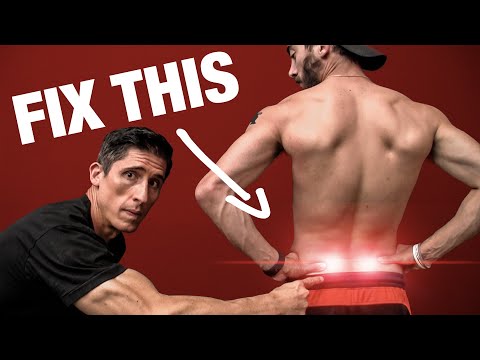
How to Fix “Low Back” Pain (INSTANTLY!)
What this covers
This is a single-presenter video in which Jeff Cavaliere, a physical therapist who runs ATHLEAN-X, argues that pain people feel in the low back is often coming from a muscle outside it. He starts with anatomy: the gluteus medius sits under the glute maximus and attaches near the PSIS, and it has two jobs, hip abduction and keeping the pelvis level during single-leg support. The video then moves in sequence, from a self-test for weakness to an immediate relief procedure and then a set of strengthening drills.
The substance is mostly practical. The relief technique pairs thumb pressure on the trigger point with a repeated leg pattern, followed by a held, fully contracted position until the muscle fatigues. Cavaliere says relief should be noticeable as soon as you stand up. He also covers the weakness test, where lifting one foot reveals whether you must shift your weight or your shoulders, and he links this to Trendelenburg gait, in which the opposite hip drops with each step. He notes that people who squat hundreds of pounds often cannot hold the isometric position, which he takes as a sign of how common the weakness is.
Two claims are flagged as contested. One is that unequal weight distribution in squats creates imbalances that lead to recurring back pain. The other is that using a lacrosse ball for self-myofascial release on an inflamed gluteus medius is counterproductive, because the irritated tissue resists the pressure. For prevention he prescribes the leg lift, a wall-based abductor drill, and the "sac swinger," a weight hung from the waist by a dog leash while walking. He recommends doing these three to five times a week, or daily while pain is present.
Localized back pain you can pinpoint with your finger is typically gluteus medius dysfunction from sitting and improper lifting mechanics, and can be rapidly relieved through targeted pressure-and-movement techniques followed by progressive strengthening exercises.
- The pain is usually gluteus medius trigger point tension, not true lower back muscle injury
- Immediate relief comes from controlled thumb pressure combined with specific leg movements that 'floss' the muscle
- Long-term prevention requires 3-5x weekly glute medius strengthening via wall holds, weighted walking, and leg lifts to restore pelvis stability and equal weight distribution in squats
This asset isn't compiled yet
You're seeing its claims, ranked. Compile it to build the argument threads, weight them, and check each claim against your library — the full view.
Localized back pain you can pinpoint with your finger is typically not low back muscle pain but rather gluteus medius dysfunction, a muscle that runs under the glute maximus and attaches to the inside of the PSIS (anterior superior iliac spine bony prominence).
“Really, what we're talking about is a glute medias. This is a rampant problem, and one that is caused by a lot of sitting, and a lot of things that we're possibly even doing wrong in the weight room.”
Many people who can squat hundreds of pounds are unable to perform the gluteus medius isometric hold because the muscle is weak, indicating how much weakness exists in this muscle despite overall lower body strength.
“I know people that can squat hundreds, and hundreds of pounds that really can't do this exercise very well. That shows how much pain and weakness there is, right?”
The gluteus medius has two primary functions: hip abduction (lifting the leg out to the side) and maintaining pelvic stability during gait by preventing the opposite hip from dropping during single-leg support.
“Two things. The first is: you should be able to use it to abduct your hip. Meaning, to lift your hip up, and out to the side. The other thing that's even more important is that, with every step you take its job is to make sure that your pelvis stays level.”
The wall-based glute medius exercise involves standing sideways to a wall with one arm up for balance, lifting the inside leg while letting it drop outward (passive abduction), then having the gluteus medius drive it back against gravity and toward the wall to work the stance-leg hip abductor, repeating for 10-15 reps of solid contractions.
“Okay, so here's what you're going to want to do to get rid of this pain once, and for all. One exercise here is, you're just going to use a wall. You put one arm up, just like that – that's not meant to push against the wall with. It's just meant for support, and balance. You take the leg that's on the inside and you lift it up. Now, what they did is, it should let this hip just drop out to the side casually, this way. But the glute medias, remember, it wants to make sure that it doesn't drop. So it's going to drive it back in until that leg touches the wall.”
The leg lift exercise—where the leg moves back into extension with toes pointed down, lifts up, comes forward, and touches down—performed repeatedly until fatigue builds tolerance and endurance should be done on both sides and serves both immediate treatment and long-term prevention of gluteus medius pain.
“Finally, the other exercise is the treatment. Remember when we had you lay on the ground and put your finger there? Well, just the movement itself – bringing your leg back behind your body, lifting up, toe down, coming forward, touch the ground, come back, and do those leg lifts – you do as many of those as you can until you build up your tolerance, and your endurance there, and you make sure you do it on both sides.”
Unequal weight distribution through legs during squats causes muscle imbalances that lead to recurrent back pain, and this can be tested by attempting to lift one leg while standing—if you have to shift your weight significantly or move your shoulders, you have unequal distribution.
“If you lift weights and you squat, the problem is, I can almost guarantee you that when you start to get this pain, at some point, it's because you don't have an equal distribution of weight through both of your legs.”
Using a lacrosse ball or hard object for self-myofascial release on an inflamed gluteus medius is counterproductive because it applies excessive pressure that the already-inflamed tissue resists, rather than helping to fix the problem.
“What you don't want to do is, you don't want to start reaching for a lacrosse ball and putting it underneath you because when you're in pain, you're already inflamed, you're putting too much pressure on this area that's likely to resist what you're trying to do, and not help to fix it.”
Trendelenburg gait—where the hip on the non-support side drops with each step—occurs when gluteus medius is not functioning properly to stabilize the pelvis during single-leg support.
“There's something called a Trendelenburg Gait where, when your hips can't do this you start to look like – show them, Jessie.”
Long-term prevention of gluteus medius pain requires performing targeted strengthening exercises 3-5 times per week, or even daily if currently experiencing pain, to build reliable muscle strength and endurance.
“How many times? You want to do this at least 3, 4, 5 times a week. Maybe even just once a day if you have the back pain right now.”
Sitting and improper weight room technique are primary causes of gluteus medius dysfunction that leads to localized back pain.
“This is a rampant problem, and one that is caused by a lot of sitting, and a lot of things that we're possibly even doing wrong in the weight room.”
The immediate pain relief technique involves applying controlled thumb pressure to the gluteus medius trigger point while moving the leg through a specific pattern: knee drops to ground, then extends behind body, then lifts with toes pointed down—repeating 10 times, resting 10 seconds, then holding the extended position with maximum squeeze to fatigue the trigger point.
“So you take your finger and your thumb, you put it right up on that spot... So once your finger is on that spot you're going to take your leg through the same direction right here. You're going to come down until your knee touches the ground. Once it touches the ground it's going to kick back, behind you, into extension. It's key that you get past the midline of your body here, and then when you do, you're going to lift up. You toes should be pointing a little bit down toward the ground when you do.”
The sac swinger exercise—suspending a kettle bell or weight with a dog leash around the waist and walking at a normal pace—forces gluteus medius to work harder by requiring control of both leg weight during swing and the suspended weight's momentum, making this an advanced version of basic hip stabilization training.
“We actually call it what it looks like. It's a sac swinger. You'll see in a second. You just basically take a dog leash and you take a kettle bell – any kind of weight here. Of course, this could be a dip belt, too. but if you don't have a dip belt, you put it right around here, and then what you're going to do is, you're going to step in. so Jessie's going to step into it, and then he's going to hook it around his waist.”
Low back pain is one of the most common conditions people deal with and can undermine workouts and gym performance, making it essential to address properly rather than tolerate.
“Guys, low back pain is one of the most common things that we all deal with and it can undermine any of your workouts. As anybody who knows, when your low back is humming it's really difficult to even get yourself in the gym, let alone to lift anything of significance.”
Immediate pain relief from the treatment technique should be felt as soon as the person stands up after completing the trigger point release procedure.
“If you find this and you do it right you're going to feel relief right away... So once we've done that, now when you stand up you should notice an immediate relief in the amount of discomfort that you feel in that spot.”
ATHLEANX programs are designed with both aesthetics and function in mind—not just getting people to look better but to feel good—because Cavaliere is a physical therapist considering both objectives.
“Guys, if you're looking for a program that puts the science back in strength – as a physical therapist everything I do has both things in mind. Not just getting you to look better, but to feel good, too.”