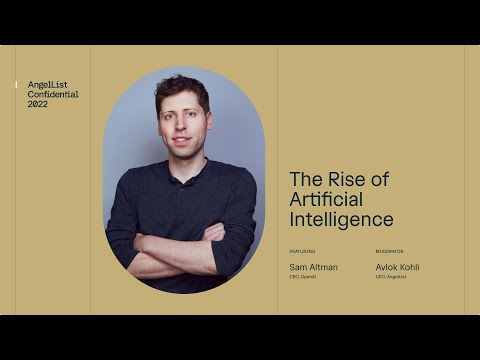
The Rise of Artificial Intelligence | AngelList Confidential 2022
What this covers
This is a 22-minute conversation from AngelList Confidential 2022 between an interviewer and Sam Altman, OpenAI's CEO. It begins with platform-shift analogies. Altman compares AI to mobile, noting that mobile had an easy mental model, the "remote control for your life," while AI is harder to explain. He argues that when something gets orders of magnitude cheaper and faster, what it makes possible changes in kind. His example is Uber, which looked unnecessary when the iPhone launched. He also calls AI both heavily hyped and still underestimated, and says people accept in the abstract that machines could do most cognitive labor at a fraction of the cost without absorbing what follows.
The middle of the talk is practical and industry-facing. Altman lays out a likely value chain: a few companies training very large foundation models, a middle layer that fine-tunes them for domains such as law, and a long tail of consumer applications. He explains why fine-tuning a base model, which already has reasoning and world knowledge, beats training from scratch. He also describes OpenAI's method of removing obstacles as they appear and doing new research when it hits a wall. He describes AI as an alien form of intelligence, like airplanes relative to birds, and so expects strengths and weaknesses unlike human ones.
The later turns are more speculative and more contested. Altman imagines AI speeding up science by 1000x and says society can only absorb change so fast. He suggests capitalism's usual mechanisms may "break down a little bit" as cognitive labor approaches zero cost. He names three underdiscussed problems: how wealth is shared, who gets access to AI systems, and global governance of AGI), where he points to nuclear arms agreements as precedent for negotiation. He also stresses limits to automation: some work people will want done by humans, some cognitive goods stay costly for reasons of status, and forecasting which jobs will exist after a revolution has a poor track record.
AI is the paradigm shift of the 2020s, comparable to mobile in the 2010s, with capabilities that society is still massively underestimating; its impact on scientific discovery, economic systems, and governance will require fundamental rethinking of capitalism, wealth distribution, and global coordination mechanisms.
- AI represents on-demand intelligence that is orders of magnitude cheaper and faster than human cognition, creating qualitative shifts in what's possible
- Acceleration of scientific discovery by 1000x would compress centuries of progress into years, with chaotic societal consequences that current institutions are unprepared for
- Fundamental assumptions of capitalism break down when the cost of cognitive labor approaches zero, requiring new frameworks for wealth distribution and resource access
This asset isn't compiled yet
You're seeing its claims, ranked. Compile it to build the argument threads, weight them, and check each claim against your library — the full view.
When something becomes orders of magnitude cheaper and faster, it creates a qualitative shift in what's possible, as demonstrated by how Uber seemed unnecessary when iPhone first launched ('why do I need Uber when I can call a taxi') but became essential once the cost and friction dropped dramatically.
“the one of the things that I think we're seeing which is true for much of technology is when you make something um way faster and way less expensive the it is a qualitative shift in what's possible and you know like people pointed out when the kind of iPhone is remote control for the world that came along they're like well why do I need this thing called Uber I can just like call a taxi um and you know when the when the very first image generators launched it's like well why do I need this I can just like pay an illustrator to do it but it turns out that like the world doesn't quite work that way and when these things change by like orders of magnitude on these two axes it's it's like really different”
Certain categories of cognitive labor will remain expensive by choice because of status, exclusivity, or cultural preferences (e.g., wine, handmade goods, art), so not all cognitive work will be fully automated even as the cost of AI intelligence approaches zero.
“there will be categories where um we want them to be expensive you know like the famous example there's some name for these kind of Goods Dublin Goods maybe but like people want wine to be more expensive uh people like liking unmade things they you know they want certain art to be really expensive”
Predicting what jobs will exist on the far side of major technological revolutions is historically very hard to do, so claims about specific jobs surviving or being created in an AGI world should be treated with skepticism.
“whenever you're on the the left side of the sort of um you know major technological revolution in human history and you try to predict the jobs on the right side like that's always really hard to do”
Certain categories of work will remain human-only because people specifically want human involvement and do not want to talk only to a computer, independent of AI capability.
“there will also be categories where we like think you know really want a human involved we don't just want to be talking to a computer”
Governance of AGI—including who decides what AGI systems are used for, what rules they follow, and how to achieve global agreement on values and norms—is underdiscussed and will require treaties and international mechanisms to establish consensus on values.
“governance like who decides what you get to use the systems for what the rules are what they will do and not do like how do we get to like Global agreement treaties whatever it's going to take on on that topic um how do we agree on what the set of values is going to be um and I don't think we're like those so those are three things that I think we're like are going to be really important and that we're not well suited for”
AI-generated on-demand intelligence for image generation, code generation, and other cognitive tasks will be orders of magnitude cheaper (approaching near-free) and faster than human cognitive labor for those narrow areas, making it qualitatively different from hiring a human.
“on-demand intelligence uh that is like you know way less expensive and way faster than for these narrow areas than what you could get from a human so you know I think like a category people are quite familiar with now is these these image generators you can definitely like go off and have you know like a artistically Talent talented person generate images for you but it took a while and it was not like close to free”
Mobile phones as a platform shift worked because they could be described metaphorically as a 'remote control for your life'—a clear, simple mental model that made the transformation intuitive and easy for people to understand.
“the the Mobile Shift was uh easy for people to wrap their heads around right because you have a mobile phone in your hand and I can't remember who said it but it's kind of remote control for your life how do you get along a bunch of PCs but it was a great it was a great quote it was it really kind of like got that yeah like you press up on something happens in the world”
Society has a hard time adapting to rapid change, and there are limits to how fast institutions and people can update their practices—this will be a constraint on how quickly benefits of 1000x-accelerated science can be realized or absorbed.
“there are just some limits to how fast I think Society can change and how quickly people and institutions take to update and do things in new ways and whatever you know you see where people get pretty set in their ways and not always negative or bad ways but that that could happen”
AI is the paradigm shift of this next decade, evidenced by a Cambrian explosion of new things being built that are delighting people and getting real significant usage, making it the platform the industry has been waiting for.
“it feels to me at this point like the if you just look at the sort of Cambrian explosion of new things being built that are you know really delighting people getting real significant usage um it seems to me like AI is the platform that the industry has been waiting for”
Fine-tuning is more efficient than training from scratch for domain-specific models (like an AI lawyer) because it starts with a base model that already has world knowledge and reasoning ability, requiring only targeted data to push the model toward specialized behavior.
“once you have trained a pretty good base model then let's say you have like now a pretty good general purpose text model but what you really want is a legal model like AI lawyer base right and you could go train from scratch you know something that would like try to say like you know do everything that a first year legal associate could do but that'd be hard um for a bunch of reasons one of which is the model wouldn't have learned basic reasoning and others it wouldn't have all the world knowledge of everything else but if you start with this model that knows everything a little bit and then give it just a little bit of data to push it in the direction of being a really good lawyer I think that's a much easier path”
The fundamental forces that have made capitalism work will 'break down a little bit' in a world where AI dramatically reduces cognitive labor costs, because the standard economic incentives and mechanisms that drive productivity and competition will operate differently when the cost of the primary productive input approaches zero.
“the fundamental forces of capitalism and what make that work I think break down a little bit and so you know is it like some version of like a basic income or basic wealth redistribution”
The value chain for AI will include a small number of companies capable of training very large foundational models, a middle layer of companies building domain-specific fine-tuned models, and a long tail of consumer-facing applications and interfaces built on top of these models.
“my guess is uh well there will be areas where you can go far with small models like image generation for example and those will just widely proliferate my guess is that the most powerful models will be quite large they'll be a relatively small part of the world that can number of companies in the world that can train them but yes then the value that is built on top of those with fine tuning or whatever else will just be absolutely tremendous”
If AI can learn to do science and accelerate the rate of scientific discovery by a factor of 1000x, the consequences for society are breathtaking and go far beyond what people discuss, regardless of whether this is fully autonomous or AI-assisted human science.
“once like AI learns how to do science and we just the rate of scientific discovery scientific progress goes up by like a factor of a thousand what that means for the world um people may say the words but they're certainly they don't seem to be acting like we're heading towards that kind of world very quickly”
People intellectually acknowledge that AI could do 90% of cognitive labor at 1/1000th the cost, but they do not actually internalize or act on what that would mean for the world, indicating a massive gap between intellectual understanding and behavioral belief.
“I think everyone is like you know AI is the new hot thing I get it it's cool it generates these images for me and people even say like okay you know what maybe it's gonna do all cognitive labor or you know 90 of cognitive labor at one one thousandth of the cost or whatever um but if you actually stop and think about what that means uh and if you actually stop and think about even further than that like okay once it's going there and once like AI learns how to do science and we just the rate of scientific discovery scientific progress goes up by like a factor of a thousand what that means for the world um people may say the words but they're certainly they don't seem to be acting like we're heading towards that kind of world very quickly”
Three underdiscussed areas that society needs to address to adapt to AI acceleration are: (1) rethinking how wealth is shared, as fundamental capitalism mechanisms may break down when cognitive labor costs approach zero; (2) establishing access rights to AI systems as the limiting resource in an AGI world; and (3) developing global governance frameworks and value alignment for AI systems.
“there's a lot of things that like people have been talking about a lot that I'm not going to rehash like how do we reskill people for new jobs how do we build resilience how do we build like better judgments so people know if they're kind of looking at you know fake content generated content or not um all of the stuff that people have already discussed I will talk about three other things that I think are under discussed rather than rehash the same even though I think those are important huge um number one is uh I think we're really just gonna have to think about how we share wealth in a very different way than we have in the past like the fundamental forces of capitalism and what make that work I think break down a little bit and so you know is it like some version of like a basic income or basic wealth redistribution or like you know some sort of version like that uh we're trying to study that I think it's collectively underexplored um and again I think people just haven't internalized what happens if the playing field shifts this much so they assume we can just sort of like tweak uh you know a small tweak on capitalism will will work um number two is how access to these systems work so the the resource that I think should matter most in a world with agis in it is like who gets time slices to use the AGI what we decided gets used for uh stuff like that and then and I think like that's just gonna require thinking about access to that limited resource in a very different way um and then the third one is uh governance like who decides what you get to use the systems for what the rules are what they will do and not do like how do we get to like Global agreement treaties whatever it's going to take on on that topic um how do we agree on what the set of values is going to be um and I don't think we're like those so”
When faced with something that threatens to upset global equilibrium (like AGI), historical precedent (e.g., nuclear MAD agreements) suggests that even competing powers will negotiate agreements, so governance by default (whoever has the biggest guns) is not inevitable.
“I think there's like a bunch of examples of why it's not gonna go that way uh I think like the kind of nuclear mutually assured destruction rollout was bad for a bunch of reasons but it's like it's still like interesting to study and it's even more interesting to study like the paths we didn't take there that were also considered um but I think when you have something that like threatens to upset the global equilibrium uh there's just like a lot of possibility there”
Base models need to learn general capabilities including basic reasoning, world knowledge, and fundamental concepts, while specialized/fine-tuned models need to learn domain-specific knowledge (e.g., case law, legal procedures, document drafting conventions) that enables them to perform at expert level in specific domains.
“the base model is basically training on everything I understand the whole world you know yeah I got it so understand the whole world and now I have to understand the legal world”
An AGI operating autonomously—receiving a one-line prompt like 'start a trillion-dollar company,' then handling all CEO duties, engineering, marketing, and distribution completely autonomously—would be fundamentally weird and require new frameworks for thinking about economic organization.
“if you let yourself like think out sci-fi fiction dream world really far where you can be like okay AGI um start a new trillion dollar company yeah and it can like be the CEO it can figure out how to go raise Capital it can do all of the engineering it can do the marketing I can do the distribution or whatever and you type this like one thing into a prompt and push to enter and it like went off into did that like that's weird and how we like think about a world like that is not it's not super obvious”
AI intelligence as currently being developed is fundamentally alien to human intelligence—inspired by biology but using a very different approach—similar to how airplanes were inspired by birds but work using completely different principles, suggesting AI will have surprising strengths and weaknesses compared to humans.
“very alien intelligence you know in the same way that like birds sort of inspired us to build airplanes but airplanes work super differently than Birds um or insects or whatever the uh like the intelligence that we're building now is like you know somewhat inspired by like how how we believe it works in humans but but like very very very different approach and and so I suspect there will be like surprising strength and weaknesses to both to both kinds”
Under current economic systems, if an AGI could autonomously build and run a trillion-dollar company from a one-line prompt, the person who issued the prompt would likely capture all the excess value created, which raises questions about fairness and whether this is a stable or acceptable arrangement.
“but then like who gets that the excess value created like who gets that exactly like there's an answer under our current system I don't think it would quite work yeah whoever puts in that first line that says build a trillion dollar company that's okay right”
AI is a rare example of something that is simultaneously extremely hyped and still massively underestimated in terms of impact, especially regarding medium-term consequences.
“AI is a rare example of an extremely hype thing that almost everyone still underestimates the impact of in even the medium term”
OpenAI's strategy is to iteratively knock down obstacles as they appear, then do additional research when hitting new blockers, and this approach is now being adopted by much of the AI industry, which should accelerate progress.
“the way we have made progress open AI is we just like knock down whatever's in front of us and then when we get stuck on something new we go do more research and figure that out um and you know when we started openai we were kind of felt like more on our own in this way of thinking but now there's like a lot of the world is is operating kind of in this direction and with a lot of excitement and energy and so I think like things can happen even faster now”
The strategy for discovering AI's beneficial uses is emergent rather than predictive: deploy useful capabilities and watch for adoption and value creation, then iterate based on observed use cases rather than pre-planning the perfect application.
“I kind of think the answer is we're just gonna like when we when we see something useful we think the technology can do we're just going to try to put it out there in the world and then hope it keeps getting copied”
AI as a paradigm shift is harder for people to understand and conceptually wrap their heads around compared to mobile, which had the intuitive 'remote control' metaphor, suggesting the challenge of communication and adoption may be steeper.
“what does that pity statement you think for AI as a paradigm shift”
Even assuming societal problems around governance and wealth distribution can be solved, the quality-of-life improvements will be extremely broad but difficult to predict in advance—new beneficial applications will emerge unpredictably, as happened with image generation and code generation tools.
“I think there's probably nothing that I can say here that is new and insightful I I like I kind of believe it's like all gonna get a lot better really quickly and it won't always be in the ways that we think like if you ask people what they wanted from an AI a year ago uh even the people who spend all day every day generating images now and found all these great use cases for it probably wouldn't have said that um you know they might have said like I want a better search engine or maybe they would have said I want you know better or something but like also before we launch copilot like no one believed models could write code this well”
The pattern of overconfident dismissals of AI capabilities (people didn't believe code generation was possible before Copilot launch) suggests that current skepticism about certain AI capabilities is likely similarly misplaced, making confident negative predictions about AI limitations unreliable.
“before we launch copilot like no one believed models could write code this well”
AI assistants (like code generation tools) will incrementally make humans more efficient, learning to do more with less human supervision, eventually becoming very good at entire tasks, though the timeline for this to happen across all domains is uncertain—it may take longer than five years.
“what I expect to happen is that the assistant just makes you more and more efficient and learns to do more and more things with less and less supervision from you and eventually it gets like really good at the whole thing but that will take a while does that happen in five years like yep maybe for some tasks I sort of Doubt for all right”
The cost of electricity, GPUs, and other computational inputs could rise dramatically and prevent the cost of intelligence from falling as far or as fast as hoped, even if AI technology itself continues to improve.
“the price of intelligence the cost of intelligence trans toward near zero um that's what I hope happens but maybe there's like a bunch of other reasons where like electricity gets super expensive gpus got super expensive and like it kind of just there's like a market price for intelligence and it doesn't fall as fast as we'd hope because the kind of the inputs just sort of like rise in price like crazy I don't think that's what's going to happen but but it it could”
Current AI techniques will eventually hit bottlenecks and break down in some places, but these are not expected to be fatal; they will require new research and potentially medium-to-large new ideas to overcome, not fundamental impossibilities.
“I don't think we know yet where it's going to break down um but there's like many places where I can imagine our current techniques hit some sort of bottleneck I don't think it'll be anything fatal but we'll have to go off and do some new research figure out some you know medium size or maybe even large size new idea”
If you are a student or founder getting started today to prepare for the AI paradigm shift, the best advice is to engage deeply with the field—whether that's working at a company like OpenAI, doing AI research, building products on AI, or any other concrete engagement—rather than staying on the sidelines.
“if someone kind of going back now to the one of the first questions I asked if you're a student or founder today if you could just if you were to point them in a single direction for how to prepare for this world would you say go work for a company like open AI would it be um just start doing some AI research or just start doing anything in the field like start building come to open AI whatever you just like get like don't don't miss out on this one like just yeah yep makes makes a total sense”
In a world with AGI systems, the scarce resource that will matter most is not compute or training data, but allocation of time slices (compute allocation/usage time) to use AGI systems, and this resource will require completely different thinking about access and distribution than current models.
“the resource that I think should matter most in a world with agis in it is like who gets time slices to use the AGI what we decided gets used for uh stuff like that and then and I think like that's just gonna require thinking about access to that limited resource in a very different way”
Mobile (iPhone) was the paradigm shift of the 2010s, making it a useful historical comparison point for understanding the magnitude and type of disruption that AI will represent in the 2020s.
“as I look back over the last decade it's pretty clear that iPhone mobile was really the big Paradigm Shift of the 2010s um and in a recent uh interview you did uh you mentioned AI as being the Paradigm Shift of this next decade”