Herman Mark Schwartz - Triffin Reloaded Lecture 3 (2023)
What this covers
This is the third and last lecture in Herman Mark Schwartz's "Triffin Reloaded" series, given at the Max-Planck-Institut für Gesellschaftsforschung in Cologne in July 2023. It works as a balance sheet of the dollar's "exorbitant privilege" against its "exorbitant burden." The lecture asks why the system persists despite its costs and what could replace it. Schwartz treats the dollar as quasi-state money and builds his case through four sets of contradictions. The first is credit growth needed to offset the constant deflationary pressure of capitalism versus the financial crises that credit creates. Drawing on Minsky, he argues that each new emission of credit validates earlier lending and selects for riskier actors. The Fed then bails them out, which rewards bad decisions and widens inequality.
The historical sweep runs from the 1982 Latin American debt crisis, when delayed marking to market kept major US banks solvent, to the swap lines and overnight repo lending of 2008–2010. The lecture also covers the tension between the Federal Reserve's inflation goals and stability abroad: raising rates strengthens the dollar and damages peripheral economies. Two more strands concern late development, which locks export-dependent economies into dollar debt, and the current account deficit as a two-edged sword. The deficit funds US growth, but it also lets China accumulate surpluses and catch up. Intellectual property rights enforced through TRIPS are presented as a pillar of US power.
The politics is where the lecture turns contentious. Schwartz holds that the central problem is legitimacy, not economics, and he ties it to a growth-legitimacy nexus at home. He cites stagnant incomes for male high school graduates and populism that moves fluidly between left and right. Rivals are assessed in turn: the yen's 1980s peak, built on real estate, and China's weaknesses, including roughly 20% youth unemployment and a large stock of dollar reserves. He compares the present to the 1970s reboot of the world economy, and sets it beside current federal subsidies for electric vehicles and batteries.
The dollar's function as global quasi-state money rests on contradictory imperatives—credit growth to offset deflation versus financial stability, differential growth versus domestic legitimacy, and US dominance versus rising peripheral economies—that generate endogenous decay in the system's ability to sustain itself, forcing a choice between rot, reboot, or war.
- Excess credit creation to prevent deflation systematically produces financial crises that require Fed bailouts, eroding the domestic social base for dollar support as inequality widens
- Higher Fed interest rates to contain inflation destabilize the periphery and force more bailouts, while lower rates undermine confidence in dollar assets; this dilemma has no stable equilibrium
- US dominance depends on outgrowing rivals, but deliberate cultivation of Chinese growth in the 1990s-2000s created a challenger that now threatens both economic and political supremacy without viable alternatives emerging
This asset isn't compiled yet
You're seeing its claims, ranked. Compile it to build the argument threads, weight them, and check each claim against your library — the full view.
Late development as a system-level mechanism locks countries into the dollar: successful late developers repress domestic demand to achieve export-dependent profitability and economies of scale; net exports require importers who must issue debt to cover imports, creating the connection to the dollar
“Late development in involved for the one for the countries that were successful in doing late development involved a repression of domestic demand which made profitability and economies of scale depend on exporting and even better on net exports. Net exports of course require someone to be a net importer. That net importer must issue assets or some kind of debt to cover those net imports and that's the connection to the dollar”
The second major contradiction involves tension between global financial stability and the Fed's inflation goals: to achieve high US growth the Fed lowers interest rates affecting mostly housing, but as the economy picks up, inflation rises, forcing the Fed to raise rates which strengthens the dollar and damages peripheral economies
“There's another contradiction between um global financial stability and the inflation goals of the Fed and it also interacts with legitimacy and here the problem is that in order to get high US growth the Fed typically is lowering interest rates which mostly operate in the US economy through the housing market a little bit less so through the automobile market and as the economy picks up steam of course the economy moves to higher rate of inflation potentially and the Fed's response to that is usually to increase interest rates and when the Fed increases interest rates that has international repercussions and the international repercussions are that the dollar exchange rate goes up”
The main problem produced by dollar system contradictions is not economic but political: loss of legitimacy; cannot have currency function as global quasi-state money without solid domestic political anchoring
“these contradictions produce not so much an economic problem as they produce a political problem of legitimacy which is why I have emphasized that in the this talk and that goes to the point that David Kleo and Susan Strange made a long time ago that you cannot have your currency function as the world's they don't say this global quasi state money unless there's a solid domestic anchoring solid domestic political anchoring”
The main problem is not primarily economic but political: the contradictions produce a political problem of legitimacy. One cannot have currency function as the world's global quasi-state money unless there is solid domestic political anchoring, as Kleo and Susan Strange noted.
“you can see this guy who otherwise is an idiot basically saying, you know, you're a multinational company, you want some favors, tell us uh why you're not manufacturing in the US. And so big point here is that the main problem is not so much economic. These contradictions produce not so much an economic problem as they produce a political problem of legitimacy which is why I have emphasized that in the this talk and that goes to the point that David Kleo and Susan Strange made a long time ago that you cannot have your currency function as the world's they don't say this global quasi state money unless there's a solid domestic anchoring solid domestic political anchoring”
The Fed bailed out the financial system in the 1982 Latin American debt crisis by delaying mark-to-market accounting with Treasury and IMF assistance, preventing bankruptcy of nine of the ten largest US banks, and has implemented increasingly formal interventions through swaps and overnight repo lending
“in the 1982 uh Latin American debt crisis in which um the Fed helped the Treasury and the IMF delay marking to market the debts of Latin American debtors because had those debts been marked to market the nine of the 10 largest banks in the US would have been bankrupt. And so that was the first round of intervention. And if we just fast forward to to 2008 and 2010, you now have a much more formal system of swaps and overnight repo lending uh by the Fed”
Deflation is a constant in capitalism, requiring a system-level approach to understand where credit growth comes from to offset it
“we needed to have a system level approach because deflation was a constant in capitalism and so we need to know where credit growth comes from”
There are both exorbitant privilege (benefits to the US) and exorbitant burden (costs to the US) in the dollar system, and both sides of the balance sheet must be examined to understand why the system persists despite its costs.
“Michael Pettis and uh in a book with um Matthew Klene mostly talk about this as a problem of uh exorbitant burden. But my point is there's also exorbitant privilege and you do need to look at both sides of that balance sheet.”
Minsky's insight that each new emission of credit validates prior extensions and rewards risk-taking behavior means the system selects for actors engaging in riskier behavior, ultimately generating situations where actors rely on continued asset appreciation to validate borrowing and service debt, causing crises
“as Minsky tells us, it's not just sociological. Each new emission of credit validates prior extensions of credit and therefore rewards risk-taking behavior. So the system is selecting for actors who engage in more and more risky behavior. And this ultimately gives you a situation in which actors are relying on continued appreciation of assets to validate their borrowing so they can pay back their debts. And so you get a crisis”
The yen was posed as a potential challenger to the dollar in the 1980s-1990s: at its peak, Japanese stock market capitalization was 40% of global total and Japan GDP 18% of global total, but this was a pyramid built on real estate values; when it crashed, Japan entered steady decline
“1980s into the 1990s, the yen was posed as a potential challenger... At its peak, Japanese stock market capitalization was 40% of the global total and Japan GDP at its peak 18% of the global total. But this was a a pyramid built on real estate values. And when that crashed, the shock turned everyone in Japan gray. And you can see the steady decline in Japanese GDP”
In the 1970s, when the US faced similar problems as center of a global empire, it rebooted the world economy through a consistent strategy: end of Bretton Woods and floating exchange rates, elimination of capital controls, shift from dumb machines to digitalized and biotech economy, change in trade rules to protect IP and crush the New International Economic Order
“If we go back to the 1970s, the US is faced with the same problems as a center of a global empire and it reboots the world economy... if you look at what happens in the 1970s, there is a reconfiguration of everything uh at the global level driven by US policy choices... What you would be most familiar with if in the money sense is the end of Brett and Woods one and a shift of floating exchange rates the elimination of capital controls. But there's also a shift in the economy driven by US defenseoriented research and development from dumb machines again think of that 1980 golf automobile to a digitalized economy and to the first biotech uh revolution. There's a change in trade rules to protect intellectual property rights and to crush the new international economic order which was a challenge from the poor countries”
Current account deficits are a two-edged sword for US dominance: they provide resources to boost domestic growth but also drag on growth and enable peripheral economies, especially China, to accumulate export surpluses and catch up economically.
“current account deficits there are a two-edged sword. On the one side, they provide extra resources to the economy, but on the other side, of course, they are a drag on growth and they enable peripheral economies, and here critically it's China that matters to catch up”
Beyond sociological incentives, Minsky's insight shows that each new credit emission validates prior extensions and rewards risk-taking, selecting for actors engaging in increasingly risky behavior until asset appreciation becomes necessary to validate prior borrowing, culminating in crisis.
“And as Minsky tells us, it's not just sociological. Each new emission of credit validates prior extensions of credit and therefore rewards risk-taking behavior. So the system is selecting for actors who engage in more and more risky behavior. And this ultimately gives you a situation in which actors are relying on continued appreciation of assets to validate their borrowing so they can pay back their debts. And so you get a crisis”
Microsoft's profitability is a function of intellectual property rights because if people could download Microsoft Office for free (like downloading a pizza), they would, but they cannot because it's protected by copyrights and patents, making it illegal to do so and allowing subscription-based pricing.
“Their profitability is a function of intellectual property rights. If I mean used to be able to do this if you could download a copy of Microsoft Office for free would you? Right? I mean, just like with a pizza, if you could download it, you would, but you can't anymore. Okay, they've put it in a subscription basis. It's in principle protected by copyrights and some patents. So, it's illegal to do that”
The Fed has intervened in financial crises through increasingly formal mechanisms: first in the 1982 Latin American debt crisis by delaying marking-to-market to prevent major US bank failures, then in 2008-2010 through swap lines and overnight repo lending, creating a pattern of ever more bailouts.
“in the 1982 uh Latin American debt crisis in which um the Fed helped the Treasury and the IMF delay marking to market the debts of Latin American debtors because had those debts been marked to market the nine of the 10 largest banks in the US would have been bankrupt”
People invest in specific assets, not GDP, and they hold US assets despite large current account deficits and rising foreign debt because they want asset appreciation. Over the long run, appreciation of US assets is significantly higher than for other countries' financial instruments.
“People don't invest in GDP. People invest in specific assets. So we could still ask the question, why do people hold these assets, right? Forget banks for a minute, but why do people hold these assets knowing that the US has a huge current account deficit, has rising foreign debt? And the answer is they hold assets because they want an appreciation. And over the long run, the US economy not only has outgrown, but over the very long run, appreciation of US assets is significantly higher than for other countries financial instruments”
Growth provides the primary social legitimacy basis for the US political system, and this growth depends on excess credit creation by banks, which systematically over-create credit due to sociological incentives (promotion and bonuses tied to growth) rather than prudent lending.
“Growth is the social base for political support for the dollar or has been until now. This growth relies on excess credit creation. And those of you who know banks um or who have been in the business world know as I maybe said earlier, no one gets promoted for being below average. No one gets bonuses for being below average. Um so at a sociological level, there's always a tendency for the banking system to overcreate credit.”
Growing right-wing and left-wing populism stems from declining trust in central banks, with many people moving fluidly between left and right extremes, suggesting class-based rather than ideological coherence
“That gives you um this growing right-wing populism but also left-wing populism since many of the people on either extreme are very uh label and move back and forth across those old leftright um distinctions”
The fourth set of contradictions involves current account surpluses in some countries (wage repression, exports) and domestic political legitimacy; surplus country workers cannot see how wage repression translates into their own growth, and surplus country firms invest in deficit countries (especially US) rather than home economies, slowing home growth and generating political discontent.
“here the problem is if you're in a surplus economy, you do wage restraint, you get higher exports, the companies uh make big profits. It doesn't necessarily translate into higher wages. It doesn't translate into faster domestic growth. And what companies in surplus countries of course have been doing is very rational. The American economy and the Anglo economies grow faster than their own economy. They know that there may be some degree of rising protectionism. So they invest in those deficit countries rather than their own economy which slows their home economy down.”
The first contradiction is between the need for adequate credit growth to offset deflation and the risk of financial crisis; these crises force central banks to bail out financial actors, which rewards bad decisions and worsens income inequality, thereby eroding the social base of support for the dollar.
“the first pair of antmies I want to talk about is the tension between adequate credit growth to offset deflation and the risk of financial crisis and then how that connects to central bank meaning mostly the Fed attempting to bail out uh the financial system when a crisis happens and how that connects to uh the social basis of support for the dollar as the global central currency”
Chinese demographics don't favor China: approximately 20% of Chinese youth aged 15-24 are currently unemployed, at Spanish crisis levels; China has huge dollar-denominated foreign exchange reserves which creates a transition problem
“demographics don't favor China. For those of you who don't know about 20% of Chinese uh youth 15 to 24 are currently unemployed which is kind of Spanish levels and they have huge dollar denominated foreign exchange reserves which creates a transition problem”
The reboot strategy includes a massive federal effort to subsidize an entirely new industrial base for the US around electric vehicles, with enormous consequences for semiconductor industry and materials supply chain; private and federal investments in batteries have led to massive increase in manufacturing construction
“which is to say a massive federal effort to subsidize an entirely new industrial base for the US around electric vehicles, which has enormous consequences for the semiconductor industry and the materials supply chain. The green dots are private sector investments in batteries. Here the other ones are federal investments. The green dots um are there because of subsidies and this has led to a massive increase in um which is this list bit at the end. You might not you might miss massive increase in manufacturing construction”
Male high school graduates in the US have experienced negative 25% growth over the last 40 years, meaning they lost 25% of real income, which makes people unhappy and generates claims for auditing the Fed and other anti-establishment rhetoric
“the average uh, high school graduate, male high school graduate in the US has had negative 25% growth, meaning lost 25% of real income over the last uh, 40 years. That makes people unhappy. And this is why you get claims uh, rhetoric of auditing the Fed and things like that”
Microsoft has high capital equipment per person and minimal employees but huge cumulative profits (comparable to the German auto industry), sustained by intellectual property protection (copyrights and patents), while Hamburg's assembly operations have many workers, some capital, and low profits—illustrating the profit structure underpinned by IP monopolies
“One company is basically equal to the core of the German automobile industry which is the core of the German economy. When you look at it as a per unit labor per employee numbers, you see this very profitable actually a very high level of capital equipment per person but not a lot of people overall. Their profitability is a function of intellectual property rights. If I mean used to be able to do this if you could download a copy of Microsoft Office for free would you? Right? I mean, just like with a pizza, if you could download it, you would, but you can't anymore. Okay, they've put it on a subscription basis. It's in principle protected by copyrights and some patents. So, it's illegal to do that”
Intellectual property rights are protected by WTO TRIPS agreement which the US pursued very aggressively in the 1970s and 1980s, making IP protection a fundamental part of the political power structure sustaining US dominance
“those intellectual property rights are protected by the WTO trips agreement which is something the US pursued very aggressively in the 1970s and 80s”
The current account deficit's flip side is the ability of the US to place dollar-denominated debt in the world economy, which allows endogenous credit creation to fund purchases of US assets; this downward pressure on US interest rates promoted growth until 2008, but ceased after the housing crash.
“the current account deficit has a as a its flip side the ability of the US to put debt out into the world and find ready buyers. So you have indogenous credit creation in the world funding the purchases of US dollar denominated assets generated by the US economy. Again up until the housing crash this tended to put downward pressure on US interest rates. So it promoted US growth. That's not true after 2008.”
Credit growth is embedded in a hierarchical system where the US state, understood expansively, is central with highly heterogeneous relations to subordinate units
“this credit growth is embedded in a hierarchical system in an empire in which the US state understood in an expansive sense is central and that it had very heterogeneous relations with subordinate units”
Money is credit and credit has varying degrees of acceptability to different actors; within nation states, money validated by the state is the most acceptable form, and this principle can explain the dollar's role when dollar-denominated credit from the Federal Reserve backs almost all monetary systems globally
“money is credit and credit is uh has varying degrees of acceptability to different actors. And that within nation states typically the money that the state validates is the most acceptable form. And that we can model the role of the dollar in the global economy on that chartist perspective because dollar denominated credit issued from the Federal Reserve is the backing for uh almost all monetary systems in the world economy”
Fed bailouts reward bad financial actors for bad financial decisions, worsening income inequality, which conflicts with the social base of support for the dollar because aggregate growth masks uneven distribution where the average person gets less or no growth
“These bailouts reward bad financial actors for bad financial decisions and therefore worsen income inequality which conflicts with the social base of support for the dollar because while there may be aggregate growth, the distribution of that growth is very uneven um with the average person getting less and less growth or maybe no growth”
China militarily is only a regional power, making it unlike a true global hegemonic power; the Chinese financial system is closed which makes it difficult to actually use the renminbi globally
“China militarily is a regional power. The financial system is closed which makes it difficult to actually use uh renmanb”
Average US male high school graduates have experienced negative 25% real wage growth over the last 40 years (losing 25% of purchasing power), which explains populist rhetoric about auditing the Fed and represents the loss of mass support for the existing system.
“the average uh high school graduate, male high school graduate in the US has had negative 25% growth, meaning lost 25% of real income over the last uh 40 years. That makes people unhappy.”
The global monetary system is organized hierarchically with the US state at the center, maintaining heterogeneous relations with subordinate units, and dollar-denominated credit issued by the Federal Reserve backs almost all monetary systems in the world economy.
“credit growth is embedded in a hierarchical system in an empire in which the US state understood in an expansive sense is central and that it had very heterogeneous relations with subordinate units”
The Minsky dynamic at the global level is magnified because shadow banking is inadequately regulated (a 'wild west') and there is significant currency mismatch in cross-border lending, creating constant tendency toward crisis.
“this is magnified in two ways at the global level. One is that the inadequate degree of regulation means shadow banking is as we would say in the US a wild west and that there's also degree of currency mismatch in this lending. So it's not just the usual Minsky dynamic but it's Minsky with even less regulation than he would expect and Minsky plus uh currency mismatch.”
From 2008 onward, US manufacturing output has been flat despite overall economic growth, a critical problem for US dominance because manufacturing capacity is viewed as essential to military and geopolitical power.
“from 2008 onward US manufacturing output is flat even though the economy is growing. So from the point of view of dominance there's a huge problem”
In surplus economies, wage restraint to boost exports does not translate into higher wages or faster domestic growth because companies invest in faster-growing deficit countries instead of their home economy, further slowing peripheral growth and increasing inequality.
“in surplus economy, you do wage restraint, you get higher exports, the companies uh make big profits. It doesn't necessarily translate into higher wages. It doesn't translate into faster domestic growth. And what companies in surplus countries of course have been doing is very rational. The American economy and the Anglo economies grow faster than their own economy. They know that there may be some degree of rising protectionism. So they invest in those deficit countries rather than their own economy which slows their home economy down.”
The US successfully rebooted the world economy in the 1970s by changing exchange rate systems (ending Bretton Woods, floating currencies), removing capital controls, reconfiguring the global economy from mechanical manufacturing to digitalization and biotech, rewriting trade rules to protect intellectual property (crushing the New International Economic Order from poor countries), shifting from nation-building to local-proxy warfare with US naval/air support, detaching China from Soviet Union, and using oil shocks as geopolitical weapons.
“If we go back to the 1970s, the US is faced with the same problems as a center of a global empire and it reboots the world economy. This is a talk about money. But if you look at what happens in the 1970s, there is a reconfiguration of everything uh at the global level driven by US policy choices.”
Forecasts on when China would catch up to the US GDP have repeatedly been wrong and moved steadily farther out: in early 2000s they predicted late 2040s, by 2010 they predicted a few years, implying catch-up by 2018, but forecasts have continuously moved farther out due to overlooking structural factors
“the projections on China have largely been these kind of straight linear extrapolations and they've largely turned out to be wrong because they weren't paying attention to these things. So this is a chart of when people forecasted China would catch up to the US. So in the early 2000s they were talking uh quite late 2040. By the year 2010 they were talking about maybe a few years right? That's what this implies, a forecast in 2010 that they catch up by 2018. And the forecasts have been moving steadily farther out”
China is militarily a regional power only, has a closed financial system that prevents renminbi global use, faces demographic headwinds with youth unemployment around 20% (Spanish levels), holds large dollar-denominated foreign exchange reserves creating a transition problem, and has other governance risks (interpreted humorously as 'window incidents').
“China militarily is a regional power. The financial system is closed which makes it difficult to actually use uh renmanb demographics don't favor China. For those of you who don't know about 20% of Chinese uh youth 15 to 24 are currently unemployed which is kind of Spanish levels and they have huge dollar denominated foreign exchange reserves which creates a transition problem.”
People don't invest in GDP; they invest in specific assets; US assets appreciate significantly more than rest of world over the long run: cumulative appreciation of US equities from 1900 to 2021 returns 6.4% real annually versus rest of world 4.3%, meaning a dollar invested in US stocks in 1900 returns $224 by 2022 while rest of world returns only $176
“If you look at cumulative appreciation of US equities, the whole package of equities from 1900 to 2021, there's an annual 6.4% real return. If you look at the rest of the world, it's 4.3%... a dollar invested in the US stock market in 1900... returns $2,24 by 2022. A dollar in the rest of the world returns only $176”
From 2008 onward US manufacturing output is flat even though the economy is growing, representing erosion of the hard metal part of the US economy, which creates a huge dominance problem
“from 2008 onward US manufacturing output is flat even though the economy is growing. So from the point of view of dominance there's a huge problem”
US equity markets have delivered 6.4% annual real returns from 1900-2021 compared to 4.3% for the rest of the world; because of compounding, a dollar invested in US stocks in 1900 would have returned $224 by 2022 versus only $176 for rest-of-world stocks, driving foreign asset accumulation in the US.
“If you look at cumulative appreciation of US equities, the whole package of equities from 1900 to 2021, there's an annual 6.4% real return. If you look at the rest of the world, it's 4.3%”
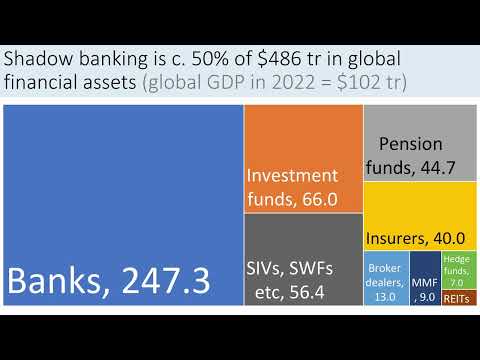
Roughly half of financial assets globally are now organized under shadow banking at large, including unregulated actors and corrupt banks, creating a system with an even larger tendency toward crisis because of money floating in essentially unregulated spheres
“after 40 years of this process is a world in which roughly half of the financial assets in the world are organized under shadow banking at large which includes Benjamin Braun who's not here, Benjamin Brown's um favorite actors, my uh favorite actors as I approach retirement age, the Saudis etc. and the crooked banks and then a number of other smaller actors”
Public opinion polling shows declining net trust in the ECB since the 2010 Eurozone crisis, with net distrust exceeding net trust (more people distrusting than trusting), and similar pattern for the Fed with a blip up during COVID when the Fed guaranteed par value of all financial instruments
“So here you can see from the onset of the 2010 2018 2010 Eurozone crisis a loss of trust in the ECB. This is net trust. So below the black line is more people distrust the ECB than trust it. And the same thing for the Fed more or less with a blip up for CO and this will become important later for those of you who don't know what the Fed did during CO in the US domestic market. They basically guaranteed the par value of every financial instrument in the economy”
The Fed is now in touch with every part of the financial system even if it can't control it, representing a deepening of the Fed's systemic role in the reboot strategy
“the Fed now is in touch with every part of the financial system even if it can't control it”
Global trade as a percentage of GDP has been declining and stagnant since the 2008 crisis; global financial flows have declined mostly due to withdrawal of European banks from global lending and populist challenges everywhere
“global trade as a percentage of GDP has been declining. It's been stagnant since the crisis. The same is true of financial flows mostly because of again withdrawal of European banks from uh global lending and of course populist challenges everywhere”
A massive federal effort to subsidize a new industrial base in electric vehicles has consequences across the semiconductor and materials supply chain, with private sector investment in batteries following federal subsidies, and manufacturing construction increasing substantially as a result.
“a massive federal effort to subsidize an entirely new industrial base for the US around electric vehicles, which has enormous consequences for the semiconductor industry and the materials supply chain. The green dots are private sector investments in batteries. Here the other ones are federal investments. The green dots um are there because of subsidies and this has led to a massive increase in um which is this list bit at the end.”
The euro is not a viable challenger to the dollar because: there is no European state to provide state backing to quasi-state money; there is no fiscal base, military base, or clear source of differential growth; the ECB's policies constrain growth; and post-Eurozone crisis, the role of the euro in global credit creation flatlines while dollar credit rises.
“The shortest possible answer to why the euro is not a real contender is that there's no European state to to provide the state in quai state money. There's no I mean you can see the list. no fiscal base, no military base, no plausible source for differential growth, partly because of the ECB”
US aggregate GDP has outgrown most surplus economies in real local currency terms and current US dollar terms over the last 30 years, with blue-line growth (real local currency) mattering more for domestic legitimacy and orange-line growth (current USD) mattering more for global power.
“if you look at aggregate GDP, what you see is that in real local currency terms and in current US dollar terms over the last um 30 years, the US has outgrown most economies... The blue is GDP growth in uh total percentage terms from 1992 to 2021... The blue matters in some sense more for domestic legitimacy. The orange matters more for global power.”
Profitability of US-domiciled firms is disproportionately high relative to the US share of global GDP: US firms account for 35% of profits among the Forbes Global 2000 despite the US being only 25% of global GDP, reflecting US control of intellectual property rights and resulting monopolies.
“the US big US firms have a disproportionately high share of profits US share of global GDP about 25% US share of profits for these large firms which account for about a third of all profits globally is 35% of that pool of profits”
Higher Fed interest rates (used to fight inflation from growth) cause dollar appreciation, which reduces growth in peripheral economies because complex global value chains financed in dollars become more expensive, raising financing costs and increasing prices of dollar-denominated imported intermediates.
“in order to get high US growth the Fed typically is lowering interest rates... as the economy picks up steam of course the economy moves to higher rate of inflation potentially and the Fed's response to that is usually to increase interest rates and when the Fed increases interest rates that has international repercussions and the international repercussions are that the dollar exchange rate goes up against other currencies... a higher US interest rate because we're now in a world of complex global value chains um which all have to be financed... all have to be financed with um mostly dollar denominated loans higher interest rates and a more expensive dollar have negative effects on growth in the periphery at large”
Deflation is a constant feature of capitalism, which requires understanding where credit growth originates and how it sustains economic activity.
“deflation was a constant in capitalism and so we need to know where credit growth comes from”
US firms have no renminbi-denominated debt while China has substantial dollar-denominated debt, creating an asymmetry that prevents China from easily shifting to the renminbi; the debt flows run in the direction of China's external constraint.
“critically again, there's an asymmetry, which is the Chinese have a lot of outstanding dollar denominated debt. US firms do not have Renman B denominated debt.”
US current account deficits enable endogenous credit creation in the world, with foreign buyers of US assets funding US consumption, which until the 2008 housing crash put downward pressure on US interest rates and promoted US growth, but this mechanism no longer operates post-2008.
“the current account deficit has a as a its flip side the ability of the US to put debt out into the world and find ready buyers. So you have indogenous credit creation in the world funding the purchases of US dollar denominated assets generated by the US economy. Again up until the housing crash this tended to put downward pressure on US interest rates. So it promoted US growth. That's not true after 2008.”
IP rights are protected by the WTO TRIPS agreement, which the US pursued very aggressively in the 1970s and 1980s; this agreement is the political mechanism protecting US firm profits and thus confidence in US asset values.
“those intellectual property rights are protected by the WTO trips agreement which is something the US pursued very aggressively in the 1970s and 80s.”
The 1970s reboot included geopolitical move to detach China from Russia, made possible because confronting Russia with two-front war allowed softer approach, which also enabled arms control agreements
“a change in the posture against the communist countries to detach China from Russia. they taunt was possible because once Russia's confronted with a two-front war, you can be nicer and that's what also allows arms control”
Growth provides both output legitimacy and the social base for support for the dollar as global currency in the US economy, homologous to how cheap food (from free trade) provided rising real wages that made British workers support the British Empire in the late 19th century.
“the basic problem is that it's growth that provides output legitimacy for most systems in particular in the US. Growth provides a social base for the dollar. This is homologous to what happened um in the British Empire in the late 19th century where labor supported free trade because free trade meant cheap food and f cheap food meant um a rising real wage.”
Late-development countries that successfully industrialize repress domestic demand and depend on exports and net exports to achieve profitability and economies of scale, which in turn requires that someone else becomes a net importer and issues debt to fund those imports; this mechanism locks those actors into dollar dependence.
“Late development in involved for the one for the countries that were successful in doing late development involved a repression of domestic demand which made profitability and economies of scale depend on exporting and even better on net exports. Net exports of course require someone to be a net importer. That net importer must issue assets or some kind of debt to cover those net imports and that's the connection to the dollar.”
For approximately 20 years (roughly 1980-2000), cheap imports from China benefited the broad mass of American consumers, with inflation in consumer non-durables remaining near zero while domestic wages stagnated; this created a political coalition supporting free trade and the dollar system.
“the US social base did benefit for about 20 years from cheaper imports largely from China. The rate of inflation for consumer non-durables over the uh last 40 years um has essentially been zero”
The Japanese yen was posed as a potential challenger to dollar supremacy in the 1980s-1990s when Japan's stock market capitalization reached 40% of global total and Japanese GDP was 18% of global GDP, but this was built on real estate bubbles that collapsed, causing Japan to stagnate relative to the US.
“1980s into the 1990s, the yen was posed as a potential challenger. At its peak, Japanese stock market capitalization was 40% of the global total and Japan GDP at its peak 18% of the global total. But this was a a pyramid built on real estate values. And when that crashed, the shock turned everyone in Japan gray. And you can see the steady decline in Japanese GDP.”
Recent US national security strategy, per Jake Sullivan's speeches, emphasizes China as a problem requiring industrial policy and sanctions, reflecting Washington's concern that differential growth matters and US dominance is at risk
“I don't know how many of you have listened to recent speeches by the um national security adviser Jake Sullivan in the US... He's if you want um email me later and I'll I'll I will email you back the critical speech. But basically what the guy has been saying is uh the Chinese are a problem and uh we need to make sure that they don't become a big problem and therefore we're going to do the following things and I'll talk about this also later. A lot of industrial policy, a lot of sanctions on China”
US profit shares are disproportionately high relative to GDP: of 4,300 firms ever appearing on Forbes Global 2000 list (2005-2022), US firms account for 35% of profits while representing only 25% of global GDP; this reflects US firms' possession of robust intellectual property rights (patents, trademarks, copyrights, brands) which create monopolies that yield profits
“if we look at the 4,300 firms in the that have ever appeared on the Forbes Global 2000 list over the 2005 to 2022 lists and we say what's their share of profits from this list um versus the share of GDP uh averaged 2017 to 2021. you get this table which is basically to the point that the US big US firms have a disproportionately high share of profits US share of global GDP about 25% US share of profits for these large firms which account for about a third of all profits globally is 35%”
Current US strategy includes a shift in where energy comes from (away from fossil fuels to renewables) and a strategic shift from the Clinton-era engagement of China to confrontation with China
“There's a shift in where energy is coming from. The old strategy of engaging China, Allah Clinton in the 1990s is now to confront China”
Loss of trust in the Federal Reserve and ECB has accelerated since the 2010 Eurozone crisis (evidenced by public opinion polls showing net distrust, with the exception of a brief blip during COVID when the Fed guaranteed par value of all financial instruments), reflecting growing loss of legitimacy for central bank management of the financial system.
“here you can see from the onset of the 2010 2018 2010 Eurozone crisis a loss of trust in the ECB. This is net trust. So below the black line is more people distrust the ECB than trust it. And the same thing for the Fed more or less with a blip up for CO”
BRICS was promoted as a potential unified challenge to the dollar system in 2023-2024 following Russian sanctions over Ukraine invasion, but the group quickly fractured and showed no real capacity to create an alternative currency bloc.
“Everyone for the last year because of sanctions around the Russian invasion of Ukraine was talking about um the bricks going their own way. So this is how it started and this is how it ended.”
We are at an inflection point in the global economy: global trade as a percentage of GDP has been declining and stagnant since the 2008 crisis, and financial flows have withdrawn largely due to European bank retreat from global lending and populist challenges everywhere.
“global trade as a percentage of GDP has been declining. It's been stagnant since the crisis. The same is true of financial flows mostly because of again withdrawal of European banks from uh global lending and of course populist challenges everywhere.”
Current US strategy, articulated by National Security Adviser Jake Sullivan, involves industrial policy emphasis, sanctions on China, effort to ensure US economy grows faster than China, and recognition of China as a structural challenge to US dominance.
“what the guy has been saying is uh the Chinese are a problem and uh we need to make sure that they don't become a big problem and therefore we're going to do the following things... A lot of industrial policy, a lot of sanctions on China and we have to make sure that the US economy grows faster than the Chinese economy.”
Neoliberal domestic policy is giving way to effort by Democrats in Congress to update and expand the welfare state, representing a domestic policy shift as part of the broader reboot strategy
“neoliberal domestic policy is giving way to at least an effort by the Democrats in the Congress to update and expand the welfare state”
The workers hurt by cheap imports in the first 20 years were disproportionately non-voting populations, especially Black women who formed the core labor force in the US clothing industry, making the political costs invisible and politically affordable.
“the people who were hurt were largely nonvoting parts of the population in particular black women um who were the core labor force in the clothing industry. So nobody cared.”
The BRICS is a made-up category, and recent efforts to create BRICS alternatives to the dollar (starting with plans for their own way after Russian invasion of Ukraine sanctions) have ended in failure, with initial plans not materializing
“What about the bricks which is a madeup category but it's out there in the literature so I have to say two words about it. Everyone for the last year because of sanctions around the Russian invasion of Ukraine was talking about um the bricks going their own way. So this is how it started and this is how it ended”
Facing the contradictions identified in the first and second lectures, the US has three options: rot (a reduction of dollar centrality in a chaotic US policy environment), reboot (reconfiguration of the global economy to retain dollar centrality), or war.
“So the three, so this is not Goldilocks. The three choices here, rot, reboot, or war.”
The first 20 years of the 40-year period benefited average US consumers from cheap imports but hurt nonvoting parts of the population, particularly Black women who were the core labor force in the clothing industry; this worked politically because no one cared, but the pattern is now reversing
“people who were hurt were largely nonvoting parts of the population in particular black women um who were the core labor force in the clothing industry. So nobody cared. But in the last 20 years, what's happened is that it's been consumer durables and consumer semidurables... this affects the mass of the voting population”
What determines whether the average person in the US or surplus countries supports the dollar system and open trade is whether they materially benefit from growth; as import competition shifted from non-voters to voters and as wage growth stagnated, the political coalition supporting the system fractured.
“what does the average person get from this system? Why would they support it? Why would US voters support the dollar as global quai state money?”
Over the last 30 years, measured in real local currency terms and current US dollars, the US has outgrown most economies, with US GDP growth significantly outpacing surplus countries, which is paradoxical given the current account deficit and points to extraction of resources as an important part of maintaining US dominance in a hierarchical system
“in real local currency terms and in current US dollar terms over the last um 30 years, the US has outgrown most economies... The US despite the current account deficit has actually outgrown most of the surplus economies which is a an interesting paradox that points to the fact that we are in a hierarchical system where the extraction of resources is an important part of maintaining uh US dominance”
There are three strategic choices for the US at the current inflection point: rot (decline in dollar centrality, chaotic US policy); reboot (retain dollar centrality through restructuring); or war (everything open, though British experience shows global wars don't preserve centrality)
“the three choices here, rot, reboot, or war. If we go back, this is not the first time this has happened... the three, so this is not Goldilocks. The three choices here, rot, reboot, or war”
Firms outside the US fall into two categories: manufacturing firms with barriers to entry from scale (semiconductor fabs requiring $20+ billion investment) or tacit knowledge (German Mittelstand); and assembly and low-skill manufacturers (like Foxconn, which assembles 50-60% of electronic computing equipment annually), neither of which generate the profits or per-capita returns of IP-monopoly firms.
“Some manufacturing firms that have a barrier to entry because of the scale of investment needed to enter the market. Think semiconductor fabs, a 20 billion investment, or a barrier to entry because of tacet knowledge. think the German Mittand and then everybody else”
Forecasts of when China would catch up to the US have systematically moved further out as reality diverges from linear extrapolation models; early-2000s projections forecast late-2040s, but by 2010 some forecasts predicted 2018; these models failed because they ignored structural constraints like those listed above.
“So in the early 2000s they were talking uh quite late 2040. By the year 2010 they were talking about maybe a few years right? That's what this implies, a forecast in 2010 that they catch up by 2018. And the forecasts have been moving steadily farther out because of these issues.”
The 1970s reboot included use of the oil shock as a geopolitical weapon, though the speaker does not elaborate on this point
“and then finally, I can't go into this in any detail right now, but you can ask him questions, the use of the oil shock as a geopolitical uh weapon”
When people fall out of Russian windows they usually fall; when they fall out of Chinese windows they usually land in prison—it's better, but this is a joke about the low quality of windows reflecting broader concerns about governance quality in authoritarian states.
“If you're a global investor, you might worry about the low quality of Chinese windows. They're almost as bad as Russian windows. When people fall out of Russian windows, they usually fall. When they fall out of Chinese windows, they usually land in a prison. It's better. The second That's a joke. You're supposed to laugh”
The speaker has had interesting conversations with doctoral students, postdocs, and fellows over 10 weeks, but the current lecture is like the third Matrix movie—too much action, not enough thought, with a plotline that disappears.
“Like the third Matrix movie. Um this one is a little too much action, not enough thought and the plotline disappears at at points.”
The speaker thanks students and postdocs for interesting conversations over the 10 weeks of lectures
“Thank you. And I'd like to thank also um all the doctoral students and postocs and I guess you're called faculty here. I don't know what you're called fellows for many interesting conversations over the last 10 weeks”