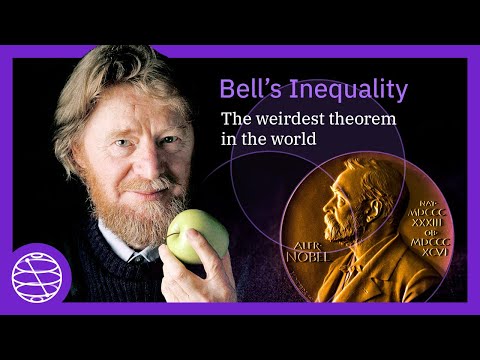
Bell's Inequality: The weirdest theorem in the world | Nobel Prize 2022
What this covers
This is a 13-minute explainer from Qiskit, presented by Olivia Lanes, built around the 2022 Physics Nobel Prize awarded to John Clauser, Alain Aspect, and Anton Zeilinger. It starts with the background: Einstein and his colleagues wrote the EPR paper arguing that quantum mechanics must be incomplete. Their worry was that the wave function, which gives only probabilities until a measurement collapses it to one definite outcome, seemed to demand either non-local action or a denial that things have definite properties independent of observation. John Stewart Bell then showed that this dispute could be turned into a mathematical test. Bell died before the prize recognized this lineage.
The middle of the video is the technical core. Bell's Theorem rests on two assumptions, locality (nothing travels faster than light) and realism (properties have definite values whether or not they are measured). Together they bound certain measurable quantities. Lanes walks through the CHSH test (CHSH inequality)), in which two distant observers, Alice and Bob, each randomly choose between two measurement projections with outcomes of ±1. Under local realism the combined value cannot exceed 2, while entangled qubits give roughly 2.8. She also takes up the obvious objection: because individual outcomes look random, the correlations do not allow faster-than-light signaling. Since nothing is known to travel faster than light, the usual reading is that realism is what must be given up.
The last stretch covers the laureates' roles. Clauser saw that Bell's result was experimentally testable and ran the first laboratory violation. Aspect closed loopholes that might have let local realism survive. Zeilinger demonstrated quantum teleportation, which Lanes clarifies is a way of transferring quantum information between entangled particles, not the Star Trek kind. The video ends with applications, naming IBM Quantum's work in computing, sensing, and cryptography, and notes that anyone can reproduce the 2.8 result on a simulator using the Qiskit tutorial.
The 2022 Physics Nobel Prize recognizes three scientists whose experimental validation of quantum entanglement proved that nature fundamentally violates classical assumptions (locality and realism), making quantum mechanics incompatible with classical physics and enabling practical quantum technologies.
- Bell's theorem mathematically proved that if locality and realism hold, quantum mechanics cannot be true
- Clauser, Aspect, and Zeilinger experimentally demonstrated CHSH inequality violations (2.8 > 2), proving nature chooses quantum mechanics over classical theory
- These experiments are now practically implemented in quantum computing, sensing, and cryptography, showing quantum entanglement is both theoretically radical and technologically useful
This asset isn't compiled yet
You're seeing its claims, ranked. Compile it to build the argument threads, weight them, and check each claim against your library — the full view.
The 2.8 value obtained in CHSH experiments can be verified and replicated by anyone using the Qiskit textbook's online tutorial and quantum simulator, demonstrating that Nobel Prize-winning quantum experiments are now accessible and reproducible by the general public.
“if you're interested, I challenge you to go online to the Qiskit textbook, and the link is linked below in the bio, and to try your hand at this experiment for yourself right now. There is a tutorial actually already published online on the Qiskit textbook, on the CHSH inequality. And you can run the experiment from your couch or wherever you are right now, and see indeed that you are going to get a number that is approximately 2.8.”
Since there is no evidence of anything in the universe traveling faster than light, scientists interpret Bell's inequality violation to mean that quantum particles do not have definite values before measurement (realism must be abandoned), rather than accepting faster-than-light signaling.
“since there's no evidence of anything in the universe traveling faster than the speed of light, the way that most scientists have interpreted this is that we have to give up the idea of realism. These quantum particles actually do not have values that are specific to them before you measure them.”
Quantum entanglement, proven through Bell inequality experiments, is the foundation upon which IBM Quantum and other quantum computing companies are building practical quantum technologies including quantum computing, quantum sensing, and quantum cryptography.
“everything that we are working on today at IBM Quantum, everything that other quantum computing companies are working on, quantum sensing, quantum cryptography, are all built upon these experiments which showed for the first time that entanglement, quantum entanglement, really is something that is so fundamentally different than classical physics can describe.”
John Bell's original research and theorem preceded the Nobel Prize-winning work, but Bell died before seeing the recognition of his contributions to quantum mechanics.
“all of this research was based upon some original experiments that were done by a gentleman named John Bell, who tragically passed away before he was able to see a Nobel Prize or something of that magnitude.”
The Nobel Prize winners (Clauser, Aspect, Zeilinger) took Bell's abstract mathematical proof and demonstrated it empirically in real-world laboratory experiments, converting a theoretical impossibility into a physical reality.
“what these gentlemen who just won the Nobel were able to do is read this, this proof, this thought experiment, and then go to the lab and actually demonstrate it in real life. So it's not just weird on paper, it's weird in the real world.”
John Clauser read Bell's theorem and recognized it could be tested experimentally, then performed the first laboratory violation of Bell's inequality, demonstrating that nature behaves as quantum mechanics predicts, not as classical theory (local realism) predicts.
“John Clauser came along and he was reading Bell's Theorem and he thought that this should be something that was able to be done experimentally. So he was able to actually perform an example in the laboratory for the first time, a violation of this equality and show that indeed, nature behaves as weirdly as predicted.”
Einstein and colleagues wrote the EPR paper arguing that quantum mechanics was incomplete because it implied unintuitive consequences that seemed impossible to Einstein.
“John Stewart Bell was reading the EPR paper which was a paper written by Einstein and some of his colleagues explaining how they believed that quantum mechanics was an incomplete theory.”
Alaine Aspect built on Clauser's work by performing additional tests of Bell's inequality and closing loopholes in the experimental design that could have allowed local realism to escape falsification.
“Alaine Aspect who was able to perform even more tests of Bell's inequality and close some of the loopholes, so to speak.”
The violation of Bell's inequality does not imply faster-than-light communication between Alice and Bob; even though measuring an entangled particle instantaneously determines the correlated outcome of the other particle, no information is transferred faster than light because the individual measurement outcomes appear random.
“A lot of people, I think, misconstrue what this actually means. Some people think that this opens the gateway for faster than light communication. This is not the case. Let me be very clear about that, because this is a really easy mistake to make.”
Bell proved mathematically that quantum mechanics is incompatible with any theory that assumes both locality and realism, showing that quantum mechanics violates what classical physics predicts.
“he was able to show, on paper at least, that quantum mechanics was incompatible with any classical theory. So anything that was basically including local realism could not possibly work with quantum mechanics.”
Einstein and colleagues believed quantum mechanics was incomplete because the wave function collapse upon measurement seemed to require non-local action or to contradict the principle that things must have definite properties independent of observation.
“Einstein said that quantum mechanics must be an incomplete theory because this could not be possible. This would necessitate things that he could not believe to be true. And so we were either missing something in the theory, somehow these particles were interacting in a way that we didn't actually understand or didn't have a description for yet. But basically it was not finished.”
Anton Zeilinger demonstrated quantum teleportation for the first time, which is not the Star Trek kind but rather a method to entangle and correlate quantum particles such that quantum information can be transferred from one particle to another.
“Anton Zeilinger who was able to show the demonstration for the first time of quantum teleportation. Which is not what you might think. it's not at all like Star Trek. People are not teleporting across the room, but instead, quantum teleportation is a way to entangle or correlate quantum particles in such a way that you can transfer quantum information from one to another.”
The 2022 Physics Nobel Prize was awarded to John Clauser, Alaine Aspect, and Anton Zeilinger for groundbreaking research and experiments in quantum mechanics.
“the Physics Nobel Prize for this year was awarded to three gentlemen: John Clauser, Alaine Aspect, and Anton Zeilinger. These gentlemen won the award for groundbreaking research and experiments in quantum mechanics.”
Bell's theorem assumes only two things—locality (nothing travels faster than light) and realism (things have definite values whether or not measured)—and derives that if both hold, then certain measurable quantities must be bounded by classical physics.
“he showed that if you only assume two things. Those things being local realism. Locality, meaning you can't travel faster than the speed of light. And realism, which means that things have definite values whether or not you measure them.”
In quantum mechanics, a wave function describes all properties of a quantum system, and upon measurement it collapses into a single, definite quantity that was previously described only probabilistically.
“in quantum mechanics, we say there exists this thing called the 'wave function.' Which describes all of the properties of your quantum system. And upon measurement, it collapses into a single quantity. That was only described probabilistically before you measured it.”
The CHSH test is a specific type of Bell inequality test that involves two distant observers (Alice and Bob) receiving particles from a source, each randomly choosing to measure either an X or Y projection, with measurement outcomes constrained to ±1.
“There are in fact many different Bell type theorems that can be shown but we're gonna look at really one specific one today which is called the CHSH test or the CHSH inequality. And so what you need to do for this thought experiment is first imagine a person named Alice and a gentleman named Bob and they are standing some distance far away from one another. And then there's another guy in the middle, let's just call him Victor. And he's going to send a particle to Alice and to Bob at the same time.”
Under the assumption of locality and realism, the CHSH value (a specific combination of Alice and Bob's measurement outcomes averaged over many trials) must be bounded by 2 or less.
“the maximum value this quantity could take on is equal to two, at most. But remember, we're running this experiment many, many times...Once we take the averages...this value has to be less than two. If the only assumptions we are making are locality and realism.”
When Alice and Bob measure entangled qubits (instead of classical particles), the CHSH value experimentally measured is approximately 2.8, which exceeds the classical bound of 2, proving that quantum mechanics violates Bell's inequality.
“Let's now assume that instead of a particle, just a random object Alice and Bob are receiving, they are going to be receiving entangled qubits...What you're actually going to measure, once you perform this experiment hundreds of times, is that this quantity is going to be approximately 2.8. Not two, not less than two. We know for sure that 2.8 is greater than two.”
Quantum particles are described by the wave function, which assigns a probability to each possible state (±1) before measurement, rather than having a definite predetermined value.
“These quantum particles actually do not have values that are specific to them before you measure them. They are instead described by what Einstein (chuckles) called and resented the 'wave function.' And so it has some probability of being in either state one or minus one before you measure it.”
Quantum mechanics is more bizarre and incompatible with classical physics than initially understood, showing that Bell's inequality violations prove nature is fundamentally weird and cannot be explained by any classical theory that includes locality and realism.
“what this showed is that quantum mechanics is even weirder and even more mysterious than we initially thought it was. It's completely incompatible with any classical theory that we can come up with. If you assume locality and realism.”
The experimental verification of Bell inequality violations is remarkable because it took only decades to go from a Nobel Prize-winning, one-of-a-kind experiment to an experiment anyone can run from anywhere in the world on a quantum simulator.
“while you might not win a Nobel Prize for doing this because lots of experiments in this vein have been done at this point, I still think it's miraculous that we have gone in a few decades from an experiment that is Nobel Prize winning to an experiment that you can do, that I can do, from anywhere in the world.”
The reason the 2022 Nobel Prize is exciting is that Clauser, Aspect, and Zeilinger proved quantum mechanics is not only theoretically weird and mysterious but also practically useful—entanglement is genuinely different from classical physics and can be harnessed technologically.
“that's why it's just a really, really exciting time for us in the field today. Because these scientists showed that not only is quantum mechanics weird and mysterious and counterintuitive, it is practical.”
Quantum mechanics brings us to the brink of the impossible and to points where full comprehension is challenging, but does not go beyond that—it remains within the realm of physical possibility.
“Quantum mechanics brings us to the brink of the impossible and it brings us to the point at which we shouldn't be able to fully comprehend what's going on, but no further than that.”