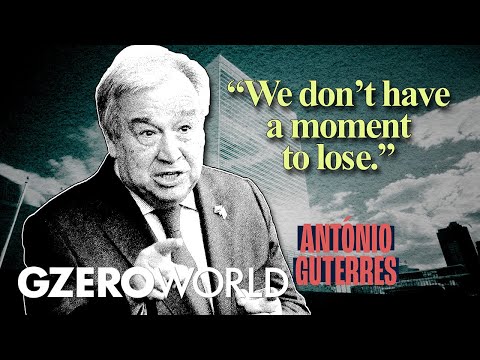
Hard Truths On Climate, Education & Poverty, From the UN’s Secretary-General | GZERO World
What this covers
This is a 17-minute interview in which Ian Bremmer questions UN Secretary-General António Guterres on GZERO World. The conversation starts with climate and widens to security, development finance, food supply and great-power rivalry. Guterres treats these as one connected problem, a case of cascading crises. He says the war in Ukraine has pushed climate into "second-order" status just as Pakistan's floods displaced 50 million people, killed over 1,000, and covered a third of the country in water.
On climate, he gives specific numbers: emissions need to fall 45% by 2030 to keep carbon neutrality by 2050 and 1.5°C within reach, but could instead rise 14%. He says only two or three years remain before tipping points make Pakistan-scale disasters the norm. That timeline is the most contested claim in the interview. He also sets out the responsibility split between emerging economies, the largest producers of emissions, and developed countries, the largest consumers of imported goods. He calls the Inflation Reduction Act an important contribution that is still not enough.
The economic section turns on fiscal space. Developing and middle-income countries, Guterres says, cannot print money without their currencies collapsing, and they get no concessional funding or debt relief outside the least developed group. He warns of default risk, damaged education systems and setbacks for the sustainable development goals. He also warns that a fertilizer shortage could leave the world short of food in 2023.
On geopolitics, he describes a West-South divide, a hobbled Security Council and a "largely bankrupted" security system in which middle powers act with impunity. He also discusses US-China relations and how Russia's invasion complicated them. He ends with the grain deal, which he says succeeded because three months of quiet diplomacy replaced megaphone diplomacy.
Guterres argues the world faces a cascading crisis where climate change, war, and economic instability interact to create irreversible tipping points, with developing nations bearing disproportionate burden due to lack of fiscal capacity and international solidarity.
- Climate action has been deprioritized by Ukraine war, causing emissions to grow when 45% reduction by 2030 is needed to avoid irreversible tipping points
- Developing countries face a 'perfect storm' of climate impacts, COVID recovery, and energy/food crises without money-printing capacity or debt relief, driving inequality and potential default waves
- International security architecture is 'largely bankrupted' due to geopolitical division, preventing effective deterrence and allowing proliferation of small conflicts with impunity
This asset isn't compiled yet
You're seeing its claims, ranked. Compile it to build the argument threads, weight them, and check each claim against your library — the full view.
Developing and middle-income countries have received no special support, no debt relief except for the least developed, and many face default risk with potential terrible consequences for global economy; middle-income countries including small island states receive no concessional funding and have no debt relief while paying rising interest rates.
“They haven't received any special support. There was no debt relief, except the suspension for the least developed countries. And we have a number of countries close to the verge of default with consequences that could be terrible for the world economy if we have a wave of defaults. Then middle-income countries, and all small island developing states are middle-income countries, do not receive any kind of concession funding. No grants and no concessional loans from international financial institutions. And there is no debt relief for them. Most of them are with high debt paying more and more high interest rates.”
Normalizing the fertilizer market in 2023 is essential because if fertilizers are not available or affordable, countries will plant less in 2022 for next season, and without addressing fertilizer supply now, the world will not have enough food in 2023.
“We are already seeing countries in the developing world where people are cultivating for the next season less than last year. Because fertilizers are too expensive or they're not available. So if in 2022, we have enough food, it is not well distributed, but in 2023, if we don't normalize the fertilizer market, we simply will not have enough food worldwide.”
The current geopolitical divide creates an environment where every middle-size power believes it can act with impunity because there is no effective deterrence; the Security Council's capacity to say 'this cannot be done' does not exist, leading to multiplication of small conflicts.
“the geopolitical divide that exists today creates an environment, in which every middle-size power feels that it can do whatever it wants, because there is full impunity. Nothing will happen. The capacity of deterrence that would exist if the whole powers with the Security Council will be able to say "this cannot be done" is not there. So we see a multiplication of small conflicts with different kinds of vectors, and each one of them not paying any attention to what the Security Council decides or even what are the positions of the superpowers, because they can play with the divisions among the superpowers.”
The West-South divide (replacing the traditional North-South divide) is growing, and this divide results in lack of effective international solidarity regarding the war in Ukraine.
“It's the West-South divide, and many people still call it the North-South divide, but it's becoming a West-South divide. And one of the consequences of that is the lack of an effective international solidarity in relation to the war in Ukraine.”
Emerging economies are the largest emitters from production perspective, but developed world is larger emitter from consumption perspective (products imported); both must reduce emissions but emerging economies need developed-country support to do so.
“The emerging economies from the point of view of production are the largest emitters. If you look at the consumption side, it's still the developed world that is the larger emitter based on the products that they import. But we need to have a solid agreement between developed countries and the emerging economies in order to be able to allow those emerging economies to reduce emissions.”
Developing countries face a 'perfect storm' combining climate change impacts, COVID vaccine distribution problems, expensive stimulus-driven inflation, and inability to print money without currency collapse, leaving them without fiscal space or external support.
“If you look at the developing countries, including many middle-income countries, they are facing a perfect storm. So they have the climate change impacts, as we all know, but they have the COVID, and we know our vaccines were distributed and we know the problems that this caused. Then the recovery from COVID. We are in the US, I am from European Union, trillions of dollars have been mobilized to support the economies with the consequence, of course, that the populations were supported, but also that there was a contribution to the restart of a global inflationary process. Now, countries in the developing world, including middle-income countries, have not capacity to print money, because if they print money, their currencies will completely fall.”
Pakistan's flooding displaced 50 million people, killed over 1,000, and covered one third of the country with water—a direct consequence of climate change that demonstrates humanity's failure to treat the crisis seriously.
“you have situations like Pakistan. 50 million people displaced, more than 1,000 people died. One third of the country covered by water.”
The world is standing at the edge of the abyss due to the combination of climate change and now the war in Ukraine, with climate becoming a second-order issue despite being the defining challenge of our time.
“With the war of Ukraine, climate change became a kind of a second-order issue. It's not only much less discussed, but measures that are absolutely essential to be taken are being postponed.”
Emissions are currently growing when they need to be reduced by 45% by 2030 to reach carbon neutrality in 2050 and limit temperature rise to 1.5 degrees above historic levels; without change, there is a risk of 14% emissions increase by 2030 instead of 45% reduction.
“emissions should be reduced by 45% until 2030, if we would be able to reach carbon neutrality in 2050 and not to allow temperatures go above 1.5 degrees in relation to the historic levels. Now, emissions are growing, and the risk is if nothing different happens in relation to what has been promised until now, the risk is that we'll have an increase of emissions in 2030 of 14% instead of a decrease of 45%.”
The Russian invasion of Ukraine changed the expected balance-of-power trajectory which was becoming a US/allies vs. China dynamic with China gaining influence in the developing world; Russia's role complicates this because Russia and China may not share the same approach to world problems.
“The Russian invasion of Ukraine has changed what looked like a new trend for the balance of power in the world. And the new trend for the balance of power in the world was essentially between the US and its allies and China with a growing influence in the developing world. What you have many times written that it was a G2 that led to G-Zero. Now, Russia has shaken this, because it's not entirely clear that Russia and China represent the same kind of approach to the world problems.”
If tipping points are reached due to insufficient emissions reductions, it will be irreversibly impossible to limit temperature rise to 1.5°C or reach carbon neutrality in 2050, resulting in the current Pakistan-scale disasters becoming the new normal across the world.
“If this happens, a lot of tipping points will be reached and it'll be irreversibly impossible to limit temperature rise to 1.5 degrees. It'll be irreversibly impossible to reach carbon neutrality in 2050, which means that what we are seeing today in Pakistan will be the new normal of a world that is facing destruction everywhere.”
Without fiscal space, developing nations cannot reorganize educational systems devastated by COVID or adequately address sustainable development goals and inequalities, which are increasing dramatically both among states and within states.
“if countries have no fiscal space, how are they going to reorganize their educational systems that were devastated by COVID? How are they going to have a minimum capacity to address the sustainable development goals and the objectives of development? How are they going to address inequalities? Because one of the dramas is that this situation is increasing dramatically inequalities, inequalities among states and inequalities among people within each state.”
Climate action must be the first priority of any government and international organization because it is the defining challenge of our time, and not treating it seriously will have irreversible consequences very soon.
“climate change is the defining challenge of our time. It must be the first priority of any government and any international organization anywhere in the world. And the fact that we are not dealing with it seriously will have irreversible consequences very soon.”
Without a solid agreement between developed and emerging economies, new investments in coal and oil/gas will be made (as consequences of Ukraine war show), and these will have consequences lasting decades.
“Because if not, and we see now with the consequences of the war in Ukraine, new investments are being made in coal, new investments are being made in oil and gas. And these will have consequences that will take decades.”
The system of security governance in the world today is largely bankrupted and needs to restore capacity for mediation and for countries to understand that misbehavior will be punished.
“And this makes the system of security governance in the world today largely bankrupted. And we need to do everything we can to, sooner rather than later, restore some capacity to be able to have mediation working and to make people understand that if they misbehave, they'll be punished.”
Dialogue between the US and China has always been completely undermined, and the current situation shows an increase in division rather than reduction of division, despite NATO becoming stronger.
“But at the same time, the dialogue between China and the US has always been completely undermined. So in the present situation, we are witnessing an increase in division and not a reduction of division. And the fact NATO is stronger doesn't mean that divide has been reduced.”
The Inflation Reduction Act is a very important contribution to climate action, coming at a critical moment when climate problems seemed forgotten, but significantly more action is still needed.
“I think it is a very important contribution. I'm not sure it is enough, but it's a very important contribution especially because it came in a moment, in which the climate problems seem to be forgotten. And finally, someone woke up and here it is, a program of action aiming, among other objectives, but aiming at strengthening the climate action in the United States. And that was a very important thing. But at the present moment, we need to do much more.”
Discreet, humble diplomacy remains effective in the modern world despite social media and megaphone diplomacy, when the goal is to build confidence that the mediator has no hidden agenda and only wants to solve the shared problem.
“And people even joke, discreet diplomacy doesn't make any sense anymore with all the social media and all these things. It's not true. There are still a number of things in which, if you want to have a result, we need to build confidence, and that is only possible if you do it in a discreet, humble way making sure that both sides can trust you, that you are not having a different agenda or a different objective, but to solve the problem we need to solve together.”
The grain and fertilizer export deal was only possible because it was conducted discreetly and confidentially for three months, building trust and confidence between parties without public megaphone diplomacy.
“But this was only possible because it was done very discreetly. For three months, I never mentioned publicly what we were doing. And we would hear all kinds of things, but we kept silent and worked slowly to build confidence to allow it to be possible.”
Food, energy, and finance crisis caused by the Ukraine war is undermining living conditions of most of the world, creating incentives for both Ukraine (full silos with new harvest coming but nowhere to store it) and Russia (massive export difficulties despite sanctions not applying to food/fertilizer) to reach an export agreement.
“we have a situation that is absolutely dramatic in the world. The food, energy, and finance crisis is undermining completely the living conditions of most of the world. And this is caused by this war. On the other hand, Russia, even if the sanctions do not apply to food and fertilizers, the truth is that because of finance, because of insurance, because of shipping, Russia has enormous difficulties in their exports. The Ukraine, as their silos full of grain, they have a new harvest coming. They have no place to put that harvest, which means they will not cultivate the following year.”
We have only two or three years remaining to revert the emissions trend before irreversible consequences with irreparable damage to the world as we know it take place.
“this is the last moment, two or three years we have in front of us, and the last moment to revert this trend. If not, irreversible consequences will take place that will have irreparable damage in our world as we know it.”
The world was standing at the edge of the abyss primarily regarding climate change a year ago, with multiple crises now intensifying the situation.
“So a year ago, you and I were sitting right here, literally right here, and I remember you said that the world was standing at the edge of the abyss. And that was mostly about climate change we were talking about, but of course, things have gotten a lot more challenging since then.”
Treatment of climate change as 'business as usual' rather than as a first-priority challenge is destroying the planet while humanity fails to pay attention.
“Climate change is being dealt now as business as usual, as if it was a small problem, and all attentions are focused on Ukraine and a few other things. I mean, we are destroying our planet and we are not paying attention.”
NATO has expanded its capabilities and resources and added two members (pending ratification), which is one element in the response to geopolitical division but does not reduce the divide itself—it is one side of a divided world.
“No, it is one element that is there, but obviously, in a divided world, it is on one side. And the question is how to create the mechanism of dialogue between the different sides.”