Analog computing will take over 30 billion devices by 2040. Wtf does that mean? | Hard Reset
What this covers
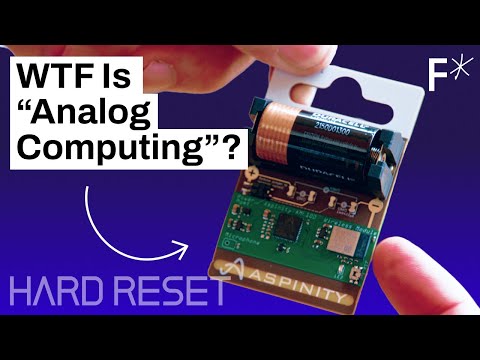
This Freethink Hard Reset episode is a short explainer built around Aspinity, a company making programmable analog chips. Its host, Jared, frames the company's work as a "dragon slayed", and an Aspinity representative supplies most of the technical explanation. The video starts from why digital displaced the analog processor: digital chips were easier to manufacture and could be programmed with software. It then covers what Aspinity says it has fixed. The main problem was voltage offset, where identical analog circuits on different silicon give slightly different outputs. Software calibration is meant to make every chip return the same result, so it outputs 2 rather than 2.1 or 1.9.
The case for the technology rests on energy. Analog-to-digital conversion and back again repeats across billions of sensors, and the video forecasts 30 billion connected devices performing always-on computing. It also claims digital energy demand is growing faster than energy supply, and that analog machine learning could cut consumption to a thousandth. Both claims are marked as contested. The speakers say analog should not replace digital. They propose analog as an always-on sensing and filtering layer that wakes digital systems only when needed.
Most of the rest is concrete applications. A TV remote could listen for a wake word with almost no battery draw. Heart monitors could track a naturally analog signal and wake a digital component only on an anomaly. Battery-powered chips could listen for bearing-failure vibrations on the half-million conveyor belt stackers operating daily. A home voice system could route commands according to which device you are looking at, so the stove doesn't switch on by accident. The closing predictions are that custom analog sensors will multiply once chip sets exist, that deployments will be personal and may never send data to the cloud, and that some audio devices may end up mostly analog.
Analog processors, once surpassed by digital computing, are being revived as software-programmable chips that can process real-world signals with 1/1000th the energy of digital systems, potentially reshaping computing architecture by serving as efficient always-on sensors that orchestrate digital systems rather than replacing them entirely.
- Analog processors can now be programmed with software like digital chips, solving the historical barriers of inconsistency and inflexibility
- Analog-to-digital conversion consumes massive energy across billions of always-on devices; analog processors eliminate this conversion overhead
- Hybrid analog-digital architectures enable low-energy continuous sensing that wakes digital systems only when needed, creating new possibilities for monitoring and IoT
This asset isn't compiled yet
You're seeing its claims, ranked. Compile it to build the argument threads, weight them, and check each claim against your library — the full view.
All information in the world is natively analog, so analog processing allows systems to understand and draw insights from data in its rawest form without requiring digital conversion.
“But all of the information in the world is natively analog. And so what analog processing allows us to do is understand and potentially inference and gather insights from that data in its rawest form.”
Analog processors were surpassed by digital processors primarily because digital could be manufactured more easily and could be programmed with software, making them far more flexible and adaptable.
“Analog processors were surpassed by digital processors, mainly because digital could be manufactured more easily and they could be programmed with software. This made them far more flexible and adaptable.”
Analog processors are not meant to replace digital computers entirely, but rather should be used strategically in combination with digital systems to optimize energy use.
“This technology isn't meant to replace digital computers, but it could mean we use them much more strategically.”
We currently spend enormous amounts of energy converting analog signals to digital and then back to analog, and this inefficient cycle repeats across billions of sensors in phones, homes, cars, and workplaces.
“Right now, we spend tons of energy breaking analog signals into digital signals, just so that our computers can understand them. And by tons of energy, we're not being hyperbolic. Think about all the sensors in your phone, your house, your car, at work. Most of them collect analog signals that have to be converted into digital signals and usually back into analog signals so that we can hear them or see them.”
Analog input signals do not need to be converted into ones and zeros when using Aspinity's processor; instead, signals from sensors can go directly into the chip with software directing how to interpret those signals.
“That means the signals from all the sensors that these chips are connected to don't need to be converted into ones and zeros- they can just go straight in. And you can write the software that directs the chip about how to interpret those signals.”
Analog has always been present in modern devices like iPhones, used for data collection and RF transmission, but has been relegated to only those primary capabilities while digital processing handles the main computation.
“Analog has not gone away. I mean, every iPhone uses analog to collect data and analog to transmit data in the form of RF. So analog has always been there, but it's been relegated to those primary capabilities.”
Because low-power analog chips can run for years on battery power, it becomes practical to monitor industrial equipment that would be impractical or uneconomical to monitor with digital systems.
“Monitoring all these things with digital systems would be impractical. But with analog systems, it starts to seem achievable.”
We expect 30 billion internet-connected devices by the end of the decade, each performing always-on computing, which will require tremendous amounts of energy if they all use digital processing.
“We expect 30 billion devices like this by the end of the decade. Every one of these will be computing on data, and it takes tremendous amounts of energy to have these always on computing.”
The energy consumption of digital computers is rising faster than the rate at which we create energy, representing a fundamental sustainability problem.
“In fact, the energy consumption of digital computers is rising faster than the rate at which we create energy- that's a problem.”
Programmable analog processors enable entirely new voice computing architectures in the home where voice commands are routed intelligently based on which device you're looking at, preventing accidental triggers (like the stove turning on when you weren't looking at it).
“This would allow me to create an entire architecture around voice computing in the home, because I could look at the faucet and say, 'Turn on,' and the stove wouldn't turn on because I wasn't looking at it.”
The optimal future architecture would have analog computers orchestrating the activity of digital computers, with analog systems providing always-on sensing and filtering, waking digital systems only when necessary.
“So, picture a scenario where analog computers orchestrate the activity of digital computers. This would mean better sensing systems and more of them in places where it can make a difference. And of course, all the sensing of the real world can be done with far less energy than the digital systems we currently use.”
A half-million conveyor belt stackers operate daily, and equipping them with analog chips that can listen for specific bearing-failure vibration patterns and run for years on battery power creates significant value through predictive maintenance.
“On a piece of equipment like a stacker, which is one of those conveyor belts that runs dirt up and makes piles and there's something on the order of a half a million of 'em in operation every day, and just, if you have a chip set that can run for years on battery power with enough machine-learning intelligence to listen to a vibration and determine that it's not just a vibration, but the type that indicates a bearing is going out, and then you could use that information to find out what it would cost to repair a bearing.”
Aspinity has solved the major problem of voltage offset—the inconsistency where identical analog circuits in different silicon produce slightly different outputs—by using software to make fine-tuning adjustments so that each chip reliably outputs the same result.
“The challenge with analog has always been when you put a certain input in, for the same circuit in a different silicon, you might get a slightly different output. And we call that 'voltage offset.' So 2.1 and 1.9 aren't exactly the same. You want it to be two. And Aspinity has solved a major hurdle, and through our software, we're able to make fine-tune adjustments so that that chip gets a 2 at the output, this chip gets a 2 at the output.”
The optimal architecture uses analog processors for always-on, low-power continuous sensing, waking up digital systems only when necessary or when data needs to be sent to the cloud.
“We can still have a combination of analog and digital locally, but we wanna be able to use that analog as your always-on computing and then wake up the digital as necessary or wake up and send data to the cloud as necessary.”
For heart monitoring applications, an analog processor can continuously monitor heartbeat signals and wake a digital component only if it detects an anomaly, or to communicate with the cloud or a health care provider.
“If the analog portion ever detects an anomaly, it can wake up the digital component that communicates with the cloud or contacts a health care provider.”
Once analog chip sets become available, we will see an explosion of innovation creating new kinds of analog sensors tailored to specific applications.
“Once you have these kinda chip sets, you're gonna see an explosion of people looking to create new kinds of analog sensors.”
Low-energy analog sensor deployments will be highly personalized and specific to individual users, without necessarily sending data to the cloud or involving third-party monitoring.
“It's this idea of, it'll be a very low-energy deployment of all of these insight-gathering devices that are very specific to you. And there's no middleman going to the cloud necessarily or no middleman that's monitoring it for you- it can come to you.”
Aspinity has specifically solved the problem of matching outputs from different analog chips by using software calibration to ensure consistency (making all chips output 2 instead of varying outputs like 2.1 or 1.9).
“And Aspinity has solved a major hurdle, and through our software, we're able to make fine-tune adjustments so that that chip gets a 2 at the output, this chip gets a 2 at the output.”
Analog processors can determine relevance of data at the sensor input stage, filtering out irrelevant information before it triggers downstream processing, thereby improving power efficiency across the entire system.
“It allows these products to be more power-intelligent. So we can really understand right at the sensor input whether the data is relevant or not. And then that drives everything after that to take advantage of that efficiency.”
Using analog processors for AI and machine learning algorithms could reduce energy consumption by 1/1000th compared to digital approaches while maintaining all the benefits of accuracy, efficiency, and power efficiency.
“Imagine being able to build new devices that use AI and machine learning algorithms, but yet, use 1/1000 of the energy that they use from a digital perspective. And so you get all those benefits of analog- the power, the efficiency, the accuracy- but now you can use a software to program it very quickly.”
Aspinity's breakthrough represents a 'dragon slayed'—solving the stability and programmability problems of analog computing that had prevented its adoption despite it being 'slowly creeping along' in the background.
“Aspinity has slayed a dragon here, and I've been going along blissfully thinking like the history of computing is set and settled. We will do digital. We will go binary. Turns out that all along, analog has been slowly creeping along. Now that we've solved the stability and programmability issues of analog computing, we're gonna see a quick reset to the entire architecture of computing.”
Smart TV remotes consume battery power continuously due to digital processors listening for wake words; with analog processors, this wake-word listening could use almost no electricity by avoiding analog-to-digital conversion.
“How often do you change the batteries in your smart TV's remote control? Well, even those batteries are slowly being nibbled away at by the digital processors that sit and listen for your voice to command them. With analog computing, it can be listening continuously for that wake word that's using almost no electricity, never doing analog-digital conversion, and then it can wake up a more expensive system to do the work of the request.”
Most computing implementations will involve blending analog and digital strengths rather than moving to all-analog computing, with some audio devices potentially becoming mostly analog.
“You probably won't ever have an all analog computer. Some things, like audio devices, might become mostly analog. That would probably be music to the ears of your vinyl-loving friend. But most implementations would be about blending the best strengths of analog and digital.”
Heart monitoring is an ideal application for analog computers because the heartbeat is an analog signal and power-efficient analog sensors could enable more people to be monitored effectively.
“For example, heart monitoring is perfect for analog computers. Our heartbeat is an analog signal. And with power-efficient, tiny sensors, more people could be monitored effectively.”
Analog intelligence might fundamentally change how intelligent devices understand and interact with users compared to cloud-based AI approaches.
“We're constantly relying on more and more intelligent devices in our lives. But analog intelligence might totally change the way those devices understand us.”
Aspinity can now program an analog processor using the same methodology as digital processors, solving a key usability and adoption problem that previously made analog processors difficult to work with compared to digital systems.
“But we also solved a key problem with regards to use model and how easy it is to use. And so we're now able to program an analog processor from Aspinity in the same way that we do digital.”
Analog processors can distinguish between different types of glass breaking (windows vs car windows, tempered vs regular glass) and trigger appropriate responses based on sophisticated filtering and decision trees.
“You can potentially build the kind of filters and decision tree that can say, 'That was glass breaking. That's a window. This is a car window, tempered glass breaking.' And then based on whether or not it hits one of those priority glass breaks, it can send that signal to the digital chip, which communicates via either Wi-Fi or cell signal.”
The first computers ever made were analog, developed in Ancient Greece, followed by slide rules, and then in the 19th century analog computers that calculated tides and solved differential equations.
“The first computers ever made were analog. Think Ancient Greece. Later on, we had slide rules, and in the 19th century, we developed analog computers that calculated how things like the tides would change over time or solve differential equations.”
With analog computing in TV remotes, battery life could last 10 to 100 times longer on the same batteries, or much smaller batteries could provide equivalent functionality.
“That means that same remote control could last 10 or even 100 times longer on the same batteries or you could just use much smaller batteries and get the same functionality.”
The episode is part of 'Hard Reset,' a series about rebuilding our world from scratch by rethinking fundamental assumptions about how the world works.
“This is 'Hard Reset,' a series about rebuilding our world from scratch.”
The Hard Reset series does not accept sponsorship money from the companies being profiled in episodes (like Aspinity), but accepts sponsorship from other companies (like BetterHelp) to fund more storytelling.
“Now, I wanna make sure you know 'Hard Reset' will never take sponsorship money from our subjects, like Aspinity, which is the company we're profiling in this episode. But sponsorships from other companies, like BetterHelp, will make it easier for us to tell more stories we know you will love.”