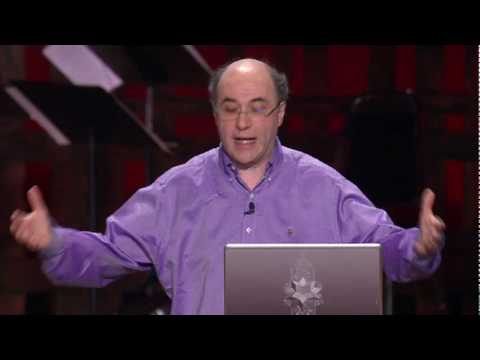
Computing a theory of everything | Stephen Wolfram
What this covers
This is a single 21-minute TED talk in which Stephen Wolfram describes roughly 30 years of work in three large projects. He began by using computers as tools for physics, then drilled into the computations involved and built a symbolic programming structure, which became Mathematica. The third project is Wolfram Alpha, which he presents as a knowledge engine. It computes answers by combining curated facts and data with methods and models drawn from centuries of science. He describes Mathematica as his own observational instrument, comparable to Galileo's telescope but pointed at the computational universe instead of the sky.
The scientific middle of the talk starts from cellular automata and Rule 30, a very simple rule that produces complex behavior. Wolfram sets this beside Benoit Mandelbrot's work on fractals and nested patterns. From there he moves to computational irreducibility, the idea that some systems can only be understood by watching them run, and the Principle of Computational Equivalence. He argues that nature produces complexity by sampling this space of programs, and that the implications reach to the limits of prediction, biology and economics, intelligence, and free will.
The most contentious stretch is his physics. He proposes that the universe may be a network updated by a simple low-level rule, with each candidate rule defining a possible universe. Some of these are sterile, with no space, time, or matter. He claims to have found candidates that reproduce special and general relativity and gravitation, with hints of quantum mechanics. Speaker-only claims like these are presented without supporting detail.
The talk then returns to practice. Wolfram says that building natural language understanding into Wolfram Alpha depended on linguistic ideas from computational exploration and on having actual computable knowledge. He says the system, and Mathematica, already contain algorithms found by mining the computational universe. He expects that integrating the two will let people specify programs in plain language, and that routine invention on the fly will become possible.
Wolfram argues that computation is the foundational idea of the next century, with applications spanning from understanding the universe's fundamental rules to democratizing knowledge and programming through systems like Wolfram Alpha and Mathematica.
- Simple computational rules can produce irreducibly complex behavior, explaining how nature generates complexity without top-down design
- Wolfram Alpha and Mathematica represent practical instantiations of computational thinking that make knowledge computable and democratize both programming and discovery
- The universe itself may be expressible as a simple computational rule operating on a network substrate, making physics fundamentally computational
This asset isn't compiled yet
You're seeing its claims, ranked. Compile it to build the argument threads, weight them, and check each claim against your library — the full view.
Simple computational rules operating on cellular automata can generate highly intricate patterns with regular structure, as exemplified by Rule 30, which follows a very simple rule yet produces amazingly complex behavior.
“Let's just run all possible programs of the particular type that we're looking at. They're called cellular automata. You can see a lot of diversity in the behavior here. Most of them do very simple things, but if you look along all these different pictures, at rule number 30, you start to see something interesting going on. So let's take a closer look at rule number 30 here. So here it is. We're just following this very simple rule at the bottom here, but we're getting all this amazing stuff.”
Wolfram spent 30 years working on three large projects: first studying physics using computers as tools, then drilling down into the computations needed and creating symbolic programming structures, which led to building Mathematica.
“I myself have spent the past 30 years of my life working on three large projects that really try to take the idea of computation seriously. So I started off at a young age as a physicist using computers as tools. Then, I started drilling down, thinking about the computations I might want to do, trying to figure out what primitives they could be built up from and how they could be automated as much as possible. Eventually, I created a whole structure based on symbolic programming and so on that let me build Mathematica.”
Wolfram Alpha is a serious knowledge engine designed to compute answers to questions by combining curated sources of facts and data with implemented methods, models, and algorithms from centuries of science and other fields.
“And last year we were able to release the first website version of Wolfram Alpha. Its purpose is to be a serious knowledge engine that computes answers to questions.”
A crucial design challenge for Wolfram Alpha is enabling users to ask questions in ordinary human language rather than formal query syntax, which requires understanding the strange and varied utterances people type into the input field.
“A crucial idea of Wolfram Alpha is that you can just ask it questions using ordinary human language, which means that we've got to be able to take all those strange utterances that people type into the input field and understand them. And I must say that I thought that step might just be plain impossible.”
There might exist a simple rule or simple program in the computational universe that describes our physical universe, suggesting that fundamental physics could be expressible as a computational process.
“Could it be that someplace out there in the computational universe we might find our physical universe? Perhaps there's even some quite simple rule, some simple program for our universe.”
The principle of computational equivalence states that even incredibly simple systems can perform computations as sophisticated as any other, and it does not take lots of technology or biological evolution to achieve arbitrary computation—it happens naturally throughout the computational universe.
“It's connected to, what I call, the principle of computational equivalence, which tells us that even incredibly simple systems can do computations as sophisticated as anything. It doesn't take lots of technology or biological evolution to be able to do arbitrary computation; just something that happens, naturally, all over the place. Things with rules as simple as these can do it.”
Benoit Mandelbrot's work on fractals and nested patterns represents a founding contribution to understanding how complexity arises, with fractals exhibiting tree-like self-similar structure where branches spawn smaller branches.
“I view Benoit Mandelbrot's work as one of the founding contributions to this kind of area. Benoit has been particularly interested in nested patterns, in fractals and so on, where the structure is something that's kind of tree-like, and where there's sort of a big branch that makes little branches and even smaller branches and so on.”
Physics history suggests the universe's fundamental rule must be quite complicated, but computational universe research shows that incredibly simple rules can produce incredibly rich and complex behavior, making simple universe rules plausible.
“the history of physics would have us believe that the rule for the universe must be pretty complicated. But in the computational universe, we've now seen how rules that are incredibly simple can produce incredibly rich and complex behavior.”
Nature manages to produce complexity by sampling what exists in the computational universe and often arriving at things like Rule 30, which explains long-standing mysteries in science about how complexity arises seemingly effortlessly from simple foundations.
“how nature, seemingly so effortlessly, manages to produce so much that seems to us so complex. Well, I think we've found its secret: It's just sampling what's out there in the computational universe and quite often getting things like Rule 30 or like this. And knowing that starts to explain a lot of long-standing mysteries in science.”
The space of all possible programs contains enormous diversity; programs can be examined and run systematically to explore what happens across the entire computational landscape, revealing patterns and behaviors that would be impossible to predict a priori.
“So we normally think of programs as being complicated things that we build for very specific purposes. But what about the space of all possible programs?”
Computational irreducibility is a fundamental concept where complex systems like Rule 30 cannot be predicted or compressed—the only way to determine their outcome is effectively to watch them evolve, which has deep implications for the limits of scientific prediction.
“It also brings up new issues, though, like computational irreducibility. I mean, we're used to having science let us predict things, but something like this is fundamentally irreducible. The only way to find its outcome is, effectively, just to watch it evolve.”
Each possible rule for updating the network corresponds to a candidate universe, and some candidate universes are completely sterile with pathologies like no space, no time, no matter, while others might be viable physics.
“And each possible rule, in a sense, corresponds to a candidate universe. Actually, I haven't shown these before, but here are a few of the candidate universes that I've looked at. Some of these are hopeless universes, completely sterile, with other kinds of pathologies like no notion of space, no notion of time, no matter, other problems like that.”
The universe's fundamental rules, if simple, must be very abstract and very low-level, operating far below the level of space or time, making them difficult to represent but potentially expressible as network evolution.
“If the rules for the universe are simple, it's kind of inevitable that they have to be very abstract and very low level; operating, for example, far below the level of space or time, which makes it hard to represent things.”
The universe can be thought of as a network that, when large enough, behaves like continuous space in the same way molecules can behave as continuous fluid, with the universe evolving by applying little rules that progressively update this network.
“one can think of the universe as being like some kind of network, which, when it gets big enough, behaves like continuous space in much the same way as having lots of molecules can behave like a continuous fluid. Well, then the universe has to evolve by applying little rules that progressively update this network.”
Wolfram has discovered candidate universes with incredibly simple rules that successfully reproduce special relativity, general relativity and gravitation, and provide hints of quantum mechanics.
“A few years ago, I was pretty excited to discover that there are candidate universes with incredibly simple rules that successfully reproduce special relativity, and even general relativity and gravitation, and at least give hints of quantum mechanics.”
Wolfram built Mathematica partly for selfish reasons—to use it himself as an observational tool, analogous to how Galileo used his telescope 400 years ago to observe the astronomical universe, but Wolfram wanted to observe the computational universe instead.
“Well, I have to admit, actually, that I also had a very selfish reason for building Mathematica: I wanted to use it myself, a bit like Galileo got to use his telescope 400 years ago. But I wanted to look not at the astronomical universe, but at the computational universe.”
Computation is probably the single biggest idea that has emerged in the past century, with effects we have only just begun to see, extending far beyond computer technology into understanding fundamental aspects of science, nature, and technology.
“I want to talk today about an idea. It's a big idea. Actually, I think it'll eventually be seen as probably the single biggest idea that's emerged in the past century. It's the idea of computation. Now, of course, that idea has brought us all of the computer technology we have today and so on. But there's actually a lot more to computation than that. It's really a very deep, very powerful, very fundamental idea, whose effects we've only just begun to see.”
The observation that simple rules produce complex behavior necessitated the creation of a new kind of science that is more general and fundamentally different from the mathematics-based science that has dominated for the past 300 years.
“when I first saw this, it came as a huge shock to my intuition. And, in fact, to understand it, I eventually had to create a whole new kind of science. This science is different, more general, than the mathematics-based science that we've had for the past 300 or so years.”
The implications of computational irreducibility and computational equivalence extend to fundamental questions about the limits of science, predictability and controllability of biological and economic processes, intelligence in the universe, free will, and the creation of technology.
“Well, this has deep implications about the limits of science, about predictability and controllability of things like biological processes or economies, about intelligence in the universe, about questions like free will and about creating technology.”
Knowledge-based computing is a new form of computation that starts not from raw computation but from a vast amount of built-in knowledge, fundamentally changing the economics of delivering computational services on the web and elsewhere.
“I've realized that Wolfram Alpha actually gives one a whole new kind of computing that one can call knowledge-based computing, in which one's starting not just from raw computation, but from a vast amount of built-in knowledge. And when one does that, one really changes the economics of delivering computational things, whether it's on the web or elsewhere.”
Wolfram Alpha's integration inside Mathematica enables precise programs that call on real-world data, allows users to give vague input and have Wolfram Alpha clarify intent, and most importantly, democratizes programming by allowing natural language specification of computational intent.
“With Wolfram Alpha inside Mathematica, you can, for example, make precise programs that call on real world data. You can also just sort of give vague input and then try and have Wolfram Alpha figure out what you're talking about. But actually I think the most exciting thing about this is that it really gives one the chance to democratize programming. I mean, anyone will be able to say what they want in plain language. Then, the idea is that Wolfram Alpha will be able to figure out what precise pieces of code can do what they're asking for and then show them examples that will let them pick what they need to build up bigger and bigger, precise programs.”
Wolfram Alpha and Mathematica are now full of algorithms discovered by searching the computational universe, demonstrating that mining the computational universe yields practical computational tools.
“Wolfram Alpha and Mathematica are actually now full of algorithms that we discovered by searching the computational universe.”
Two major breakthroughs enabled natural language understanding in Wolfram Alpha: new linguistic ideas derived from studying the computational universe, and the realization that having actual computable knowledge fundamentally changes how one can approach language understanding.
“Two big things happened: First, a bunch of new ideas about linguistics that came from studying the computational universe; and second, the realization that having actual computable knowledge completely changes how one can set about understanding language.”
Wolfram hopes to use Wolfram Alpha to routinely perform invention and discovery on the fly, finding wonderful stuff that neither engineers nor incremental evolution would ever discover.
“I'm hoping we can, for example, use that even to get Wolfram Alpha to routinely do invention and discovery on the fly, and to find all sorts of wonderful stuff that no engineer and no process of incremental evolution would ever come up with.”
Wolfram's scientific paradigm of computation suggested that replicating a whole brain would not be necessary, allowing him to pursue making systematic knowledge computable without first achieving artificial general intelligence.
“Well, then I got to thinking: This scientific paradigm of mine suggests something different -- and, by the way, I've now got huge computation capabilities in Mathematica, and I'm a CEO with some worldly resources to do large, seemingly crazy, projects -- So I decided to just try to see how much of the systematic knowledge that's out there in the world we could make computable.”
There has been an interesting coevolution between Wolfram Alpha and its human users, where the system learns from actual usage patterns and improves over time.
“And, in fact, there's been an interesting coevolution that's been going on between Wolfram Alpha and its human users, and it's really encouraging.”
Finding the complete physics in the computational universe is not certain, but given the progress to date, Wolfram believes it is almost embarrassing not to at least try, requiring building technology as deep as existing physics.
“So, will we find the whole of physics? I don't know for sure, but I think at this point it's sort of almost embarrassing not to at least try. Not an easy project. One's got to build a lot of technology. One's got to build a structure that's probably at least as deep as existing physics.”
After 30 years of work on computation—building tools, methods, and turning intellectual ideas into millions of lines of code and infrastructure—Wolfram realizes how much more powerful the idea of computation really is, with much more to come.
“I've been working on the idea of computation now for more than 30 years, building tools and methods and turning intellectual ideas into millions of lines of code and grist for server farms and so on. With every passing year, I realize how much more powerful the idea of computation really is. It's taken us a long way already, but there's so much more to come.”
Composers have found unexpected musical forms by searching the computational universe, suggesting that the computational universe can be used to generate mass-customized creativity.
“this has become surprisingly popular among composers finding musical forms by searching the computational universe. In a sense, we can use the computational universe to get mass customized creativity.”
Computation is destined to be the defining idea of the future, with implications spanning from the foundations of science to the limits of technology to the very definition of the human condition.
“From the foundations of science to the limits of technology to the very definition of the human condition, I think computation is destined to be the defining idea of our future.”
Wolfram wanted to systematize knowledge and make it computable, a goal that philosophers like Leibniz had wondered about 300 years earlier, but Wolfram initially assumed replicating a whole brain would be necessary to make progress.
“ever since I was a kid, I'd been thinking about systematizing knowledge and somehow making it computable. People like Leibniz had wondered about that too 300 years earlier. But I'd always assumed that to make progress, I'd essentially have to replicate a whole brain.”
In the computational universe, there is an inexhaustible supply of programs, and the challenge is figuring out how to harness them for human purposes by discovering which programs serve specific needs.
“There's an inexhaustible supply of programs out there. The challenge is to see how to harness them for human purposes.”
Wolfram's work, particularly on Rule 30 and cellular automata, relates to Benoit Mandelbrot's work on fractals and nested patterns, but goes to a different level in terms of complexity generation.
“I think things like the Rule 30 cellular automaton get us to a different level. In fact, in a very precise way, they get us to a different level because they seem to be things that are capable of complexity that's sort of as great as complexity can ever get”
Any serious candidate for our universe is inevitably full of computational irreducibility, making it irreducibly difficult to determine how it will behave and whether it matches observed physics.
“Any serious candidate for our universe is inevitably full of computational irreducibility. Which means that it is irreducibly difficult to find out how it will really behave, and whether it matches our physical universe.”
In recent years, Wolfram has discovered that you don't have to search far in the computational universe before finding candidate universes that are not obviously inconsistent with observed physics.
“the exciting thing that I've found in the last few years is that you actually don't have to go very far in the computational universe before you start finding candidate universes that aren't obviously not our universe.”
Wolfram Alpha is still in its early stages, with scaling happening nicely and increasing confidence in the system, and Wolfram Alpha technology is expected to appear in more and more places working with both public data and private knowledge.
“in many ways, we're still at the very beginning with Wolfram Alpha. I mean, everything is scaling up very nicely and we're getting more confident. You can expect to see Wolfram Alpha technology showing up in more and more places, working both with this kind of public data, like on the website, and with private knowledge for people and companies and so on.”
Wolfram Alpha requires curating a vast number of different sources of facts and data, which necessitated building a pipeline combining Mathematica automation with human domain experts.
“For a start, one has to curate a zillion different sources of facts and data, and we built quite a pipeline of Mathematica automation and human domain experts for doing this.”
Mathematica combines a precise formal language with carefully designed capabilities allowing complex computations in just a few lines of code, enabling both algorithmic computation and user interface generation.
“we have Mathematica, with its sort of precise, formal language and a huge network of carefully designed capabilities able to get a lot done in just a few lines.”
Rule 30 from cellular automata is a particularly good randomness generator, and other simple programs serve as good models for processes in the natural or social world.
“Something like Rule 30, for example, turns out to be a really good randomness generator. Other simple programs are good models for processes in the natural or social world.”
Wolfram is committed to completing the project of finding the rule for the universe within this decade, such that people can type "the theory of the universe" into Wolfram Alpha and receive an answer.
“I'm committed to seeing this project done, to see if, within this decade, we can finally hold in our hands the rule for our universe and know where our universe lies in the space of all possible universes ... and be able to type into Wolfram Alpha, "the theory of the universe," and have it tell us.”
Mathematica has had 23 years of continuous development with ideas and capabilities being added at an increasing rate, resulting in benefits for R&D, education, and many other areas.
“for the past 23 years, at an increasing rate, we've been pouring more and more ideas and capabilities and so on into Mathematica, and I'm happy to say that that's led to many good things in R & D and education, lots of other areas.”
Wolfram Alpha contains approximately 8 million lines of Mathematica code implemented by experts from many different fields to encode methods, models, and algorithms from centuries of scientific and other knowledge.
“Well, even starting from Mathematica, this is still a huge amount of work. So far, there are about 8 million lines of Mathematica code in Wolfram Alpha built by experts from many, many different fields.”
More than 80 percent of web queries to Wolfram Alpha are handled successfully on the first attempt, and the fraction is considerably larger for mobile applications like the iPhone app.
“Right now, if we look at web queries, more than 80 percent of them get handled successfully the first time. And if you look at things like the iPhone app, the fraction is considerably larger.”
String theory, attempted over the past 25 years to return to and explain the standard model of physics, has not quite achieved this goal, though Wolfram believes his computational approach may have resonance with some aspects.
“The things that people have tried to do in the last 25 years or so with string theory and so on have been an interesting exploration that has tried to get back to the standard model, but hasn't quite gotten there.”