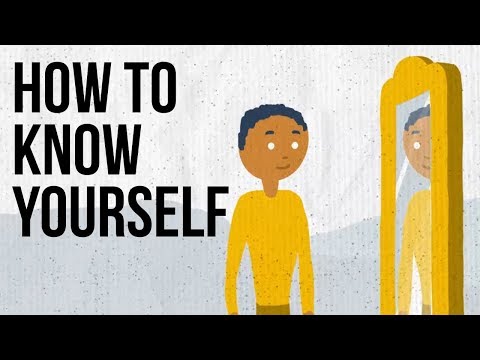
What this covers
This six-minute School of Life film, narrated by a single unidentified speaker, treats self-knowledge as something received before it is achieved. It starts from the Greek injunction to know yourself, then argues that nobody is born able to do this. A child acquires an identity because an early caregiver studies them fairly and kindly and plays them back in a way that makes sense. The small acts it describes are modest: telling an upset infant "that must really have hurt," or allowing that it's fine not to feel happy on a birthday.
The middle of the film follows what happens when that process fails. Mirroring can be out of sync with reality, as when a parent insists a visibly miserable child is happy, which scrambles the child's access to their own emotions. A parent who repeatedly implies bad intent, or who simply shows little interest, can leave a child feeling not only uncherished but barely real. The film calls this a feeling of unreality) and ties it directly to emotional neglect. By contrast, a parent who puts the best gloss on ill-temper and failure lays the ground for resilient self-esteem.
The adult consequences are the most pointed part. Without an inner measure, people swallow the verdicts of others whole under denigration, and they crave applause under adulation. The film also says they laugh at unfunny jokes, adopt fashionable ideas, and trade truer talents for easy popularity. It notes that many accomplished people carry this wound. The film ends on repair: a wise, kindly figure such as a psychotherapist can supply the missing witnessing at any age, leaving a person somewhat less hungry for praise, less afraid of opposition, and more original.
Self-knowledge, built through being genuinely seen and mirrored by others in early life, is foundational to psychological resilience and authentic identity, without which we remain vulnerable to external judgment and internal confusion about our values.
- Identity formation requires early mirroring by a trusted other who validates feelings and interprets the child generously
- Without stable self-knowledge, we become enslaved to public opinion and external praise rather than consulting internal values
- Adult self-knowledge can be reconstructed through therapeutic relationships that provide proper witnessing and validation
This asset isn't compiled yet
You're seeing its claims, ranked. Compile it to build the argument threads, weight them, and check each claim against your library — the full view.
No one is born with an independent ability to know who they are; we learn to have an identity because in early years, if we are blessed, someone else takes the trouble to study us with immense fairness, attention, and kindness and then plays us back to us in a way that makes sense, giving us the beginning of a true portrait of our identity
“no one is born with an independent ability to know who they are we learn to have an identity because if we're blessed in our early years someone else takes the trouble to study us with immense fairness attention and kindness and then plays us back to us in a way that makes sense and that we can later emulate they give us the beginning of a true portrait of our identity”
Realizing that we lack a stable identity is a sobering realization, but we can with a fair wind start to correct the problem at any point in our lives by seeking out the help of a wise and kindly other person, perhaps a good psychotherapist, who can study us closely, mirror us properly, and validate what they see through their eyes
“realizing that we lack a stable identity is a sobering realization but we can with a fair wind start to correct the problem at any point we need to seek out the help of a wise and kindly other person perhaps a good psychotherapist someone who can study us closely mirror us properly and then validate what they see through their eyes”
People who lack self-knowledge will laugh at jokes that aren't funny, uncritically accept undeserving concepts that are in vogue, and neglect their truer talents for easy popular wins, trailing public opinion slavishly rather than consulting an inner barometer for what they should want, feel, and value
“we'll laugh at jokes that aren't funny uncritically accept undeserving concepts that are in vogue and neglect our truer talents for easy popular wins will trail public opinion slavishly constantly checking the world's whims rather than consulting an inner barometer in order to know what we should want feel and value”
Parental mirroring can go very wrong when a parent offers mirroring that is out of sync with the reality of the child, such as insisting 'look who's such a happy little boy or girl' when actually the opposite is clearly the case, thereby badly scrambling the child's ability to connect with their own emotions
“a parent may offer mirroring that is out of sync with the reality of the child look who's such a happy little boy or girl a parent might insist when actually the opposite is clearly the case thereby badly scrambling the child's ability to connect with their own emotions”
By being witnessed generously and learning to study how we really feel and take seriously what we actually want, we can learn to take our own sides and feel increasingly solid inside, trusting ourselves more than we trust the crowd
“we can learn to study perhaps for the first time how we really feel and take seriously what we actually want we can by being witness generously more often learn to take our own sides and feel increasingly solid inside trusting ourselves more than we trust the crowd”
Many accomplished people have a fundamental wound: they don't have a stable sense of what they're worth and don't have a secure hold on their own values or judgments, making them fundamentally uncertain about who they are
“many of us are wandering the earth accomplished in many ways capable of fulfillment at many points but with a fundamental wound that stops us from becoming who we truly might be we don't quite know who we are it isn't of course that we can't remember the basics of our biographies we're unsure around two things in particular firstly we don't have a stable sense of what we're worth and secondly we don't have a secure hold on our own values or judgments”
Without knowing who we are, we tend to have particular trouble coping with either denigration or adulation; if other people decide we are worthless or bad, there will be nothing inside us to prevent us from swallowing their verdicts in their entirety, no matter how wrong-headed, extreme, or unkind
“without knowing who we are we tend to have particular trouble coping with either denigration or adulation if other people decide that we are worthless or bad there will be nothing inside us to prevent us from swallowing their verdicts in their entirety however wrong-headed extreme or unkind these might be we'll be helpless before the court of public opinion”
A good parent offers generous interpretations of the child's behavior, staying on the child's side and always ready to put the best possible gloss on moments of ill-temper or failure, which forms the basis upon which resilient self-esteem can later emerge
“ideally the child isn't just known he or she is also interpreted as likable a good parent offers generous interpretations they're on the side of the child and are always ready to put the best possible gloss on moments of ill-temper or a failure which forms the basis upon which resilient self-esteem can then later emerge”
When a parent repeatedly suggests the child is ill-intentioned or no good, or the parent may simply not show very much interest in the child focusing themselves elsewhere, the child grows up with a feeling that not only is it not worth cherishing but also that it doesn't even quite exist
“the parent might only lend the child a very harsh punitive way of interpreting itself repeatedly suggesting that the child is ill-intentioned or no good or the parent may simply not show very much interest in the child focusing themselves elsewhere so that the child grows up with a feeling that not only is it not worth cherishing but also because it hasn't been adequately seen and mirrored that it doesn't even quite exist”
People who develop strong self-knowledge will be a little less hungry for praise, a little less worried by opposition, and a lot more original in their thinking because they will have learned the vital art of both knowing and befriending who they really are
“having come to know ourselves like this we will be a little less hungry for praise a little less worried by opposition and a lot more original in our thinking we will have learned the vital art of both knowing and befriending who we really are”
Knowing who one is is the legacy of having been known properly by somebody else at the start; the early identity-building unfolds through small validating steps such as a parent saying 'that must really have hurt' in response to an upset, thereby validating an infant's own feelings
“knowing who one is is really the legacy of having been known properly by somebody else at the start this early identity building tends to unfold with apparently innocuous but life-saving small steps oh that must really have hurt a parent might say in response to an upset thereby validating an infant's own feelings”
It's okay not to feel happy on your birthday, a parent might say delicately, upholding an infant's less typical response to certain events
“it's okay not to feel happy on your birthday the parent might say at another point delicately upholding an infant's less typical response to certain events”
We can learn to feel we might be able to say no, not always swaying in the wind, and feel we are in possession of some of the ultimately important truths about us once we have come to know ourselves
“feeling that we might be able to say no not always swaying in the wind and feeling that we are in possession of some of the ultimate important truths about us”
A feeling of unreality is the direct consequence of emotional neglect, occurring when a child hasn't been adequately seen and mirrored by a parent
“a feeling of unreality is the direct consequence of emotional neglect”
Lacking an independent verdict on one's own worth, people become unnaturally hungry for external praise; the clapping of an audience will matter far more than would ever be wise, and they will be prey to rushing towards whatever idea or activity the crowd happens to love
“lacking an independent verdict we also stand to be unnaturally hungry for external praise the clapping of an audience will matter to us far more than would ever be wise we'll be pray to rushing towards whatever idea or activity the crowd happens to love”