The developed world is on the brink of a financial, economic, social and political crisis
What this covers
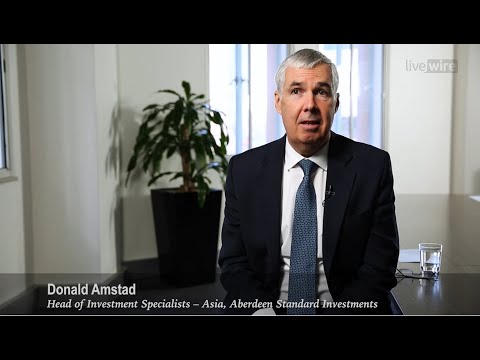
This is a single-speaker interview from Livewire Markets, in which Donald Amstad of Aberdeen Standard Investments argues that the West has become the unorthodox actor in global finance. The transcript does not identify him, so the speaker is attributed only through the publisher's description. His starting point is a historical reversal. In the 1998 Asian crisis, the IMF and the US Treasury told Asian governments not to print money and to absorb the pain. In 2007-2008 the Fed, ECB, Bank of Japan, Bank of England and Swiss National Bank did exactly that. From there he follows the consequences through negative yield bonds, strained financial institutions, and finally social and political stress.
The financial mechanics get most of the attention. Every crisis of the past three decades, he says, began with a bubble in a risky asset class, whereas now the bubble may be in the "risk-free" asset, which undermines the role bonds have played in balanced portfolios. He describes pension funds unable to discount liabilities at negative rates, funds holding physical banknotes, and insurers whose liabilities were set when yields were higher. He also points to $3 trillion of triple-B US corporate debt set against a $1 trillion high-yield market. If a downgrade wave arrives, he argues, yield curve inversion would find central banks with little room left, given near-zero rates and an already swollen central bank balance sheet.
The sharper claims come later. He puts US unfunded government liabilities at about $124 trillion against roughly $20 trillion of GDP and calls currency debasement inevitable. He says another round of quantitative easing (QE)) would mainly benefit the top 1%, risking political backlash, and he floats the possibility of civil war over claims on government revenue. Most of these points are contested or fringe. In contrast, he presents emerging markets, and China in particular, as solvent and orthodox, with profitable state-owned enterprises (SOEs)) and no political cycle under Xi Jinping. He expects them to be hit first but to recover first.
The Western developed economies face catastrophic financial instability due to unorthodox monetary policies and unfunded liabilities, while emerging markets with orthodox policies and stronger balance sheets represent a relatively safer investment environment despite near-term volatility.
- Western central banks have exhausted monetary policy tools (zero rates, expanded balance sheets) and cannot respond to the next recession without triggering bank, pension fund, and insurance company insolvencies
- The US has $124 trillion in unfunded government liabilities versus $20 trillion in GDP, making currency debasement inevitable and solvency impossible under current policy
- Emerging market governments maintain solvent balance sheets, orthodox monetary policies, and profitable state-owned enterprises that provide fiscal flexibility the West lacks
This asset isn't compiled yet
You're seeing its claims, ranked. Compile it to build the argument threads, weight them, and check each claim against your library — the full view.
Pension funds face a mathematical impossibility in calculating liabilities under negative risk-free rates: you cannot discount future cash flows by a negative discount rate, creating accounting crises where pension funds cannot determine what they owe beneficiaries.
“I went to see a pension fund in Europe not so long ago... he said I know that I have about 8 billion Swiss francs of assets but with the 10-year Swiss government bond at minus 50 basis points I don't know what my liabilities are because how can you discount by a negative risk-free rate it's mathematically impossible you can't do it”
Every crisis in the past 30 years involved a bubble in a specific risky asset class (equities in 1987, tech in 2000, credit in 2007, emerging markets in 1998), but the West has never had to cope with a bubble in the risk-free asset class itself.
“every crisis we've had has always been about a bubble bursting in in 1998 in emerging markets in 2007 it was it was credit markets in in 1987 it was it was the stock market in 2000 it was in tech what we've never had to cope with before is when there is a bubble in the risk free asset class”
Pension funds are holding physical banknotes in bank vaults rather than investing in negative-yielding bonds because physical cash maintains nominal value, while the 30-year Treasury has dropped below 2%, massively increasing pension fund liabilities as long-term yields decline.
“he said tomorrow I'm going to go to the board and I'm going to suggest that we take all our money out of negative yielding bonds and hold physical banknotes in a bank vault at the bank down the road so that we can pay our pensioners out of physical cash because at least physical cash maintains its value in nominal terms”
In the US bond market there is $3 trillion of corporate debt sitting at triple-B rating, but the high-yield market is only $1 trillion total; if highly-leveraged triple-B companies face an economic slowdown and slide into double-B territory, $1 trillion of new high-yield debt cannot absorb into the existing $1 trillion high-yield market and must reprice dramatically.
“in the u.s. bond markets there's 3 trillion dollars of corporate debt sitting at triple B now the u.s. high-yield market is only one trillion dollars if some of these very highly leveraged triple-b names are faced with an economic slowdown and their business models go kaput then they're gonna start sliding into double B territory and the question we have to ask is who the hell is going to buy all this newly high yielding debt that is now double B or single B yeah one trillion of new high-yield debt just doesn't go into an existing 1 trillion dollar bond market it just doesn't make sense it has to massively reprice”
During the 1998 Asian financial crisis, the IMF and US Treasury prevented Asian governments from printing money in response to the crisis by threatening they would become like Zimbabwe, leading to banks failing, companies folding, and unemployment rising, but eventually enabling recovery through current account rebalancing and rate cuts.
“every single president finance minister Prime Minister central bank governor in every Asian country wanted to print money in response to the Asian crisis and the IMF said no no no no no you can't do that because if you do you're gonna end up like Zimbabwe”
Western governments and central banks in 2007-2008 did exactly what they had forbidden Asian governments from doing in 1998: they printed money, with the Fed, ECB, BOJ, Bank of England, and Swiss National Bank all initiating money printing in response to the crisis.
“what did Western governments and central banks do they did exactly what they had told Asian governments not to do 10 years earlier they went and printed money the Fed printed money the ECB printed money the BOJ the Bank of England the Swiss National Bank they all started printing money”
Negative interest rates and inverted yield curves cause significant damage to individuals, banks, pension funds, and insurance companies; elderly savers feel poor because they earn no interest on savings and economize unnecessarily, banks cannot make money in negative yielding environments with flat yield curves and tight credit spreads.
“the terrible damage this experiment is doing to individuals to banks to pension funds and to insurance companies if you take my mother for example little old lady who lives in London she doesn't earn any interest on her bank account anymore and she feels poor and she feels that she has to economize with her spending”
If QE pushes the stock market back up after a volatility spike, the 99.9% of the population who have been left behind will not tolerate more handouts to the top 1%, leading to social and political instability.
“if it pushes the stock market back up again then the 99.9% are probably not going to tolerate more handouts to the point 1 percent so that leads to social and political instability”
When the bond bubble 'pops' and the West wakes up and takes the medicine, emerging markets will initially be hit hard but will recover first and fastest because they have the ability to respond more proactively due to stronger balance sheets than developed nations.
“when BAC goes pop what's the new risk free in an environment where the West finally wakes up and takes the medicine it's going to impact everybody including emerging markets so emerging markets will not be immune but I think in that type of environment relatively emerging markets will do better and emerging markets will do better because they will be able to respond more proactively and they are able to do that because frankly emerging market balance sheets are far stronger than the balance sheets of the developed world”
The real problem for the US is not debt but unfunded government liabilities, which total over $124 trillion dollars, vastly exceeding the US GDP of roughly $20 trillion and the government debt of roughly $20 trillion.
“but debt isn't the problem in the United States its liabilities I would urge everyone watching this video to go to a website called u.s. debt clock dot org and look at the bottom of that chart in the middle and there is one clock that's ticking away which is the liabilities of the US government now the US economy is roughly 20 trillion and the debt of the US government is roughly 20 trillion sirs 100 percent of GDP maybe 21 or so now but the problem is the liabilities the liabilities of the US government now are over 124 trillion dollars”
China and the West differ fundamentally in two ways: (1) China has no political cycle with Xi Jinping likely president for a very long period, and (2) the Chinese government is solvent due to low debt levels, low liabilities, and profitable state-owned enterprises.
“what's the essential difference between China and the West well there are there are two that I can think of one is political yeah in China there is no political cycle Zi Jing ping is president and and he will be for a very long period of time to come there is very little doubt about that unless he falls under the proverbial bus but of course the difference between the Chinese government and the American government is that Chinese government is solvent and the reason why they're solvent is a they have very low levels of debt secondly they're very low levels of liability and thirdly they have an asset pact balance sheet because in China you have state-owned enterprises”
Insurance companies face a massive mismatch between the yields on assets they can buy today and the value of their liabilities, which were set when yields and interest rates were much higher, creating a growing insolvency problem.
“you have insurance companies globally that have this incredible mismatch between you know the yield of the assets that they can go out and buy today and and the value of their liabilities with which was set when yields and interest rates were much much higher”
Traditionally, government bonds in portfolios have served as the asset class that appreciates when risky assets fall (as demonstrated in 1998 when equities fell and bond prices rose), enabling portfolio rebalancing profits over decades, but this model breaks when there is a bubble in the risk-free asset class itself.
“what has been the role of government bonds been in portfolios yeah it's been the asset class that makes money when risky assets fall off you know in 1998 when equities fell if you had bonds you did really well because bond prices went up when equities went down and yeah if you did your portfolio rebalancing and sold out of your bonds and bought equities and if you did that in every bump along the road over the last twenty or thirty years you've you've done well”
The US government will face a fight over claims on its revenue, with different groups competing for the limited resources the government can actually pay out, potentially leading to civil war as groups advocate for their entitlements.
“and that's the problem and then you're gonna get a fight in the United States over who gets the claims on the US government that they can pay and that means you probably break down into civil war”
If the US Treasury yield curve inversion is correct as a harbinger of recession (as it has been historically), Western central banks have very limited firepower to respond because interest rates are already near zero and central bank balance sheets are already massively expanded.
“if the US yield curb is right and the inversion of twos tends in the Treasury market is the harbinger of the next recession which it has been every time historically then central banks in the West have very very limited firepower today to respond to economic weakness there really are no more bullets left in the gun or very very few they fired all the bullets we already have interest rates at almost zero we've already got massively expanded central bank balance sheets”
Western central banks have been playing 'whack-a-mole' with volatility for the last decade, responding to each volatility spike by cutting rates and/or printing money, but the speaker worries they cannot continue this pattern much longer.
“western central banks have done over the last decade since the global financial crisis is they've been playing whack-a-mole with volatility every time volatility has spiked up they've managed to hit it on the head by some combination of cutting interest rates and/or printing money am I worried basically is this it is that if we have another spike up in volatility can the banks still pay whack Amole and I and I worry that they can't”
The West now faces a financial crisis that is becoming economic, social, and political, while emerging markets broadly run orthodox economic and monetary policy and represent a relatively safe haven compared to the developed world.
“in the emerging world economic and monetary policy is broadly Orthodox it's the West that is running unorthodox economic and monetary policy and it's the West ironically that is now on the on the cliff edge there is a there is a crisis in the West which is financial and that is becoming economic and it's becoming social and it's becoming political”
The US government has promised to pay people $124 trillion dollars for healthcare, unemployment, Social Security and other benefits but has not funded these promises, making them unfunded liabilities that cannot be paid in currency worth more than toilet paper, leading to inevitable currency debasement.
“what that means is that US government has promised to pay people for health care for unemployment for Social Security for whatever it is they've made promises to pay people 124 trillion dollars but they haven't funded it that's why it's an unfunded liability where the hell is the US government going to get 124 trillion dollars from there is no way on earth that they can pay this money to the people to whom they owe it in terms of a currency that is worth you know much more than than toilet paper it just cannot be done”
If central banks attempt another round of quantitative easing (QE) to suppress volatility, the result will be bank insolvencies, pension fund insolvencies, and insurance company insolvencies simultaneously, creating a systemic financial collapse.
“because I think we're at the end of the game because if they do come out with another bout of QE then banks are gonna go bust pension funds are going to go bust insurance companies are going to go bust”
The West may be at the point where it finally has to 'take its medicine'—endure a genuine recession/depression with policy support severely constrained—meaning it is on top of a roller coaster looking down, with the need to put a blindfold on because it will be a scary decline.
“so maybe we are at the point where the West finally has to take its medicine and then we really are on the top of the roller coaster looking down and it's probably better to put a blindfold on this it's going to be a pretty scary right”
The United States has exceptionally high levels of debt across all sectors: government debt under President Trump is out of control, students are heavily in debt, and corporate America is more highly leveraged than it was in 2007.
“a lot of people focus on the debt in the United States and everywhere you look in the United States its awash with debt the government debt under President Trump is out of control students are up to their ears in debt and corporate America is the most highly leveraged it's ever been corporate America is more highly leveraged today than it was in 2007”
Central banks have purchased massive quantities of government bonds as a consequence of their money printing, resulting in negative yield environments; the Swiss 10-year government bond yields almost -1% and the Swiss 50-year bond yields at a negative rate to maturity.
“when central banks were printing money what they've done is they've they've bought bonds with with those proceeds... the ECB have bought so many bonds and the Swiss National Bank is a huge buyer of of German government bonds... so that as you say we now have this situation where we have negative yields on bonds we have the Swiss 10-year government bond yielding almost -1 percent and the Swiss 50-year bond at a negative yield to maturity”
Only the top 1% of the 1% (the elite holding equities) have made money in the last decade, while 99.9% of the population have been left behind as the stock market inflates into a huge bubble through monetary policy.
“the only people who've made money in the last 10 years are the 1% of the 1% the elite who hold equities and of course we have this huge bubble in the in the stock market and 99.9% of the population have been left behind”
Governments in Asia and emerging markets have very sound economic and monetary policies in comparison to the West, which is heading down a 'Zimbabwe school of Economics' path of currency debasement.
“governments in Asia governments in emerging markets they have very sound economic and monetary policies in comparison to the West which is heading down this Zimbabwe yeah School of Economics path”
American society is currently breaking down along racial, gender, and religious lines, with Black, Brown, Asian, women, gay, and Muslim Americans already under attack, representing the beginning of civil conflict.
“frankly it's almost like civil war is breaking out in America at the moment you know if you are black if you are brown if you are yellow if you are a woman if you are gay if you are Muslim you are already under attack in America it's happening and it's it's very sad Society is breaking down”
The US has an extraordinary president (referring to Trump), Brexit is happening in Europe, and the UK government is in similar dire straits to the US with similarly impossible promises, while Italy is threatening to exit the European Union, with the West broadly becoming a 'basket case'.
“we have this extraordinary president in the United States we have Briggs it happening in Europe and the UK government's obviously I'm upon the UK government is in in similar dire straits out the UK government has similarly made promises that to people to pay that they can't possibly keep we have Italy threatening to come out of the European Union it's the West that's a basket case now”
State-owned enterprises in China, particularly the big four banks, churn out massive profits, providing the Chinese government with a profitable asset base that Western governments lack.
“most of these enterprises in China are massively profitable you know the big four banks in China churn out massive profits”