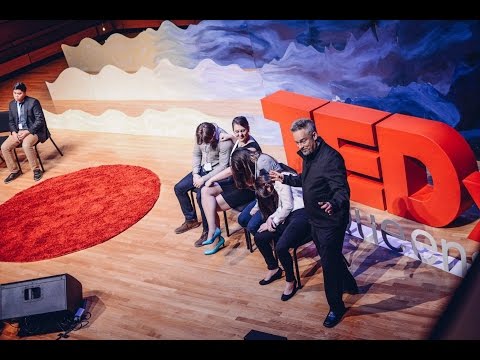
"Is Hypnosis Fake?" Hypnotist stuns TEDX crowd
What this covers
This is a 25-minute TEDxQueensU talk in which filmmaker and hypnotist Albert Nerenberg runs a series of standard hypnotic inductions on the audience as a rough, quasi-scientific test of whether hypnosis is real. The tone is comic, and the staging is that of a stage hypnosis show. Underneath it is an attempt at a street-level account of how the phenomenon works. Along the way the audience is turned into chickens, and Nerenberg says the chickens still show fear when shown cucumbers. The talk ends with the claim that "hypnosis is totally and completely fake," which he frames as a paradox: once the hypnotized hear it, their memories of the session return, and a post-hypnotic suggestion does the work of showing that the demonstration was real.
The historical stretch covers Anton Mesmer, the Austrian doctor who drew thousands of visitors a day in 1780s Paris with magnets and incantations. King Louis XVI ordered a Royal Commission led by Benjamin Franklin to investigate him. Nerenberg argues that its verdict of fraud pushed hypnosis into the shadows, which he says is why hypnotism books are still shelved with the occult. He also blames film villains, such as Sonny Gallo's evil hypnotist, for the stereotypes of chicken acts, mind control and the diabolical. He mentions shamans as probable first practitioners.
The explanatory turn is biological. He links induction to eye-flicker patterns, sleep paralysis and the REM dream state. He cites Professor Michel Juba's 1960s work on REM in the womb, which he reads as how mammals acquire innate behaviors and fears. From this he draws a recuperative picture of hypnosis, and he adds that humans are unique among mammals in being able to imagine and enact almost any scenario. The more contested claims are about rapid skill acquisition, hypnotic bars that produce drunkenness without alcohol, and his remark that some studies have concluded hypnosis does not exist. Nerenberg also argues that hypnosis is a shared human inheritance rather than the property of professionals.
Hypnosis is a genuine physiological and psychological phenomenon rooted in accessing the REM dream state, not a magician's trick or fraud, and represents a fundamental human capability with therapeutic and learning applications that remains scientifically underexplored.
- Hypnotic induction triggers REM-like eye movement patterns and sleep paralysis, indicating access to neurological dream mechanisms
- Historical dismissal by Benjamin Franklin and the Royal Commission established an unfounded cultural narrative of hypnosis as fraud that persists today
- Humans possess unique imaginative capacity to reprogram themselves through hypnosis, unlike other mammals, enabling therapeutic reprocessing and accelerated learning
This asset isn't compiled yet
You're seeing its claims, ranked. Compile it to build the argument threads, weight them, and check each claim against your library — the full view.
Stage hypnosis is a real phenomenon that produces measurable effects in hypnotized individuals.
“I suggest you that hypnosis is entirely real in fact stage hypnosis is real and hypnotherapy is real”
Hypnotized individuals who come out of trance will experience a post-hypnotic suggestion effect where specific words or signals trigger return to hypnotic trance or recall of memories from the hypnotic session.
“you'll have no idea what happened while you were on this stage you will forget everything that happened to you on this stage until you hear me say the word fake then everything will come flooding back to you you remember everything”
People in hypnotic trance experience a state of eye closure and physical relaxation that appears similar to sleep but is distinct from normal sleep—described as 'hypnotic sleep.'
“what these people are experiencing is something that we call hypnotic sleep hypnotic sleep is actually they appear to be sleeping but I'm gonna suggest you that that is not true they are not actually sleeping”
Professor Michel Juba from the University of Lyon conducted experiments in the 1960s showing that mammals experience a powerful REM dream state while in the womb, which may be essential to genetically programming them with innate behaviors and fears.
“professor Michel Juba experimental medicine the University of Lyon the sixties did a series of experiments he's called the Christopher Columbus of dreams and his theory is that mammals are all mammals while they're in the womb basically enjoy a powerful REM state a dream state that dream state may be essential to programming us to be what we are”
Popular artwork from the time depicted Mesmer being sent to the fires of obscurity by the light of Reason, Science, and Justice, symbolizing the scientific establishment's rejection of his work.
“here's some popular artwork at the time that shows Mesmer being sent to the fires of obscurity by the light of Reason science and justice”
The hypnotic state is fundamentally recuperative and healthy because hypnosis accesses and activates the REM dream state, which is itself tremendously recuperative.
“with hypnosis we hack into the fundamental programming state which also happens to be a state that is itself tremendously recuperative this dreaming state is tremendously recuperative and healthy”
Hypnosis is a common human capability and cultural inheritance available to all people, not the exclusive province of hypnotists or hypnotherapists.
“hypnosis is not the preserve of hypnotist or hypnotherapist even it is the common massive and amazing inheritance of all humanity”
The final claim that 'hypnosis is totally and completely fake' is paradoxically true because everyone who was hypnotized will, upon hearing it, have their memories of the hypnotic demonstrations return and realize the entire presentation demonstrated hypnosis is entirely real, making the statement fake.
“so I would just like to say in conclusion I hope today that I have demonstrated that hypnosis is totally and completely fake thank you very much”
Humans demonstrate imagination capabilities unique among mammals, allowing them to be hypnotically programmed to imagine and enact any scenario—from becoming animals to aliens—demonstrating their cognitive flexibility.
“humans have the ability unlike other mammals apparently to dream just about anything we can imagine ourselves as chickens as aliens as any kind of weird associated thought or or feeling and that really shows why humans have such a powerful and it's a sonnet to some extent limitless imagination”
The eye flickering observed in hypnotized subjects indicates their eyes are rolled up in their heads, which is a distinctive feature of the hypnotic state and may contribute to the cultural stereotype of hypnosis as diabolical (as seen in film depictions like The Exorcist).
“I don't know if you can see it clearly but you see this person right here can you see it their eyes are actually flickering now why would their eyes are flicking on to suggest something interesting that their eyes are actually rolled up in their heads now why would that happen isn't that kind of weird and I'm going to suggest you let's go back to our friend the shaman look at the shaman his eyes are also rolled up”
Hypnosis enables rapid skill acquisition that mimics the science fiction premise of 'learning through insertion,' as when hypnotized individuals demonstrate complex behaviors they claim not to consciously know.
“You probably remember the movie the matrix and the matrix neo is programmed to know kung fu it's advanced technology helps them know kung fu and I'm going to suggest to you that we can do something like that today”
A quasi-scientific test of hypnosis can be performed by administering hypnotic inductions and suggestions in a controlled setting to determine empirically whether hypnosis is real or fake.
“if that's true if hypnosis is fake can I propose maybe a simple test that basically we perform right here this is a quasi scientific formula that we perform a series of very simple hypnotic inductions and maybe some hypnotic suggestions and we see what happens if if not if no if hypnosis is fake then nothing will happen if it's real then I guess we'll see”
Sonny Gallo was a 20th century film star who played an evil hypnotist, exemplifying how cinema perpetuated the stereotype of hypnotism as sinister or diabolical.
“here's an example of a son Gally who is a 20th century film star who is a evil hypnotist”
As a result of Benjamin Franklin's Commission finding Mesmer fraudulent, hypnosis has ever since 'lived in the shadows,' and in North American and Canadian bookstores, books on hypnotism are typically shelved in the occult section rather than science or psychology.
“in fact here's some popular artwork at the time that shows Mesmer being sent to the fires of obscurity by the light of Reason science and justice I would say that till this day as a result hypnosis hypnotism lives in the shadows in fact if you go to a bookstore often in North America or Canada and ask for books and hypnotism you'll usually be referred to the occult section so this is why hypnosis remains in the realm of the fake”
The pendulum-based hypnotic induction technique works by producing specific eye movement patterns that trigger entry into a hypnotic state.
“is it possible that the original hypnotist to use the stereotype of hypnotist somebody uses a pendulum that goes back and forth but that pendulum going back and forth is doing something particular to the eyes”
When people are turned into chickens under hypnosis and then shown cucumbers, they experience fear despite being in the role of a chicken, demonstrating that hypnotic suggestions can program biological or instinctual responses across different role scenarios.
“you are a chicken Peck and you say macaw you do all the chickeny things...you are a chicken...I'll just ask you remind you as chickens and cats you have been programmed to be mortally afraid of cucumbers if you see an image if you see a picture or an image of a cucumber you will scream”
Anton Mesmer, an Austrian doctor, was so influential in popularizing hypnosis in 1780s Paris that the word 'mesmerized' derives from his name.
“there's one man who really put hypnosis on the map and that's this guy Anton Mesmer an Austrian doctor he was so influential that the word to be entranced to be mesmerised is from his name Mesmer”
King Louis XVI of France ordered a Royal Commission, led by Benjamin Franklin, to investigate Mesmer's claims of healing through magnetic forces.
“they put pressure on the king of France Louis xvi who actually organized a Royal Commission to investigate Mesmer which was led by this guy Benjamin Franklin”
Mesmer attracted over 3,000 visitors per day to his practice in 1780s Paris, claiming to heal them through strange incantations and the use of magnets.
“in the 1780s more than three thousand people a day would often go visit Mesmer to be healed he would do strange incantations he would appear to knock people out he would give them and hold them with magnets”
Sleep paralysis is a natural phenomenon that occurs every night during sleep, where the body becomes involuntarily paralyzed to prevent physical movement during dreams.
“every night when you go to sleep you become paralyzed by your own body so that if you dream that you are running or falling or jumping you don't actually jump out of your bed or run out of your bed”
Some serious scientific studies have concluded that hypnosis does not exist and that the hypnotic state is not real.
“even among the scientific community there's been studies that show serious studies that show that there is no such thing as hypnosis that the hypnotic state does not actually exist”
Hypnotic bars exist where people are hypnotized to experience complete drunkenness while remaining physically sober.
“the hypnotic bar as previously mentioned a bar where people are hypnotized to be completely drunk while they remain absolutely sober is also real”
The general public perceives hypnosis primarily through three false stereotypes: that it involves turning people into chickens, that it is a form of mind control, or that it is sinful and quasi-diabolical.
“most people probably see hypnosis is really about you know turning people into chickens basically and another thing if you ask somebody who's a little bit let's say a little more paranoid that you'll find out that hypnosis is really about mind control and you talk to somebody who's a little more traditional and you'll find out that hypnosis is really about sin and something's quasi diabolical”
Cats appear to be afraid of cucumbers because cucumber shapes resemble snakes, and domestic cats respond with fear even though they have never encountered snakes in North America.
“why are cats afraid of cucumbers because cucumbers remind them of what or look like what snakes exactly they look like snakes but hold on a second with domestic cats in North America or in Kingston anywhere like that would they ever encounter a snake no never so why would domestic cats all seemingly be programmed to already be afraid of snakes that they've never met”
Shamans, particularly Aboriginal and Native shamans, were historically the first practitioners of hypnosis, though they kept their techniques secret.
“probably the first hypnotist were shamans aboriginal and native shamans here's an example a real example from 1914 but Shawna's generally didn't share their secrets”
If we don't understand hypnosis, it is possible we could currently be being hypnotized without knowing it.
“now what if I said to you that if we don't understand hypnosis is it possible that we could be being hypnotized right now you basically don't know”
Veterinarians and behavioral scientists have theorized that cats' reaction to cucumber images represents cats reliving traumas from their evolutionary past, though this explanation is less parsimonious than the innate programming hypothesis.
“there's actually a veterinarian rodent wrote an article for the newspaper that explained that what's actually going on here is that cats are actually reliving traumas they're not but here's the weird thing why are cats afraid of cucumbers”