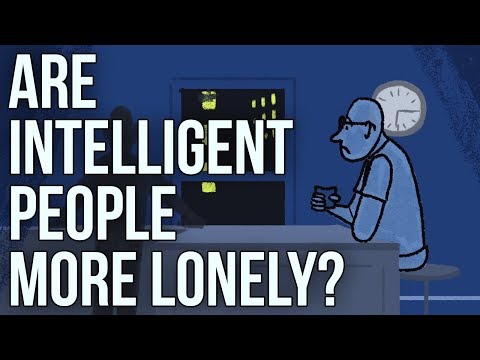
Are Intelligent People More Lonely?
What this covers
This five-minute School of Life film is narrated by Alain de Botton. It begins with an awkward premise: that cleverness could lead to loneliness sounds arrogant. He answers by narrowing the definition. Degrees and ordinary cleverness, he says, have little to do with the kind that matters, which he calls emotional intelligence. That means a capacity for self-honesty and self-observation, in effect being a more committed reporter of one's own inner states. He also calls it a species of courage, aimed at the fear of seeming weird or mad rather than at any outside enemy.
The middle of the film explains why this produces isolation. Most people edit out their wilder, more impatient or frightening sides, and de Botton suggests the suppressed material resurfaces in insomnia. Those who do report honestly risk incomprehension, irritation or boredom, because candid thoughts about politics, architecture, family life or sexuality are more intense or tender than conversation usually permits. Fewer people are practising this honesty, so fewer are available to swap authentic notes on being alive.
The remedy he proposes is art, described as humanity's "secret diary." Libraries, cinemas and galleries hold the sensations and truths that never made it into polite exchange. An Emerson line, that in geniuses we find "our own neglected thoughts," frames creators as articulating what readers already half-know. This leads to a loosened idea of friendship, since our best friends may have died 250 years ago and still reach us through paint, poetry or music.
There are two turns near the end. De Botton anticipates the charge that all this flatters the sensitive and excuses social incompetence, calling it a mean, undemocratic thought that borrows from Romantic culture. He also says the aim is not a world with ever more art to soothe loneliness, but one where people share authentically often enough that art is less necessary.
Emotional intelligence—defined as capacity for self-honesty and self-observation of inner experience—is a form of courage that often leads to social isolation, but art serves as a uniquely suited remedy by providing intimate communication with creators across time who share similar truths about human experience.
- Emotional intelligence requires acknowledging and reporting inner states that are socially inadmissible, making genuine connection with others rare
- Art functions as humanity's secret diary, capturing truths that cannot be expressed in ordinary social contexts
- The ideal outcome is not increasing art consumption but improving our capacity to share authentically in everyday life
This asset isn't compiled yet
You're seeing its claims, ranked. Compile it to build the argument threads, weight them, and check each claim against your library — the full view.
The quote 'In the minds of geniuses, we find—once more—our own neglected thoughts' (attributed to Emerson) suggests that genius consists of articulating and elevating thoughts that already exist within others but which they have failed to acknowledge or value.
“Or, as Emerson once put it, 'In the minds of geniuses, we find – once more – our own neglected thoughts.'”
Emotional intelligence is defined as a capacity for self-honesty and self-observation: the ability to notice one's own inner experiences, including the less socially admissible aspects of oneself, and the ability to observe the rich, strange, and profound experiences passing through consciousness.
“What is meant is emotional intelligence, which exists (or not) in every strata and nook of society. Emotional intelligence means a capacity for self-honesty and self-observation; it means, a knack for opening oneself up to the stranger, more exciting, less easily admissible aspects of oneself and at the same time for noticing the many beautiful, peculiar and profound experiences and sensations passing through consciousness.”
Emotional intelligence, properly understood, is a species of courage—not courage to fight an external enemy but courage directed at vanquishing fear of being perceived as weird or going mad.
“In this context, emotional intelligence emerges as a species of courage, directed at vanquishing not an external enemy but a fear of being weird or of going mad.”
We have over-privileged certain standard notions of friendship as requiring physical presence, simultaneity, and reciprocal availability—but our best friends may have died 250 years ago and be communicating with us via art (paint, poetry, music, etc.).
“We have perhaps over-privileged certain standard notions of friendship. We may just have to accept that our best friends could have died 250 years ago – and be chatting to us via dabs of paint or within rhyming pentameters.”
The goal should not be a society where art is ever more prevalent and available as a response to loneliness, but rather a society where art becomes less necessary because people have improved their capacity to share more authentically about who they truly are in ordinary moments of life.
“That said, the goal shouldn't be a society where art is ever more prevalent and more available when loneliness strikes. It is perhaps a society where art is ever less necessary – because we have grown better at knowing how to share more of who we are in the ordinary moments of our lives; where we have found a more direct and reliable path out from our loneliness.”
What is ordinarily called intelligence—degrees and cleverness—has nothing to do with the emotional intelligence that matters for human flourishing.
“It is important, therefore, to be clear what is meant here by intelligence. It has nothing to do with degrees or any of the criteria by which we ordinarily measure cleverness.”
Saying emotional intelligence and isolating sensitivity creates superiority and allows someone to pass off social incompetence as virtue is a 'very mean and undemocratic thought' that trades off Romantic cultural ideals.
“It sounds like a very mean and undemocratic thought, trading off the peculiar glamour that isolation has in a Romantic culture – in order to gain an oblique sense of superiority and perhaps pass off an absence of social skills as a virtue.”
Art functions as humanity's secret diary: works of art are records of all the thoughts, feelings, and sensations that could not be expressed in regular social contexts but which have found a home in intimate, honest communication between the artwork and its audience.
“There is one resource that is exceptionally well suited to address the feelings of disconnection liable to be felt by the emotionally intelligent: art. Works of art are humanity's secret diary: records of all that could not be said in regular social contexts, but which have found a home in the more intimate, honest communication that can take place between an art-work and its audience.”
An intelligent person is, above all else, a superior and more committed reporter of their own inner states—someone who can accurately and unflinchingly document their internal experience.
“A certain sort of intelligent person is, above all else, a superior and more committed reporter of their inner states.”
Emotionally intelligent people have an uncommonly hard time not being lonely when in relationships or social situations with other people, but they have an unusually easy time finding company and connection with people who are not in the room—via art, which is a form of intimate communication across time.
“Therefore, while emotionally intelligent people may have an uncommonly hard time not being lonely with a person, they have an unusually easy time finding company with people who are not in the room, the fancy term for which we call art.”
By constantly suppressing and editing out uncomfortable inner experiences, people ensure they remain disconnected from the troubling wonders and strange, profound sensations that are always passing through consciousness; this unprocessed material returns to trouble them in moments of insomnia.
“And simultaneously, we ensure that we are never far from something that can take us powerfully away from ourselves, and so miss out on the troubling wonders that streak across the mental horizon at every instant. Most of what is in our minds remains unfelt and unseen, troubling us only in the small hours. Insomnia is the revenge for all that we tried so hard not to notice in the daylight.”
Fewer people across society are committed to self-honesty and self-observation, and therefore fewer people are available to exchange authentic notes on what it truly feels like to be alive.
“There are simply fewer people at large committed to self-honesty and self-observation – and therefore up for exchanging notes on what it's truly like to be alive.”
Most people habitually edit out and suppress their more generous, wilder, impatient, and terrifying aspects of self, presenting only a socially acceptable version to the world, which means they exclude the richest parts of what they truly feel, want, and think.
“We cleave tightly to reassuring notions of what normal people are like, which means we exclude a lot – often the richest bit – of what we truly feel, want and think. We edit out our more generous, wilder, more impatient, more terrifying sides; leaving only the socially admissible husk that we artfully pretend is who we are.”
People devoted to self-honesty and self-observation have an above-average chance of meeting with incomprehension, irritation, censorship, or boredom when they attempt to share their internal observations frankly in ordinary social company.
“It is almost certain that people who have devoted themselves to self-honesty and self-observation have an above average chance of meeting with incomprehension, irritation, censorship or boredom when they attempt to share the data from their own minds frankly in company.”
Libraries, cinemas, and galleries around the world serve as repositories for sensations and truths that did not easily make it into standard social interactions—containing what emotionally intelligent people need to state and crave to hear in their moments of loneliness.
“The libraries, cinemas and galleries of the world are repositories for all the sensations that didn't easily make it into standard interactions and that contain what we need to state, and crave to hear as audiences, in our lonely states.”
Truthful thoughts and feelings about politics, architecture, family life, or sexuality sound more threatening, intense, oblique, or tender than what is socially allowed in ordinary conversation.
“Their thoughts (it might be on politics or architecture, family life or sexuality) will sound more threatening, intense, oblique or tender than is allowed.”